
“The best time to plant a tree was 20 years ago. The second best time is now.” – Chinese proverb. For investors, that tree is $500 sitting in an S&P 500 ETF.
Most people don’t invest $500 because they think it won’t matter.
They’re wrong – but not in the way most personal finance blogs tell you. The truth about starting small is messier, more interesting, and more honest than the inspirational fluff you usually get.
Here’s what $500 actually does in an S&P 500 ETF over 10, 20, and 30 years. The real numbers. The real risks. And the part most articles skip entirely.
Quick Answer
Invested in an S&P 500 ETF at a historical average return of 10% per year, $500 grows to roughly $1,297 after 10 years, $3,364 after 20 years, and $8,725 after 30 years – without adding another dollar. Add $50 per month, and that 30-year number jumps past $113,000.
This article stays focused on the compounding effect of a broad S&P 500 ETF. Growth-fund tilts are a separate portfolio decision and are better considered after you understand the core holding.
What Is an S&P 500 ETF, and Why Does It Keep Coming Up?
The S&P 500 is a stock market index tracking 500 of the largest publicly traded U.S. companies – Apple, Microsoft, Amazon, and 497 others. It’s not a product you buy. It’s a measuring stick.
An S&P 500 ETF is the product. It’s a fund that mirrors the index. Buy one share and you instantly own a proportional slice of all 500 companies.
Instead of picking stocks, reading analyst reports, or guessing which company will win the next decade, you can own a broad slice of the market through one simple fund.
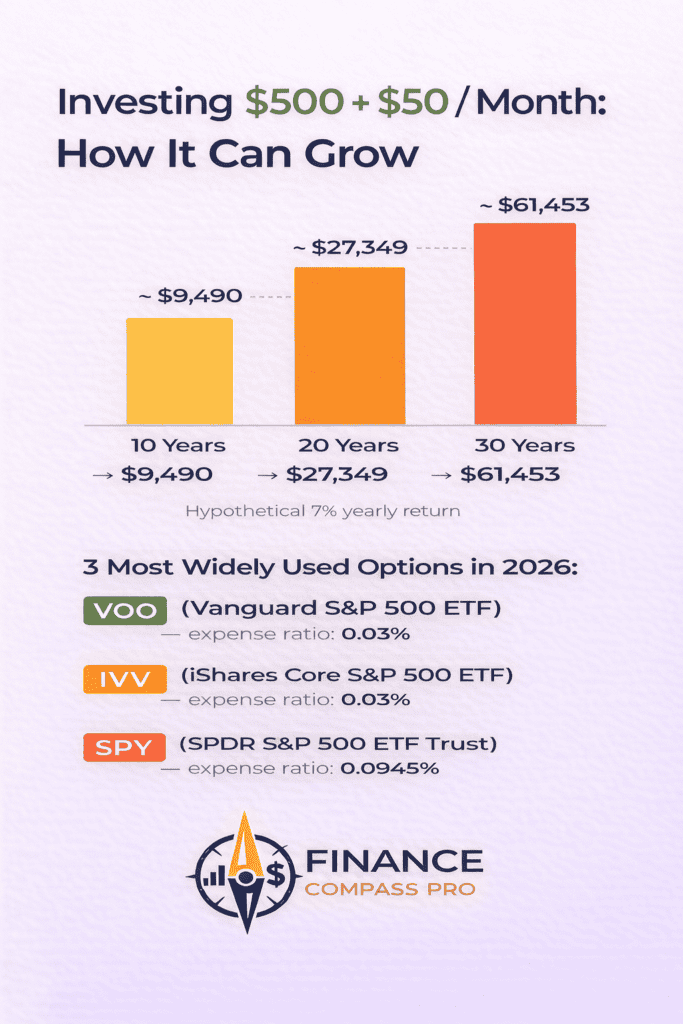
The three most widely used options in 2026:
- VOO (Vanguard S&P 500 ETF) – expense ratio: 0.03%
- IVV (iShares Core S&P 500 ETF) – expense ratio: 0.03%
- SPY (SPDR S&P 500 ETF Trust) – expense ratio: 0.0945%
For someone starting with $500, the choice between these three is essentially irrelevant. The 0.06% difference in fees amounts to 30 cents a year on a $500 investment. What matters is that you pick one and buy it.
If you’re not yet clear on how a S&P 500 index fund actually works, read that guide before continuing. Understanding the structure makes it much easier to stay calm when the market drops.
If you’re wondering which of these ETFs beginners should actually choose – and how they fit together – read:
→ ETFs for Beginners: How to Choose, Compare, and Build a Simple Portfolio
The Numbers: What $500 Does Over Time
Compound interest is the reason wealthy investors talk about starting early with almost religious intensity. Here’s why.
Table 1: $500 Invested Once – No Additional Contributions
| Years | At 7% (inflation-adjusted) | At 10% (historical average) | At 12% (strong decade) |
|---|---|---|---|
| 5 | $701 | $805 | $881 |
| 10 | $984 | $1,297 | $1,552 |
| 15 | $1,379 | $2,089 | $2,735 |
| 20 | $1,934 | $3,364 | $4,823 |
| 25 | $2,712 | $5,418 | $8,500 |
| 30 | $3,801 | $8,725 | $14,981 |
Assumes annual compounding. Returns are not guaranteed. Past performance does not predict future results.
Most people read numbers like this and still wait.
The difference isn’t knowledge.
It’s action.
At 10%, $500 becomes $8,725 in 30 years – a 17x return on an investment you made once and never touched. That’s not a trick. That’s arithmetic.
Here’s where most beginner finance articles stop. They show you the good number and move on. Let’s not do that.
What the Tables Don’t Show You
The 10% average is real – it’s what researchers cite when examining the S&P 500’s long-run historical performance. But that number papers over some brutal short-term realities:
- 2008: The S&P 500 dropped 37% in a single calendar year.
- 2022: It fell 18% as interest rates spiked.
- 2020: A 34% crash in five weeks during the early pandemic.
Every one of those drops recovered. Every one produced new all-time highs eventually. But “eventually” is not a defined timeline. Recoveries took 1 year in 2020 and over 5 years after 2008.
The practical implication: if you invest $500 today and need it in 18 months, an S&P 500 ETF is the wrong vehicle. A high-yield savings account or short-term CD is not exciting – but it also won’t be worth $310 when you need $500.
What Happens When You Add Contributions
One-time investments are illustrative. Regular contributions are transformative.
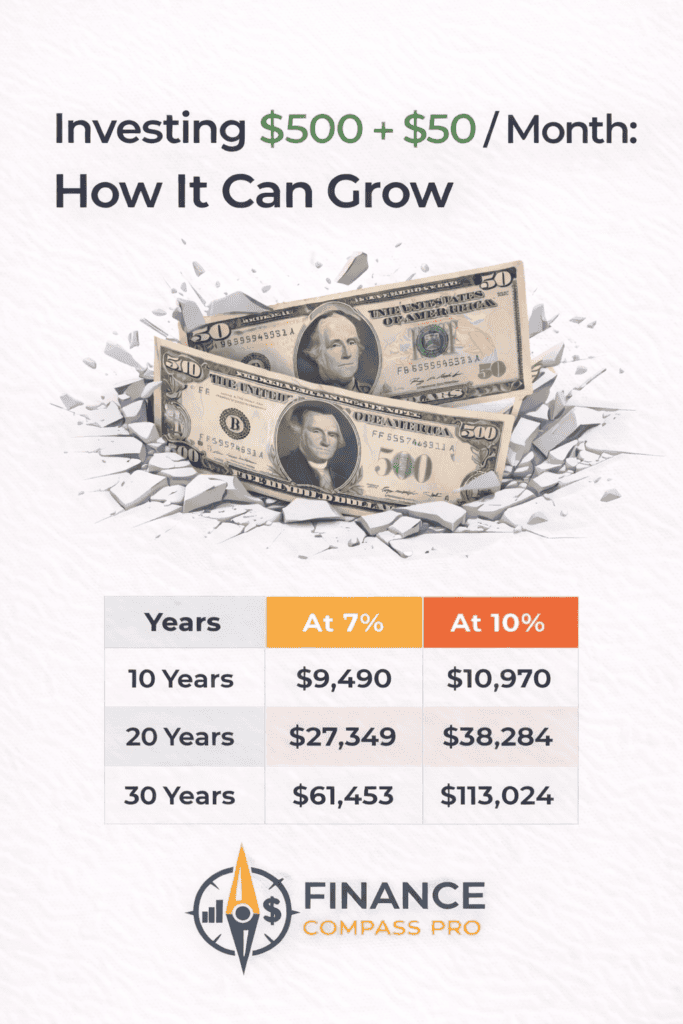
Table 2: $500 Initial Investment + $50 Per Month
| Years | At 7% | At 10% |
|---|---|---|
| 10 | $9,490 | $10,970 |
| 20 | $27,349 | $38,284 |
| 30 | $61,453 | $113,024 |
At 10% average returns, $500 plus $50 per month for 30 years produces over $113,000. Your actual out-of-pocket contribution: $18,500. The remaining $94,500 is compound interest – money generated entirely by the money you already invested.
This is the argument for starting before you have a lot to invest. The first $500 doesn’t just produce $8,725. It produces $8,725 plus every dollar of compounding it enables on every contribution that follows.
Why the S&P 500 Specifically – and What You’re Actually Betting On
Critics of passive index investing have a legitimate point: when you buy an S&P 500 ETF, you’re betting that the United States economy will continue producing large, profitable companies over the next several decades.
That’s not a certainty. Japan’s Nikkei index peaked in 1989 and spent the next 35 years failing to recover. Investors in a “buy and hold Japanese index funds” strategy had a miserable time.
The counterargument – and it’s a strong one – is that the U.S. market is more structurally diverse, more globally integrated, and has a longer track record of innovation-driven recovery than any comparable market. That’s why institutional investors, pension funds, and Nobel Prize-winning economists recommend S&P 500 index funds as a baseline for equity exposure.
You’re not betting on a single company. You’re betting on 500. And the S&P 500 has an automatic self-correcting mechanism: underperforming companies get dropped and replaced with stronger ones. The index evolves.
Three structural advantages worth knowing:
Built-in diversification. 500 companies across technology, healthcare, consumer goods, financials, energy, and industrials. One sector collapses and it’s a portion of your portfolio, not all of it.
Cost discipline. VOO and IVV charge 0.03% annually. On $10,000, that’s $3. Actively managed funds often charge 0.5%–1.5%. Over 30 years, that fee difference compounds significantly against you.
Passive management. You are not trying to outperform the market. You’re trying to match it. The data consistently shows that most active fund managers fail to beat their benchmark index over 10+ year periods. Passive beats active – not always, but systematically.
If you want a deeper look at how ETFs work under the hood – how they’re priced, traded, and structured differently from mutual funds – that guide covers everything a beginner needs before buying their first share.
How to Buy an S&P 500 ETF With $500
The mechanics are straightforward. The friction most beginners face is psychological, not logistical.
Step 1: Open a brokerage account.
Fidelity and Schwab both have zero minimums and no account fees. Both support fractional shares, meaning you can invest exactly $500 regardless of what a single share of VOO costs. For a full walkthrough, see our guide on how to open a brokerage account.
Step 2: Fund the account.
Bank transfer typically takes 1-3 business days. Some platforms allow instant funding up to a limit.
Step 3: Search the ticker symbol.
VOO. IVV. SPY. Type it into the search bar.
When people talk about investing in an S&P 500 ETF, they often think of VOO or SPY first. IVV is another major option that tracks the same index. You can compare the three in our IVV ETF guide.
Step 4: Buy shares.
Enter $500 as a dollar amount (not a share count) if your platform supports fractional shares. Submit the order.
Step 5: Set a recurring purchase.
$50 per month on autopilot. This single step – more than any other – is what separates investors who build wealth from investors who dabble.
Total time: approximately 15 minutes. If you’re still on the fence about the amount, our guide on how to start investing with $500 walks through the mindset and the mechanics together.
One More Decision: Where You Hold the ETF Matters
Buying VOO is the investment decision. Choosing where to hold it is the tax decision. They’re equally important.
A Roth IRA holds your ETF in a tax-free wrapper. All growth is untaxed at withdrawal. For a beginner in a low-to-moderate tax bracket, this is frequently the highest-value container available.
A taxable brokerage account has no contribution limits and no age restrictions. You pay capital gains tax on profits when you sell – but long-term holders often qualify for the 0% or 15% rate.
The account decision depends on the goal. If this $500 is for retirement, a tax-advantaged account may be appropriate; if you need flexibility before retirement, a taxable brokerage account may fit better. Roth IRA vs. Brokerage Account handles that decision directly without turning this compounding example into a retirement-account guide.
The Real Reason to Invest $500
The compounding math is real. But the most important thing $500 does isn’t financial – it’s behavioral.
Investors who start with small amounts build the habits, the vocabulary, and the emotional tolerance for market volatility that allow them to stay invested when things get ugly. The person who has watched their $500 drop to $380 and recover to $650 will not panic-sell when their $50,000 portfolio dips 20%. Understanding what these market cycles look like – both the declines and the recoveries – is essential preparation. See our guides on what is a bear market and what is a bull market to build that foundation before prices move against you.
Starting small is not a compromise. It’s education with real stakes – and the returns on that education compound too. If you’re in your 20s and want a complete plan for turning small investments into long-term wealth, see our guide on how to start investing in your 20s.
Bottom Line
$500 in an S&P 500 ETF won’t change your life this year. Left alone for 20-30 years, it will. The math is simple. The execution takes 15 minutes. The only variable is whether you start today or keep waiting for a better time that statistically will not appear.
Open an account. Buy VOO or IVV. Set a recurring $50 contribution.
Then stop thinking – and start building.
If you need a simple step-by-step plan to do this the right way, start here:
→ How to Build Your First Investment Portfolio (Step-by-Step Guide)
Disclaimer: The information on this page is for educational purposes only and does not constitute financial, legal, tax, or investment advice. FinanceCompassPro.com is not a licensed financial advisor, broker, or tax professional. Individual results will vary. Always conduct your own research and consult a qualified professional before making any financial decision. Past performance does not guarantee future results. All investing involves risk, including possible loss of principal.