
Open any financial news site and within thirty seconds you’ll encounter three contradictory opinions about where the market is heading.
One analyst says buy. Another says hold. A third says a correction is coming and you should be in cash. All three are confident. None of them agree.
It’s no wonder most beginners feel overwhelmed before they’ve made a single investment.
If the terminology itself is part of the problem, start with 10 Investing Terms Every Beginner Must Know before working through the five principles below.
But here’s what the noise obscures: the investors who consistently build wealth over time are not the ones who follow the most sophisticated strategies. They’re the ones who master a small number of fundamental principles – and apply them patiently, year after year, regardless of what the headlines say.
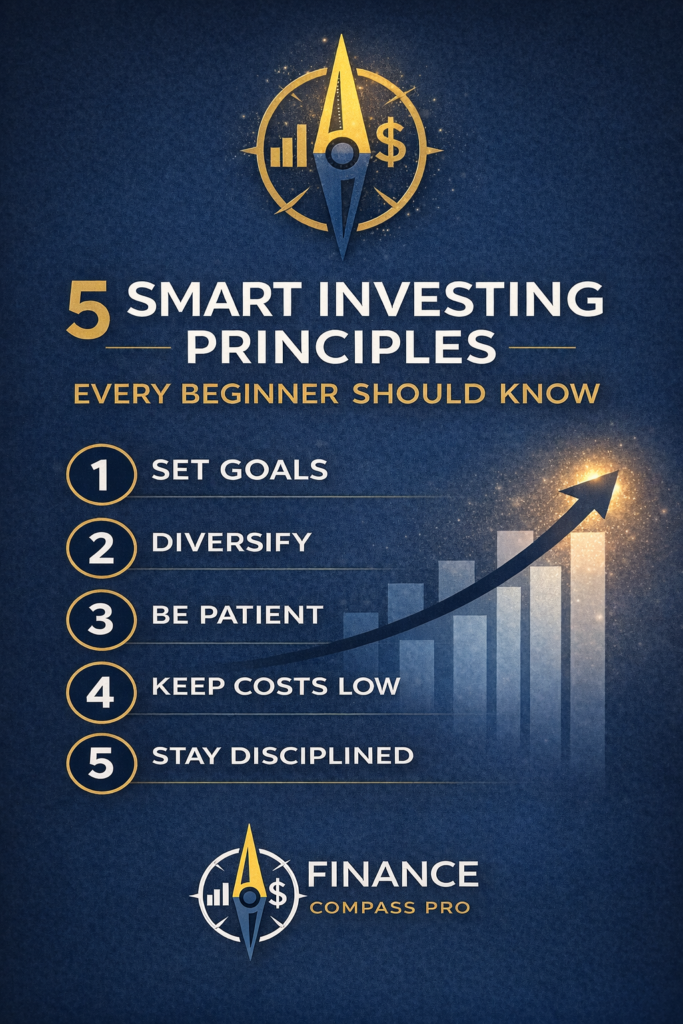
Smart investing rests on five principles: set a clear financial goal, diversify your investments, stay invested instead of trying to time the market, keep costs low, and manage emotional decisions.
These principles aren’t secrets. They’re not complicated. And they don’t require a finance degree or hours of market research.
I’ve spent years watching people overcomplicate investing – and lose money doing it. The ones who built real wealth weren’t smarter. They just understood a few principles deeply and stopped second-guessing them.
There are five of them. Once you understand how they work together, the path forward becomes significantly clearer.
Pillar 1: Start With a Clear Financial Goal
Most people start investing the wrong way.
They open a brokerage account, look at the list of available investments, and try to pick something that seems reasonable. Sometimes they choose what they’ve heard of. Sometimes they choose what’s trending. Rarely do they start with the most important question:
What is this money actually for?
Your investment goal determines everything downstream – which assets make sense, how much risk you can reasonably tolerate, how long you can leave your money invested, and what “success” even looks like for your situation.
A 28-year-old investing for retirement 35 years away should invest very differently from a 45-year-old building a college fund with a 10-year runway. Same market, same instruments, but fundamentally different strategies – because the goals are different.
Before buying a single share of anything, get specific. Not “I want to grow my money” but “I want to have $400,000 available for retirement by age 62.” Not “I want passive income” but “I want $500/month in dividend income within 10 years.”
Specific goals produce specific strategies. Vague intentions produce emotional, reactive investing – and emotional, reactive investing rarely ends well.
📌 Related reading: How to Build Your First Investment Portfolio (Step-by-Step Guide)
“I’ve never seen a successful investor who couldn’t answer this question in one sentence: what is this money actually for? Start there.”
Pillar 2: Diversification Is Your Portfolio’s Defense System
Imagine putting your entire net worth into the stock of a single company. The company reports better-than-expected earnings. You feel like a genius.
Then an accounting scandal surfaces. The stock drops 70% in a week. That’s not a hypothetical – it happened to Enron shareholders, to Lehman Brothers investors, to countless people who concentrated their wealth in a single bet.
Diversification is the structural answer to this risk.
The core idea is straightforward: when you spread your investments across many different assets, sectors, and geographies, the failure of any single investment has a limited impact on your overall portfolio. You’re not counting on one company, one industry, or one country to carry your financial future.
In practice, diversification for most beginners doesn’t require a complex multi-asset allocation. A single broad market index fund – tracking the S&P 500 or the total U.S. stock market – provides instant exposure to hundreds of companies across dozens of industries. One purchase, instant diversification.
As your portfolio grows, you can layer in additional diversification: international exposure, bonds, real estate investment trusts (REITs), and other asset classes. But even at the most basic level, the principle holds: spread the risk, so no single outcome can derail the entire strategy. The decision of how to divide your money across those asset classes is called asset allocation – and it’s the structural decision that shapes everything else in your portfolio. What Is Asset Allocation? The Strategy Behind Every Successful Portfolio explains exactly how to build that structure correctly.
Diversification in Practice: Concentration vs. Spread
| Portfolio Type | Holdings | One Holding Falls 80% | Portfolio Impact |
|---|---|---|---|
| Concentrated | 2 stocks (50% each) | 1 of 2 fails | −40% total |
| Moderately diversified | 10 stocks (10% each) | 1 of 10 fails | −8% total |
| Broad index fund | Hundreds of companies | Impact depends on the holding’s portfolio weight | Usually limited compared with a concentrated portfolio |
Simplified illustration. Actual results depend on correlations between holdings and market conditions.
📌 Related reading: What Is Diversification in Investing?
📌 Related reading: What Is an Index Fund? The Beginner’s Complete Guide
Pillar 3: Time in the Market Beats Timing the Market
Here’s an investing cliché that is also completely true: no one can consistently predict what the market will do in the short term.
Even professionals rarely time the market consistently. Fund managers, economists, and confident financial TV analysts all struggle with the same problem: nobody knows exactly when prices will rise or fall. Over time, research shows that simply staying invested often produces better results than trying to jump in and out at the perfect moment.
And yet the temptation is real. When markets are falling, it feels smart to sell and wait for the bottom. When they’re rising, it feels smart to wait for a pullback before buying. Both instincts make intuitive sense. Both consistently destroy returns when acted on.
The reason comes down to compounding.
Compounding works through time. Money invested early generates returns. Those returns generate their own returns. That cycle, repeated over decades, produces results that dwarf what any clever short-term strategy can achieve. But it only works if you stay invested – because missing even a handful of the market’s best days in any given year can dramatically reduce your overall returns.
The practical strategy that removes timing pressure entirely is dollar-cost averaging: investing a fixed amount on a fixed schedule, regardless of market conditions. When prices are high, your fixed amount buys fewer shares. When prices are low, it buys more. Over time, your average cost per share smooths out – and you stop trying to predict what’s unpredictable.
If you’re not sure how to actually apply this in a real portfolio structure, follow the related reading link above on building your first portfolio.
📌 Related reading: What Is Dollar-Cost Averaging and Why Smart Investors Use It
📌 Related reading: 7 Investing Mistakes Beginners Should Avoid
“The market rewards patience far more consistently than it rewards cleverness.”
Pillar 4: Keep Your Investment Costs Low
This pillar is the most boring. It’s also one of the most impactful.
Investment fees are expressed in small percentages – 0.03%, 0.50%, 1.0%, 1.5% – that feel meaningless in isolation. They are not meaningless over time. Because of compounding, fees don’t just reduce your returns each year. They reduce the base on which future returns are calculated, which means their drag compounds in the wrong direction year after year.
The math is striking.
How Annual Fees Compound Against You: $10,000 Invested at 7% Gross Return
| Annual Fee | After 10 Years | After 20 Years | After 30 Years | Lost to Fees (30yr) |
|---|---|---|---|---|
| 0.03% (low-cost index ETF) | $19,616 | $38,480 | $75,485 | ~$638 |
| 0.50% (mid-range fund) | $18,771 | $35,236 | $66,144 | ~$9,979 |
| 1.00% (active mutual fund) | $17,908 | $32,071 | $57,435 | ~$18,688 |
| 1.50% (high-fee fund) | $17,081 | $29,178 | $49,840 | ~$26,283 |
Assumes annual compounding with the stated annual fee subtracted from a 7% gross annual return. Rounded to the nearest dollar. Illustrative only.
The difference between a 0.03% expense ratio and a 1.50% expense ratio – on a single $10,000 investment – costs you roughly $25,600 over 30 years. That’s not money you consciously spent. It quietly left your portfolio in small annual increments, compounding against you the entire time.
The practical implication is simple: for most individual investors, particularly beginners, low-cost index ETFs and index funds are the most efficient vehicles available. They provide broad diversification, require no active management, and carry expense ratios that are a fraction of what actively managed funds charge.
📌 Related reading: What Is an ETF and How Does It Work?
Pillar 5: Emotional Discipline Is What Separates Good Investors From Everyone Else
The first four pillars are intellectual. They require understanding concepts and making logical decisions.
The fifth pillar is behavioral. And it’s where most investors – beginners and experienced alike – actually struggle.
Markets move in cycles. They always have and they always will. Bull markets produce extended periods of rising prices, growing confidence, and the temptation to take on more risk than your strategy calls for. Bear markets produce fear, falling prices, and the overwhelming urge to sell and stop the pain. To understand exactly what each cycle looks like and how long they typically last, see our guides on what is a bull market and what is a bear market.
Both impulses feel rational in the moment. Both tend to produce poor outcomes when acted on.
Here’s what typically happens: a beginner invests during a period of market strength, feeling good about their decision. The market then corrects – as it inevitably does – and their portfolio drops 20%. The emotional response is powerful: this is a mistake, I need to get out, I’ll re-enter when things stabilize.
They sell. The market recovers. They re-enter higher than where they sold. They’ve locked in losses and missed the recovery – exactly the opposite of what they intended.
The protection against this pattern is a written strategy made in advance, combined with automated investing habits that reduce the number of active decisions you make. You can’t panic-sell what you’ve automated. You can’t chase performance if you’re committed to a fixed allocation.
Financial habits are the foundation that makes investment strategy sustainable. Budgeting, tracking spending, keeping fixed costs low – these aren’t separate from investing. They’re what make consistent investing possible over the long term.
📌 Related reading: 7 Simple Money Habits That Will Transform Your Finances
📌 Related reading: 7 Investing Mistakes Beginners Should Avoid

How the 5 Pillars Work Together
Each of these principles is valuable on its own. Combined, they form a system that’s significantly more powerful than any of its individual parts.
Clear goals determine your strategy. Diversification protects it. Time in the market lets it compound. Low costs preserve more of what it earns. And emotional discipline keeps you following it long enough for all the above to matter.
The 5 Pillars: Quick Reference
| Pillar | Core Principle | Common Mistake It Prevents |
|---|---|---|
| Clear Goals | Define what you’re investing for before you invest | Random, unfocused allocation |
| Diversification | Spread risk across many assets | Single-stock concentration risk |
| Time in Market | Stay invested; use dollar-cost averaging | Trying to time market entry/exit |
| Low Costs | Choose low-expense-ratio funds | Paying 1–2% fees that compound against you |
| Emotional Discipline | Follow a plan; automate where possible | Panic-selling during downturns |
Putting the 5 Pillars Into Practice
If you’re reading this before making your first investment, you’re already ahead. Most people learn these principles after making the expensive mistakes they prevent.
Once these principles are clear, use our beginner investing guide for the complete starting sequence, review the retirement accounts guide to choose the right account for your situation, and follow the seven-step portfolio guide when you are ready to build a diversified portfolio.
That’s the entire foundation. Everything else is refinement.
The investors who will be in a dramatically better financial position five, ten, and twenty years from now are not the ones who found the cleverest strategy today. They’re the ones who started with a sound, simple approach – and had the patience to look boring while it worked.
Understanding these principles is one thing.
Applying them consistently is what actually builds wealth.
Most beginners don’t fail because they lack knowledge. They fail because they never turn these ideas into a structured system they can follow.
This article is for informational and educational purposes only and does not constitute financial advice. Fee projections and return figures are estimates based on illustrative scenarios and historical averages – they are not guaranteed. Some tools or platforms may be mentioned for educational purposes to help you take action and begin investing more effectively.