
Ask experienced investors what the single most important principle in building long-term wealth is, and most of them will give you a version of the same answer.
Don’t put all your eggs in one basket.
It sounds almost too simple. Like advice that couldn’t possibly be the foundation of a serious investment strategy. But behind that phrase is one of the most rigorously validated principles in all of finance – one that consistently separates investors who build sustainable wealth from investors who experience catastrophic setbacks that never fully recover.
Diversification isn’t just about owning multiple investments. It’s about building a portfolio structure that can survive uncertainty, absorb adversity, and continue growing – through conditions you predicted and the ones you didn’t.
“Diversification is the only free lunch in investing. It reduces risk without proportionally reducing return – and it’s available to anyone willing to use it.”
In this guide, we’ll break down exactly what diversification is, how it works mechanically, and how to implement it in a way that creates genuine resilience rather than the illusion of it.

The Problem Diversification Solves
To understand why diversification matters, it helps to understand what investing without it actually looks like.
Imagine you’ve done your research. You’ve identified a company that looks genuinely promising – strong revenue growth, a competitive product, positive analyst coverage. You invest a significant portion of your capital in that single position.
Now imagine that six months later, the company faces an unexpected regulatory challenge. Or a key executive departs. Or a competitor releases a product that fundamentally changes the market. Or a global economic event hits their sector disproportionately.
None of these outcomes were predictable from your initial research. All of them are plausible. And if your capital is concentrated in that single position, any one of them can permanently damage your financial progress in a way that takes years to recover from.
This is concentration risk – and it’s the specific problem that diversification is designed to solve.
When your investments are spread across many different assets, no single adverse outcome can dominate your result. One company struggling significantly is absorbed by the broader portfolio. The damage is real but limited. The portfolio continues functioning.
That continuity – the ability to keep moving forward through individual setbacks – is the core value that diversification provides.
How Diversification Actually Works
The mathematical foundation of diversification is correlation – the degree to which different investments move together in response to the same events.
When two investments are highly correlated, they tend to rise and fall together. Owning both provides little actual diversification benefit – you’re essentially doubling down on the same underlying risk.
When two investments are uncorrelated or negatively correlated, they tend to respond differently to the same events. When one rises, the other may stay flat or decline. When one falls, the other may hold value or rise. Combining them in a portfolio reduces the overall volatility of the whole – not because either investment is safer individually, but because their different responses to the same conditions partially offset each other.
This is why a diversified portfolio doesn’t just mean owning many investments. It means owning investments that behave differently from each other.
A portfolio of twenty technology stocks is not meaningfully diversified. When the technology sector faces headwinds – rising interest rates, regulatory pressure, shifting consumer behavior – all twenty positions respond similarly. The concentration risk is sector-level rather than company-level, but it’s still concentration risk.
True diversification distributes that risk across assets, sectors, and geographies that respond to different conditions in different ways.
The Three Layers of Effective Diversification
🏛️ Layer 1: Asset Class Diversification
Different asset classes respond differently to the same economic conditions – and combining them reduces the sensitivity of your portfolio to any single economic environment.
Stocks tend to perform well during periods of economic growth and corporate earnings expansion. They’re the primary engine of long-term wealth building for most investors, but they can decline sharply during recessions or periods of economic uncertainty.
Bonds often move in the opposite direction from stocks during market stress. When investors become risk-averse and sell equities, they frequently move into bonds, pushing bond prices up. This inverse relationship makes bonds a natural stabilizing component in a diversified portfolio.
Cash and cash equivalents provide liquidity and stability – not meaningful long-term growth, but a buffer that reduces the need to sell other assets at depressed prices during downturns.
For most beginning investors, a portfolio combining stocks and bonds in proportions appropriate to their timeline and risk tolerance provides the foundational layer of asset class diversification.
🏭 Layer 2: Sector Diversification
Within equities, different industries respond to different conditions.
Technology companies tend to benefit from low interest rates and growth optimism – and suffer when rates rise or growth expectations fall. Energy companies are heavily influenced by commodity prices. Consumer staples companies – those selling essential goods like food and household products – tend to hold their value during recessions because demand remains relatively stable regardless of economic conditions. Healthcare is similarly defensive.
A portfolio concentrated in a single sector carries every risk specific to that sector in addition to broader market risk. Spreading across multiple sectors reduces that layer of exposure – ensuring that a headwind facing one industry doesn’t disproportionately impact the overall portfolio.
🌍 Layer 3: Geographic Diversification
Different economies move on different cycles. When the U.S. market is experiencing a slowdown, emerging markets may be in a period of accelerated growth. When European economies are contracting, Asian markets may be expanding.
Geographic diversification ensures your portfolio isn’t entirely dependent on the performance of a single country’s economy. For most individual investors, adding international exposure through a broad international index fund provides adequate geographic diversification without requiring detailed knowledge of specific foreign markets.

The Easiest Way to Diversify: ETFs
For most beginning investors, the practical question isn’t whether to diversify – it’s how to do it efficiently without requiring extensive research or complex portfolio management.
The answer, for most people, is ETFs.
A single broad market ETF holding 500 companies provides instant diversification across hundreds of positions, multiple sectors, and various company sizes – in one transaction, at minimal cost. You don’t need to research each company, monitor individual positions, or make ongoing decisions about which holdings to adjust.
The diversification is built into the structure.
What Is an ETF and How Does It Work covers the full mechanics of how ETFs function – and why their structure makes them particularly effective as a diversification tool for individual investors.
When you combine a broad domestic equity ETF with an international ETF and a bond ETF, you’ve created a genuinely diversified portfolio spanning thousands of individual securities across multiple asset classes and geographic regions. That combination – simple to build, inexpensive to maintain, and historically effective – is the foundation of what many experienced investors actually use.
If you’re ready to build that structure, How to Build Your First Investment Portfolio walks through exactly how to combine these components into a coherent long-term strategy.
Diversification vs. Stock Picking: Understanding the Trade-Off
Many beginners are drawn to individual stocks. The appeal is understandable – the stories of exceptional returns from early investors in transformative companies are real and compelling.
But those stories represent a specific selection bias. For every company that compounded dramatically over two decades, dozens of seemingly promising companies stagnated, declined significantly, or failed entirely. The investors concentrated in those companies experienced very different outcomes.
The honest trade-off between individual stocks and diversified funds is this: stocks offer a higher ceiling but a much lower floor. A diversified ETF cannot go to zero – the collective failure of 500 companies simultaneously is not a realistic scenario. An individual stock absolutely can.
For most beginners, the question isn’t which approach produces the best theoretical outcome in ideal circumstances. It’s which approach produces the best real-world outcome across the full range of circumstances – including the ones that are difficult to predict.
Stocks vs ETFs for Beginners goes deeper into this comparison and provides a framework for thinking about when individual stock positions might make sense to add alongside a diversified core – rather than replacing it.
Common Diversification Mistakes
Here’s where many investors believe they’re diversified – and aren’t.
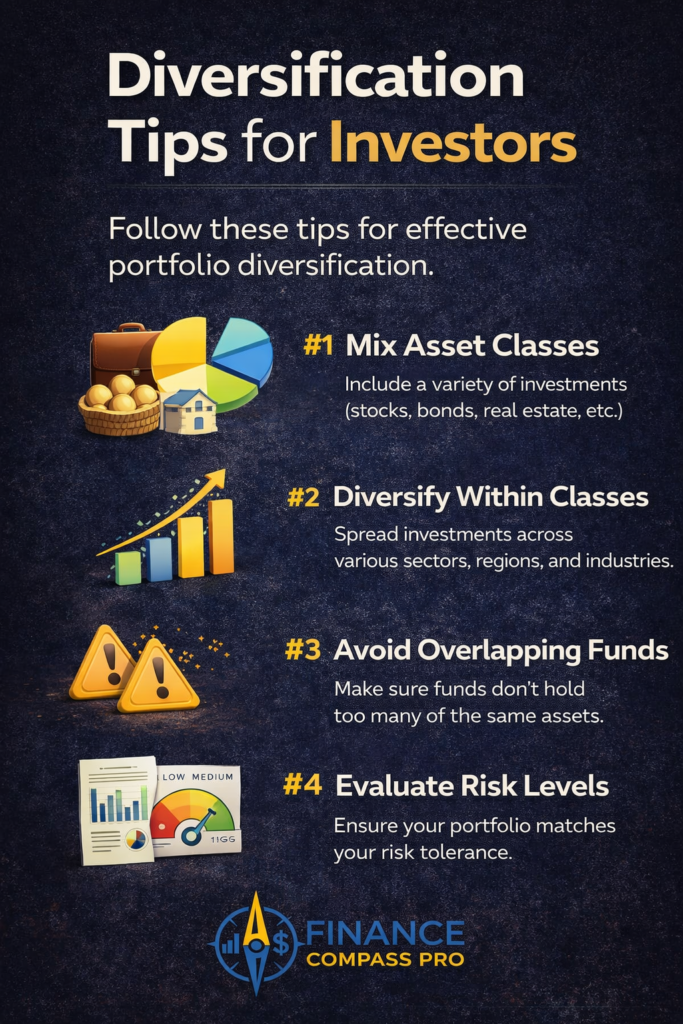
Owning multiple stocks in the same sector. Holding ten technology stocks feels diversified. But if the technology sector faces significant headwinds, all ten positions are likely to respond similarly. The diversification is illusory – it’s company-level but not sector-level.
Investing only in one country. A portfolio entirely in U.S. stocks has no protection against conditions that specifically affect the U.S. economy – dollar weakness, domestic policy changes, or periods when international markets significantly outperform.
Buying different funds that hold the same assets. Two S&P 500 ETFs from different providers are not diversification – they’re duplication. Understanding what each fund actually holds is worth the time before adding it to a portfolio.
Confusing quantity with diversity. Owning twenty investments that all move together is not more diversified than owning five. What matters is the correlation between holdings, not the number of them.
True diversification means spreading risk across assets that respond to different conditions in genuinely different ways – not simply accumulating more positions.
Time Diversification: The Layer Most Beginners Miss
There’s a fourth dimension of diversification that receives less attention than asset class, sector, and geography – but that’s equally important for long-term investors.
Time diversification means spreading your investment activity across time rather than concentrating it at a single moment.
When you invest a large sum at once, you’re fully exposed to whatever market conditions exist at that specific moment. If you invest immediately before a significant market decline, the timing works against you. If you invest immediately before a sustained rally, it works in your favor. You have no control over which scenario applies.
Investing consistently over time – adding to your portfolio at regular intervals regardless of market conditions – spreads that timing risk across many different market environments. Some purchases will happen at higher prices. Some will happen at lower prices. Over time, your average cost reflects a range of market conditions rather than a single moment.
This is the principle behind dollar-cost averaging – and it’s one of the most practically powerful applications of diversification available to individual investors. What Is Dollar-Cost Averaging explains how this time-based diversification works and why it consistently outperforms attempts to time market entry for most long-term investors.
What Diversification Cannot Do
It’s worth being clear about what diversification doesn’t offer – because misunderstanding its limits leads to unrealistic expectations.
Diversification does not protect you from broad market declines. When the overall market falls significantly, a diversified portfolio falls too – see our guide on what a bear market is for how these broad declines typically unfold. The protection is against concentrated losses from individual positions, sectors, or geographies – not against systemic market movements that affect all asset classes simultaneously.
It does not guarantee positive returns in any given year. A diversified portfolio will underperform a concentrated one in the sector or asset class that dominates any specific period.
And it does not eliminate the need for patience. Diversification works over long time horizons. Investors who expect it to produce smooth, uninterrupted upward movement on a monthly basis will be disappointed.
The honest case for diversification is not that it produces perfect outcomes. It’s that it prevents the catastrophic outcomes – the concentrated losses that permanently alter a financial trajectory – while maintaining consistent participation in the long-term growth that markets have historically delivered.
“Diversification won’t make you the best-performing investor in any given year. It will make you one of the most resilient ones – and resilience is what compounds into wealth over time.”
Building Diversification Into Your Portfolio
You don’t need a complex strategy to be genuinely diversified. You need a clear structure applied consistently.
1. Start with a broad market fund. A total market index ETF provides instant diversification across hundreds or thousands of companies in a single position. This is your foundation.
Diversification can also extend beyond the U.S. market. If your portfolio is entirely U.S. stocks, the next decision is whether international exposure belongs in your allocation at all. Should Beginners Invest Internationally? How Much Global Exposure You May Need explains that allocation decision before you choose a specific fund.
2. Add international exposure. A simple international index fund extends your diversification beyond a single economy. Even a 20–30% international allocation meaningfully reduces geographic concentration risk.
3. Include a stability component. A bond fund or bond ETF provides counterbalance during equity downturns. Your allocation depends on your timeline – younger investors typically hold less, those closer to needing the money hold more.
4. Rebalance when your allocation drifts. Over time, different asset classes grow at different rates and can shift your portfolio away from its target. How to Rebalance Your Portfolio explains when rebalancing is actually warranted and how to restore the target mix without unnecessary trading.
5. Resist the urge to concentrate during strong runs. The most dangerous time to abandon diversification is when a single sector or asset class is dramatically outperforming. That outperformance is precisely when concentration risk is highest – because mean reversion tends to follow extended periods of exceptional returns.
Frequently Asked Questions
Diversification means spreading your money across different assets, sectors, and geographies that respond differently to the same economic conditions. This reduces the impact any single investment’s poor performance can have on your overall portfolio.
It protects against concentration risk – the danger of having too much capital tied to a single company, sector, or country. A diversified portfolio can absorb one investment performing poorly without derailing your overall progress.
A broad market ETF holding hundreds of companies provides instant diversification in a single purchase. Combining a domestic stock ETF, an international ETF, and a bond ETF creates a genuinely diversified portfolio without requiring individual stock research.
Tools to Build a Diversified Portfolio
| Platform / Tool | What It’s Good For |
|---|---|
| Fidelity (fidelity.com) | Commission-free ETF trading, $0 account minimum, excellent fund selection |
| Charles Schwab (schwab.com) | Commission-free ETFs, strong research tools, beginner-friendly interface |
| Vanguard (vanguard.com) | Best for long-term, low-cost index investing – the original index fund provider |
| ETFdb.com (free) | Comparing ETFs by category, expense ratio, holdings, and performance |
| Portfolio Visualizer (free) | Backtesting portfolio allocations and checking correlation between holdings |
This article is for informational and educational purposes only and does not constitute financial advice. The platforms and tools mentioned in this post are included for educational reference only – no affiliate relationships are currently in place. Always consult a qualified financial professional before making investment decisions.