You already know the full strategy and allocation logic behind this approach.
You know the three slots – U.S. stocks, international stocks, bonds – and you understand why ETFs beat individual stock-picking for most beginners.
Now comes the part most guides skip: the actual execution.
What do you click? In what order? What do you do when your account is funded and you’re staring at a trade screen for the first time?
This is that guide. Concrete steps. Real numbers. And the honest truth about why most people abandon this strategy in month two – and how to not be one of them.
Step 0: Choose the Right Account Type First
Before you buy a single share, you need to answer one question: where are you building this portfolio?
This matters more than which ETFs you pick.
Roth IRA – If you have earned income and your income is below the IRS limit (phases out between $153,000-$168,000 single / $242,000-$252,000 married for 2026), open a Roth IRA first. Your contributions grow tax-free and you pay zero tax on withdrawals in retirement. It’s the single best account structure for a long-term ETF portfolio.
Taxable brokerage account – If you’ve already maxed your Roth IRA ($7,500/year limit for 2026, $8,600 if 50+), or you want flexibility to access money before retirement age, a taxable brokerage account is your next vehicle.
If you’re not sure which account should come first, Roth IRA vs. Brokerage Account compares the tax shelter and flexibility trade-off directly. Make that account decision before placing the first trade.

The Three Slots: What You’re Buying and Why
A 3-ETF portfolio isn’t a marketing concept. It’s the minimum number of funds needed to own the entire global stock market plus a stabilizing bond position – at a combined expense ratio often below 0.05%.
| Slot | What It Holds | Low-Cost Options |
|---|---|---|
| U.S. Total Market | All ~3,700 U.S. publicly traded companies | VTI, FSKAX (Fidelity), SWTSX (Schwab) |
| International | Stocks in 40+ countries outside the U.S. | VXUS, FZILX (Fidelity) |
| Bonds | U.S. investment-grade bonds for stability | BND, FXNAX (Fidelity) |
If you’re investing through Fidelity, FSKAX + FZILX is a strong zero-fee combination. At Schwab, SWTSX + SCHF works similarly. Vanguard investors typically use VTI + VXUS + BND.
If you’d like to understand what ETFs are and how they trade before placing your first order, read that first – it’ll make the trade screen less intimidating.
Month 1: Open, Fund, and Buy
Week 1–2: Open and Fund Your Account
- Open your account (Roth IRA or taxable brokerage – see Step 0)
- Link your checking account
- Initiate a transfer – even $100 is enough to start
- Wait 2-5 business days for the transfer to settle
Week 2–3: Place Your First Trades
Once your cash is available, go to the trade screen. Select each ETF, choose “market order,” and enter either the dollar amount (if the platform allows fractional shares) or the number of shares.
Allocation starting point by age:
| Age Range | U.S. Stocks | International | Bonds |
|---|---|---|---|
| 20s–30s | 80% | 10% | 10% |
| 40s | 70% | 15% | 15% |
| 50s | 60% | 15% | 25% |
For the U.S. stock portion of a simple portfolio, some investors use a total market ETF, while others use an S&P 500 ETF. If you are comparing major S&P 500 ETF options, our IVV vs VOO vs SPY guide explains the key differences.
Example with $1,000 (age 28, 80/10/10):
| ETF | Allocation | Dollar Amount |
|---|---|---|
| VTI | 80% | $800 |
| VXUS | 10% | $100 |
| BND | 10% | $100 |
Place each trade separately. Use market orders during regular trading hours (9:30 AM–4:00 PM ET). The price difference between a market order and a limit order is irrelevant when you’re buying to hold for 20 years.
Week 3–4: Set Up Two Automations
Automation 1 – Monthly contribution: Set a recurring transfer from your bank to your brokerage on the same date each month. Pick an amount that doesn’t require willpower – even $100/month is better than $500/month that you’ll cancel in a stressful month.
Automation 2 – Dividend reinvestment (DRIP): In your brokerage settings, enable automatic dividend reinvestment for each ETF. This means every dividend payment automatically buys more shares rather than sitting as idle cash. Over 20 years, this compounding effect is substantial.
If you’re deciding whether to invest everything at once or spread it out, the research consistently favors lump sum investing when you have a large amount available. For ongoing contributions, monthly automatic investing is the default.
Month 2: The Hardest Month
Here is what happens in month two: nothing visible. And that’s where most beginners make their most expensive mistake.
The market will move. Some days your portfolio will be down $40. Some days up $70. If you check it every day, your brain will start treating those fluctuations as signals – and eventually, during a rough week, it’ll whisper that maybe you should sell before it gets worse.
Don’t.
Research from Fidelity found that their best-performing accounts over a decade were either forgotten entirely or belonged to people who had died. That’s how powerful inaction is.
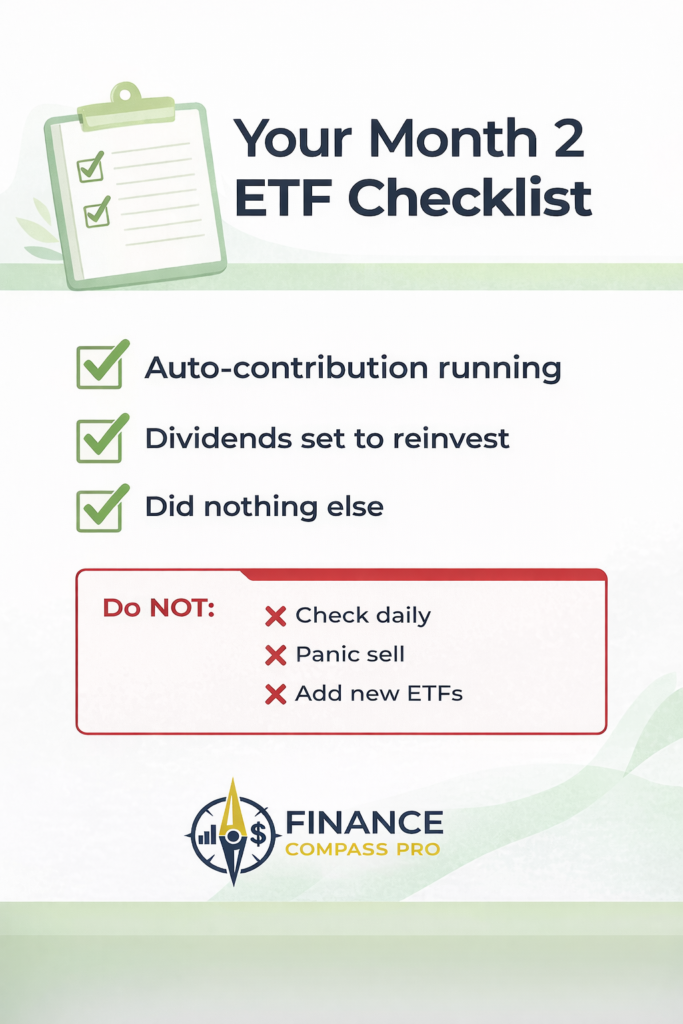
Your month-two checklist is exactly three items:
- [ ] Confirm automatic contribution ran
- [ ] Confirm dividends are set to reinvest
- [ ] Do nothing else
Month 3: Verify Your System, Then Step Back
At the 90-day mark, run one review:
- [ ] All three ETFs are in the account
- [ ] Automatic contributions are running on schedule
- [ ] DRIP is active on all three funds
- [ ] Your allocation is within 5% of your target
- [ ] You haven’t made any panic sells
If everything checks out, you’ve built the system. Your job now is to keep contributing and leave the portfolio alone.
When to Rebalance (And When Not To)
Rebalancing is necessary when one fund has drifted significantly from your target. But most beginners rebalance too often – which triggers unnecessary taxes in taxable accounts and disrupts long-term compounding.
Trigger for rebalancing: Any fund drifts more than 5-10 percentage points from its target allocation.
Example: Your target is 80/10/10. After a strong U.S. stock run, your portfolio sits at 88/7/5. That’s a meaningful drift – rebalance.
How to rebalance without selling:
Direct new contributions toward the underweight funds first. For the full decision framework—including drift thresholds, tax considerations, and when selling is actually necessary—see How to Rebalance Your Portfolio.
When you do need to sell, do it inside your Roth IRA where there are no capital gains tax consequences. In a taxable account, selling triggers taxes – minimize this by always rebalancing with new money first.
What $300/Month Looks Like Over Time
This portfolio is not exciting. That’s the point. Here’s what boring compounding looks like at a 7% average annual return (approximate long-term historical average for a diversified stock/bond portfolio):
| Timeline | Total Contributed | Estimated Portfolio Value |
|---|---|---|
| 10 years | $36,000 | ~$49,000 |
| 20 years | $72,000 | ~$147,000 |
| 30 years | $108,000 | ~$340,000 |
These numbers assume $300/month, 7% annual return, dividends reinvested. They’re not a guarantee – but they illustrate why the behavioral discipline of month two matters more than the ETF selection.
Eventually, a portfolio like this generates meaningful distributions. Read more about how ETF dividends can eventually generate passive income once your portfolio reaches a size where it starts working for you.

Your 90-Day Execution Summary
| Phase | Action |
|---|---|
| Before you start | Choose account type (Roth IRA vs taxable) |
| Week 1–2 | Open account, fund it, wait for settlement |
| Week 2–3 | Buy 3 ETFs per your allocation target |
| Week 3–4 | Set up monthly auto-contribution + DRIP |
| Month 2 | Confirm automation, ignore daily moves |
| Month 3 | Run checklist, verify system, step back |
| Ongoing | Add contributions monthly, rebalance once/year if needed |
The 3-ETF portfolio doesn’t require skill. It requires consistency. Do the setup right once, automate it, and then get out of your own way.
For the broader 7-step framework this execution plan fits into, see How to Build Your First Investment Portfolio.
Disclaimer: The information on this page is for educational purposes only and does not constitute financial, legal, tax, or investment advice. FinanceCompassPro.com is not a licensed financial advisor, broker, or tax professional. Individual results will vary. Always conduct your own research and consult a qualified professional before making any financial decision. Past performance does not guarantee future results. All investing involves risk, including possible loss of principal.