
Tags: #ETFs vs stocks #beginner investing #how to invest #stock market basics #build wealth
One question stops more beginners cold than almost any other.
Should you buy individual stocks – or should you start with ETFs?
It feels like a simple question. It isn’t.
Because the answer isn’t just about potential returns. It’s about risk tolerance, time commitment, emotional control, and – more than anything – the likelihood that you’ll actually stick with your strategy long enough for it to work.
This guide breaks it all down plainly. No jargon. No hype. Just the clearest comparison you’ll find on the internet.
“New to investing? Start here first.” → Investing for Beginners: The Complete Guide
What You’re Actually Choosing Between
Let’s define both clearly before comparing them.
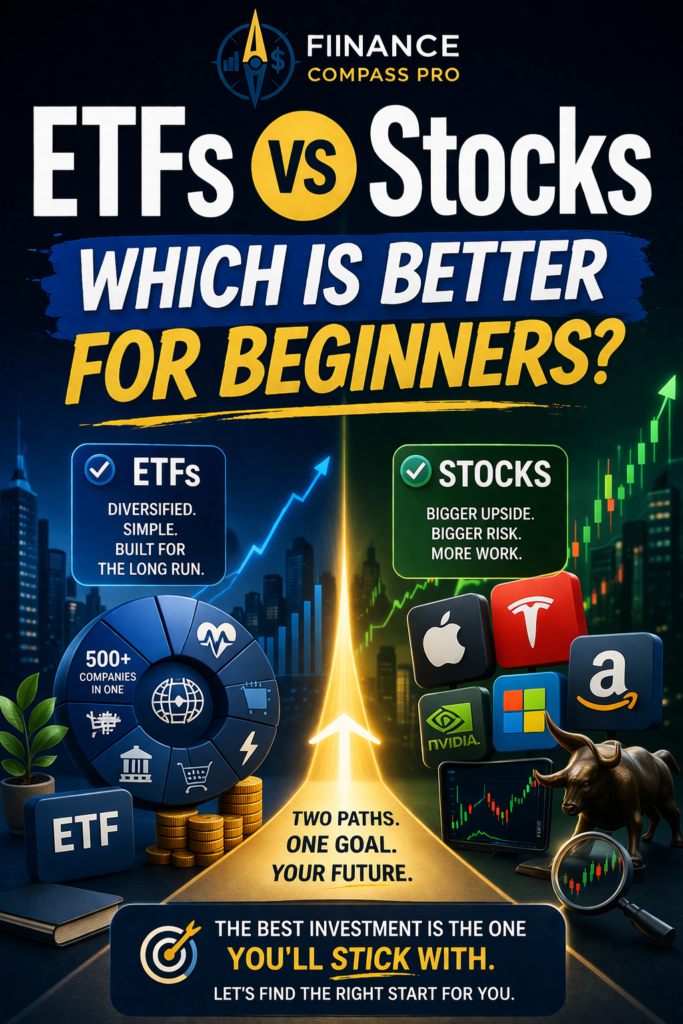
An individual stock is a share of ownership in a single company. When you buy Apple, Tesla, or Nike, you own a small slice of that business. Your returns depend entirely on how that one company performs.
An ETF – Exchange-Traded Fund – is a basket of many stocks bundled into a single investment. When you buy an S&P 500 ETF, you’re instantly invested in 500 of the largest US companies at once. One purchase. Hundreds of companies.
That difference sounds simple. But its implications run deep.
“Want the full ETF breakdown?” → What Is an ETF and How Does It Work?
The Case for Individual Stocks
Individual stocks are not inherently bad investments. For the right investor, they can be genuinely powerful.
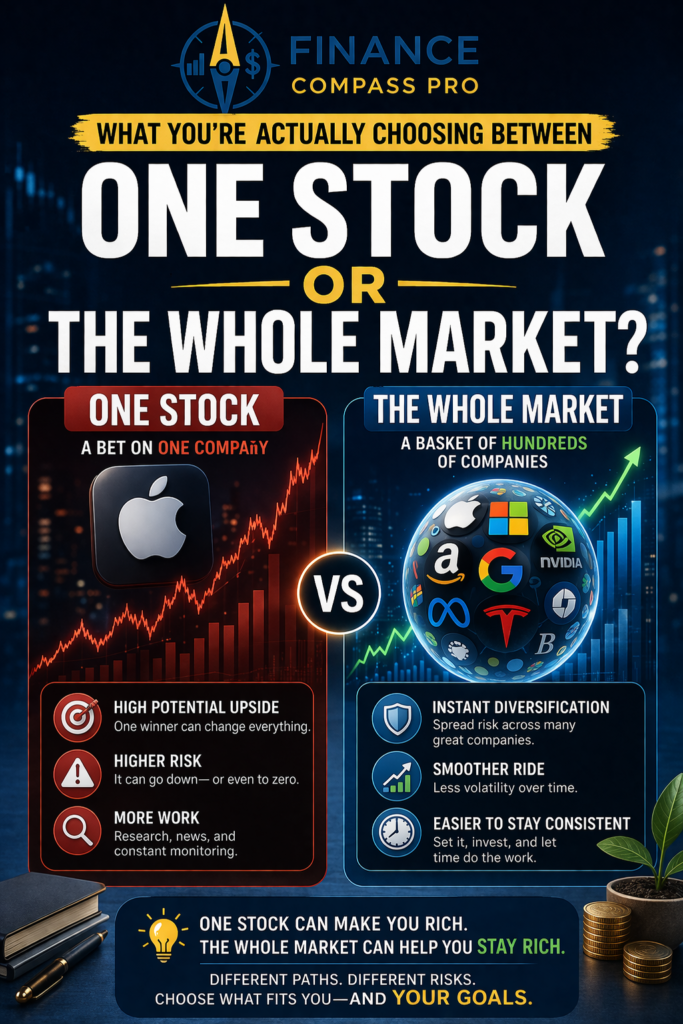
The upside is real. A single stock can double, triple, or grow ten times over a decade. Early Amazon investors turned modest positions into life-changing wealth. The same is true of early Apple, early Netflix, early Microsoft.
But here’s what those stories leave out.
“For every Amazon, there are hundreds of companies that looked equally promising – and quietly disappeared.”
For every story of extraordinary gains, there are thousands of stocks that underperformed, stagnated, or went to zero. The survivors are remembered. The rest are forgotten.
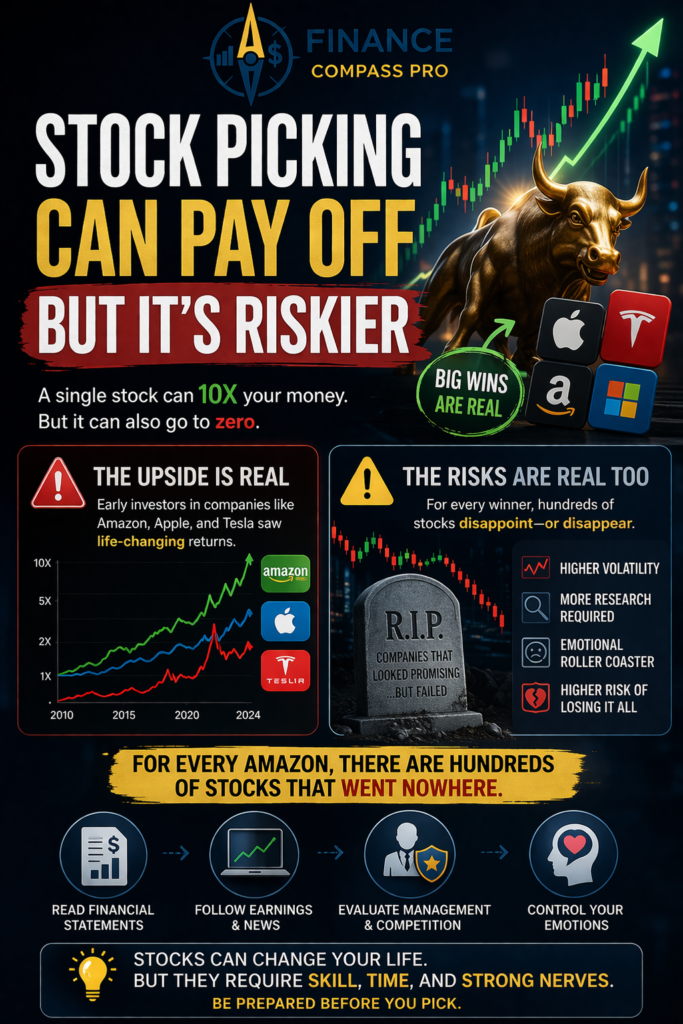
Investing in individual stocks effectively requires:
- Understanding how to read financial statements
- Following earnings reports and industry news
- Evaluating management quality and competitive positioning
- Managing your emotional response to daily price swings
This is a skill set. It takes time to develop. And even professional fund managers – with teams of analysts and decades of experience – fail to consistently beat the market.
For beginners still learning how markets behave, the responsibility that comes with individual stock investing is significant.
“Avoiding the most common beginner errors” → 7 Investing Mistakes Beginners Should Avoid
The Case for ETFs
ETFs approach investing from a different angle entirely.
Instead of trying to identify which companies will outperform, ETFs simply capture the market’s overall return. And over long time horizons, that return has been remarkably consistent.
The US stock market has averaged roughly 10% annually over the past century – including recessions, crashes, wars, and crises. No individual stock picking required.
| Metric | Individual Stocks | ETFs |
|---|---|---|
| Diversification | Low (1–20 companies) | High (100–3,000+ stocks) |
| Research Required | Significant | Minimal |
| Volatility | Higher | Smoother |
| Potential Upside | Unlimited (per stock) | Market-rate returns |
| Time Commitment | Active | Passive |
| Beginner-Friendliness | Lower | Higher |
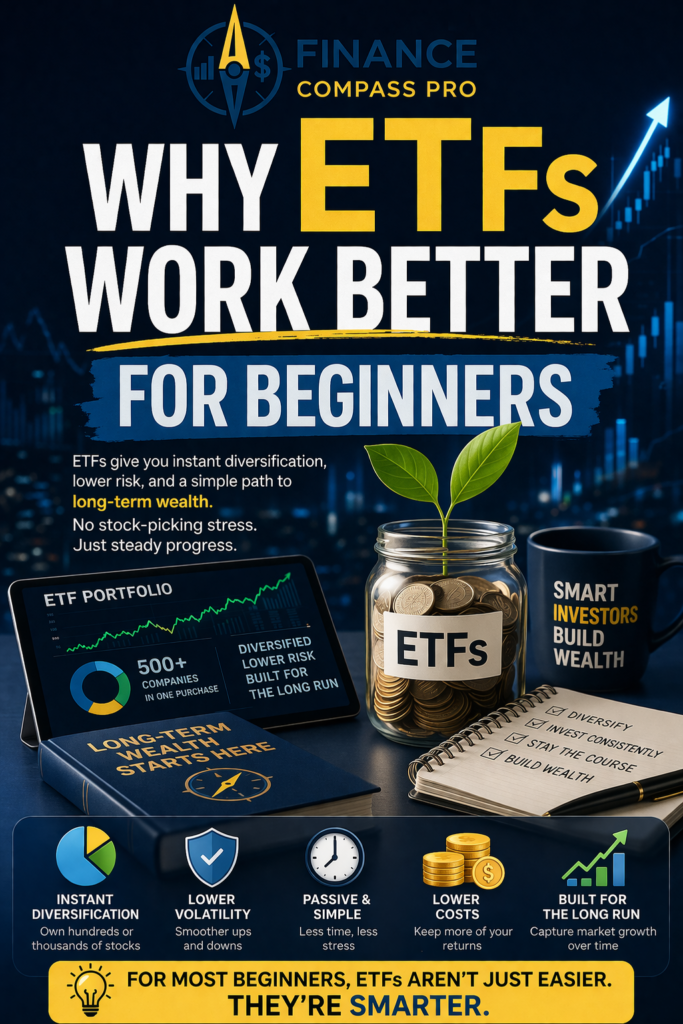
ETFs don’t promise the highest possible return. They promise consistent, broad exposure to long-term market growth – which is exactly what most beginners need most.
“How diversification protects your money” → What Is Diversification in Investing?
“The simplest ETF strategy to start with” → The Simple 3 ETF Portfolio Strategy Most Beginners Should Start With
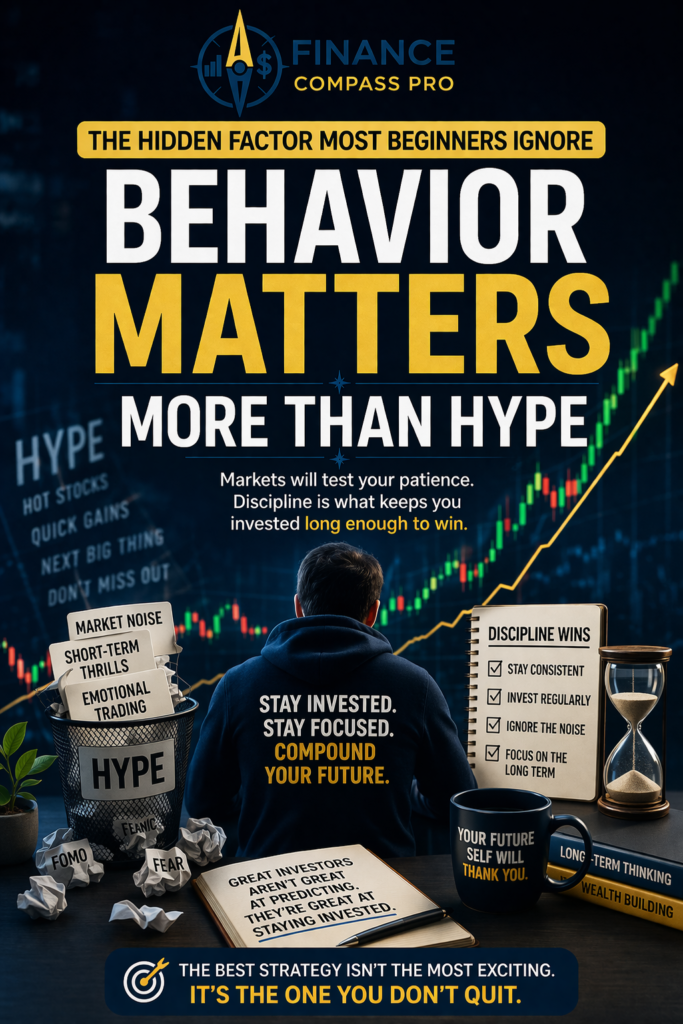
The Hidden Factor Most Beginners Ignore
There’s a layer to this decision that rarely gets discussed.
It’s not just about returns. It’s about behavior.
Investing strategies only work if you can actually follow them through market highs, market crashes, and everything in between. A theoretically superior strategy that you abandon during the first major downturn is worse than a simpler strategy you hold for twenty years.
Individual stocks move fast. A single bad earnings report can drop a stock 20% in a day. If that’s your only holding, that’s a 20% drop to your entire portfolio. Most beginners aren’t emotionally prepared for that – and they react by selling.
ETFs move too. But when 500 companies are in your fund, a bad day for one company barely registers. The smoothed volatility makes it dramatically easier to hold through hard stretches.
“The best investment strategy is the one you don’t abandon.”
The biggest threat to a beginner’s wealth isn’t choosing the wrong stock. It’s panic-selling at the worst possible moment.
“The strategy that makes staying invested easier” → What Is Dollar-Cost Averaging and Why Smart Investors Use It
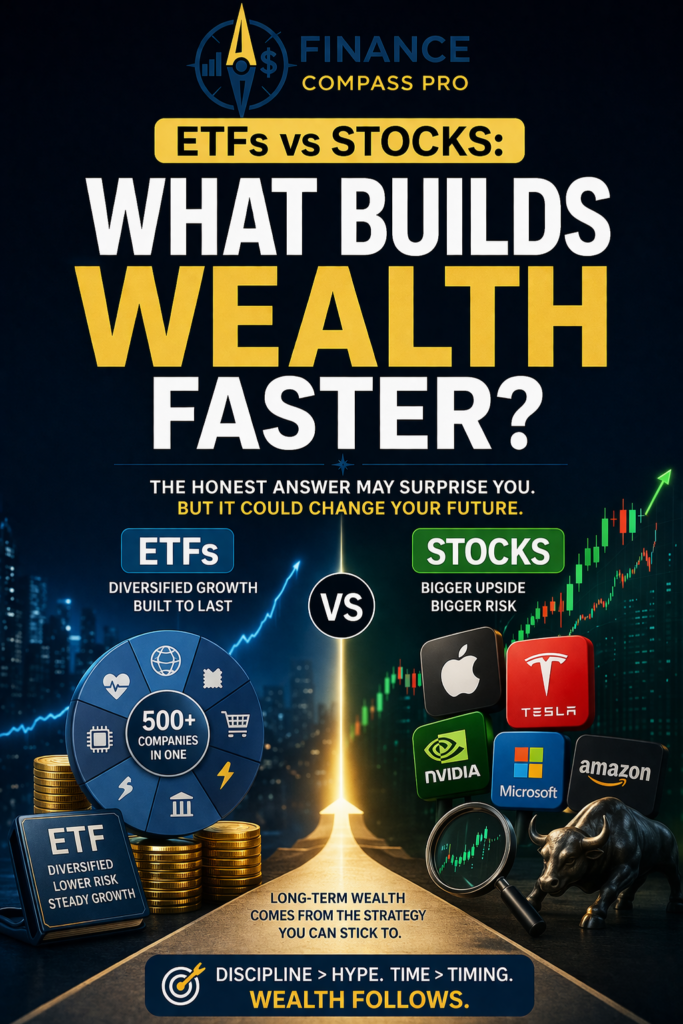
ETFs vs Stocks: Which Builds Wealth Faster?
This is the question everyone really wants answered.
The honest answer: it depends on the investor – not the instrument.
A disciplined stock picker with deep research skills and iron emotional control can outperform the market over time. Some do. Most don’t.
The average beginner who sticks with a simple, low-cost ETF strategy consistently outperforms the average beginner who tries to pick stocks – not because ETFs are inherently superior, but because the behavior required to hold ETFs is more sustainable.
Compounding does most of the work in long-term investing. And compounding only works when you stay invested.
“Time in the market beats timing the market. Every time
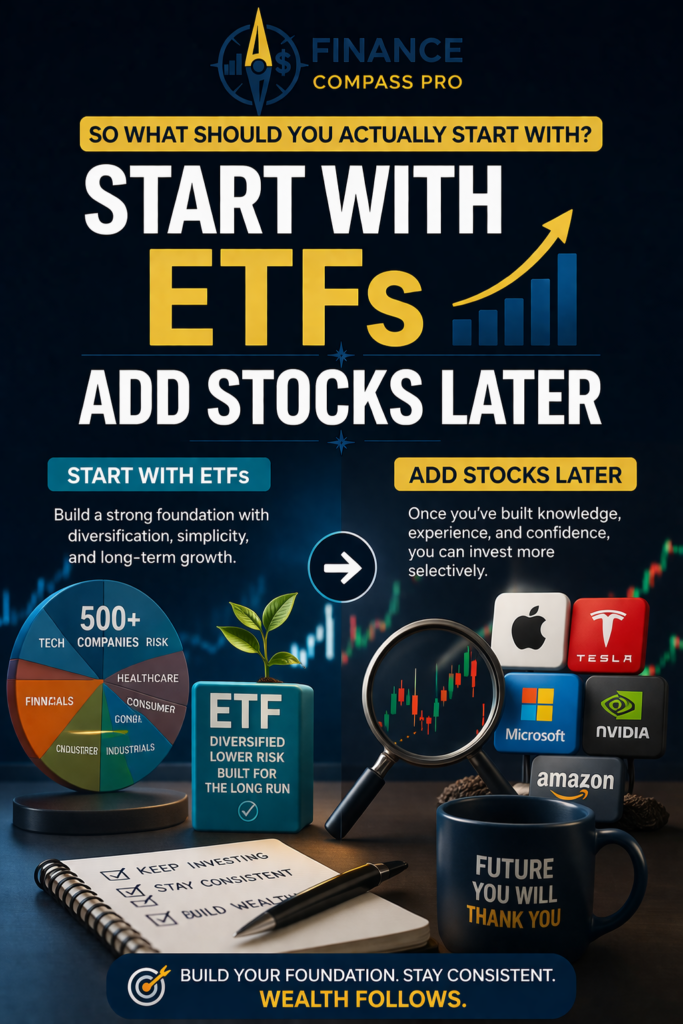
So What Should You Actually Start With?
Here’s the framework most experienced investors recommend for beginners.
Start with ETFs as your foundation
Build your core portfolio around 1–3 broad market ETFs. Keep it simple. Automate contributions. Don’t touch it.
This gives you market exposure immediately while you spend time learning – and learning is exactly what you should be doing in the background.
Study individual stocks while your ETFs grow
Use the months and years your ETF portfolio compounds to understand how businesses work. Read annual reports. Follow industries you’re curious about. Learn what makes a company genuinely valuable.
This education is worth more than any stock tip.
Add individual stocks only when you’re ready
If and when you decide to invest in individual companies, treat it as a satellite position – a small allocation alongside your core ETF holdings. Not a replacement for them.
A common starting structure: 80–90% ETFs, 10–20% individual stocks you’ve researched carefully.
Never let excitement override structure
The most dangerous moment for any investor is watching a single stock surge and feeling the urge to go all-in.
That’s precisely when structure matters most. Excitement is not a strategy.
“How to build a portfolio that holds up over time” → How to Build Your First Investment Portfolio
The Bottom Line
The question isn’t which option is “better” in theory.
It’s which one you can execute consistently – through good markets and bad, through headlines and noise, through fear and euphoria.
For most beginners, ETFs provide the best foundation. They reduce the cost of early mistakes. They smooth volatility. They make it easier to stay invested long enough for compounding to do its job.
Individual stocks can play a meaningful role later – once you’ve built the foundation, managed your emotions through a full market cycle, and developed a genuine research process.
Start simple. Stay consistent. Build from there.
Ready to Start Investing?
You don’t need to figure out everything at once.
Start by choosing a reliable brokerage platform – Fidelity, Charles Schwab, and Vanguard are all beginner-friendly options with no account minimums and strong ETF selection. If you prefer a more hands-off approach, robo-advisors like Betterment or Wealthfront handle portfolio construction automatically.
The most important move is the first one.
[RELATED POSTS]
→ What Is an ETF and How Does It Work?
→ What Is an Index Fund? A Beginner’s Guide
→ What Is Diversification in Investing?
→ What Is Dollar-Cost Averaging and Why Smart Investors Use It
→ The Simple 3 ETF Portfolio Strategy Most Beginners Should Start With
→ How to Build Your First Investment Portfolio
This article is for informational and educational purposes only and does not constitute financial advice. No affiliate relationships are currently in place for any platforms or tools mentioned in this post. Past performance does not guarantee future results. Always consult a qualified financial professional before making investment decisions.
Pingback: The Simple 3 ETF Portfolio Strategy Most Beginners Should Start WithThe Simple 3 ETF Portfolio Strategy Most Beginners Should Start With -
Pingback: ETFs vs Stocks for Long-Term Investing: Which Actually Wins?ETFs vs Stocks for Long-Term Investing: Which Actually Wins? -