
Most beginner investors obsess over the wrong thing.
They spend hours researching which stocks to pick, which ETF has the best returns, which sector is “hot” right now. Meanwhile, they completely ignore the decision that research shows matters far more than any of that.
That decision is asset allocation.
Studies consistently show that more than 90% of a portfolio’s long-term performance comes not from which specific investments you choose – but from how you divide your money across different types of assets.
This guide explains exactly what asset allocation is, why it’s the foundation of every successful investment strategy, and how to figure out the right mix for your specific situation.
What Is Asset Allocation?
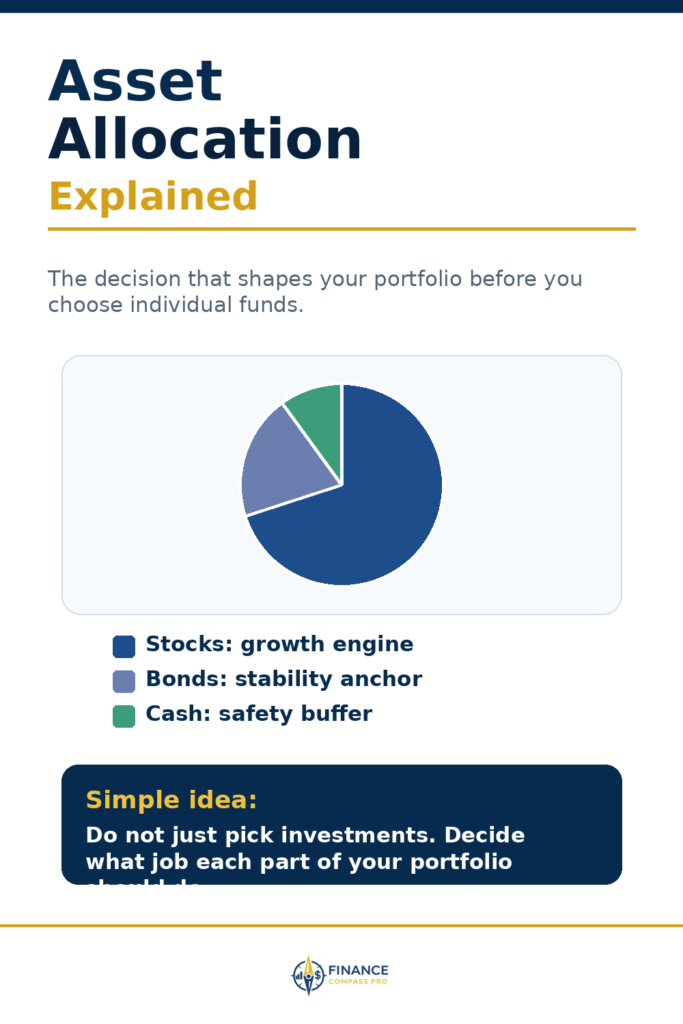
Asset allocation is the strategy of dividing your investment portfolio among different asset categories – most commonly stocks, bonds, and cash.
The idea is straightforward: different types of assets behave differently in different market conditions. When one goes down, another might hold steady or go up. By spreading your money across multiple categories, you reduce the risk that any single event wipes out your portfolio.
Here’s the simplest way to think about it:
Asset allocation is not about picking winners. It’s about building a portfolio that can survive anything the market throws at it – and still grow over time.
A classic example: when the stock market crashes, investors often flee to bonds, driving bond prices up. A portfolio that holds both cushions the blow from the stock market drop.
The Three Core Asset Classes
Before you can allocate, you need to understand what you’re allocating between.
1. Stocks (Equities)
Stocks represent ownership in a company. They offer the highest long-term growth potential of any major asset class – historically around 10% per year for a broad U.S. index – but they come with significant short-term volatility.
Stocks are the growth engine of your portfolio.
💡 What Is a Stock? A Beginner’s Complete Guide
2. Bonds (Fixed Income)
Bonds are loans you make to governments or corporations in exchange for regular interest payments. They’re more stable than stocks but offer lower returns – typically 3–5% annually over time.
Bonds are the stability anchor of your portfolio.
3. Cash and Cash Equivalents
This includes savings accounts, money market funds, Treasury bills, and certificates of deposit (CDs). These offer the lowest returns but maximum safety and liquidity.
Cash is your safety buffer – not typically a long-term growth tool.
| Asset Class | Role in Portfolio | Avg. Historical Return | Risk Level |
|---|---|---|---|
| Stocks | Growth engine | ~10% per year | High |
| Bonds | Stability anchor | ~3–5% per year | Low–Medium |
| Cash / Equivalents | Safety buffer | ~4–5% (high-yield, 2026) | Very Low |
| Real Estate (REITs) | Income + diversification | ~8–10% per year | Medium |
| International Stocks | Global diversification | ~7–9% per year | High |
Historical averages. Past performance does not guarantee future results.
Why Asset Allocation Matters More Than Stock Picking
In 1986, financial researchers Brinson, Hood, and Beebower published one of the most cited studies in investment history. Their conclusion: asset allocation explained more than 90% of a portfolio’s return variability over time.
Stock selection – which specific companies you chose – explained less than 5%.
Think about what that means. The investor who carefully picked 20 “great” companies but had 100% in stocks got crushed in 2008. The investor who picked simple index funds but split intelligently between stocks and bonds? Still down – but far less. And recovered faster.
The mix matters more than the individual ingredients.
The most important investment decision you’ll ever make isn’t which stock to buy. It’s how to divide your money across asset classes.
The Two Forces That Shape Your Allocation
Two factors determine the right asset allocation for you specifically.
1. Time Horizon
Your time horizon is how long before you need the money.
The longer your horizon, the more risk you can take – because you have time to recover from market downturns. A 25-year-old investing for retirement at 65 has 40 years to let the market recover from any crash. A 60-year-old retiring in 5 years does not.
This is why conventional wisdom has always said: the younger you are, the higher your stock allocation should be.
2. Risk Tolerance
Risk tolerance is your ability – both financial and psychological – to handle investment losses without making panic-driven decisions.
Risk tolerance should shape the stock-bond mix before you start choosing individual funds. If you are unsure how much volatility you can realistically handle, start with What Is Risk Tolerance and How to Find Yours, then compare the tradeoff between growth and stability in Stocks vs. Bonds. Once that high-level allocation is clear, fund selection becomes a much simpler implementation decision.
Two investors can have identical time horizons but very different risk tolerances. Someone who lost sleep during the 2020 COVID crash and nearly sold everything has a lower risk tolerance than someone who calmly bought more.
Neither is right or wrong. But your risk tolerance should shape your allocation. A portfolio you can’t stick with is worse than a “suboptimal” portfolio you’ll actually hold through downturns.
Your allocation only works if it matches the level of volatility you can actually tolerate without abandoning the plan.
Common Asset Allocation Models
Here are the most widely used allocation frameworks, from aggressive to conservative.
| Model | Stocks | Bonds | Best For |
|---|---|---|---|
| Aggressive | 90–100% | 0–10% | Young investors, 20+ year horizon, high risk tolerance |
| Growth | 70–80% | 20–30% | Mid-career investors, 10–20 year horizon |
| Balanced | 60% | 40% | Investors within 10 years of retirement |
| Conservative | 40–50% | 50–60% | Near-retirement, low risk tolerance |
| Income | 20–30% | 70–80% | Retirees needing steady cash flow |
These aren’t rigid rules – they’re starting points. The right allocation is personal.
The Classic Rule – And Why It’s Outdated
You may have heard the old rule: “subtract your age from 110 to get your stock percentage.”
So a 30-year-old would hold 80% stocks, 20% bonds. A 60-year-old would hold 50% stocks, 50% bonds.
It’s a decent starting point – but it was built for a different era.
Here’s why many financial experts now update this rule:
- People live longer. A 65-year-old today may have 25–30 more years ahead. An all-bond portfolio at that age could fail to keep up with inflation over three decades.
- Interest rates have changed. Bond yields were much higher in the 1980s and 90s. The return case for heavy bond allocations has weakened.
- Index funds changed the game. A diversified stock portfolio (like an S&P 500 index fund) is inherently less risky than picking individual stocks was decades ago.
Many advisors today suggest using 120 or even 130 minus your age for the stock percentage – acknowledging longer lifespans and the need for continued growth.
| Age | Old Rule (110 − Age) | Updated Rule (120 − Age) |
|---|---|---|
| 25 | 85% stocks | 95% stocks |
| 35 | 75% stocks | 85% stocks |
| 45 | 65% stocks | 75% stocks |
| 55 | 55% stocks | 65% stocks |
| 65 | 45% stocks | 55% stocks |
Use these as a starting framework – not a prescription. Your personal situation, income needs, and risk tolerance all matter.
Asset Allocation vs. Diversification: What’s the Difference?
These two terms are often confused. They’re related but not the same.
Asset allocation is the big-picture decision: how much of your portfolio goes into each asset class (stocks vs. bonds vs. cash).
Diversification is what happens within each asset class: owning many different stocks instead of just one, many different bonds instead of just one.
Think of it this way:
- Asset allocation = deciding to put 70% in stocks and 30% in bonds
- Diversification = making sure your 70% stocks includes hundreds of companies, not just Apple
You need both. A portfolio of 100% stocks in a single company is undiversified. A portfolio of 60% stocks and 40% bonds where the stocks are all in one sector is allocated but not diversified.
💡 Deep dive: What Is Diversification in Investing? (The Smart Way to Reduce Risk)
How to Actually Build an Allocated Portfolio
Here’s how to put this into practice – step by step.
Step 1: Define Your Time Horizon
When will you need this money? Retirement in 30 years? A house down payment in 5 years? Your answer determines everything else.
Step 2: Assess Your Risk Tolerance
Ask yourself honestly: if my portfolio dropped 30% tomorrow, what would I do? If your answer is “panic and sell,” you need a more conservative allocation than the numbers say.
Step 3: Choose Your Allocation Model
Use the table above as a starting point. Adjust based on your personal situation.
Step 4: Select Your Investments
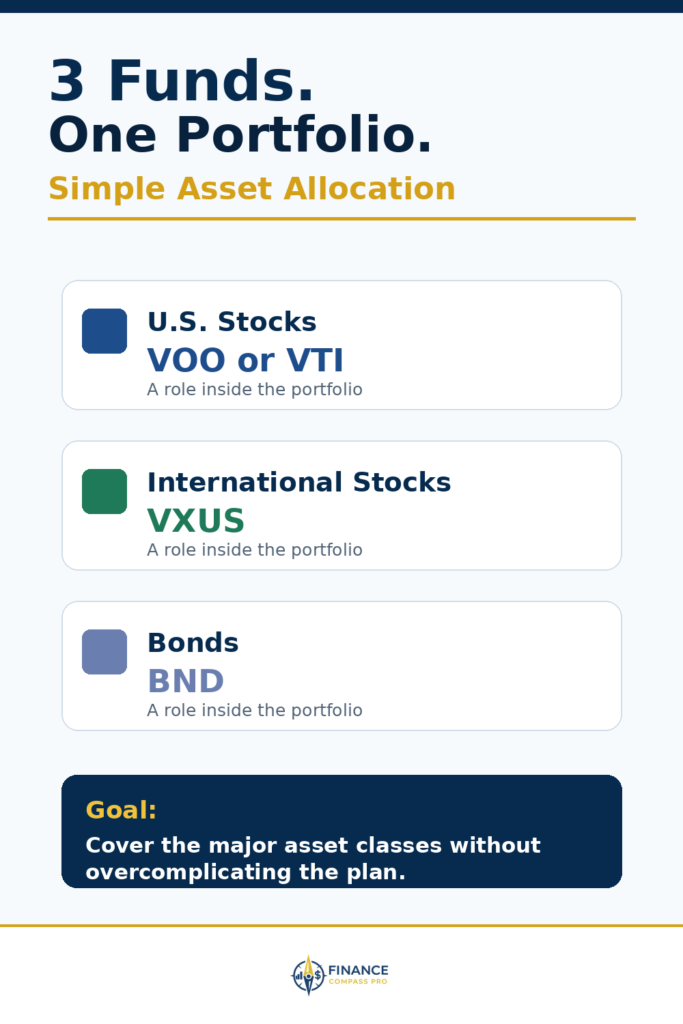
For most beginners, the simplest and most effective approach is to use just two or three low-cost index funds to cover each asset class:
| Asset Class | Simple Option | Expense Ratio |
|---|---|---|
| U.S. Stocks | VOO or VTI (Vanguard) | 0.03% |
| International Stocks | VXUS (Vanguard) | 0.07% |
| Bonds | BND (Vanguard) | 0.03% |
The key is to choose the asset-class mix first and the specific funds second, then diversify within each chosen asset class rather than adding funds without a clear role.
Asset allocation is not only about stocks versus bonds. It can also include how much of your stock allocation belongs in U.S. stocks versus international stocks. If you are deciding whether to add global exposure and how much may be appropriate, see Should Beginners Invest Internationally?.
Three funds. Total portfolio covered. Annual cost: less than $1 per $1,000 invested.
💡 This is exactly the approach behind the three-fund portfolio: The Simple 3 ETF Portfolio Strategy Most Beginners Should Start With
If you want to see how this allocation works inside a complete beginner portfolio, our guide on how to build your first investment portfolio walks through the full 7-step process.
Step 5: Rebalance Regularly
Over time, your allocation will drift. If stocks have a great year, they’ll make up a larger share of your portfolio than you planned. Rebalancing means periodically selling a bit of what’s grown and buying more of what’s lagged – to restore your target allocation.
Most investors rebalance once a year. Some rebalance when an asset class drifts more than 5% from its target. Either approach works. For a full walkthrough of when, why, and how to do this – including whether you actually need to sell anything – see How to Rebalance Your Portfolio.
Asset Allocation Through Life Stages
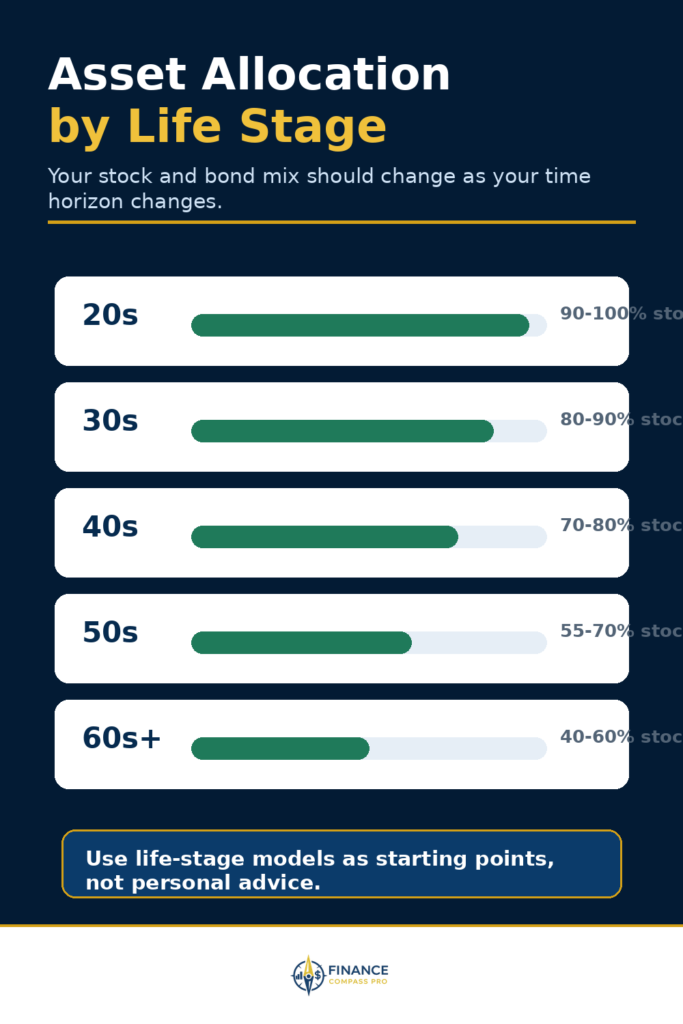
Your allocation isn’t static. It should evolve as your life changes.
| Life Stage | Typical Allocation | Primary Goal |
|---|---|---|
| 20s — Early Career | 90–100% stocks | Maximum growth; time to recover from losses |
| 30s — Building Wealth | 80–90% stocks | Aggressive growth with early stability layer |
| 40s — Mid-Career | 70–80% stocks | Balancing growth and capital preservation |
| 50s — Pre-Retirement | 55–70% stocks | Protecting accumulated wealth |
| 60s+ — Retirement | 40–60% stocks | Income generation, inflation protection |
Note that even in retirement, most financial planners recommend maintaining meaningful stock exposure. A 65-year-old with a 25-year life expectancy still needs growth to outpace inflation.
The Shortcut: Target-Date Funds
If choosing and maintaining your own allocation feels overwhelming, there’s a simple solution: target-date funds.
These are “set it and forget it” funds that automatically adjust your asset allocation as you get closer to retirement. You pick your target retirement year – say, a 2055 fund if you plan to retire in 2055 – and the fund does the rest.
Early on, it holds mostly stocks. As 2055 approaches, it gradually shifts toward bonds and more conservative assets. Automatically. Without you doing anything.
The downside: slightly higher fees than building your own three-fund portfolio. The upside: complete automation and zero chance of forgetting to rebalance.
For investors who don’t want to think about this at all, target-date funds are a genuinely good solution.
Common Asset Allocation Mistakes
Even with the right framework, investors often trip up in predictable ways.
Mistake 1: Being Too Conservative Too Early
A 25-year-old with 50% in bonds is leaving enormous growth on the table. Time is your greatest asset. Use it.
Mistake 2: Never Rebalancing
A portfolio that starts at 70/30 stocks/bonds can drift to 90/10 after a bull market – exposing you to far more risk than you planned for. Rebalance at least annually.
Mistake 3: Chasing Performance
Shifting your allocation toward whatever did well last year is one of the most reliable ways to underperform the market. Last year’s winners are frequently next year’s laggards.
Mistake 4: Panic Selling During Crashes
A 60/40 portfolio that you abandon during a crash is infinitely worse than a 100% stock portfolio you hold through it. The best allocation is one you’ll actually stick with. To understand what a market crash looks like and how long they last, see our guide on what is a bear market.
Mistake 5: Ignoring Taxes
Your allocation should account for where you hold assets, not just what you hold. Tax-advantaged retirement accounts and taxable brokerage accounts can change the tax cost of the same portfolio. Keep that account-placement question separate from the core allocation decision here; once your target stock-bond mix is set, you can decide which account should hold each asset.
The perfect asset allocation on paper is worthless if you abandon it the moment the market gets uncomfortable.
Key Takeaways
- Asset allocation – how you divide your money across stocks, bonds, and cash – drives over 90% of long-term portfolio performance.
- The two key factors shaping your allocation: time horizon and risk tolerance.
- Longer time horizons = higher stock allocation. Shorter horizons = more bonds and stability.
- Common models range from 90/10 (aggressive) to 20/80 (income-focused).
- For most beginners, a simple three-fund ETF portfolio covers everything at minimal cost.
- Rebalance annually to maintain your target allocation as markets move.
- The best allocation is the one you’ll actually hold through market ups and downs.
FAQ
A. Most 30-year-olds with a retirement horizon of 30+ years can afford an aggressive allocation of 80-90% stocks and 10-20% bonds. With that much time, market downturns become buying opportunities rather than threats. That said, if you have low risk tolerance, there’s nothing wrong with including more bonds to stay calm during volatility.
A. A 60/40 portfolio holds 60% stocks and 40% bonds. It’s been considered the “classic” balanced portfolio for decades – offering meaningful growth while providing downside protection. It’s generally suited for investors within 10–15 years of retirement.
A. Real estate can add valuable diversification and income. Most investors access real estate through REITs (Real Estate Investment Trusts) or real estate ETFs rather than physical property. A 5-10% allocation to real estate within your stock portion is common.
A. Your strategic allocation (the big-picture split between stocks, bonds, etc.) should only change when your life circumstances change significantly – retirement getting closer, major shift in income, or meaningful change in risk tolerance. Don’t adjust based on market conditions or news headlines.
A. Absolutely. “Investing in index funds” tells you the vehicle – but not the destination. A 100% stock index fund portfolio and a 60/40 stock-bond index fund portfolio will behave very differently. The allocation decision is just as important regardless of whether you’re using individual stocks or index funds.
Build Your Portfolio on a Solid Foundation
Asset allocation isn’t exciting. It doesn’t make headlines. Nobody goes viral for having a well-allocated portfolio.
But behind virtually every investor who successfully built long-term wealth, you’ll find the same thing: a clear, consistent asset allocation they stuck with through every market cycle.
Start with the right foundation:
👉 Investing for Beginners: The Complete Guide to Building Wealth in 2026
See how to put this into practice with just three funds:
👉 The 3 ETF Portfolio Strategy: Simple, Diversified, and Built to Last
And if you need to understand how to stay consistent when markets fall:
👉 What Is Dollar-Cost Averaging and Why Smart Investors Use It
📋 DISCLAIMER
This article is for informational and educational purposes only and does not constitute financial advice. ETF data, fund structures, and expense ratios referenced reflect publicly available information as of early 2026 and are subject to change. Verify current details at the fund provider’s website before investing. No affiliate relationships are currently active for any funds or platforms mentioned. Always consult a qualified financial professional before making investment decisions.