
You’ve heard the advice a hundred times: “Start investing.” But when you actually sit down to do it, you hit a wall. Where does the money go? How do you actually buy a stock or an ETF?
The answer, almost always, starts with a brokerage account. Opening one is easier than it sounds – most people finish the entire process, from application to first purchase, in about 15 minutes.
Before you can buy your first ETF, index fund, or stock, you need one essential tool: a brokerage account. It is the account that connects your saved money to the investment market.
If you’ve never heard the term before – or you’ve heard it but aren’t quite sure what it means – this guide is for you. By the end, you’ll know exactly what a brokerage account is, how it works, and how to open one even if you’re starting from zero.
What Is a Brokerage Account?
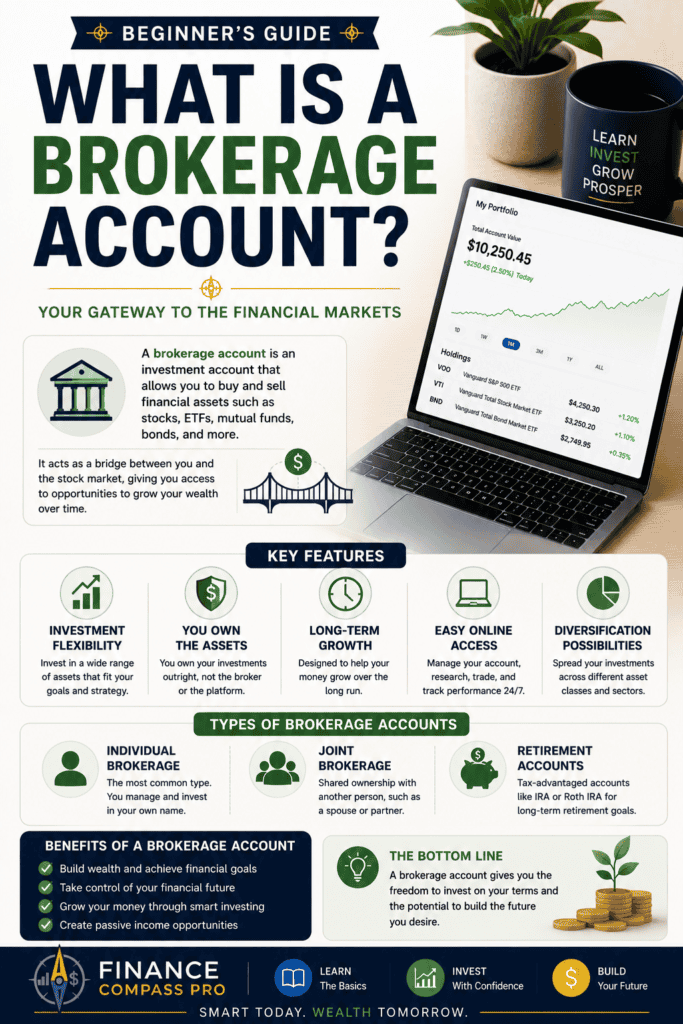
A brokerage account is a type of financial account that lets you buy and sell investments -things like stocks, ETFs, index funds, and bonds. For a deeper look at how a taxable brokerage account is structured once it’s open, including protections and tax forms, see Taxable Brokerage Account Explained.
Think of it this way: just like you need a bank account to hold and spend cash, you need a brokerage account to hold and invest in securities. It’s the gateway between your money and the financial markets.
You open the account through a brokerage firm – a company that’s licensed to execute trades on your behalf. Well-known examples include Fidelity, Charles Schwab, and Vanguard. When you deposit money into your brokerage account, you can then use it to purchase investments. Those investments sit inside the account and grow (or shrink) based on how the market performs.
Unlike a savings account, a brokerage account is not FDIC insured. Your money is exposed to market risk – which means the value of your investments can go up or down. That’s the trade-off for the potential of higher long-term returns.
How Is a Brokerage Account Different From a Retirement Account?
This is one of the most common points of confusion for beginners, so it’s worth clearing up directly.
A brokerage account – sometimes called a taxable brokerage account or a standard investment account – has no special tax treatment. You can put in as much money as you want, withdraw it whenever you want, and use it for any financial goal. The downside is that you’ll owe taxes on any capital gains or dividends you earn each year.
For a full breakdown of how those taxes work, see ETF Taxes Explained. One advantage of a taxable account is the ability to use tax-loss harvesting – see ETF Tax-Loss Harvesting Explained for how that works.
For a guide on which ETFs work best inside a Roth IRA versus a taxable account, see Best ETFs for Roth IRA.
A retirement account, like a Roth IRA or a traditional 401(k), comes with tax advantages – but also restrictions. If you have access to both a workplace 401(k) and a Roth IRA, see Can You Have a Roth IRA and a 401(k) at the Same Time? for how to use them together.
If your income is too high for direct Roth IRA contributions, see Backdoor Roth IRA Explained for a legal alternative. For how a Roth IRA compares to the brokerage account described in this guide, see Roth IRA vs. Brokerage Account.
Once your account is open, you’ll also be asked to choose between a cash account and a margin account – see Cash Account vs. Margin Account for why a cash account is the simpler default for most beginners.
There are annual contribution limits, and withdrawing money early usually comes with penalties.
What Can You Hold in a Brokerage Account?
Once your brokerage account is open and funded, you can invest in a wide range of assets:
- Stocks: Ownership shares in individual companies like Apple, Amazon, or Google.
- ETFs (Exchange-Traded Funds): Baskets of stocks or bonds that trade like a single share. A popular choice for beginners.
- Index funds: Funds that track a market index like the S&P 500.
Related guide: What Is an Index Fund? - Bonds: Debt securities that pay interest over time. See our guide on what is a bond.
- REITs: Real estate investment trusts – a way to invest in real estate without buying property.
- Cash: Uninvested cash in your account may earn interest through a money market fund.
For beginners, the most straightforward starting point is usually a low-cost S&P 500 ETF or a total market index fund. You get instant diversification across hundreds of companies with a single purchase.

How Does a Brokerage Account Work?
The mechanics are simpler than most people expect.
- You open an account with a brokerage firm (online, in minutes).
- You deposit money – either a lump sum or a recurring transfer from your bank.
- You use that money to purchase investments inside the account.
- Your investments are held in the account and grow over time.
- When you’re ready, you can sell investments and withdraw the cash – or reinvest the proceeds.
Most modern brokerages have mobile apps and user-friendly platforms that make the process straightforward. Many also offer fractional shares, meaning you can buy a slice of an expensive stock for as little as $1.
One thing to keep in mind: buying and selling investments inside a taxable brokerage account can trigger tax events. When you sell a position at a profit, you may owe capital gains tax. Capital Gains Tax for Beginners explains how short-term and long-term gains are treated and why holding period matters. This is one reason a buy-and-hold strategy tends to work well in a brokerage account.
If you’re trading frequently rather than buying and holding, you’re also subject to a different set of margin rules – the FINRA Pattern Day Trader rule changed significantly in 2026, and it’s worth understanding before you enable margin on a new account.
How to Open a Brokerage Account (Step by Step)
Opening a brokerage account is faster than most people expect. Here’s what the process typically looks like:
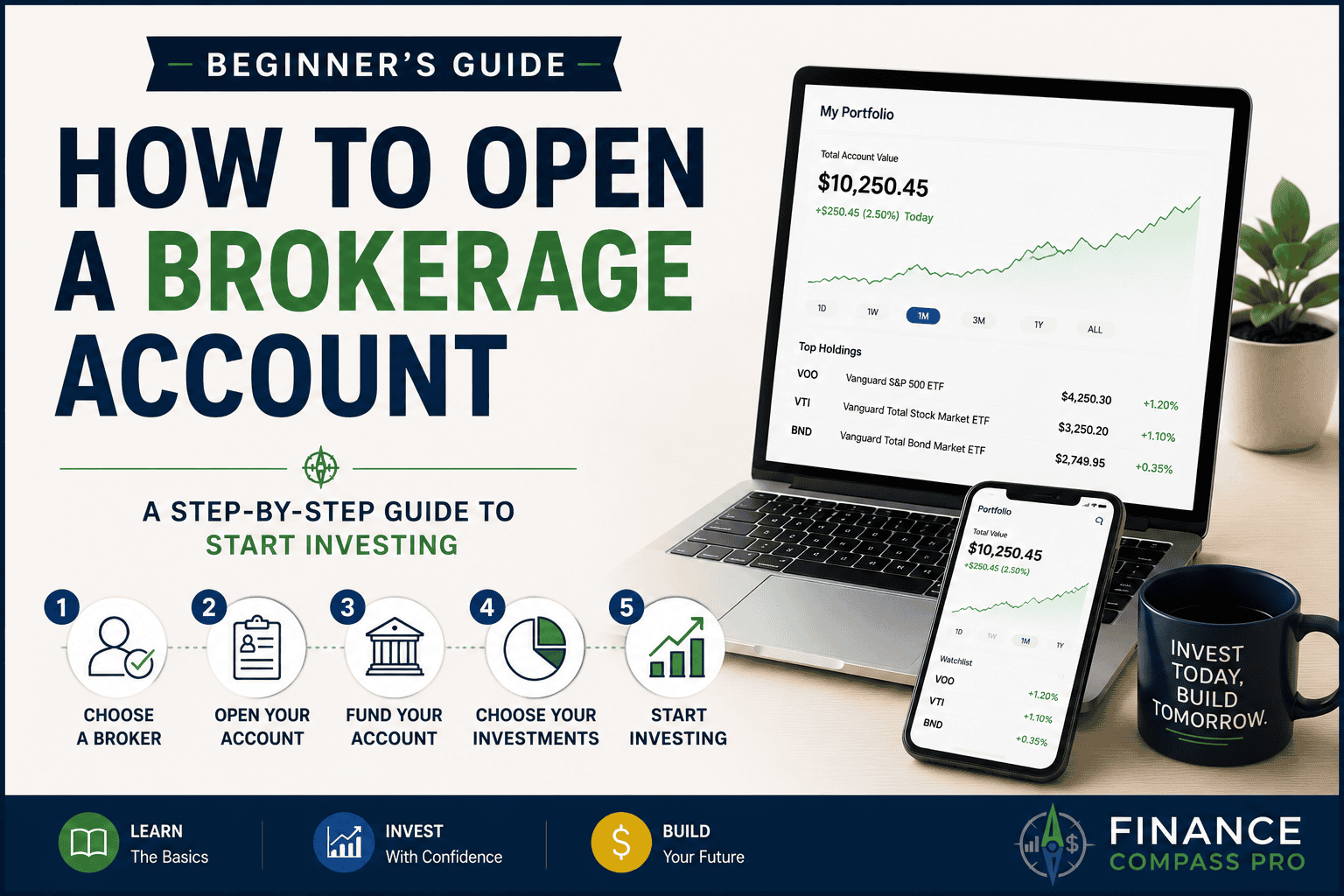
Step 1: Choose a brokerage.
Look for a platform that charges no account minimums and $0 commissions on trades. Fidelity, Schwab, and Vanguard are consistently recommended for beginners.
Step 2: Start the application.
Go to the brokerage’s website and click “Open an Account.” You’ll fill out a short application asking for your name, address, Social Security number, and employment information. This is required by law for identity verification.
Step 3: Choose your account type.
For a standard brokerage account, select “Individual Taxable Account” or “Standard Brokerage Account.” If you’re opening a retirement account, you’d choose Roth IRA or Traditional IRA instead.
Step 4: Fund your account.
Link your bank account and transfer funds. Some brokerages let you start with as little as $1.
Step 5: Make your first investment.
Before choosing your first ETF, stock, or index fund, make sure you know what goal that money serves. If your timeline is unclear, start with how to set financial goals before you invest. If you’re just getting started, read How to Invest Your First Paycheck.
Search for the ETF or index fund you want to buy, enter the dollar amount or number of shares, review the order, and confirm. If the order screen asks whether you want a market order or a limit order, see Market Order vs. Limit Order before you submit your first trade. The entire process, from application to first purchase, can take as little as 15 minutes.

What to Do After You Open Your Account
Set up automatic contributions. Even $50 or $100 a month, invested consistently, compounds into a meaningful amount over time.
Keep it simple. A single broad-market ETF is a legitimate long-term strategy used by professionals and everyday investors alike.
Next step: learn how to build your first investment portfolio.
Check in, but don’t obsess. A monthly or quarterly check-in is usually enough for long-term investors. Think long term – the longer your money stays invested, the more time compound growth has to work in your favor.
Brokerage Account FAQ
Yes. In many cases, $100 is enough to open an account and make your first small investment. Some brokerages let you start with less, especially with fractional shares.
The account itself can be safe with a reputable firm, but the investments inside can still lose value. Cash in a bank account may be FDIC insured; stocks, ETFs, and index funds move with the market.
Yes. To buy ETFs, stocks, or most index funds on your own, you generally need a brokerage account.
Usually, yes. Selling for a profit may create a taxable gain, and cash may take a few days to settle before withdrawal.
They serve different purposes. A Roth IRA is usually better for retirement due to tax advantages, but has contribution limits. Many people use both.
The Bottom Line
A brokerage account is the foundational tool of personal investing. Opening one is easier than it’s ever been – the barriers are low, the costs are minimal, and the process takes minutes. The harder part is staying consistent and thinking long term.
Next, read: What Is an ETF? A Beginner’s Guide to Smart Investing
Or for the complete beginner roadmap this account fits into, see Investing for Beginners: The Complete Guide to Building Wealth in 2026.
This article is for informational and educational purposes only and does not constitute financial advice. Verify current figures at IRS.gov and SIPC.org. Always consult a qualified financial professional before making financial decisions.