
Disclosure: This article is for informational and educational purposes only. FinanceCompassPro.com may earn compensation through display advertising or affiliate relationships. We may reference third-party products, services, platforms, or tools for educational purposes. These mentions are not paid endorsements unless clearly stated. Nothing in this article constitutes personalized financial, legal, tax, or investment advice.
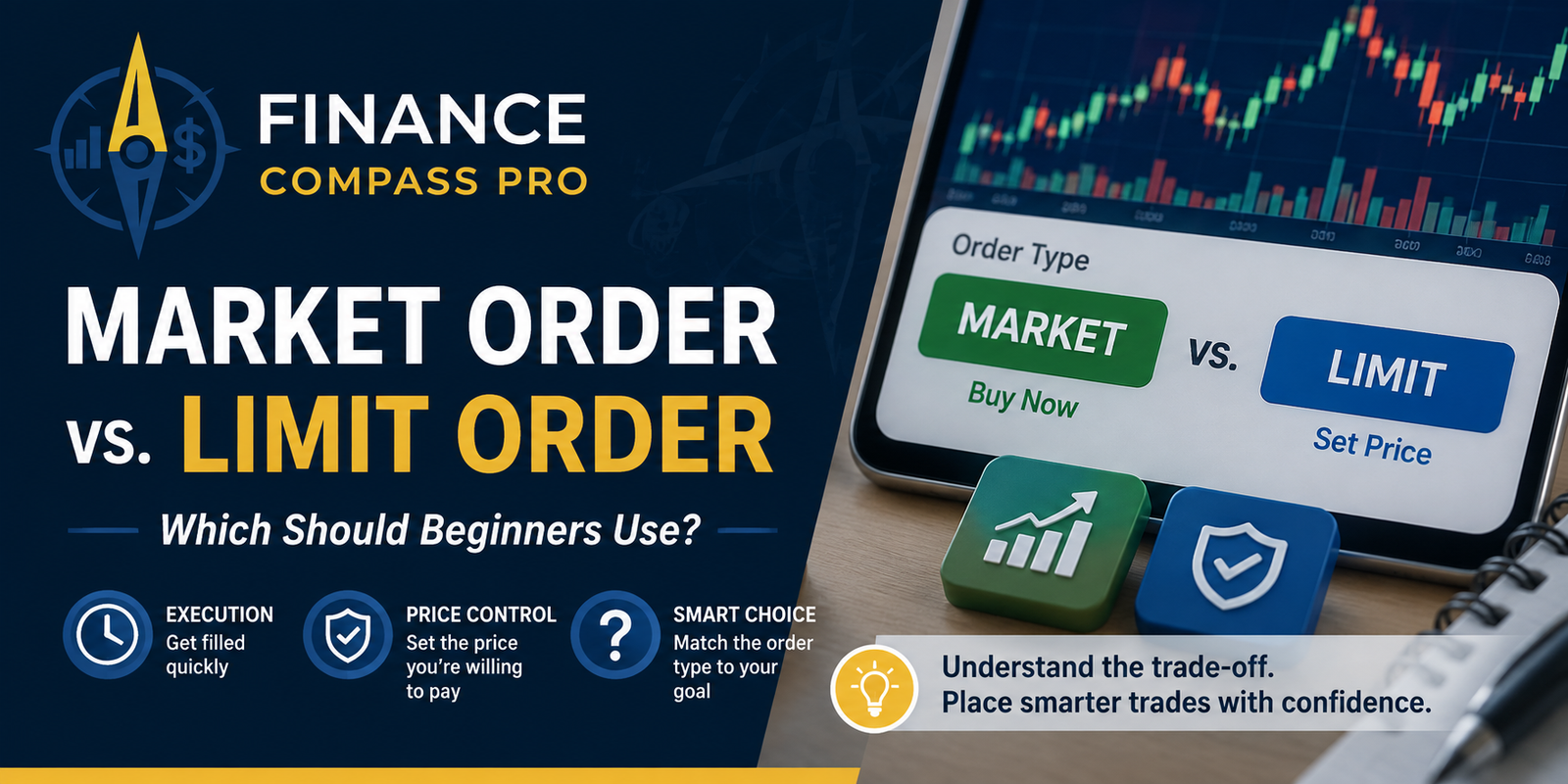
You’ve opened your brokerage account. If you haven’t yet, start with our guide to how to open a brokerage account.
Then you go to place your first trade, and the order screen asks you something you weren’t expecting: Market or Limit?
This is where a lot of first-time investors hesitate. Learning what to buy is one thing. Knowing how to actually place the order is another.
Quick Answer
A market order prioritizes getting the trade executed quickly, but it does not guarantee the exact price you will receive.
A limit order gives you control over the highest price you are willing to pay when buying, but the trade may never execute.
Neither one is automatically better. The real choice is between execution certainty and price control.
With a highly liquid ETF during regular trading hours, a market order may be reasonable. When prices are moving quickly, liquidity is lower, or you simply want tighter control over what you pay, a limit order may make more sense.
What a Market Order Actually Does
A market order tells your broker: buy or sell this security now at the best available price.
Investor.gov explains that a market order generally prioritizes execution, but the price is not guaranteed. The price you see when you click the button may not be the exact price at which the trade is completed.
That distinction matters most when prices are changing quickly or the security does not trade very often.
For a highly liquid ETF such as VOO or VTI, the bid-ask spread is often relatively narrow under normal market conditions. With a less-liquid stock or ETF, the gap between available buying and selling prices can be wider.
What a Limit Order Actually Does
A limit order tells your broker: only buy this security at my limit price or lower, or only sell it at my limit price or higher.
Suppose an ETF is trading around $100 and you place a buy limit order at $99.50.
Your order can execute at $99.50 or less, but it won’t execute above the price you set.
That gives you more price control. The trade-off is simple: the order might never fill.
If the market price never reaches your limit, you don’t buy the shares. Your cash remains uninvested unless you change the order or place a new one.

The Hidden Trade-Off Most Guides Skip
The choice isn’t really about which order type is “better.”
It’s about what you want the order to prioritize:
- Market order: prioritize getting the trade executed.
- Limit order: prioritize controlling the price.
A market order gives up some price control for a greater likelihood of immediate execution.
A limit order gives you price control but introduces the possibility that nothing happens.
For someone building a long-term portfolio, that trade-off is usually more useful to understand than memorizing a rule that says one order type is always right.
Before You Click Buy, Check the Bid and Ask
Your broker’s order screen will usually show two prices:
- Bid: the highest price a buyer is currently offering.
- Ask: the lowest price a seller is currently willing to accept.
The difference between them is the bid-ask spread.
When that spread is very narrow, a market order in a heavily traded ETF may fill close to the price you see.
When the spread is wider, price control becomes more important.
This is one reason it’s useful to look at more than the last traded price before submitting an order.
A Simple Decision Framework
- Buying a highly liquid ETF such as VOO or VTI during regular trading hours? A market order may be reasonable because highly liquid ETFs often have relatively narrow bid-ask spreads during normal market conditions.
- Buying near the market open or close? Consider a limit order, especially when prices are moving quickly or the bid-ask spread is wider than usual.
- Buying an individual stock or a less-liquid ETF? A limit order may give you useful protection against paying more than you expected.
- Seeing a noticeably wide bid-ask spread? Price control deserves more attention. A limit order lets you define the maximum price you are willing to pay.
- New to your broker’s order screen? Slow down before submitting the trade. Check the order type, number of shares, price instructions, and whether the market is currently open.
A Beginner Mistake to Avoid
One easy mistake is assuming an order entered outside regular trading hours will behave exactly the same way as an order entered during the normal session.
It may not.
What happens to an order entered before the market opens or after it closes depends on your brokerage firm, the order type, and the instructions you select.
Some orders may wait for the next regular trading session, while many brokerage firms accept only limit orders for extended-hours trading.
Extended-hours markets can also have lower liquidity, wider bid-ask spreads, and greater price uncertainty than normal trading hours.
Before placing an after-hours trade, check your broker’s specific policy rather than assuming the order will be handled the way you expect.
Market Order vs. Limit Order: A Quick Comparison
| Feature | Market Order | Limit Order |
|---|---|---|
| Main priority | Execution | Price control |
| Exact price guaranteed? | No | Price limit is controlled |
| Execution guaranteed? | Generally prioritizes execution, but price is not guaranteed | No |
| Highly liquid ETFs | Often reasonable during regular hours | Also usable |
| Fast-moving prices | Greater price uncertainty | Can provide more price control |
| Main risk | Different execution price than expected | Order may never execute |
Where This Fits in Your Investing Plan
Order type is only one small part of making your first investment.
If you haven’t decided what you’re actually buying yet, start with What Is an ETF and How Does It Work?
That guide explains why ETFs are often used as building blocks in beginner portfolios.
Once you’re ready to combine investments into a complete structure, move on to How to Build Your First Investment Portfolio.
The learning sequence is simple: open the account → understand the order → choose the investment → build the portfolio.

Bottom Line
Market orders and limit orders solve different problems.
A market order prioritizes execution but leaves the final price uncertain.
A limit order controls the price you are willing to accept but creates the possibility that your trade won’t happen at all.
For your first trade, focus less on finding the “best” order type and more on understanding that trade-off.
Check the bid and ask, confirm whether the market is open, and review the order details before submitting.
That small habit is more useful than memorizing a rule that says beginners should always use one order type.
FAQ
A. It depends on the trade. A market order prioritizes execution but does not guarantee the execution price. A limit order gives you price control, but the trade may not execute.
A limit order may be more appropriate when price control matters more, while a market order may be reasonable for a highly liquid security during normal market conditions.
A. Yes. A limit order is not guaranteed to execute.
If the market never reaches a price that satisfies your limit, the trade will not fill.
A. It depends on your brokerage firm, order type, and trading instructions.
Some eligible orders may wait for the next regular session, while many firms accept only limit orders for extended-hours trading.
Check your broker’s policy before submitting an order outside regular market hours.
A. Not necessarily.
Highly liquid ETFs often have relatively narrow bid-ask spreads during normal market conditions, so a market order may be reasonable during regular trading hours.
A limit order can still be used when you want more control over the price.
A. A market order prioritizes execution, while a limit order prioritizes price control.
With a market order, the final price can differ from what you expected.
With a limit order, the trade may not execute at all.
This article is for informational and educational purposes only and does not constitute financial advice. It is not a recommendation to buy or sell any specific security. Order types, trading sessions, and execution policies may vary by brokerage firm. Always review your broker’s current rules and consider consulting a qualified financial professional before making investment decisions.