
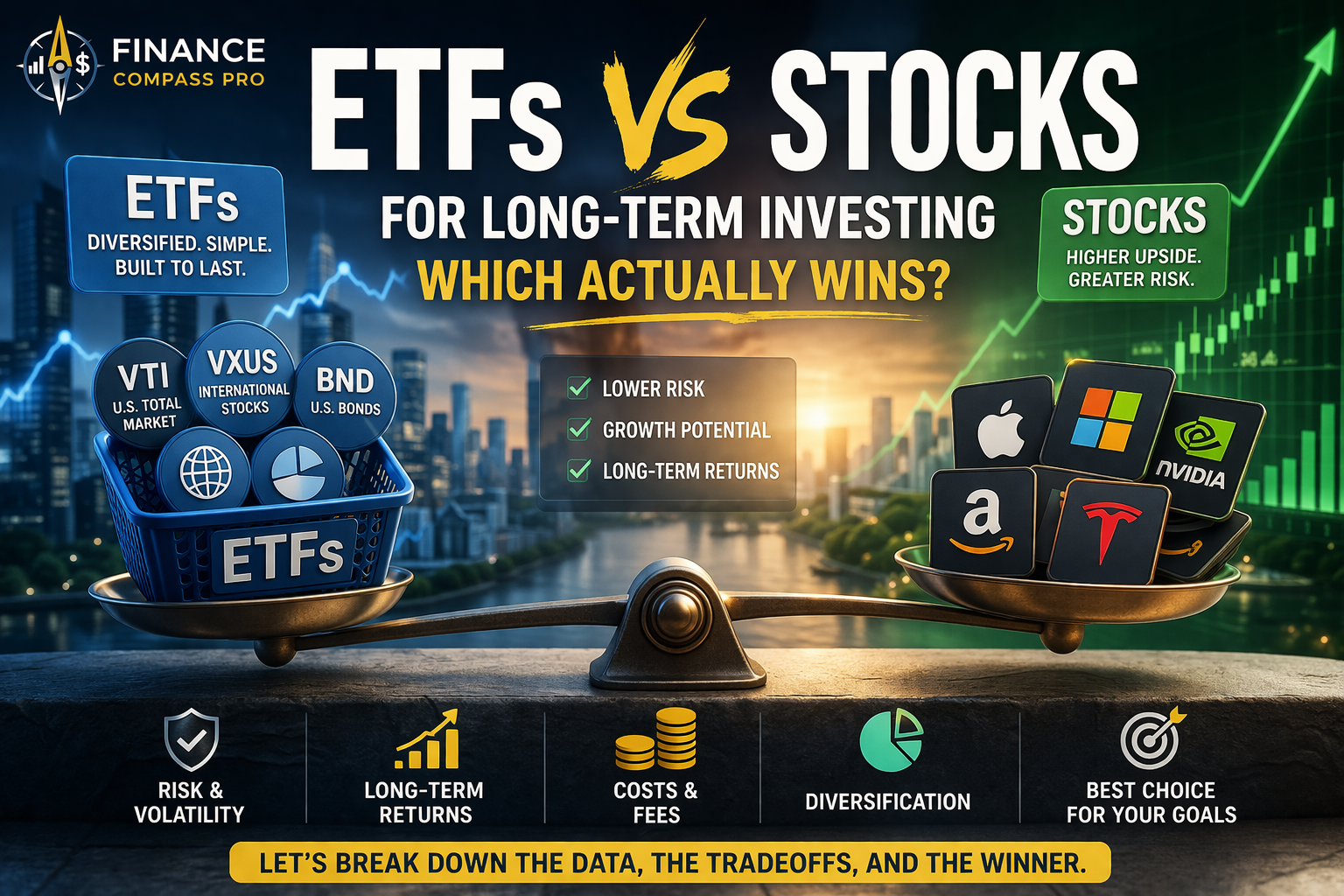
This is one of the most common debates in personal finance.
Should you buy individual stocks and try to pick winners? Or should you invest in ETFs and own the whole market?
The honest answer isn’t what most people expect – and the data might surprise you.
What You’re Actually Choosing Between
Before we compare, let’s be precise about what each option is.
Individual Stocks
When you buy a stock, you’re buying ownership in a single company. If you buy 10 shares of Apple, your return depends entirely on how Apple performs. Great company, great returns. Wrong company, potentially zero.
ETFs (Exchange-Traded Funds)
An ETF bundles hundreds or thousands of stocks into a single fund. Buying one share of VTI (Vanguard Total Stock Market ETF) gives you proportional ownership in over 3,700 U.S. companies simultaneously. Your return follows the overall market, not any individual company.
The question is: for a long-term investor, which approach produces better outcomes?
What the Research Actually Shows
Here’s where the debate gets uncomfortable for stock pickers.
Study after study shows that most individual investors – and even most professional fund managers – underperform a simple index fund over long periods.
Key findings:
- Over 15-year periods, roughly 92% of actively managed large-cap funds underperform the S&P 500 index
- Individual retail investors underperform the market by an average of 1.5-3% annually, largely due to timing mistakes and transaction costs
- The S&P 500 has returned approximately 10% annually on average over the past 90+ years
This doesn’t mean individual stocks can’t beat the market. Some do – dramatically. But the odds of identifying those winners in advance, before the gains happen, are extremely low.
The market already prices in publicly available information almost instantly. You’re competing against hedge funds with teams of analysts, proprietary data, and algorithmic trading systems. Beating them consistently over 20–30 years is exceptionally rare.
The Real Advantages of ETFs for Long-Term Investors
1. Instant Diversification
One share of VTI gives you exposure to Apple, Microsoft, Amazon, Tesla, and 3,700+ other companies. One bad quarter at any single company barely moves the needle on your overall portfolio.
2. Dramatically Lower Fees
The average ETF expense ratio: 0.03-0.20%.
The average actively managed fund: 0.50-1.00%.
The cost of stock picking (commissions, bid-ask spreads, time): harder to quantify, but real.
On a $100,000 portfolio over 30 years, the difference between 0.05% and 1.0% in fees is roughly $200,000+ in lost compound growth.
3. You Don’t Have to Be Right About Individual Companies
When you own the total market, you don’t need to predict whether Tesla or Ford wins the EV race, whether Pfizer or Moderna captures the next drug market, or whether Google or Microsoft leads in AI. You own all of them.
4. Lower Emotional Risk
Individual stocks are volatile. A single earnings miss can drop a stock 20-30% in a day. When your entire portfolio is in a handful of stocks, that’s terrifying – and it leads to panic selling at the worst time.
A diversified ETF portfolio rarely drops 20% in a single day. The stability makes it far easier to stay invested during downturns.
5. Tax Efficiency
ETFs are structured to minimize taxable events. They rarely distribute capital gains, which means less of your compound growth gets interrupted by tax bills each year.
The Real Advantages of Individual Stocks
1. The Potential for Market-Beating Returns
This is the main appeal, and it’s real – just rare. If you had bought Amazon in 2001, Netflix in 2007, or Apple in 2003, you’d have made life-changing returns that no index fund could match.
2. Concentration Can Build Wealth Fast
Diversification protects against loss. But it also limits upside. Concentration in a winning stock can produce extraordinary results. Many of the world’s wealthiest people got there by concentrating in a single company.
3. You Understand the Business
Some investors have genuine edge – deep industry expertise, professional knowledge, or firsthand insight into a company’s product. A nurse might spot a medical device company’s breakthrough before Wall Street. A software engineer might recognize a platform’s network effect early. Real edge exists.
4. Active Engagement
Some people simply enjoy researching companies and following their investments closely. If investing is also a hobby, individual stocks provide engagement that ETFs don’t.
A Direct Comparison
| Factor | ETFs | Individual Stocks |
|---|---|---|
| Diversification | Instant, built-in | Must build manually |
| Fees | Very low (0.03–0.20%) | Variable (potentially high) |
| Time required | Minimal | Significant |
| Emotional stability | High | Lower |
| Upside potential | Market rate | Unlimited |
| Downside risk | Limited by diversification | Single company can go to zero |
| Skill required | Low | High |
| Best for | Most long-term investors | Experienced, research-driven investors |
The Hybrid Approach Most Experts Recommend
You don’t have to choose one or the other entirely.
A popular strategy for long-term investors: 90/10 or 80/20.
- 80–90% of your portfolio in low-cost ETFs (the core)
- 10–20% in individual stocks you’ve researched and believe in (the satellite)
This gives you the stability and diversification of ETFs for the bulk of your wealth, while allowing you to participate in the potential upside of individual companies you’re confident in.
If your stock picks underperform, you’ve only hurt 10-20% of your portfolio. If they outperform, you capture those gains on top of your solid ETF foundation.
The key rule: Never put money into individual stocks that you can’t afford to lose entirely. Because with any single company, that outcome is always possible.
Who Should Choose ETFs?
You’re an ETF investor if:
- You’re a true beginner with no investing experience
- You don’t have time to research individual companies
- You want to invest and not think about it constantly
- You’ve already experienced panic-selling during market downturns
- Your goal is long-term retirement wealth
- You want to minimize fees and maximize compound growth
The reality: For the vast majority of long-term retail investors, a portfolio of low-cost index ETFs will produce better outcomes than stock picking – not because picking is impossible, but because the time, skill, and discipline required to do it successfully are harder to maintain than most people expect.
Who Should Consider Individual Stocks?
You might be ready to pick individual stocks if:
- You have genuine expertise in an industry
- You’re willing to do serious fundamental analysis (reading financial statements, understanding competitive moats, tracking management quality)
- You can hold through 30-50% drawdowns without panicking
- You have a core ETF portfolio already handling the bulk of your retirement savings
- You treat individual stock picks as satellite positions, not your primary strategy
The Long-Term Numbers
The S&P 500 has returned approximately 10% annually before inflation over the long run.
A $10,000 investment at 10% annually:
| Years | Value |
|---|---|
| 10 years | $25,937 |
| 20 years | $67,275 |
| 30 years | $174,494 |
| 40 years | $452,593 |
This is what patient, diversified ETF investing delivers – no stock picking required, no market timing, no expertise.
To consistently beat this with individual stocks over 30+ years requires both skill and discipline that very few investors sustain.
The Bottom Line
ETFs win for most long-term investors – not because individual stocks can’t outperform, but because the odds of successfully outperforming over 20-30 years are much lower than most people assume.
Start with ETFs. Build your foundation. Then, only after you have a strong core portfolio, explore individual stocks with a small portion of your money if you have genuine conviction and real research behind it.
The market rewards patience and diversification far more reliably than it rewards brilliance.
Internal Links Used:
- Which Is Better for Beginners ETFs or Stocks
- How to Build Your First Investment Portfolio
- Investing for Beginners: The Complete Guide to Building Wealth in 2026
- What Is Dollar-Cost Averaging and Why Smart Investors Use It
This article is for informational and educational purposes only and does not constitute financial advice. No affiliate relationships are currently in place for any platforms or tools mentioned in this post. Past performance does not guarantee future results. Always consult a qualified financial professional before making investment decisions.