
Most people spend their first paycheck before it clears.
That’s not a criticism – it’s genuinely exciting to see a number in your account that you earned. And there’s nothing wrong with celebrating that milestone.
But there’s a question worth sitting with before you spend a dollar of it:
What if this paycheck – not a future, larger one – was the one that changed your financial life?
Not because of the amount. Because of what you decided to do with it.
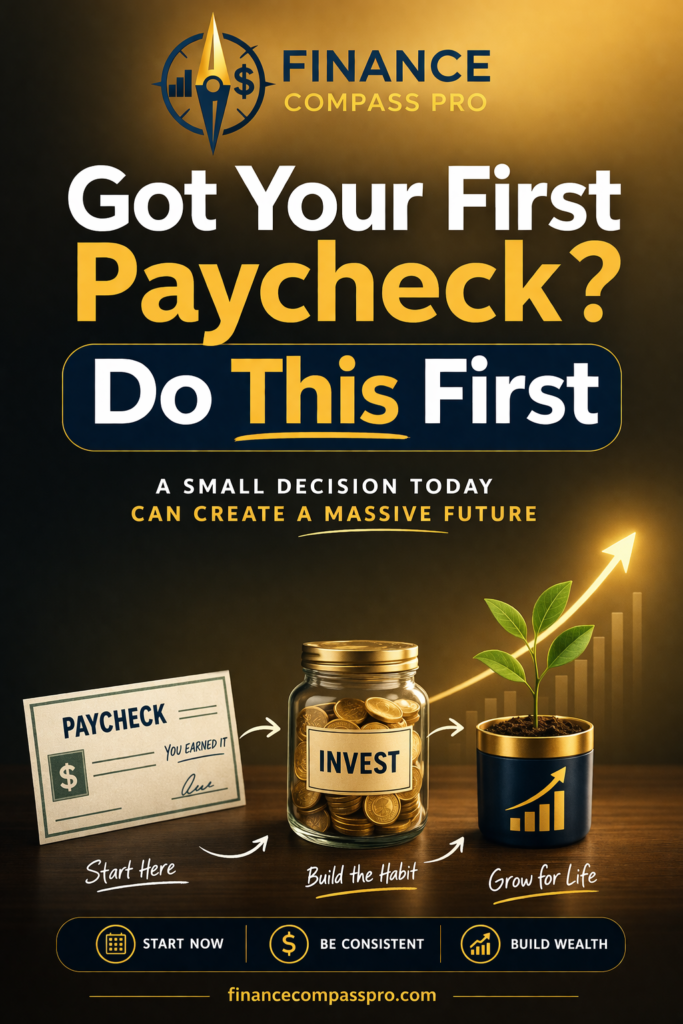
The investors who build meaningful wealth over a lifetime almost never started with large amounts of money. They started with a decision – usually an early one – to make investing a habit before spending filled every available dollar. That habit, repeated month after month and year after year, compounds into something that genuinely changes a life.
Your first paycheck is the cleanest opportunity you’ll ever have to make that decision. You have no existing spending habits built around this income yet. No subscriptions, no lifestyle expectations, no pressure to maintain a status quo. Just a blank slate and a choice.
Here’s how to make the right one.
Why the Amount Doesn’t Matter – But the Timing Does
The first objection most people have to investing early is practical: the amounts feel too small to matter.
If your first paycheck is $800 and you set aside 20% for investing, you’re looking at $160. That doesn’t feel like it’s going to build wealth.
The math, however, tells a very different story.
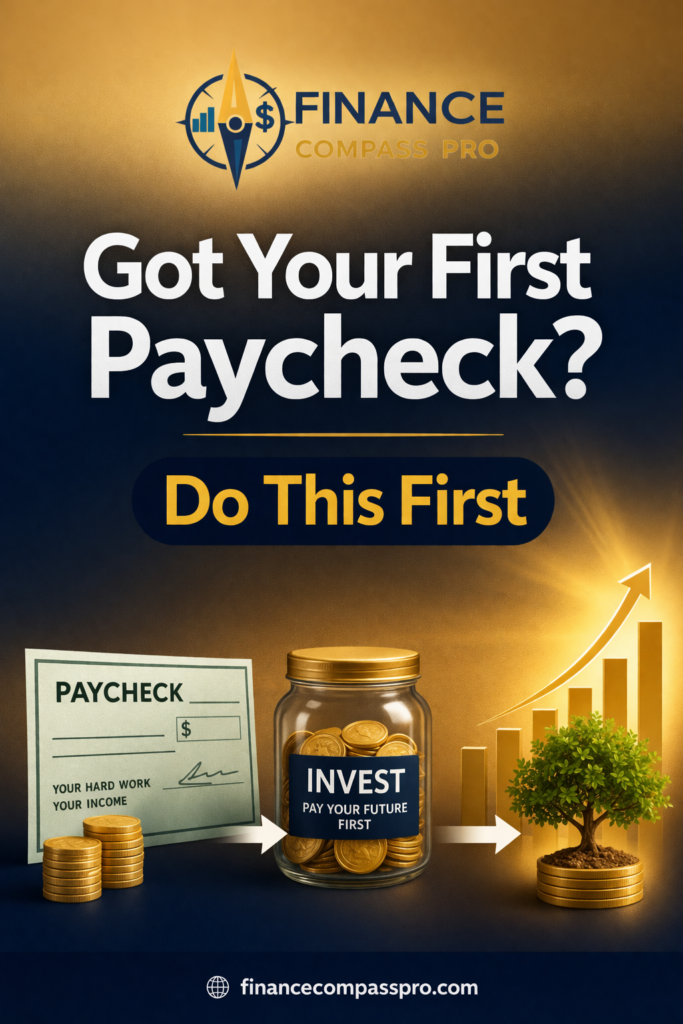
What $160/Month Becomes When You Start at Different Ages (7% Average Annual Return)
| Starting Age | Monthly Investment | Total Contributed by 65 | Estimated Portfolio at 65 |
|---|---|---|---|
| 22 | $160/month | $82,560 | ~$527,000 |
| 30 | $160/month | $67,200 | ~$271,000 |
| 40 | $160/month | $48,000 | ~$107,000 |
| 50 | $160/month | $28,800 | ~$33,000 |
Assumes 7% average annual return, compounded monthly. Illustrative only – past performance does not guarantee future results.
The person who starts at 22 contributes only $15,000 more than the person who starts at 30 – but ends up with nearly twice the portfolio. That gap doesn’t come from the extra contributions. It comes from time: eight additional years of compounding growth that the 30-year-old never gets back.
This is why the amount of your first paycheck is almost irrelevant. What matters is establishing the habit while compounding still has decades to work.
📌 Related reading: How to Start Investing With $100: A Beginner’s Step-by-Step Guide
“The best investment decision isn’t about which stock to pick. It’s about which year you decide to start.”
Step 1: Give Your Paycheck a Structure Before You Spend It
The most common reason people fail to invest consistently isn’t lack of intention – it’s lack of structure.
When income arrives as a single number in a checking account, it feels like one pool of available money. And available money gets spent. Bills, food, a dinner out, a few things you’ve been meaning to buy – by the end of the month, “I’ll invest what’s left” becomes “there wasn’t anything left.”
The fix is to assign every dollar a category before you spend a single one.
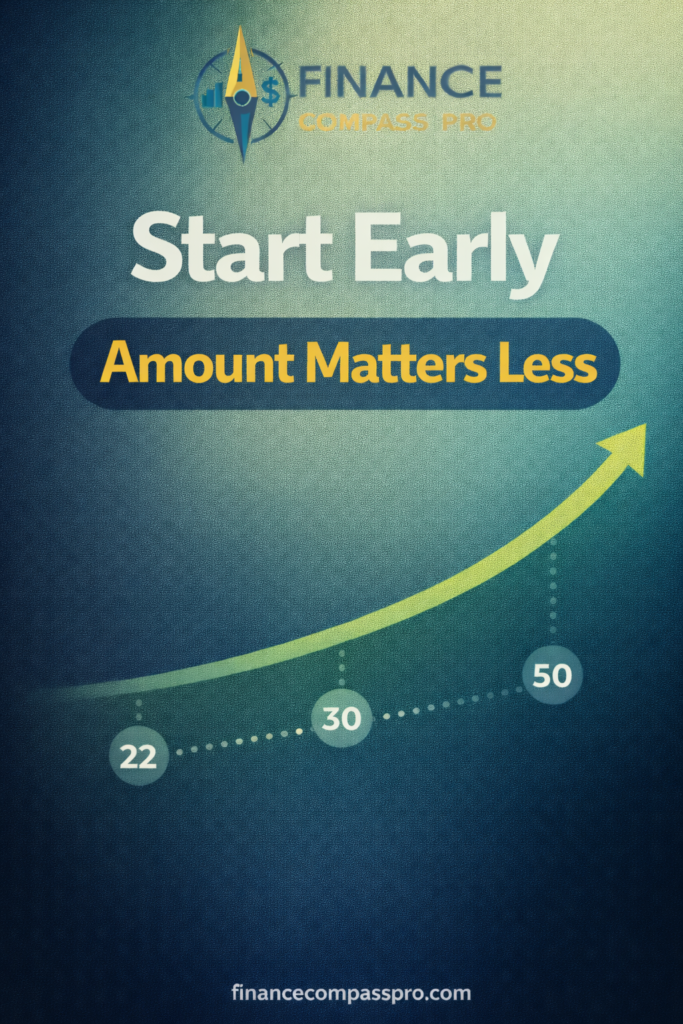
A simple starting framework that works well for most beginners:
50% → Essential living expenses. Rent, utilities, groceries, transportation, insurance – the non-negotiables.
20% → Personal spending. Dining out, entertainment, subscriptions, clothing, and discretionary purchases. This category exists so you don’t feel deprived – which is what causes most budgets to collapse.
30% → Saving and investing. This is higher than the classic 50/30/20 formula suggests, and deliberately so. When you’re young with relatively low fixed expenses, this is the window to build financial momentum. As your income grows, your fixed expenses typically won’t grow proportionally – which means this percentage can stay high or even increase.
If 30% feels aggressive, start at 20% and increase by 5% every six months. The key is that the investing portion is decided before the paycheck arrives – not allocated from whatever remains.
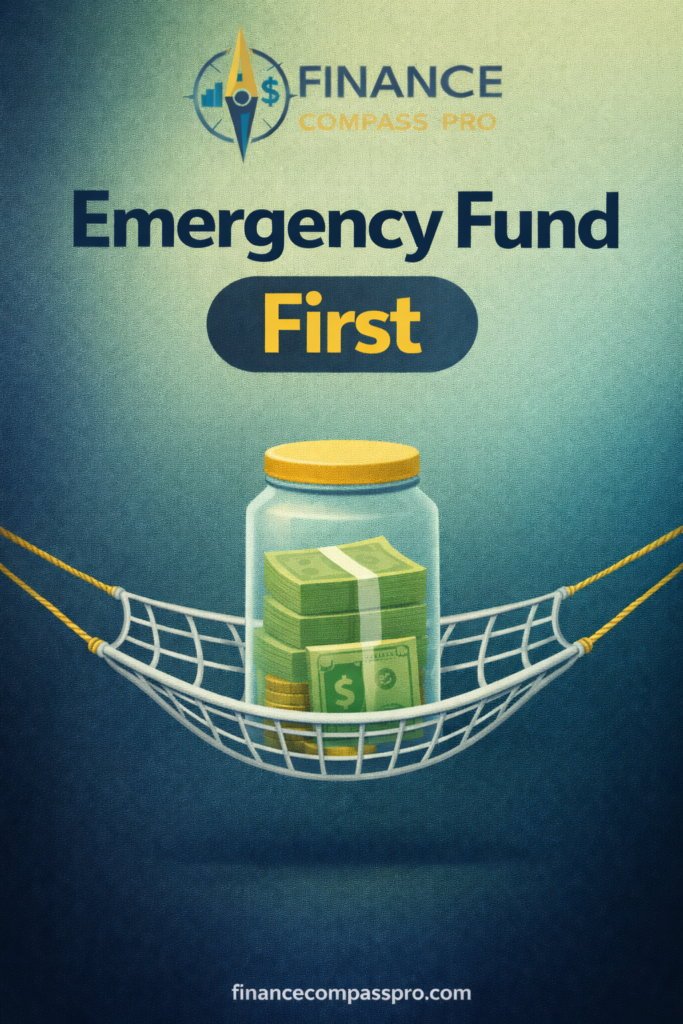
Step 2: Build a Small Emergency Fund Before Investing Aggressively
Before putting money into the market, one thing should come first: a basic emergency fund.
This is not about pessimism. It’s about protecting your investment strategy.
Without a cash buffer, the first unexpected expense – a car repair, a medical bill, a temporary income interruption – forces you to sell investments at whatever price they happen to be at that moment. If the market is down, you lock in those losses. More importantly, you break the consistency that makes long-term investing effective.
A starter emergency fund of $500 to $1,000 is enough to begin. It doesn’t need to be three to six months of expenses right away – that’s a later goal. For now, you just need enough cushion that a single unexpected expense doesn’t derail your investment plan.
Keep this in a high-yield savings account where it earns something while remaining accessible. Once it’s in place, your investment contributions can proceed without a safety net concern underneath them.
Step 3: Start With the Simplest Investments Available
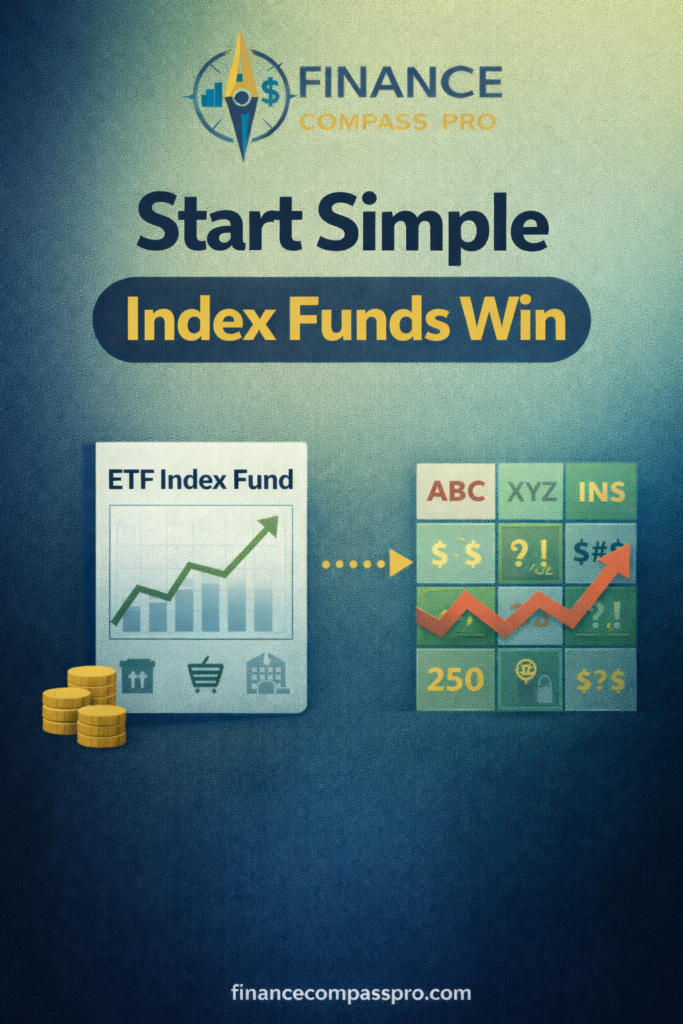
Your first investment should not be complicated.
Not individual stocks, not options, not sector-specific bets on industries you’ve been reading about. The instinct to research specific companies and pick promising names is understandable – it feels more active, more in control. In reality, it adds risk without adding expected returns for most individual investors.
The most effective starting point, supported by decades of data and endorsed by investors ranging from Warren Buffett to everyday millionaires, is a broad market index fund or ETF.
Here’s why this works so well for beginners:
Instant diversification. One purchase gives you exposure to hundreds or thousands of companies simultaneously. No single company’s failure can significantly damage your portfolio.
Low costs. Index ETFs typically carry expense ratios between 0.03% and 0.20% – a fraction of what actively managed funds charge, and a difference that compounds dramatically over decades.
No expertise required. You don’t need to research earnings reports, follow quarterly guidance, or make ongoing decisions. The fund tracks the index automatically.
A single S&P 500 index fund is a complete, sensible, long-term investment for a beginning investor. You can always add complexity later. Starting simple means starting – which is the only thing that actually matters at this stage.
📌 Related reading: What Is an Index Fund? The Beginner’s Complete Guide
📌 Related reading: What Is an ETF and How Does It Work?
📌 Related reading: How to Build Your First Investment Portfolio
Step 4: Invest on a Schedule, Not When It Feels Right
The second most common mistake beginners make – right after not starting – is trying to time their investments.
They wait for a dip. They hesitate when prices seem high. They hold cash during volatility, intending to “buy when things stabilize.” By the time they feel comfortable, prices have often recovered past where they could have bought.
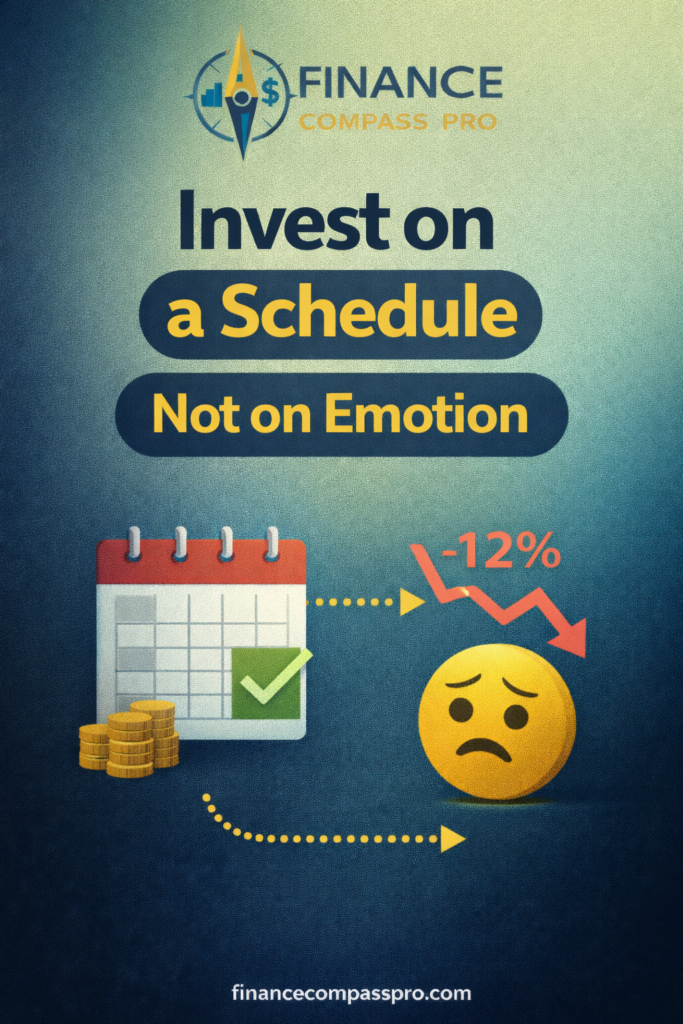
The strategy that eliminates this problem entirely is dollar-cost averaging: investing a fixed amount on a fixed schedule, regardless of what the market is doing.
When you invest $200 on the first of every month – whether the market is up, down, or sideways – something important happens. You automatically buy more shares when prices are low and fewer when prices are high. Over time, your average cost per share reflects a middle ground that neither panic nor greed would have achieved.
More importantly, you remove the decision-making from the process. There’s no monthly question of “should I invest now or wait?” The answer is always the same: you invest on the scheduled date, as planned.
That consistency – more than any market timing strategy – is what produces reliable long-term results.
📌 Related reading: What Is Dollar-Cost Averaging and Why Smart Investors Use It
Step 5: Automate Everything You Can
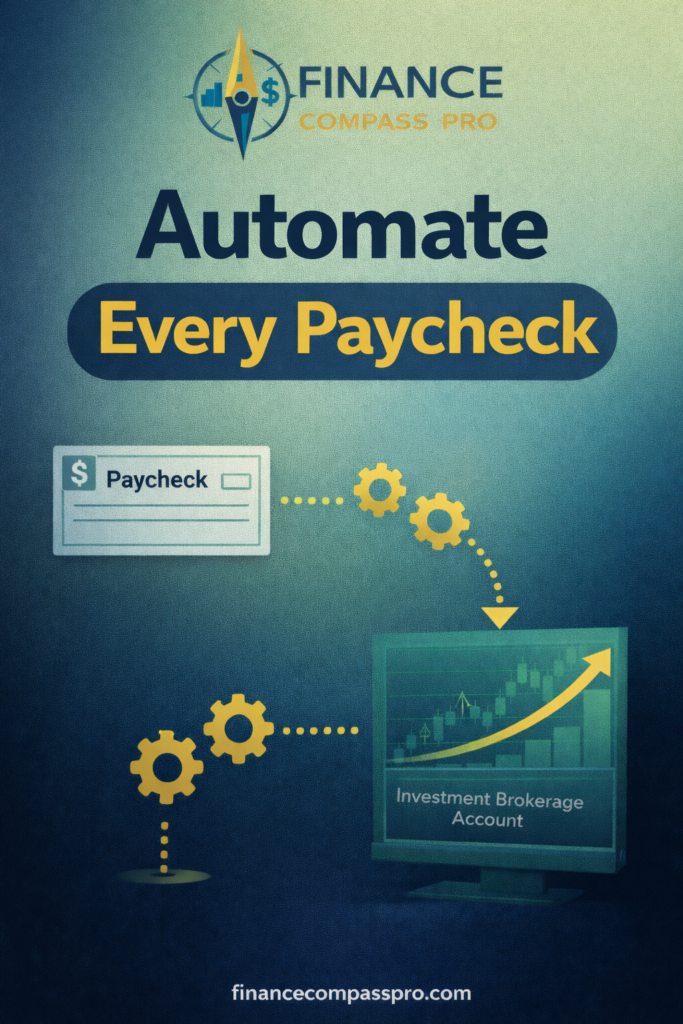
The most powerful thing you can do after setting up your investment strategy is to make it run without you.
Automated investing removes the two biggest threats to consistent behavior: forgetting and hesitating. When a transfer happens automatically, you never face the monthly choice of whether to invest or spend that money. It’s already gone before the temptation arises.
Most major brokerages allow you to set up automatic monthly purchases of index funds with just a few clicks. You choose the amount, the fund, and the date – and it runs indefinitely. You don’t need to log in and execute it manually each month.
Combined with an automatic transfer from your checking account on payday, this creates a system where a portion of every paycheck goes directly toward your future without requiring any ongoing discipline or decision-making. The habit is baked into the structure.
“What gets automated gets done. Build the system once, then let it work while you get on with your life.”
The Mistakes Most People Make With Their First Paycheck
Even with good intentions, a few patterns consistently derail first-time investors:
Spending first, saving what’s left. By the time the end of the month arrives, there’s rarely anything left. Decide on your investment amount before you spend, not after.
Waiting until the amount feels “worth it.” There’s no threshold at which investing becomes worth doing. The value of early investing is entirely about time, not amount. $50/month started at 22 outperforms $500/month started at 40.
Chasing trending investments. Your first paycheck is not the time to bet on a stock you’ve been reading about. Build the foundation first – a boring, diversified index fund – before adding anything speculative.
Overcomplicating the portfolio. One or two broad index funds is a complete portfolio for a beginner. The complexity can always be added later. The cost of overcomplicating early is confusion, inconsistency, and abandonment.
📌 Related reading: 7 Investing Mistakes Beginners Should Avoid
What This Looks Like in Real Numbers
Let’s make the abstract concrete.
Assume your first paycheck nets $2,000/month after tax. Using a 50/20/30 split, you direct $600 toward saving and investing. You put $200 into a starter emergency fund each month until you hit $1,000, then shift the full $600 into monthly index fund contributions.
That’s $600/month, automated, in a broad market index fund.
At 7% average annual return over 30 years, that single consistent habit produces approximately $735,000.
Not from a windfall. Not from picking the right stock. From $600 a month, started with your first paycheck, left to compound.
That’s what the decision is actually worth.

Final Thoughts: The Decision Is the Point
Your first paycheck won’t make you wealthy. Neither will your second or your tenth.
But the decision you make with your first paycheck – to treat investing as non-negotiable rather than optional – creates a habit that every subsequent paycheck reinforces. And habits, compounded over decades, are exactly how ordinary incomes produce extraordinary financial outcomes.
Start with whatever percentage you can. Automate it. Choose a simple index fund. And then – this is the hardest part – leave it alone and let time do its job.
The investors who will be financially secure thirty years from now aren’t necessarily the ones earning the most today. They’re the ones who started the habit earliest and had the discipline to keep it.
Your first paycheck is the start of that habit.
You Might Also Like:
5 Pillars of Smart Investing Every Beginner Should Know
How to Start Investing With $100: A Beginner’s Step-by-Step Guide
How to Start Investing With $500 – A Beginner’s Guide
What Is an Index Fund? The Beginner’s Complete Guide
What Is an ETF and How Does It Work?
What Is Dollar-Cost Averaging and Why Smart Investors Use It
How to Build Your First Investment Portfolio
7 Investing Mistakes Beginners Should Avoid
This article is for informational and educational purposes only and does not constitute financial advice. Investment projections and compounding figures are estimates based on historical averages and are not guaranteed. No affiliate relationships are currently in place for any platforms or tools mentioned in this post. Past performance does not guarantee future results. Always consult a qualified financial professional before making investment decisions.