
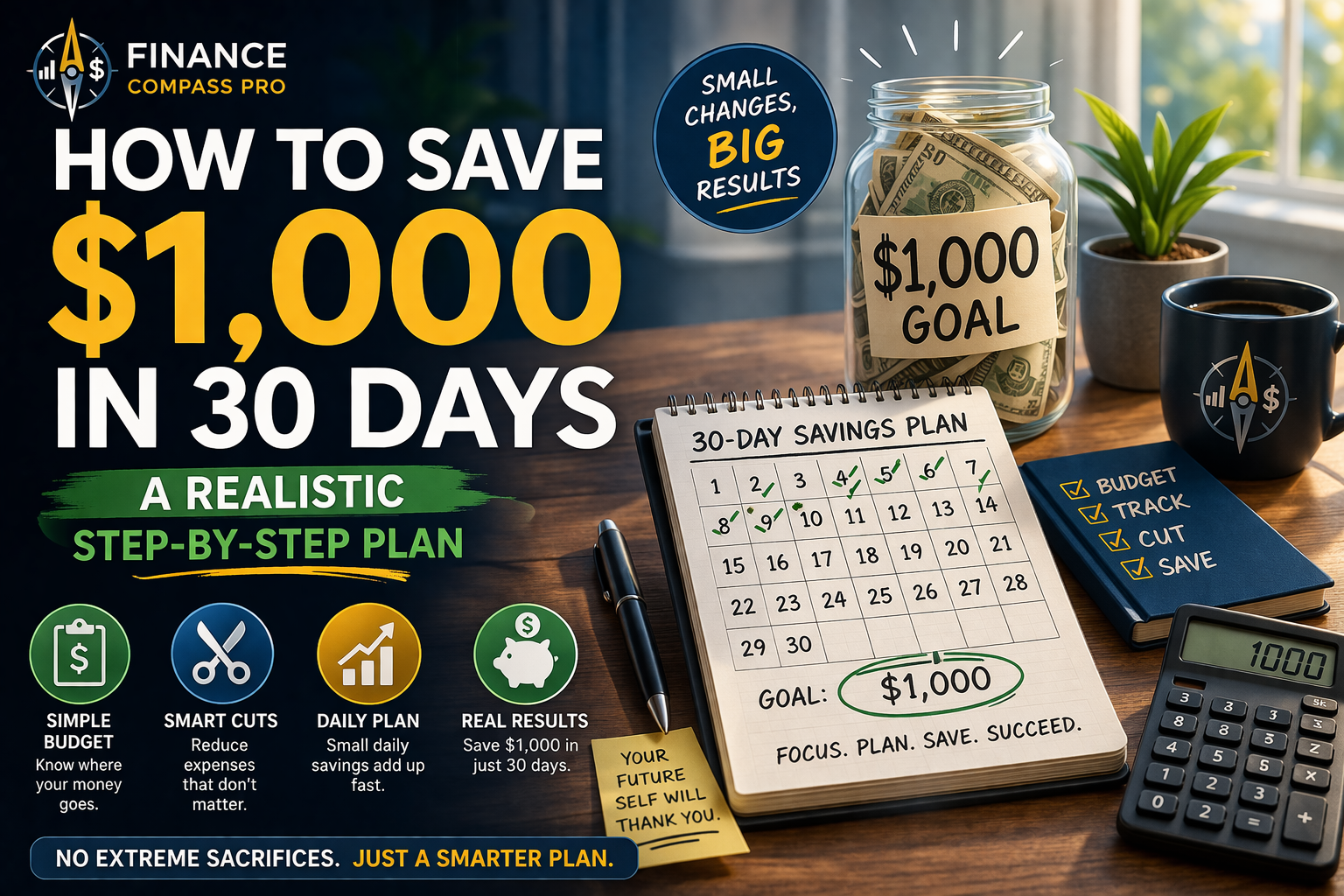
The most common thing I hear from people who want to start investing is this: “I don’t have anything left over to invest.” This guide is for exactly those people. Because before you invest, you need a financial cushion – and $1,000 is where that starts.
Many people believe saving money fast is impossible – but the problem is usually strategy, not income.
If you’re trying to save your first $1,000 fast or looking for a realistic 30-day savings plan, this guide is built for you.
One thousand dollars in 30 days.
That’s $33.33 per day. Or roughly $250 per week.
Is it possible? For most working adults, yes – with focus, intentionality, and a willingness to make some short-term tradeoffs.
This isn’t a “sell your possessions and eat ramen” guide. It’s a practical, realistic plan that works whether you’re earning $2,500 or $6,000 per month.
Why $1,000 Is the Right First Target
Before the plan, let’s be clear about why this number matters.
$1,000 is the minimum financial cushion that separates people who stay in debt from people who start building wealth.
While you’re building that cushion, keep the goal narrow: create enough liquid savings to absorb a small emergency without immediately reaching for debt.
Without $1,000 in savings, one unexpected car repair or medical copay goes straight onto a credit card. That debt costs 20%+ in interest. You’re now paying tomorrow’s money to cover today’s emergency.
With $1,000 in savings, you absorb that same emergency without debt. The cycle breaks.
If recurring spending is what keeps resetting your progress, review Hidden Monthly Expenses That Are Draining Your Budget before starting the 30-day plan.
Financial researchers have found that households with at least $1,000 in liquid savings experience significantly lower rates of financial distress than those with nothing saved – even controlling for income level.
This is the goal. Let’s get there.
Step 1: Calculate Your Real Number
Not everyone needs to save the full $1,000 from scratch. Take 5 minutes right now to calculate your actual gap.
Check your accounts:
- Checking account balance (minus minimum needed to cover bills)
- Savings account balance
- Any other liquid assets
Subtract your target of $1,000. The result is exactly how much you need to generate in the next 30 days.
If you have $350 already, you need $650. That’s $21.67 per day – much more achievable.
Write this number down. This is your 30-day mission.
Step 2: Identify Your Income Sources
List every dollar coming in this month:
- Primary paycheck(s)
- Freelance or gig income
- Side income of any kind
- Money owed to you that you can collect
Now identify every mandatory expense – rent, utilities, minimum debt payments, insurance. These are non-negotiable.
Subtract mandatory expenses from income. What remains is your discretionary spending – and that’s where your $1,000 is hiding.
| Category | Items to Include | Action |
|---|---|---|
| Monthly Income (+) | Primary Job, Freelance, Side Hustles, Tax Refunds | Maximize |
| Mandatory Expenses (-) | Rent, Utilities, Minimum Debt, Insurance, Groceries | Maintain |
| Discretionary Spending (✂️) | Dining Out, Subscriptions, Entertainment, Hobbies | Cut / Pause |
| Potential Savings | “This is where your $1,000 target is hidden.” | |
Step 3: Cut the 5 Biggest Discretionary Drains Immediately
If you’re trying to figure out how to save money quickly, this is where most of the progress happens.

You’re not cutting these forever. Just for 30 days. This temporary period can fund the permanent safety net that changes your financial trajectory.
1. Dining Out and Coffee
The average American spends $475+ per month on food outside the home. Cutting this in half saves $237.
Pack lunch. Make coffee at home. Limit restaurant meals to one or two this month.
2. Streaming Services
Audit every subscription: Netflix, Hulu, Disney+, HBO, Spotify, Apple TV+, gaming subscriptions. The average household subscribes to 4+ streaming services.
Cancel all but one for 30 days. Saving: $40–$80.
3. Impulse Online Purchases
Delete the saved payment methods from Amazon, your shopping apps, and your browser. Add a 48-hour waiting rule before any non-essential online purchase. If you want to understand the psychological reason that rule works — and why impulse spending is so hard to stop without one — Psychological Spending Triggers That Make You Spend Without Realizing It breaks down the five behavioral patterns that drain your budget without you noticing.
4. Alcohol and Entertainment
Bar tabs, Ubers home from bars, concert tickets, weekend entertainment – these add up fast. One heavy weekend night out often costs $80–$120 when you add it all up.
5. Gym Memberships You’re Not Using
If you haven’t been to the gym in two weeks, pause the membership for 30 days. Most gyms allow this.
30-day estimated savings from these five cuts: $300–$500.
Step 4: Generate Extra Income
Cutting spending alone often isn’t enough. The other half of the equation is generating more money this month.
Sell Things You Own
Go room by room and identify items you haven’t used in 6+ months. Electronics, clothing, furniture, sports equipment, tools.
List them on Facebook Marketplace, eBay, Craigslist, or Poshmark. Motivated sellers who price competitively can move $200–$500 worth of items in a weekend.
Gig Economy – Fastest Cash Available
- DoorDash / Uber Eats / Instacart: Most cities allow same-week earnings or instant cashout
- TaskRabbit: Handyman tasks, furniture assembly, moving help – $30–$80/hour
- Rover: Dog walking or pet sitting – $15–$25 per walk, $40–$80 per overnight
- Freelance work on Fiverr or Upwork: Writing, design, data entry, virtual assistant
A single weekend of focused gig work can generate $100–$300 in extra cash.
Offer a Service to Your Network
Post on your personal social media. Do you have a car? Offer airport pickups. Own a pressure washer? Offer driveway cleaning. Know how to code, design, write, or edit? Offer discounted services for quick turnarounds.
This often generates more per hour than gig platforms because there’s no middleman taking a cut.
Ask for Extra Hours at Work
If overtime is available, this is the cleanest path to extra money. Even 5 extra hours per week at your current rate can add $150–$300 to your monthly take-home, depending on your pay.
Step 5: Set Up a Separate Savings Account

This is non-negotiable.
The $1,000 you’re building needs to live in a separate account – ideally a high-yield savings account – not in your checking account where it will get spent.
Open a high-yield savings account if you don’t have one. Many online banks (Ally, Marcus by Goldman Sachs, SoFi, Capital One 360) offer interest rates 10–20x higher than traditional banks with no minimums and no monthly fees.
Every dollar you save this month goes directly here. Not into checking. Here.
Once your savings habit is in place, the next step is learning how to put that money to work.
The 30-Day Savings Tracker
Break the goal into weekly milestones:
| Week | Weekly Target | Cumulative Savings |
|---|---|---|
| Week 1 | $250 | $250 |
| Week 2 | $250 | $500 |
| Week 3 | $250 | $750 |
| Week 4 | $250 | $1,000 |
Track your progress every Sunday. If you’re behind after Week 1, you know immediately and can adjust – not discover at the end of the month that the goal slipped away.
A Sample 30-Day Action Plan
| Period | Days | Key Action Steps |
|---|---|---|
| Phase 1: Launch | 1 – 3 | Calculate gap number • Open HYSA • Cancel non-essential subscriptions • Post 5+ items for sale online. |
| Phase 2: Build | 4 – 14 | Transfer first sales to savings • Pack lunches/make coffee • Sign up for a gig platform • Target: $250. |
| Phase 3: Sustain | 15 – 21 | Identify new income if behind • Maintain expense discipline • Deposit all extra earnings • Target: $500. |
| Phase 4: Finish | 22 – 30 | Final income push • Do not touch the savings account • Goal: $1,000 Complete! |
What to Do After You Hit $1,000
First: celebrate. This is genuinely harder than most people realize.
Then: don’t stop here.
The ultimate emergency fund target is 3-6 months of expenses. $1,000 is the foundation, not the finish line. Keep the habits going and extend your runway with How to Build an Emergency Savings Account.
Once you have a full emergency fund, redirect those same savings habits toward investing. The discipline you built saving $1,000 in 30 days is the same discipline that builds a six-figure investment portfolio over decades.
Before you move money from savings into the market, make sure you understand the line between the two. Savings protect short-term needs, while investing is designed for long-term growth. If that distinction is still unclear, read this guide on the difference between saving and investing.
Once you’ve built your first $1,000, the next step is investing it wisely:
- How to Start Investing With $100: A Beginner’s Step-by-Step Guide
- How to Start Investing With $500: A Step-by-Step Beginner’s Plan That Actually Works
What If $1,000 in 30 Days Is Truly Impossible?
Sometimes the income situation doesn’t allow for it. If $1,000 in 30 days is genuinely unreachable given your income and fixed obligations, adjust the timeline without abandoning the goal.
$1,000 in 60 days = $500 per month = $16.67 per day.
$1,000 in 90 days = $333 per month = $11.11 per day.
Progress at $333/month is infinitely better than $0/month. Set the timeline that makes sense for your income, and focus relentlessly on the habit of consistent saving.

The Bottom Line
Saving $1,000 in 30 days is achievable for most working adults – but it requires treating it like a real project with a real deadline.
Cut the five biggest discretionary drains. Generate extra income through sales and gig work. Track weekly. Move every dollar immediately to a separate savings account.
Thirty days of focus. A lifetime of financial stability as the foundation.
Start today. The habits you build this month don’t disappear when the 30 days are over – they become the foundation everything else is built on.
Saving your first $1,000 is the start – what you do with it next is what builds wealth.
READY TO KEEP BUILDING?
- How to Build a Simple Budget That Actually Works
- 7 Simple Money Habits That Will Transform Your Finances
This article is for informational and educational purposes only and does not constitute financial advice. Historical returns referenced are based on long-term averages and are not guaranteed. No affiliate relationships are currently in place for any platforms, tools, or funds mentioned in this post. Always consult a qualified financial professional before making investment decisions.