

The interest rate story gets all the attention.
Bad credit costs you more on your mortgage. More on your car loan. More on your personal loan. That’s true – and if you want the exact numbers, read exactly how much a low score costs you in interest.
But that’s only one chapter of the story.
Your credit score can show up in more places than most people expect. It may be checked when you apply for an apartment, go through an employment background check, renew car insurance, or set up utilities in a new city.
Most people don’t find out how far the credit score reaches until they’re already paying a price they didn’t expect.
This post covers everything the interest rate article doesn’t.
Understand What’s Actually Being Measured
Before diving into consequences, it helps to understand how your score is calculated in the first place. Your FICO score reflects five factors – payment history (35%), credit utilization (30%), length of credit history (15%), credit mix (10%), and new inquiries (10%).
The reason these factors matter beyond lending is simple: they signal financial reliability. And financial reliability is something landlords, employers, and insurers all want to evaluate – because it correlates with the kind of risk they’re taking on you.
Not every credit score factor changes quickly, but utilization is one of the few you may be able to influence within a billing cycle or two. Our guide on credit utilization explains why reported card balances matter so much – and if you’re unsure whether to pay your statement balance or current balance, see Statement Balance vs. Current Balance. If you’re worried that checking your own credit score could hurt it, see Does Checking Your Credit Score Hurt It? – it doesn’t.
1. Where You Can Live
Renting an Apartment
This is the most immediate way a credit score affects daily life for people who don’t own a home.
Most landlords and property management companies run a credit check before approving a lease. They’re looking at two things: your score and your report.
What typically happens at different score levels:
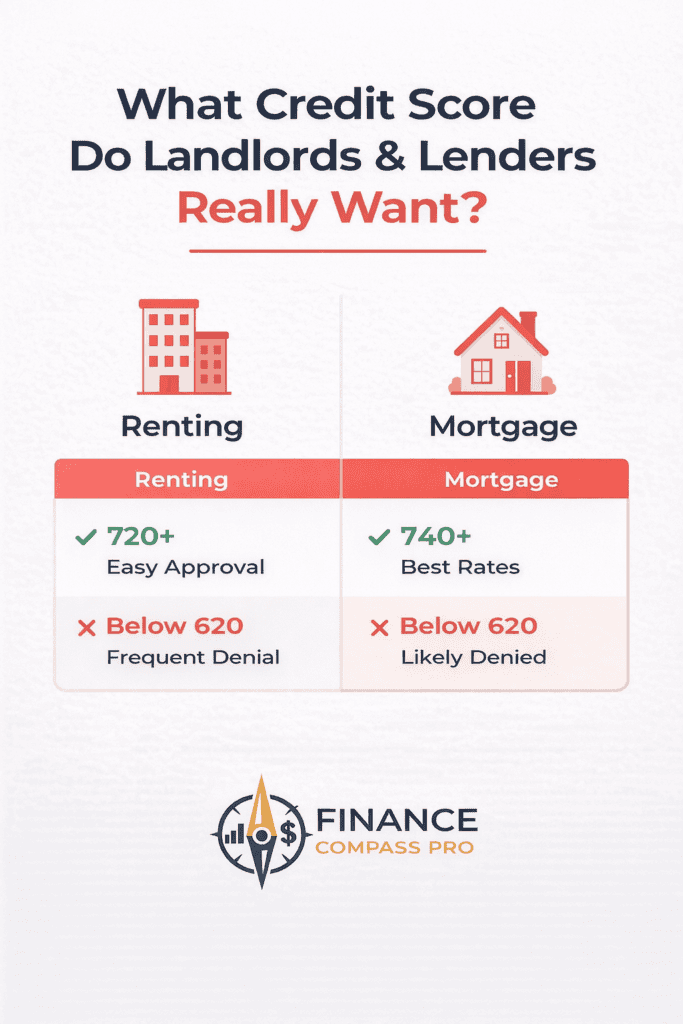
| Credit Score | Typical Rental Outcome |
|---|---|
| 720+ | Standard approval, standard deposit |
| 660–719 | Usually approved; may require larger deposit |
| 620–659 | Conditional approval – co-signer or extra deposit likely |
| Below 620 | Frequent denials in competitive markets |
Here’s what “extra deposit” means in practice. In a city where average rent is $1,800/month, a standard security deposit is one month ($1,800). A landlord who sees a 590 score might require two months – an extra $1,800 you need to come up with on move-in day. In major metro areas where rent runs $2,500–$3,500, that gap becomes $2,500-$3,500 in extra cash tied up for the duration of your lease.
That’s money you can’t use to pay down debt, build savings, or invest.
In competitive rental markets – New York, San Francisco, Austin, Denver – landlords with a full pool of applicants simply move on. A credit score below 650 can make finding an apartment a part-time job.
Buying a Home
Beyond the rate impact, your score determines loan eligibility itself:
| Score Range | Loan Access |
|---|---|
| 740+ | All loan types, best rates |
| 700–739 | Conventional loans at competitive rates |
| 660–699 | Conventional with rate premium; FHA available |
| 620–659 | FHA loans; limited conventional options |
| Below 620 | Most lenders decline; alternative lenders only |
Falling below 620 doesn’t just cost you a better rate. It can remove conventional homeownership as an option entirely.
The most direct financial impact usually shows up in borrowing costs. For the numbers behind that, see how your credit score affects interest rates.
2. Whether You Get Hired
Most people are surprised to learn this exists.
Employers in certain industries run credit checks as part of pre-employment background screening. They don’t see your actual credit score – they see a modified version of your credit report with account numbers and date of birth removed. What they’re evaluating is the pattern: do you meet your financial obligations?
Industries where credit checks are most common:
- Financial services (banking, wealth management, accounting)
- Federal employment and security clearances
- Law enforcement
- Roles with access to client funds, company accounts, or sensitive data
- Senior management positions
The logic is straightforward: someone under significant financial stress may be more susceptible to fraud, theft, or conflicts of interest. Whether you agree with that reasoning or not, it’s legal in most states – though employers must obtain your written consent before running the check.
State restrictions matter here. California, Colorado, Connecticut, Hawaii, Illinois, Maryland, Nevada, Oregon, Vermont, and Washington all restrict or prohibit the use of credit checks in employment decisions, with certain exceptions. If you live in one of these states and weren’t in a federally regulated role, a credit check may not be a factor at all.
If you’re in a state without protections and applying to a financial role, a history of charge-offs, collections, or a recent bankruptcy could cost you an offer – after a successful interview.

3. How Much You Pay for Insurance
Car Insurance: The Biggest Surprise
In most U.S. states, auto insurers use a credit-based insurance score – a separate calculation derived from your credit history – to help set your premium. Their actuarial data shows that people with lower credit scores file more claims on average.
The financial impact is not small.
According to industry analyses, drivers with poor credit pay an average of $1,500 more per year for auto insurance than drivers with excellent credit – for the same car, same driving record, and same coverage level. In some states and with some insurers, the gap is even wider.
| Credit Tier | Average Annual Premium Impact |
|---|---|
| Excellent (750+) | Baseline rate |
| Good (700–749) | +$200–$400/year |
| Fair (650–699) | +$500–$900/year |
| Poor (below 600) | +$1,000–$1,800+/year |
Over five years of poor credit, that’s potentially $7,500–$9,000 extra paid in insurance alone – money that never builds equity, never compounds, never comes back.
State exceptions: California, Hawaii, Massachusetts, and Michigan prohibit the use of credit scores in auto insurance pricing. If you live in one of these four states, your premium is calculated without this factor.
Homeowners and Renters Insurance
The same credit-based scoring logic applies to homeowners and renters insurance in most states. A lower score typically means a higher premium, and in rare cases, a denial of coverage. The impact is smaller than auto insurance but still meaningful – often $100-$300/year extra for renters, more for homeowners.
4. Day-to-Day Financial Friction
Beyond the big categories, a low credit score creates friction in everyday life that most people don’t anticipate until they encounter it.
Utility deposits. When setting up electricity, gas, or internet service, providers often run a soft credit check. With strong credit, you pay no deposit. With poor credit, you may face a $100-$300 deposit per utility. Moving to a new apartment while rebuilding credit can mean $300–$600 in upfront utility deposits before your first bill arrives.
Cell phone service. Major carriers check credit before approving postpaid plans. A low score can push you to prepaid plans with higher per-line costs, no device financing, and limited plan options.
Business formation. If you’re planning to start a business, personal credit history directly affects your access to small business loans, business credit cards, and vendor accounts. Many SBA lenders use personal credit as a primary underwriting factor. A damaged personal credit file can block early-stage business financing.
The Compounding Damage Problem
Here’s what makes a low credit score particularly difficult to escape: the consequences stack and reinforce each other.
A 590 credit score means a higher security deposit → less cash to pay down debt → higher credit utilization → score stays low → car insurance costs $1,200 more per year → less money available for debt payoff → one unexpected expense triggers a missed payment → score drops further.
This is not a hypothetical. It’s a pattern that repeats constantly for people who don’t understand what’s driving it. The good news is that once you understand the mechanism, breaking the cycle becomes a concrete problem with a concrete solution.
If you’re ready to act, how to improve your score fast covers the fastest legitimate moves. And if you want the full picture – starting from any score level and building to 800 – our step-by-step credit score roadmap walks through each stage with realistic timelines.
What Strong Credit Actually Unlocks
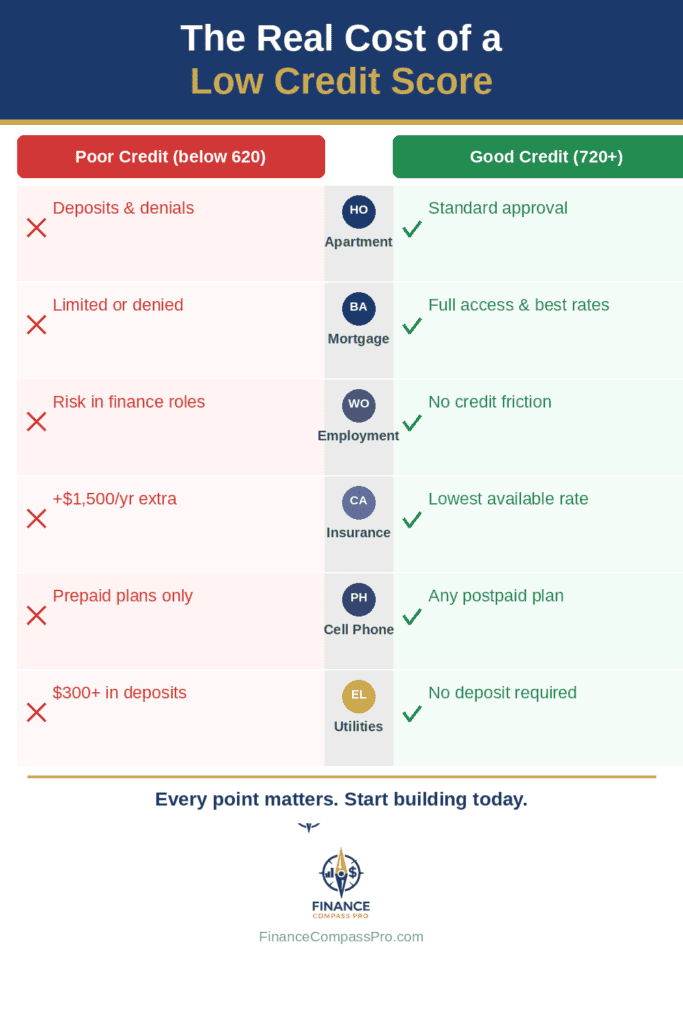
| Life Area | Poor Credit (below 620) | Good Credit (720+) |
|---|---|---|
| Apartment | Deposits, co-signers, rejections | Standard approval |
| Mortgage | Very limited or denied | Full access, competitive rates |
| Employment | Risk in financial/government roles | No credit-related friction |
| Auto insurance | Up to $1,800/year extra | Lowest available tier |
| Homeowners/renters insurance | +$100–$300/year | Best available rate |
| Utilities | $100–$300 deposit per account | No deposit |
| Cell phone | Prepaid only or large deposit | Any postpaid plan |
| Business financing | Limited or denied | Access to SBA, credit lines |
The Bottom Line
Interest rates are the most expensive consequence of a low credit score – but they’re not the only one. The true cost is spread across every major financial decision you make: where you live, how much you pay for insurance, whether you can get certain jobs, and how much friction you face in basic services.
The encouraging part is that all of these gates open as your score improves. A score moving from 580 to 670 doesn’t just save you on loan interest – it unlocks apartments, reduces insurance premiums, and removes deposit requirements across the board.
Understanding the five factors that make up your score is where this work begins. Every point is worth more than most people realize.
Disclaimer: The information on this page is for educational purposes only and does not constitute financial, legal, tax, or investment advice. FinanceCompassPro.com is not a licensed financial advisor, broker, or tax professional. Individual results will vary. Always conduct your own research and consult a qualified professional before making any financial decision. Credit score impacts vary by bureau, lender, and individual credit profile. Check your own reports at AnnualCreditReport.com.