The most common thing I hear from people in their 30s and 40s isn’t “I wish I’d picked better stocks.” It’s “I wish I’d started in my 20s.” This guide is for anyone who still has that option.
Many people search for how to start investing in your 20s with no money, but the real barrier isn’t money – it’s starting.
Your 20s are the single most powerful decade of your investing life.
Not because you have the most money. You probably don’t.
Not because you have the most knowledge. You’re just starting out.
It’s because you have the one thing no amount of money can buy back later: time.
This guide breaks down exactly how to start investing in your 20s – even if you’re living paycheck to paycheck, carrying student loans, or have zero experience with the stock market.
WHO THIS GUIDE IS FOR
If you’re in your 20s and wondering how to start investing with little or no money, this guide is built for you.
If you’re searching for a simple, step-by-step plan to start investing early, you’re exactly where you need to be.
Why Your 20s Are a Cheat Code for Wealth
Let’s talk numbers.
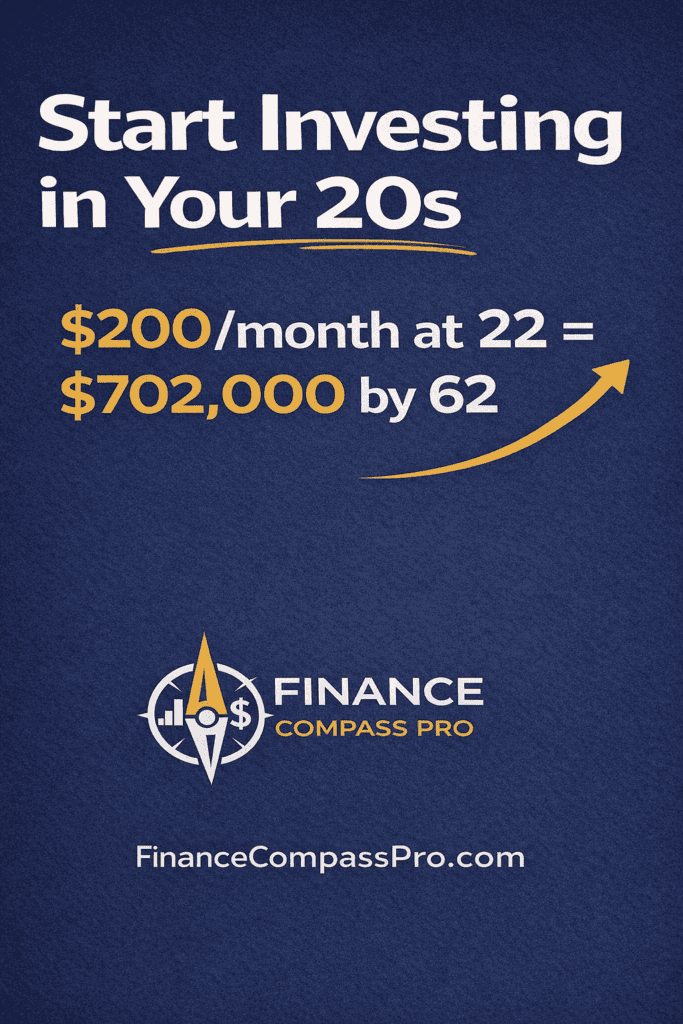
If you invest $200 per month starting at age 22 and earn an average annual return of 8%, you’ll have approximately $702,000 by age 62.
Start the same investment at age 32, and you’ll have around $298,000 – less than half.
Same $200. Same return rate. A $404,000 difference – just from starting 10 years earlier.
That’s the power of compound interest. Einstein reportedly called it the eighth wonder of the world. In your 20s, time is doing most of the heavy lifting for you. You just have to start.
Most people who start investing at 32 instead of 22 don’t realize the cost until it’s too late to fix. That $404,000 gap isn’t from bad stock picks. It’s from one decade of waiting.
The Mindset Shift You Need First
Most people in their 20s make one of two mistakes.
Mistake 1: Waiting until they feel “ready.”
There is no ready. The market won’t pause for you. Every month you wait is compound growth you never get back.
Mistake 2: Thinking they need a lot of money to start.
You don’t. Many brokerages today offer fractional shares, $0 minimums, and commission-free trading. You can start with $50.
The goal in your 20s isn’t to invest perfectly. It’s to invest consistently. Momentum matters more than perfection.
Step 1: Handle Your Financial Foundation First
Before you invest a single dollar, get three things in place: a starter emergency fund, a plan for high-interest debt, and a strategy for capturing any employer match.
If you still need to build that safety net, start with our guide on how to build an emergency savings account.
And if your employer offers retirement matching, make sure you understand how a 401(k) employer match works before sending extra money anywhere else.
Step 2: Choose the Right Account Type
A Roth IRA can be especially powerful in your 20s because contributions are made with after-tax dollars, while qualified withdrawals in retirement can be tax-free. For the full breakdown, see our guide on what a Roth IRA is.
If you’re deciding between a Roth IRA and a Traditional IRA, Traditional IRA vs. Roth IRA in 2026: Which One Saves You More Money Over 30 Years? breaks down which account wins at different income levels – and why the answer almost always favors the Roth for investors in their 20s.
A 401(k) is also important, especially if your employer offers matching contributions or if you want to automate investing directly from your paycheck. Our guide on what a 401(k) is explains how the account works.
If you are ready to open a regular taxable investing account, see our step-by-step guide on how to open a brokerage account.
Step 3: What to Actually Invest In
Here’s the honest answer for most 20-year-olds: low-cost index ETFs.
For most beginners, the better starting point is broad, low-cost index ETFs – not individual stock picking, crypto speculation, or options trading.
Index ETFs.
They give you instant diversification, extremely low fees, and historically competitive returns. You don’t need to pick winners. You just need to own the whole market.
If you are new to ETFs, start with our guide on what an ETF is and how it works.
A Simple 3-Fund Portfolio for Your 20s
| Fund | What It Covers | Allocation |
|---|---|---|
| VTI (Vanguard Total Stock Market ETF) | All US stocks | 60% |
| VXUS (Vanguard Total International ETF) | International stocks | 30% |
| BND (Vanguard Total Bond Market ETF) | US bonds | 10% |
Once you understand the basics, a simple three-fund structure can give you broad exposure to U.S. stocks, international stocks, and bonds. For a deeper breakdown, see our guide on the 3 ETF portfolio strategy.

Step 4: How Much Should You Invest in Your 20s?
A good starting target is 10–15% of your take-home income.
That might feel like a lot if you’re early in your career. Here’s how to make it work: start with whatever you can afford – even $50 or $100 per month. Then increase your contribution by 1% every time you get a raise or pay off a debt. Most people barely notice the difference, but the long-term impact is significant.
Rough Monthly Guide by Income
| Monthly Take-Home | 10% Target | 15% Target |
|---|---|---|
| $2,500 | $250 | $375 |
| $3,500 | $350 | $525 |
| $5,000 | $500 | $750 |
You don’t need to hit these numbers perfectly. The goal is to build the habit. Automate your contributions so the money moves before you have a chance to spend it.
Step 5: Automate Everything
Automation removes emotion from the equation. You will not forget to invest because life gets busy, and you will be less tempted to wait for the perfect market moment.
This is what dollar-cost averaging looks like in practice: investing a fixed amount on a fixed schedule, regardless of market conditions.
Automation is the closest thing beginner investors have to a cheat code. Not because it is clever, but because it removes the one variable that destroys many portfolios: emotional decision-making.
Common Mistakes 20-Somethings Make
Waiting for the “perfect” time to invest.
There is no perfect time. The best time was yesterday. The second best is today.
Checking the portfolio every day.
Markets fluctuate constantly. Daily checking leads to emotional decisions. Check monthly at most.
Ignoring fees.
A fund with a 1% expense ratio versus a 0.03% expense ratio doesn’t sound dramatic – but over 40 years, that difference can cost hundreds of thousands of dollars.
Putting everything in one stock.
Concentration might produce big gains – but it can also wipe you out. Diversification protects what you’ve built.
Lifestyle inflation eating the investment budget.
Every time your income goes up, resist the urge to upgrade your lifestyle proportionally. Channel raises into investments first.
For a deeper breakdown of the patterns that cause new investors to lose money, see our guide on why beginners lose money investing.

What Your Portfolio Might Look Like Over Time
| Age | Investing Since | Monthly $200 at 8% |
|---|---|---|
| 25 | 3 years | ~$8,100 |
| 30 | 8 years | ~$27,200 |
| 35 | 13 years | ~$57,600 |
| 40 | 18 years | ~$106,400 |
| 50 | 28 years | ~$283,000 |
| 62 | 40 years | ~$702,000 |
These aren’t guarantees – markets go up and down. But they show what consistent, patient investing can produce when time is on your side.
Ready to put it all together? Read: How to Build Your First Investment Portfolio
Before you open your first account, make sure the financial foundation in Step 1 is in place. Then move directly into the account and portfolio decisions above instead of adding unrelated financial tasks to the investing sequence.
The Bottom Line
Investing in your 20s doesn’t require a finance degree, a big salary, or a hot stock tip.
It requires three things: starting now, keeping it simple, and staying consistent.
Open a Roth IRA. Buy low-cost ETFs. Automate your contributions. Then go live your life and let compound interest do the work.
The best investment decision of your 20s isn’t a specific stock. It’s the decision to start at all.
You don’t need more information. You need a starting point. The earlier you start, the easier everything becomes.
For the complete beginner roadmap this fits into, see Investing for Beginners: The Complete Guide to Building Wealth in 2026.
Disclaimer: The information on this site is for educational purposes only and does not constitute personalized financial, tax, or investment advice. Always consult a qualified financial professional before making investment decisions. Investing involves risk, including the possible loss of principal. Past performance is not indicative of future results. Index fund returns referenced are historical averages and are not guaranteed.