
If you’re just starting your investing journey, one of the first questions you’ll
face is this:
Should I buy individual stocks? Or go with ETFs?
It seems like a simple question. Both trade on the stock market. Both can grow your wealth. Both show up in the same brokerage account.
But once you understand what’s actually happening under the hood, they serve very different purposes – and choosing the wrong starting point is one of the most common reasons beginners either lose money or give up entirely.
This guide breaks down exactly what each one is, how they compare, and which approach makes more sense depending on where you are in your investing journey.
WHAT IS A STOCK – AND WHAT ARE YOU ACTUALLY BUYING?
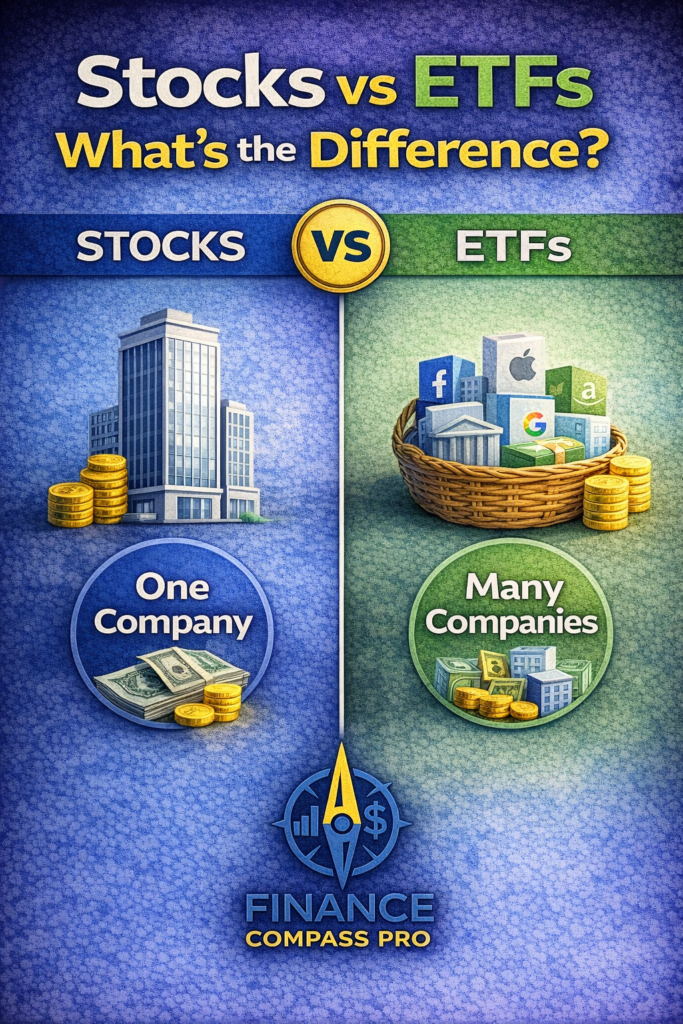
When you buy a stock, you’re purchasing a small ownership stake in a single company.
If you buy shares of Apple, you own a fraction of Apple. If Apple grows, your shares become more valuable. If Apple struggles, your shares lose value. Your financial outcome is directly tied to the performance of that one company.
This sounds simple – and in concept, it is. The challenge is execution.
To invest successfully in individual stocks, you need to evaluate a company’s financial health, understand its competitive position, follow its earnings reports, and make judgment calls about its future. You need to know when to hold through a rough quarter and when a decline signals a deeper problem.
That’s not impossible for beginners. But it requires time, attention, and a tolerance for uncertainty that most people underestimate until they’re sitting on a 30% loss and trying to decide what to do next.
For a complete foundation before diving into either option, Investing for Beginners: The Complete Guide to Building Wealth in 2026 covers everything you need to understand before placing your first trade.
WHAT IS AN ETF – AND WHY IS IT DIFFERENT?
An ETF – Exchange-Traded Fund – is a collection of investments bundled into a single product that trades on the stock market like a regular stock.
When you buy one share of an S&P 500 ETF, you’re not buying one company.
You’re buying a proportional stake in 500 of the largest companies in the United States – all at once, through a single purchase.
That single distinction changes everything about the risk profile.
If one company in the fund has a terrible quarter, it barely moves the needle.
You’re insulated by the other 499. The fund’s overall performance reflects the broad direction of the market, not the fate of any one business.
For a deeper look at how ETFs are structured and why they work the way they do, What Is an ETF and How Does It Work? A Beginner’s Guide to Smart Investing explains the mechanics clearly.
And if you want to understand the index fund side of the equation – the passive strategy that ETFs are often built around – What Is an Index Fund? A Beginner’s Guide to Smart Investing gives you that context.
THE CORE DIFFERENCE: A SIMPLE COMPARISON
Most explanations of stocks vs ETFs focus on technical definitions. But the real difference comes down to three things: risk, effort, and outcome consistency.
STOCKS and ETFs
| Stocks | ETFs | |
|---|---|---|
| What you own | Single company | Slice of many companies simultaneously |
| Performance depends on | That company’s decisions and market | Broad market trends |
| Upside potential | High – no ceiling on individual returns | Moderate – tracks market performance |
| Downside risk | Can go to zero | Cannot go to zero (market-wide failure) |
| Research required | Ongoing – earnings, financials, news | Minimal – set and maintain |
| Volatility | Higher – single-company events matter | Lower – individual events are absorbed |
| Best for | Informed, patient, experienced investors | Beginners and consistent long-term growth |
Here’s what the data shows: over any 20-year period in the S&P 500’s history, a broad market index fund has never delivered a negative return. Individual stocks, on the other hand, can go to zero – and many do.
That doesn’t make stocks bad. It makes them different – and more demanding of the investor.
WHY BEGINNERS OFTEN LOSE MONEY WITH STOCKS (AND HOW IT HAPPENS)
The pattern repeats itself constantly among new investors.
Someone discovers investing. They hear a story – a stock that doubled, a company that exploded in value, a friend who made 40% in six months. They open a brokerage account, buy shares in a few companies they’ve heard of, and wait.
Then the market moves against them.
The stock drops 15%. They feel anxious. It drops another 10%. They sell – locking in a real loss – just before the stock recovers.
This isn’t bad luck. It’s the predictable result of investing in something you don’t fully understand, without a clear framework for how to respond when things go wrong.
7 Investing Mistakes Beginners Should Avoid covers this pattern – and several others – in detail. Understanding these mistakes before they happen is one of the most practical things a new investor can do.
WHY ETFs ARE OFTEN THE SMARTER FIRST STEP
ETFs remove the biggest structural problem beginners face: concentration risk.
When your money is in one company, one bad earnings report, one leadership change, one regulatory decision can significantly damage your portfolio. When your money is in 500 companies, those individual events become noise.
This is why the majority of professional financial planners recommend ETFs as the default starting point for new investors. Not because ETFs are exciting – they’re not – but because they’re forgiving. They give you exposure to market growth without requiring you to be right about any specific company.
Broad diversification through ETFs also connects directly to how experienced investors protect their portfolios over time. What Is Diversification in Investing? The Smart Way to Reduce Risk explains why spreading your investments across many assets is one of the most important risk management tools available to any investor.
WHEN STOCKS ACTUALLY MAKE SENSE
This isn’t an argument against stocks. It’s an argument for sequencing.
Individual stocks make sense once you have the following in place:
You understand financial statements. Knowing how to read a basic income statement and balance sheet lets you evaluate whether a company’s current price reflects its actual value – or whether you’re buying hype.
You can handle volatility without panic-selling. A stock you believe in can drop 30% during a market correction and recover fully within a year. If you can’t hold through that psychologically, you will sell at the worst time.
You have a core ETF position already working. Adding individual stocks on top of a stable ETF foundation is very different from starting with individual stocks. One approach uses stocks as an enhancement. The other uses them as a gamble.
You’re investing for the long term. Short-term stock picking is essentially speculation. Long-term investing in quality companies is fundamentally different – and has a much better historical track record.
In other words: ETFs protect beginners. Stocks reward investors who have done the work.
THE STRATEGY MOST SMART BEGINNERS USE
Here’s something most investment guides don’t say clearly enough:
It’s not stocks vs ETFs. It’s how you combine them.
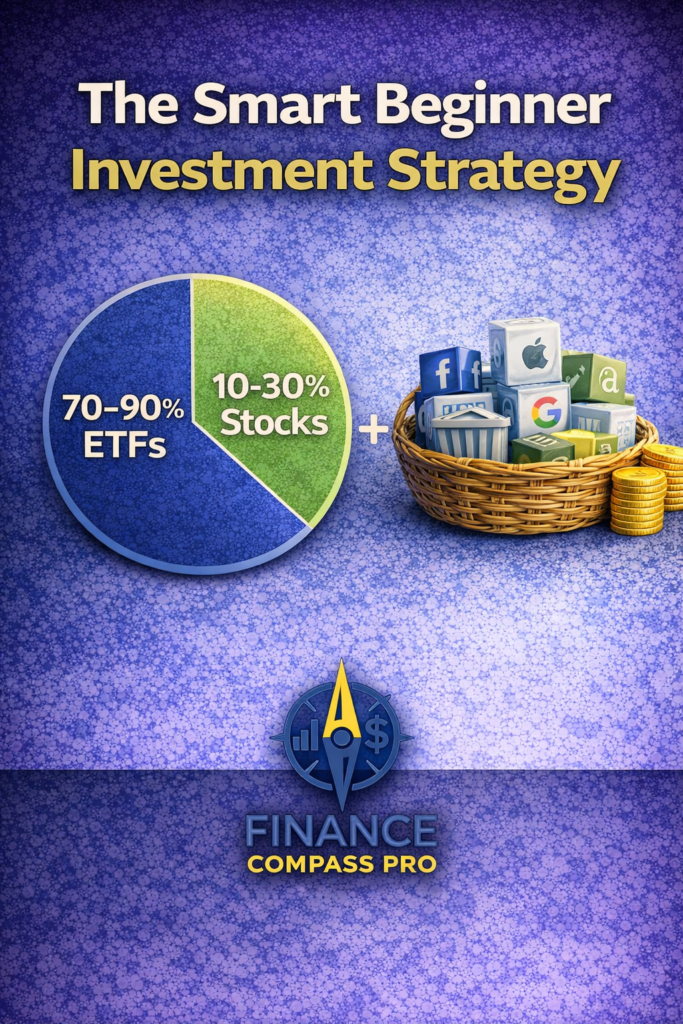
A practical starting structure for most beginners looks like this:
| Portfolio Layer | Allocation | What to Hold | Purpose |
|---|---|---|---|
| Core | 70–90% | Broad market ETF (S&P 500, Total Market) | Stability, diversification, long-term growth |
| Satellite | 10–30% | Individual stocks you’ve researched thoroughly | Upside potential, active learning |
This structure gives you the best of both. Your foundation is protected by diversification. Your growth potential isn’t limited by it.
How to Build Your First Investment Portfolio shows you exactly how to put this kind of structure together from scratch – including how to decide on your allocation based on your risk tolerance and time horizon.
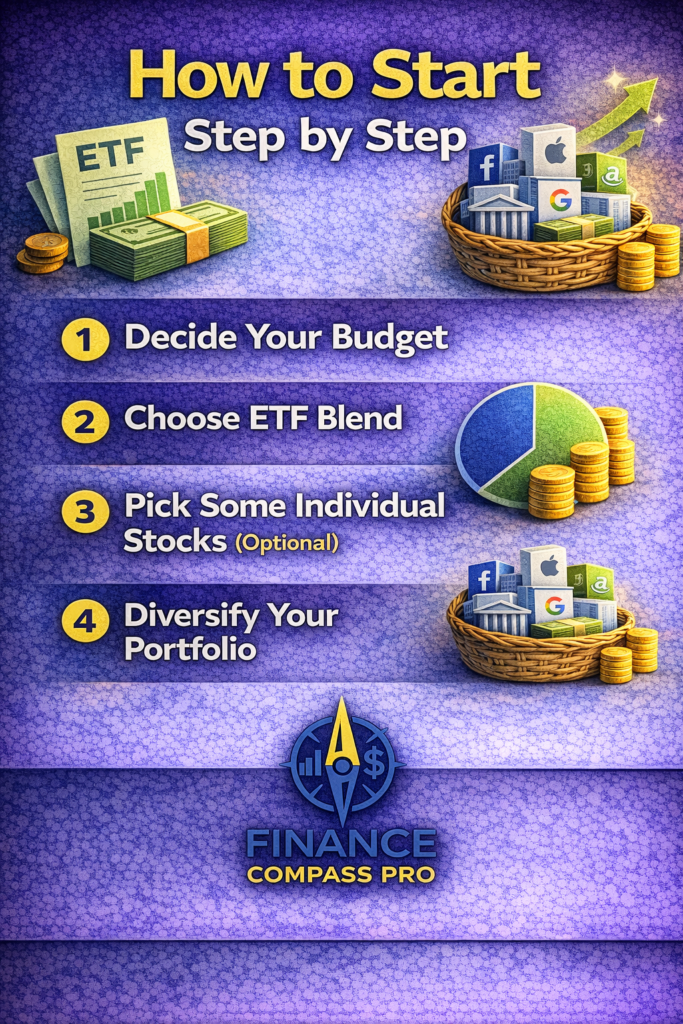
HOW TO START (A PRACTICAL STEP-BY-STEP)
If you’re starting from zero, here’s the simplest path forward.
Step 1: Open a brokerage account
Choose a platform that offers commission-free trading and fractional shares.
This lets you start with small amounts while building the habit of investing regularly.
Step 2: Start with one broad market ETF
An S&P 500 ETF – like VOO, SPY, or IVV – is the most straightforward starting
point. You’re immediately invested in 500 of the largest US companies with a single purchase.
Step 3: Add to your position consistently using dollar-cost averaging
Rather than trying to invest a large amount at the “right time,” invest a fixed amount on a regular schedule regardless of what the market is doing.
What Is Dollar-Cost Averaging and Why Smart Investors Use It explains why this approach removes one of the biggest sources of beginner anxiety – trying to time the market.
Step 4: Build your knowledge before adding individual stocks
Use the time while your ETF grows to learn how to evaluate individual companies.
When you’re ready, add one or two stocks you’ve researched thoroughly – not stocks you’ve heard about or feel excited about.
Step 5: Let time do the work
The single biggest advantage most investors have is time. Starting earlier with a simple strategy consistently outperforms starting later with a complex one. How to Start Investing With $100: A Beginner’s Step-by-Step Guide shows you that the amount matters far less than the act of beginning.
THE QUESTION THAT ACTUALLY MATTERS
Most people frame this as a competition: stocks vs ETFs, which one wins?
But that’s not the right question.
The right question is: which approach matches where I am right now?
If you’re at the beginning of your investing journey, with limited time to research companies and a low tolerance for watching your portfolio swing up and down unpredictably – ETFs are the smarter starting point. Not because they’re the best investment possible, but because they’re the best investment for your current situation.
And “best for your current situation” is the only benchmark that matters.
Over time, your knowledge grows. Your comfort with market fluctuations increases.
Your portfolio develops a stable foundation. At that point, adding individual stocks becomes a reasonable and informed decision rather than a hope.
Start with what you can maintain. Then build from there.
The investors who build real wealth over time aren’t usually the ones who made the best single stock pick. They’re the ones who stayed invested, stayed consistent, and let compounding do the work across years and decades.
That process starts with a simple decision – and it starts today.
BOTTOM LINE
Stocks and ETFs aren’t competing products. They’re tools that serve different purposes at different stages of your investing journey.
For most beginners, ETFs are the better starting point. They’re forgiving, diversified, and require less ongoing attention. Stocks become powerful additions once you’ve built a foundation and developed the knowledge to use them well.
Start simple. Build consistently. Add complexity only when you understand it.
This article is for informational and educational purposes only and does not constitute financial advice. Past performance of any investment is not indicative of future results. No affiliate relationships are currently in place for any tools or platforms mentioned in this post. Always consult a qualified financial professional before making investment decisions.
Pingback: Passive Income From ETFs: How to Build Monthly Cash Flow With Minimal EffortPassive Income From ETFs: Build Cash Flow Without Managing Individual Stocks -
Pingback: How to Build Your First Investment Portfolio: A Beginner’s Step-by-Step GuideHow to Build Your First Investment Portfolio -
Pingback: Investing for Beginners: The Complete Guide to Building Wealth in 2026Investing for Beginners: The Complete Guide to Building Wealth in 2026 -
Pingback: The Simple 3 ETF Portfolio Strategy Most Beginners Should Start WithThe Simple 3 ETF Portfolio Strategy Most Beginners Should Start With -
Pingback: What Is Diversification in Investing? (The Smart Way to Reduce Risk)What Is Diversification in Investing? (The Smart Way to Reduce Risk) -
Pingback: What Is an ETF and How Does It Work? A Beginner’s Guide to Smart InvestingWhat Is an ETF and How Does It Work? A Beginner’s Guide to Smart Investing -
Pingback: The 3 ETF Portfolio Strategy: Simple, Diversified, and Built to LastThe 3 ETF Portfolio Strategy: Simple, Diversified, and Built to Last -