Disclosure: This post is for informational and educational purposes only. FinanceCompassPro.com may earn compensation through display advertising. We may also reference third-party products, services, or platforms by name for educational purposes – these mentions are not paid endorsements unless explicitly stated. Nothing in this post constitutes personalized financial, legal, tax, or investment advice.
What is a mutual fund? If you have ever opened a workplace retirement account like a 401(k), browsed a brokerage platform, or looked through an investment menu, you have almost certainly seen mutual funds listed.
For decades, mutual funds have been one of the most common ways everyday investors build diversified portfolios. They show up in retirement plans, target-date funds, brokerage accounts, and long-term investment strategies.
Yet many beginners still have only a vague idea of what happens after they buy one.
Understanding mutual funds matters because it helps you make better choices. Should you use a mutual fund, an ETF, or an index fund? Does the fee matter? Is professional management worth paying for? And in 2026, when low-cost ETFs are everywhere, do mutual funds still make sense?
Here is a plain-English breakdown of how mutual funds work, what they cost, and when they may still be useful.
What Is a Mutual Fund?
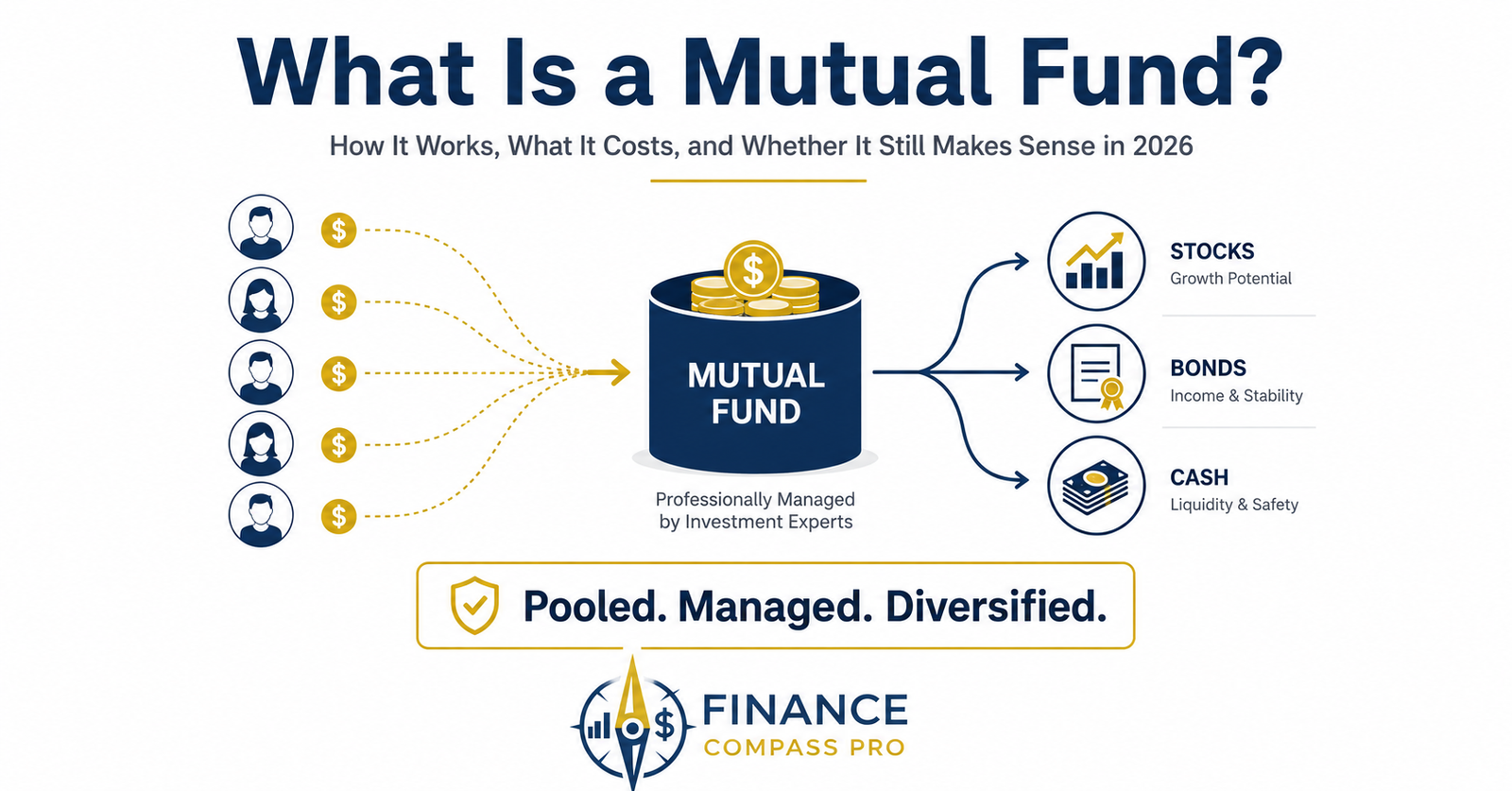
A mutual fund is a pooled investment vehicle.
When you invest in a mutual fund, your money is combined with money from many other investors. That combined pool is then used to buy a portfolio of securities such as stocks, bonds, money market instruments, or a mix of different assets.
Some mutual funds are actively managed by professional managers who choose what to buy and sell. Others are passively managed and simply track an index like the S&P 500.
That distinction matters.
A mutual fund is not automatically “active” or “expensive.” Some mutual funds are high-cost actively managed products. Others are extremely low-cost index funds. The structure is the same, but the strategy and cost can be very different.
When you buy a mutual fund, you own shares of the fund itself. You do not directly own each individual stock or bond inside the fund. If the investments inside the fund rise in value, your fund shares may rise. If the underlying holdings decline, your fund shares may decline as well.
For investor education on mutual funds and ETFs, see the SEC Investor.gov guide to mutual funds and ETFs.

How Does a Mutual Fund Work?
Mutual funds work differently from stocks and ETFs. A stock or ETF trades throughout the day on an exchange. Its price moves constantly during market hours.
A mutual fund does not work that way.
Mutual funds are priced once per day after the market closes. The fund company calculates the total value of all the assets inside the fund, subtracts liabilities, and divides that amount by the number of fund shares outstanding. This price is called the net asset value, or NAV.
This means that if you place an order to buy or sell a mutual fund at 10 a.m., your order does not execute at a live intraday price. It executes later at the closing NAV.
For long-term investors, this is usually not a major problem. In fact, it can be a benefit because mutual funds are designed more for long-term investing than short-term trading.
The basic process looks like this:
- You invest money into the fund.
- Your money is pooled with money from other investors.
- The fund buys a portfolio of securities based on its stated strategy.
- The fund is priced once per day at closing NAV.
- You earn returns through price appreciation, dividends, interest, or a combination of these.
Types of Mutual Funds
Stock Funds
Stock funds, also called equity funds, invest primarily in stocks. They may focus on large U.S. companies, small companies, growth stocks, value stocks, international markets, specific sectors, or broad market exposure. Stock funds generally offer higher long-term growth potential, but they also come with more volatility.
Bond Funds
Bond funds invest in government bonds, corporate bonds, municipal bonds, or a mix of fixed-income securities. They usually offer lower potential returns than stock funds, but they can provide income and stability. Bond funds are often used by investors who want to reduce portfolio volatility or generate more predictable income.
Balanced Funds and Asset Allocation Funds
Balanced funds hold both stocks and bonds in a single fund. Some use a fixed allocation, such as 60% stocks and 40% bonds. Others adjust over time. Target-date funds are a popular type of asset allocation fund. You choose a fund based on your expected retirement year, and the fund gradually shifts from more aggressive to more conservative as that date approaches.
Money Market Funds
Money market funds invest in short-term, high-quality debt instruments. They are designed to maintain stability and provide modest income, but they are not the same as FDIC-insured bank deposits. They can be useful as a cash-like holding inside a brokerage account, but investors should understand that they are still investment products.
Index Mutual Funds
An index fund can be structured as a mutual fund. Instead of trying to beat the market, an index mutual fund tracks a market index such as the S&P 500 or a total stock market index. These funds are usually passively managed and often have very low expense ratios.
This is why the phrase “mutual fund” can be confusing. A mutual fund can be an expensive active fund, or it can be a cheap index fund.
Actively Managed vs. Passively Managed Mutual Funds
This is one of the most important distinctions in the entire mutual fund world.
Actively Managed Funds
Actively managed funds employ professional managers who research investments, make buy and sell decisions, and attempt to outperform a benchmark index. The appeal is easy to understand. If a skilled manager can beat the market, investors may earn higher returns.
The challenge is cost and consistency. Active funds usually charge higher fees because they require analysts, research, trading, and management. Those fees create a hurdle. The manager must outperform the index by enough to overcome the extra cost.
Long-term active fund results vary by category, but SPIVA scorecards and other industry research have repeatedly shown that many actively managed funds fail to beat their benchmarks over longer periods after fees.
Passively Managed Funds
Passively managed mutual funds, often called index funds, do not try to beat the market. They simply track an index. If the index holds 500 companies, the fund holds those companies in similar proportions. Because there is less trading, research, and active decision-making, index funds usually cost much less than actively managed funds.
For many beginners, a low-cost index mutual fund is a stronger starting point than an expensive active fund.

Mutual Fund vs. ETF: What Is the Difference?
Mutual funds and ETFs can hold the same underlying assets. Both can invest in stocks, bonds, index strategies, or diversified portfolios. The difference is in structure, trading, cost, and tax treatment.
| Feature | Mutual Fund | ETF |
|---|---|---|
| Trading | Once per day at closing NAV | Throughout the day like a stock |
| Minimum investment | Often higher, though many are lower now | Often one share or fractional shares |
| Expense ratios | Varies widely; active funds often higher | Often low for broad index ETFs; niche or active ETFs may cost more |
| Tax efficiency | Can be less tax-efficient in taxable accounts | Often more tax-efficient in taxable accounts |
| Best for | 401(k)s, automatic investing, target-date funds | Taxable accounts, flexibility, intraday trading |
ETFs often have an advantage in taxable brokerage accounts because their structure can reduce capital gains distributions. But inside a 401(k), IRA, or other tax-advantaged account, the tax-efficiency difference between mutual funds and ETFs matters much less.
This is why mutual funds are still common inside workplace retirement plans. They may not be as flexible as ETFs, but they can work perfectly well when they are low-cost and properly selected.
For a deeper comparison of exchange-traded funds, see our guide on what is an ETF. You can also review our guide on what is an index fund if you want to understand passive investing more clearly. If you decide an ETF fits your goals better than a mutual fund, ETFs for Beginners walks through how to choose, compare, and build a simple portfolio.
What Does a Mutual Fund Cost?
Cost is one of the most important factors in mutual fund selection – and one of the easiest to overlook.
Expense Ratio
The expense ratio is the annual fee charged by the fund, expressed as a percentage of your investment. A fund with a 1.0% expense ratio costs $100 per year on a $10,000 balance. A fund with a 0.05% expense ratio costs $5 per year on the same balance.
That difference may look small at first. Over decades, it can become enormous. Using a simplified compounding example, a 1.0% annual expense ratio can cost tens of thousands of dollars more than a 0.05% expense ratio over 30 years. The exact difference depends on return assumptions and compounding method, but the principle is clear: lower costs leave more money working for you.
Sales Loads
Some mutual funds charge a commission when you buy or sell shares. A front-end load is charged when you buy. A back-end load is charged when you sell. A 5% front-end load means that if you invest $10,000, only $9,500 actually goes to work immediately.
For most everyday investors, there is usually no need to pay a sales load when high-quality no-load funds are widely available.
12b-1 Fees
Some mutual funds charge 12b-1 fees, which are used for marketing and distribution expenses. These fees are usually included in the fund’s expense ratio, but they are still worth checking. A fund with higher distribution costs may be less investor-friendly than a comparable no-load, low-cost alternative.
The bottom line is simple: always check the expense ratio, avoid unnecessary sales loads, and favor low-cost funds when possible.

When Does a Mutual Fund Still Make Sense in 2026?
Inside a 401(k) or 403(b)
Many workplace retirement plans offer mutual funds rather than ETFs. In that setting, your goal is not to avoid mutual funds. Your goal is to choose the best mutual funds available inside the plan – usually low-cost index mutual funds, diversified target-date funds, or broad stock and bond funds with reasonable fees.
To understand how to make better choices inside your workplace retirement plan, see our guide on how to maximize your 401(k).
For Automatic Investing
Mutual funds have traditionally been excellent for automatic investing. Many platforms allow you to invest a fixed dollar amount on a recurring schedule without worrying about share prices. ETFs have become easier to automate as fractional shares have become more common, but mutual funds still handle automatic investing very smoothly on many platforms.
For Target-Date Funds
Target-date retirement funds are often structured as mutual funds. For someone who wants a single fund that automatically adjusts over time, a target-date mutual fund can be a reasonable choice, especially inside a retirement account. The key is to check the expense ratio.
When Mutual Funds Are Less Attractive
Mutual funds are less attractive when they come with high expense ratios, sales loads, high 12b-1 fees, poor long-term performance versus a benchmark, or when a lower-cost ETF alternative does the same job more efficiently in a taxable account.
How to Evaluate a Mutual Fund
Before investing in any mutual fund, check these key items:
- Expense ratio – Lower is generally better. For passive index funds, look for expense ratios below 0.20% when possible.
- Load structure – Look for no-load funds. A sales load creates an immediate drag on your investment.
- Fund objective – Read what the fund is designed to do and confirm it matches your investment goal.
- Benchmark comparison – For active funds, compare long-term performance against the relevant benchmark after fees.
- Fund size and track record – Very new or very small funds may carry additional risk. Established funds are generally easier to evaluate.
The Bottom Line
A mutual fund is a pooled investment vehicle that allows many investors to combine their money into one professionally managed or index-tracking portfolio.
Mutual funds are not automatically good or bad. Some are expensive and unnecessary. Others are low-cost, diversified, and extremely useful.
For most beginners, the most important lessons are simple: favor low-cost index funds when possible, avoid sales loads, check the expense ratio, and understand whether the fund is active or passive before investing.
Mutual funds still make sense in 2026, especially inside 401(k)s, 403(b)s, and target-date retirement strategies. They may be less attractive in taxable brokerage accounts when a lower-cost, more tax-efficient ETF can do the same job.
To see how mutual funds fit into the broader portfolio picture, read our guide on stocks vs. bonds.
Disclaimer: This article is for educational purposes only and does not constitute personalized financial or investment advice. Fund performance, fees, and availability vary. Consult a qualified financial professional for advice specific to your situation.