
If you’ve spent any time researching how to start investing, you’ve encountered the term ETF.
It appears in beginner guides, on investing apps, in financial news, in almost every conversation about building wealth for the first time. And yet, for most people who are just starting out, what an ETF actually is – and why it matters so much – remains vaguely understood rather than clearly grasped.
That vagueness is worth resolving. Because ETFs aren’t just one option among many for beginning investors. For most people, they’re the single most practical tool available for building long-term wealth – and understanding how they work changes how you think about investing entirely.
“You don’t need to pick the right company. You need to own the right system. ETFs are how most investors access that system.”
In this guide, we’ll break down exactly what ETFs are, how they work mechanically, why they’ve become the foundation of modern individual investing, and how to start using them effectively.
The Problem ETFs Were Designed to Solve
To understand why ETFs matter, it helps to understand what investing looked like before they existed.
For most of the twentieth century, individual investors who wanted exposure to the stock market had two realistic options.
The first was buying individual stocks – selecting specific companies, researching their financials, monitoring their performance, and accepting the risk that any single company could decline sharply or fail entirely. This approach required significant knowledge, time, and emotional discipline. And even professional stock-pickers, with research teams and decades of experience, failed to consistently outperform the broader market.
The second option was actively managed mutual funds – pooled investment vehicles where professional managers selected stocks on behalf of investors. These funds promised expert selection but came with high management fees, limited trading flexibility, and a historical track record that, in aggregate, underperformed simple market indexes over long periods.
ETFs – Exchange-Traded Funds – emerged as a fundamentally different structure. One that combined the simplicity of broad market exposure with the trading flexibility of individual stocks, at a fraction of the cost of actively managed funds.
The result was something most ordinary investors had never had reliable access to before: an efficient, low-cost way to own the entire market.
What an ETF Actually Is
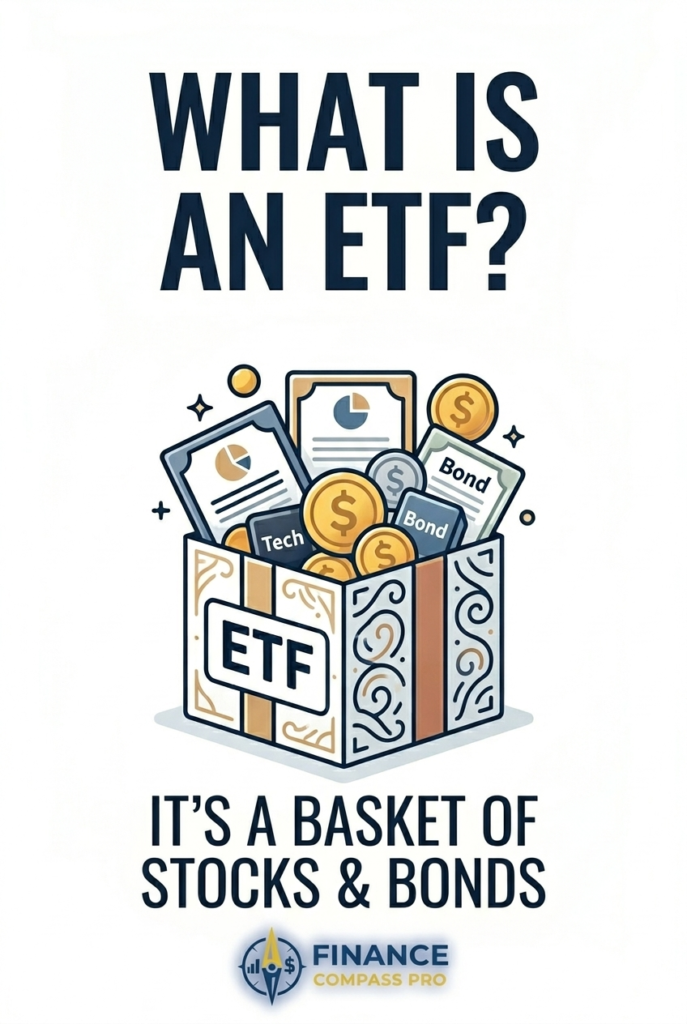
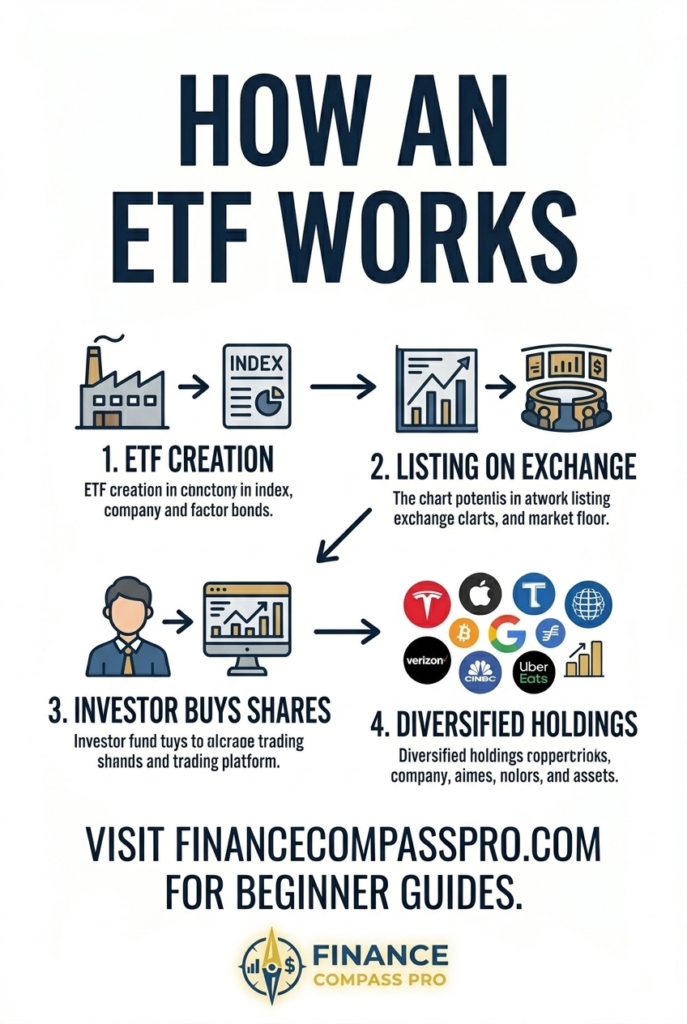
An ETF is a fund that holds a collection of assets – typically stocks, bonds, or a combination – and trades on a stock exchange like an individual share.
When you buy one share of an S&P 500 ETF, you’re not buying a stake in a single company. You’re buying a proportional ownership stake in a fund that holds shares of all 500 companies in the S&P 500 index simultaneously. Apple, Microsoft, Amazon, Google, and 496 others – all in one transaction.
The price of that ETF share moves throughout the trading day, reflecting the collective movement of everything the fund holds. When the market rises, the ETF rises. When it falls, the ETF falls. The performance mirrors the underlying index it tracks.
This structure produces two outcomes that are enormously valuable for individual investors.
First, instant diversification. Instead of betting on a single company’s performance, you’re spreading your investment across hundreds or thousands of companies simultaneously. One company reporting disappointing earnings, facing regulatory action, or experiencing a competitive disruption has a marginal impact on a fund holding 500 positions – rather than a devastating impact on a concentrated position.
Second, simplicity. You don’t need to research individual companies, monitor quarterly earnings, or make ongoing decisions about which stocks to hold. The index does the selection. You own the outcome.
How ETFs Work Mechanically
Understanding the mechanics of how ETFs function helps you use them more confidently.
📊 Tracking an Index
Most ETFs are designed to track a specific index – a predefined list of assets that represents a market, sector, or asset class. The S&P 500 index, for example, represents the 500 largest publicly traded companies in the United States. An ETF tracking this index holds shares in those 500 companies in proportions that mirror the index.
When the index is updated – when companies are added or removed based on their size or other criteria – the ETF adjusts its holdings accordingly. This happens automatically, without requiring any action from you as an investor.
💰 The Expense Ratio
ETFs charge a small annual fee for managing the fund, expressed as a percentage of your investment called the expense ratio. For broad market index ETFs, these fees are remarkably low – often 0.03% to 0.20% annually. That means on a $10,000 investment, you might pay $3 to $20 per year in management fees.
This is substantially lower than the 1–2% fees typical of actively managed funds – a difference that compounds significantly over decades.
📈 Trading Like a Stock
Unlike traditional mutual funds, which are priced once per day after markets close, ETFs trade continuously throughout the market day. You can buy or sell at any point during trading hours at the current market price.
For most long-term investors, this intraday trading flexibility matters less than it sounds. The more important implication is accessibility ETFs are available through virtually every brokerage platform, often with no commission and no minimum investment beyond the price of one share.
The Main Types of ETFs
Not all ETFs are the same. Understanding the major categories helps you identify which ones belong in your portfolio and why.
🏛️ Broad Market Index ETFs
These track the overall stock market or a major index like the S&P 500, the total U.S. market, or a global market index. They provide the widest possible diversification at the lowest cost.
Examples: VTI (Vanguard Total Stock Market), VOO (Vanguard S&P 500), ITOT (iShares Core S&P Total U.S. Stock Market)
For most beginners, a broad market index ETF is the ideal starting point – and for many experienced investors, it remains the core of their portfolio indefinitely.
🌍 International ETFs
These hold stocks from markets outside the United States – either specific regions (Europe, Asia, emerging markets) or the entire world excluding the U.S. Adding international exposure diversifies your portfolio geographically, reducing dependence on the performance of any single economy.
🏭 Sector ETFs
These focus on a specific industry – technology, healthcare, energy, financial services, consumer staples. Sector ETFs allow investors to express conviction about particular industries without selecting individual companies.
For beginners, sector ETFs are best approached with caution – they introduce concentration risk that broad market funds specifically avoid.
💰 Dividend ETFs
These hold companies selected for their history of paying regular dividends – distributions of profit to shareholders. Dividend ETFs are particularly relevant for investors building passive income streams, as they generate regular cash flow in addition to potential price appreciation.
If generating income from your investments is a priority, Best Dividend ETFs for Passive Income covers how dividend ETFs work as an income strategy and which funds are most widely used for this purpose.
🏦 Bond ETFs
These hold fixed-income securities – government bonds, corporate bonds, or a mix. Bond ETFs tend to be less volatile than equity ETFs and often move in the opposite direction during market downturns, providing portfolio stability.
For most beginning investors, bond ETFs become relevant as a portfolio stabilizing component rather than a primary holding.
ETFs vs. Individual Stocks: The Core Trade-Off
This is one of the first decisions most beginners face – and understanding the actual trade-off makes the choice significantly clearer.
Individual stocks offer the highest potential returns. If you identify a company early in a period of exceptional growth and hold it through that growth, the returns can be extraordinary. The stories of early Amazon or Apple investors are real.
But those stories represent survivorship bias. For every company that compounded dramatically over two decades, dozens of seemingly promising companies stagnated, declined, or failed entirely. The investors who concentrated in those companies experienced very different outcomes than the investors who held broad market funds.
The core trade-off is this: individual stocks offer higher ceiling potential but also a much lower floor. One company can go to zero. A diversified ETF holding 500 companies cannot.
For most beginning investors – and for many experienced ones – the question isn’t really which approach produces the best theoretical outcome in ideal circumstances. It’s which approach produces the best real-world outcome across the full range of circumstances, including the ones that are difficult to predict.
Broad market ETFs provide a high floor, consistent participation in overall market growth, and the simplicity to maintain through conditions that cause more complex strategies to break down.
Stocks vs ETFs for Beginners goes deeper into this comparison – including a framework for thinking about when individual stocks might make sense to add alongside a core ETF position.
Why ETFs Are the Foundation, Not a Starting Point You Graduate From
Here’s something worth saying clearly.
ETFs are not training wheels. They’re not the simplified version of investing you use before you’re ready for the “real” strategies.
For the majority of professional institutional investors, low-cost index funds and ETFs form the core of long-term portfolios. The evidence base for passive, index-based investing accumulated over decades is among the strongest in all of finance.
The reason ETFs are recommended for beginners isn’t because they’re simple. It’s because simplicity and effectiveness are not in conflict here – they’re aligned. A broad market ETF held consistently over twenty years has outperformed the majority of actively managed funds in historical data. Not some of the time. Most of the time.
This is what makes the combination of ETFs and consistent investing such a powerful foundation. You’re not accepting lower returns in exchange for simplicity. You’re accessing a strategy that has historically produced strong returns precisely because it doesn’t require you to be right about individual companies, sectors, or market timing.
When you combine ETFs with a disciplined approach to consistent investing – adding to your position at regular intervals regardless of market conditions – you create a system that compounds quietly and reliably over time. What Is Dollar-Cost Averaging explains why that consistency, applied to a broadly diversified ETF, is one of the most powerful wealth-building approaches available to individual investors.
Building a Portfolio Around ETFs
Once you understand what ETFs are and how they work, the next question is how to combine them into a coherent portfolio structure.
For most beginners, the answer is simpler than it initially appears.
A total market ETF for broad domestic equity exposure. An international ETF for geographic diversification. A bond ETF for stability. Three funds, covering the full spectrum of investable assets at minimal cost, with automatic diversification across thousands of individual securities.
This structure – often called a three-fund portfolio – doesn’t require ongoing tactical decisions, expensive management, or specialized knowledge to maintain. It requires consistent contributions and the patience to stay invested through market cycles.
The Simple 3 ETF Portfolio Strategy Most Beginners Should Start With walks through exactly how to build and maintain this structure – including how to think about allocation between the three funds based on your timeline and goals.
And if you’re ready to think through the broader portfolio construction process, How to Build Your First Investment Portfolio covers the full framework for moving from individual fund selection to a long-term investment strategy.
The Real Power of ETFs: Owning the Market, Not Predicting It
The single most important insight about ETFs isn’t mechanical. It’s philosophical.
Most investment strategies are built on the assumption that success comes from being smarter than the market – identifying opportunities others have missed, predicting movements others haven’t anticipated, making decisions that turn out to be correct more often than not.
ETFs are built on a different assumption: that consistently being right about the market is extraordinarily difficult, even for professionals – and that owning the entire market, consistently and at low cost, produces better outcomes for most investors than attempting to outperform it.
That assumption is supported by decades of data. And more importantly, it produces a strategy that most individual investors can actually maintain – through volatile markets, through periods of slow growth, through the conditions that cause more aggressive or complex approaches to break down.
“You don’t win at investing by predicting what happens next. You win by owning the outcome – whatever it is – and staying invested long enough for it to compound.”
ETFs are how you own the outcome.
How to Get Started With ETFs Today
You don’t need to resolve every question before taking a first step. You need a clear starting point.
1. Open a brokerage account.
Choose a platform that offers commission-free ETF trading and fractional shares – allowing you to invest any dollar amount without needing the price of a full share.
2. Start with one broad market ETF.
A total market index fund or S&P 500 ETF provides immediate exposure to hundreds of companies. One fund is a stronger starting point than multiple funds chosen without a clear framework.
3. Set up automatic recurring investments.
Automate your contribution on the day after your paycheck arrives. Automation removes the monthly decision and eliminates the temptation to time the market.
4. Enable dividend reinvestment.
Most platforms allow dividends to be automatically reinvested in additional shares. This activates the compounding mechanism that makes long-term ETF investing so powerful.
5. Review quarterly – not daily.
ETFs are long-term instruments. Daily performance monitoring introduces emotional noise that consistent investing is specifically designed to eliminate.
This article is for informational and educational purposes only and does not constitute financial advice. No affiliate relationships are currently in place for any platforms, funds, or tools mentioned in this post. Past performance of any investment is not indicative of future results. Always consult a qualified financial professional before making investment decisions.
Pingback: Passive Income From ETFs: How to Build Monthly Cash Flow With Minimal EffortPassive Income From ETFs: Build Cash Flow Without Managing Individual Stocks -
Pingback: How to Start Investing With $500: A Simple and Smart Beginner StrategyHow to Start Investing With $500: A Simple and Smart Beginner Strategy - microinvestguru.com
Pingback: What Is an Index Fund? A Beginner’s Guide to Smart Investing -
Pingback: Stocks vs ETFs for Beginners: Which Investment Is Better for You?Stocks vs ETFs for Beginners: Which Investment Is Better for You? -
Pingback: What Is Diversification in Investing? (The Smart Way to Reduce Risk)What Is Diversification in Investing? (The Smart Way to Reduce Risk) -
Pingback: What Is Dollar-Cost Averaging and Why Smart Investors Use ItWhat Is Dollar-Cost Averaging and Why Smart Investors Use It -
Pingback: How to Start Investing With $100: A Beginner’s Step-by-Step Guide -
Pingback: The 5 Pillars of Smart Investing Every Beginner Should UnderstandThe 5 Pillars of Smart Investing Every Beginner Should Understand -
Pingback: How to Stop Running in Place and Build Real Wealth in 2026How to Stop Running in Place and Build Real Wealth in 2026 -
Pingback: Data-Driven Investment Insights: Precision Strategies for Modern Asset GrowthData-Driven Investment Insights: Precision Strategies for Modern Asset Growth -
Pingback: The Simple 3 ETF Portfolio Strategy Most Beginners Should Start WithThe Simple 3 ETF Portfolio Strategy Most Beginners Should Start With -
Pingback: Which Is Better for Beginners ETFs or Stocks -
Pingback: Best Dividend ETFs for Passive Income (A Simple Strategy That Actually Works) -
Pingback: How to Start Investing With $1,000: A Simple Beginner’s GuideHow to Start Investing With $1,000: A Simple Beginner’s Guide -
Pingback: How to Build a Simple Budget That Actually Works in 2026How to Build a Simple Budget That Actually Works in 2026 -
Pingback: How to Start Investing With $500 (Step-by-Step Beginner Guide)How to Start Investing With $500 -
Pingback: How to Invest Your First Paycheck: A Simple Guide to Start Building Wealth EarlyHow to Invest Your First Paycheck -