
Most people don’t lose money in the stock market because they picked the wrong stocks.
They lose money because of behavior.
Panic selling at the bottom. Chasing a trend at the top. Ignoring fees for years. Investing without a plan and abandoning ship the first time things get uncomfortable.
These aren’t rare failures. They’re the norm. And the painful part is that most of them are completely avoidable.
This guide covers the seven most common investing mistakes beginners make – not to scare you away from investing, but to give you a clear map of what not to do. Because in investing, avoiding mistakes is often more valuable than finding the perfect opportunity.
If you’re just getting started, consider pairing this with a solid foundation first: What Is an Index Fund? The Beginner’s Complete Guide gives you the core strategy most of these mistakes are working against.
Mistake #1: Trying to Time the Market
The fantasy is appealing: buy at the absolute bottom, sell at the peak, repeat.
The reality is that nobody does this consistently. Not retail investors, not professional fund managers, not hedge funds with entire research teams dedicated to exactly this problem.
Markets move based on millions of variables – earnings reports, geopolitical events, Federal Reserve decisions, investor psychology, and thousands of other factors interacting simultaneously. Predicting short-term movements reliably is, for all practical purposes, impossible.
What happens to investors who try anyway? They end up doing the opposite of what they intend.
Studies on investor behavior consistently show that the average investor earns significantly less than the funds they invest in – because they buy after prices have already risen (out of excitement) and sell after prices have already fallen (out of fear). They’re perpetually late in both directions.
The fix is straightforward: stop trying to time the market, and start focusing on time in the market.
Investors who stay consistently invested through market cycles almost always outperform those who jump in and out. A strategy like dollar-cost averaging – investing a fixed amount on a regular schedule regardless of market conditions – removes timing from the equation entirely.
📌 Related reading: What Is Dollar-Cost Averaging and Why Smart Investors Use It
“Time in the market beats timing the market. The best day to invest was yesterday. The second best is today.”
Mistake #2: Investing Without a Clear Strategy
Buying a stock because you heard about it on a podcast is not a strategy. Neither is investing in whatever ETF showed up first in your brokerage’s search results.
Without a clear plan, investing becomes reactive – and reactive investing produces inconsistent, often poor results.
A real investment strategy answers at least three questions:
What are you investing for? Retirement in 30 years looks different from saving for a house down payment in 5. Your time horizon changes everything about which investments make sense.
How much risk can you tolerate? This isn’t just about personality – it’s about math. If your portfolio drops 30%, will you stay invested or panic-sell? Your honest answer to that question determines how aggressive your allocation should be.
How will you invest consistently? A strategy without a contribution plan is just wishful thinking. Set a number – even $50/month – and commit to it.
Once those questions are answered, building a portfolio becomes much simpler. For most beginners, a low-cost index fund or ETF aligned with a long time horizon and regular contributions is the answer.
📌 Related reading: How to Build Your First Investment Portfolio
Mistake #3: Not Diversifying
This one destroys portfolios fast.
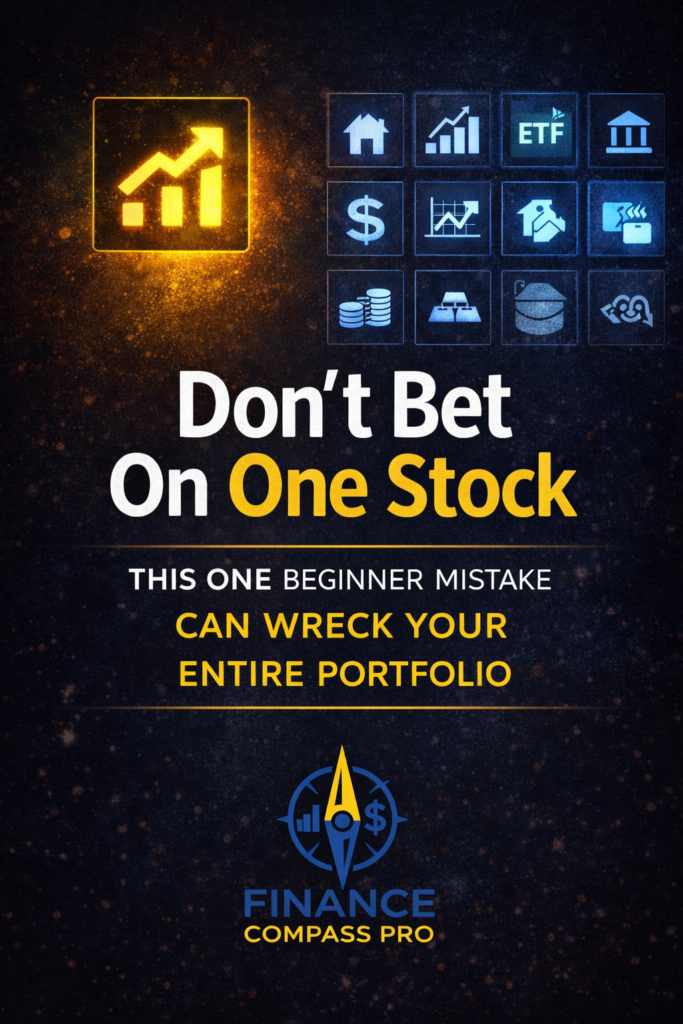
Putting a large percentage of your money into a single stock – even a company you believe in deeply – is a concentrated bet. And concentrated bets, by definition, carry concentrated risk.
Consider some once-beloved companies that investors loaded up on: Enron (bankruptcy, 2001), Lehman Brothers (bankruptcy, 2008), Bed Bath & Beyond (bankruptcy, 2023). Each had loyal shareholders who believed in the company right up until the collapse.
Diversification doesn’t mean you never lose. It means no single loss can wipe you out.
The most practical solution for beginners is exactly what makes index funds and ETFs so powerful: they provide instant diversification across hundreds or thousands of companies with a single purchase. One S&P 500 index fund gives you exposure to 500 large U.S. companies. A total market ETF gives you thousands.
Diversification: Concentrated vs. Spread Portfolio
| Scenario | Holdings | If One Investment Drops 80% | Portfolio Impact |
|---|---|---|---|
| Concentrated | 2 stocks (50% each) | One collapses | -40% total |
| Diversified (Index Fund) | 500+ companies | One collapses | -0.16% total |
This is a simplified illustration. Actual results vary based on portfolio composition and market conditions.
The math alone makes the case. Diversification is not a conservative choice – it’s the rational one.
📌 Related reading: What Is Diversification in Investing?
Mistake #4: Letting Emotions Drive Decisions
Markets go up. Markets go down. This is not a malfunction – it’s how markets work.
The problem is that human brains are not wired for volatility. When our portfolio drops 20%, the emotional response is the same as any perceived threat: act now, eliminate danger, stop the bleeding.
That instinct, applied to investing, produces some of the most costly decisions people make with their money.
The pattern plays out in two directions:
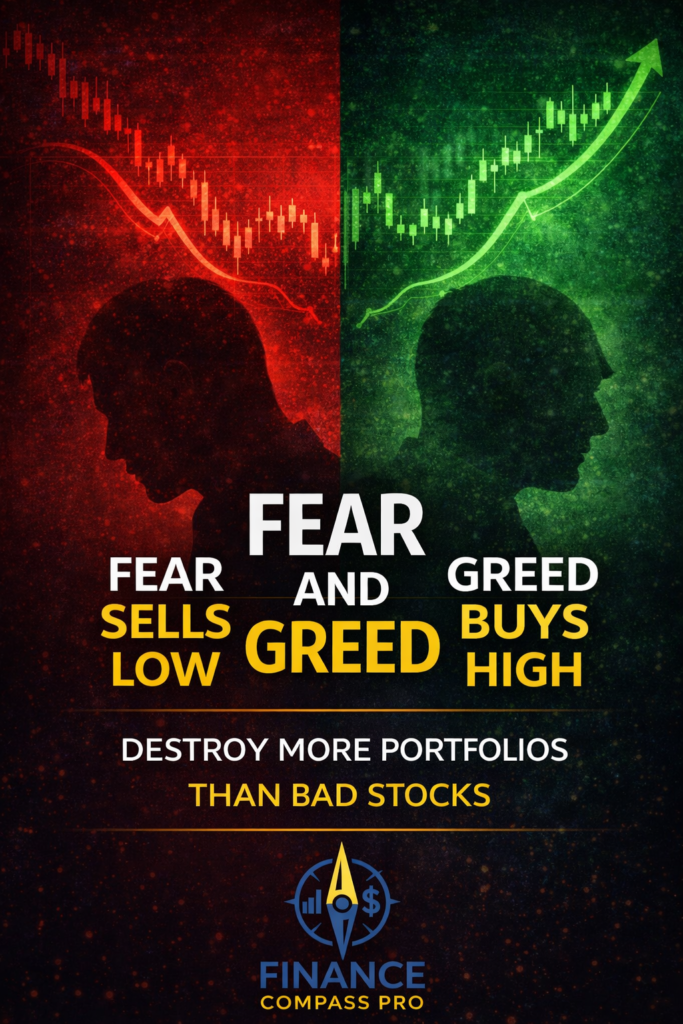
Fear-driven selling. The market drops significantly. Headlines turn apocalyptic. You sell your holdings to “stop the losses.” Then the market recovers – as it has after every single downturn in history – and you’ve locked in permanent losses by selling at the bottom.
Greed-driven buying. A sector is surging. Everyone is talking about it. You pile in near the top, driven by fear of missing out. When the hype fades and prices correct, you’re left holding an overvalued position.
Both patterns share the same root cause: making decisions based on how you feel in the moment rather than what your strategy calls for.
The most effective protection against emotional investing is a written strategy you commit to in advance – one that explicitly says what you will and won’t do during market volatility. When the moment of panic comes (and it will), you’re not deciding what to do. You’re following a plan you already made.
“The investor’s chief problem – and even his worst enemy – is likely to be himself.”
– Benjamin Graham
Mistake #5: Ignoring Investment Fees
Fees are the most boring topic in investing. They’re also one of the most expensive things most investors never pay attention to.
Here’s why they matter: fees compound just like returns do – except in the wrong direction.
Consider two investors who each put $10,000 into the market for 30 years, earning 7% annual returns before fees:
The Real Cost of Investment Fees Over Time
| Annual Fee | Value After 30 Years | Total Lost to Fees |
|---|---|---|
| 0.03% (low-cost index fund) | ~$74,500 | ~$500 |
| 0.50% (mid-range fund) | ~$68,000 | ~$7,000 |
| 1.00% (active mutual fund) | ~$61,400 | ~$13,600 |
| 1.50% (high-fee fund) | ~$55,400 | ~$19,600 |
Based on $10,000 initial investment, 7% gross annual return, 30-year period. Illustrative only.
The difference between a 0.03% expense ratio and a 1.00% expense ratio doesn’t sound dramatic. Over 30 years, it’s more than $13,000 on a single $10,000 investment.
For most beginner investors, the practical takeaway is simple: choose index funds and ETFs with low expense ratios (below 0.20% is a good benchmark), and avoid actively managed funds with high annual fees unless there’s a compelling reason to pay for them.
📌 Related reading: What Is an Index Fund? The Beginner’s Complete Guide

Mistake #6: Expecting Fast Profits
Investing is not a get-rich-quick mechanism. Anyone who tells you otherwise is either selling something or confused about what investing actually is.
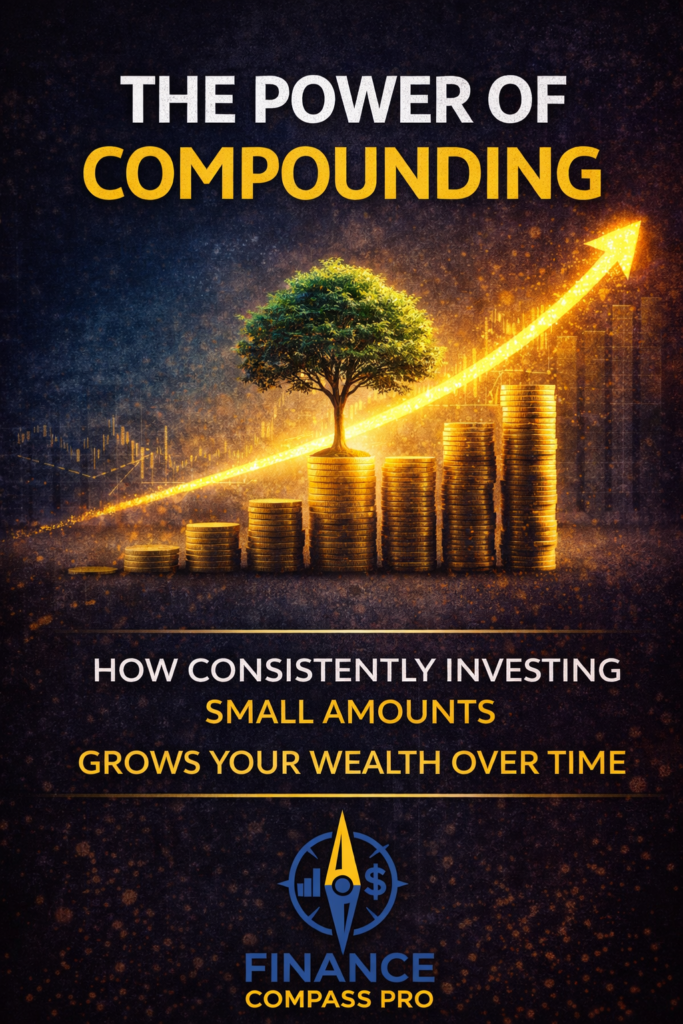
The frustrating truth is that the most reliable path to wealth through investing is also the least exciting: invest consistently in diversified, low-cost funds, and wait. For years. For decades.
Warren Buffett – worth over $100 billion – made approximately 97% of his wealth after age 65. Not because he had some late-career breakthrough, but because compounding growth takes time to produce dramatic results, and he had been invested for decades before the truly large numbers appeared.
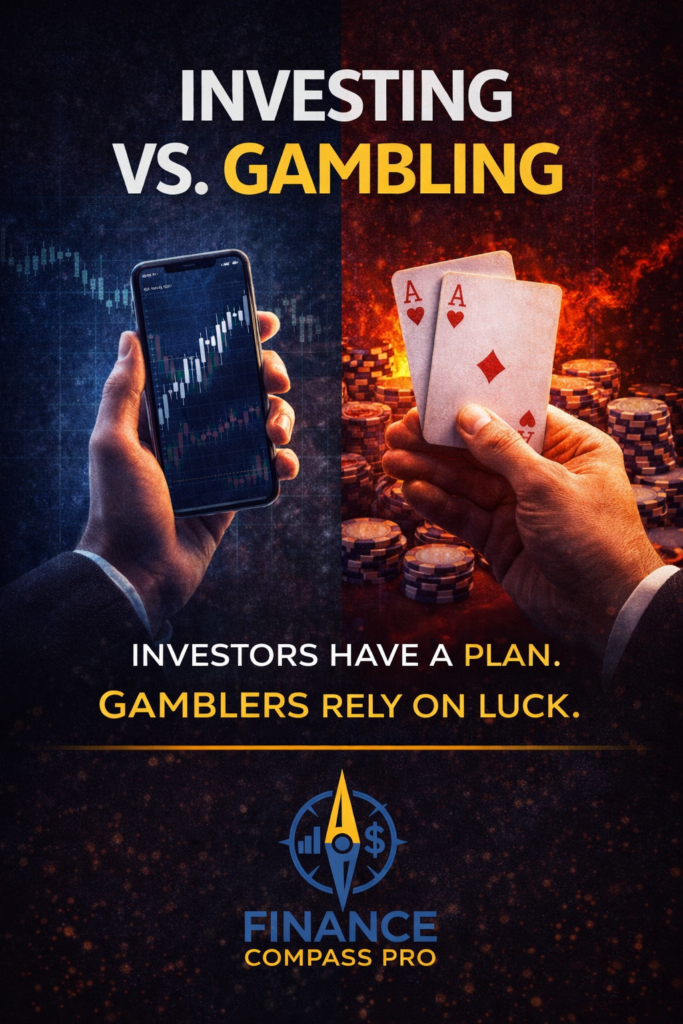
The dangerous version of this mistake is speculation dressed up as investing. Pouring money into trending assets, meme stocks, or “can’t miss” opportunities in hopes of doubling your money quickly. These bets occasionally pay off spectacularly – and far more often result in significant losses.
If you’re tempted by fast returns, ask yourself: what is my actual time horizon? If the answer is 20–30 years, a boring index fund almost certainly outperforms any high-risk strategy over that period. The math is simply not close.
📌 Related reading: How to Start Investing With $500
Mistake #7: Stopping Your Financial Education
The financial world changes. New investment vehicles appear. Tax laws shift. Market dynamics evolve. The strategies that made sense in one decade may need adjustment in the next.
Investors who treat their initial research as sufficient and never update their knowledge gradually fall behind – not because the fundamentals change (they largely don’t), but because their understanding remains static while the world around them moves.
This doesn’t mean you need to become a full-time financial researcher. But it does mean developing a habit of continued learning: reading reliable personal finance content, understanding concepts like asset allocation and rebalancing as your portfolio grows, and staying broadly aware of major economic conditions.
The compounding effect applies to knowledge as well as money. Small, consistent additions to your financial understanding build over years into a genuine edge.
The Honest Summary
Here’s what the seven mistakes above have in common: they’re all behavioral, not technical.
You don’t need to understand advanced financial modeling to avoid them. You need discipline, a clear plan, and the patience to follow it even when every instinct says otherwise.
Quick Reference: 7 Mistakes and Their Fixes
| Mistake | What It Looks Like | The Fix |
|---|---|---|
| Timing the market | Waiting for the “right moment” to invest | Dollar-cost average on a fixed schedule |
| No strategy | Investing based on headlines or trends | Define goals, risk tolerance, time horizon |
| No diversification | Heavy concentration in 1–2 stocks | Use broad index funds or ETFs |
| Emotional decisions | Panic-selling during drops | Follow a pre-written plan; automate contributions |
| Ignoring fees | Holding high-expense-ratio funds | Choose funds with <0.20% expense ratios |
| Chasing fast profits | Speculating on trending assets | Think in decades; focus on consistency |
| Stopping learning | Never updating financial knowledge | Read regularly; revisit your strategy annually |
Investing well is mostly about getting out of your own way.
Start with a simple strategy. Keep your costs low. Diversify broadly. Contribute consistently. And leave emotion at the door.
That’s not glamorous advice. But it’s the advice that actually works.
📌 Related reading: How to Build Your First Investment Portfolio
📌 Related reading: What Is Dollar-Cost Averaging and Why Smart Investors Use It
You Might Also Like:
How to Build Your First Investment Portfolio
What Is an Index Fund? The Beginner’s Complete Guide
What Is an ETF and How Does It Work?
What Is Diversification in Investing?
What Is Dollar-Cost Averaging and Why Smart Investors Use It
How to Start Investing With $100: A Beginner’s Step-by-Step Guide
How to Start Investing With $500
This article is for informational and educational purposes only and does not constitute financial advice. Fee and return projections are estimates based on illustrative scenarios and are not guaranteed. No affiliate relationships are currently in place for any platforms or tools mentioned in this post. Past performance does not guarantee future results. Always consult a qualified financial professional before making investment decisions.
Pingback: Passive Income From ETFs: How to Build Monthly Cash Flow With Minimal EffortPassive Income From ETFs: Build Cash Flow Without Managing Individual Stocks -
Pingback: What Is an Index Fund? A Beginner’s Guide to Smart Investing -
Pingback: How to Build a Simple Budget That Actually Works in 2026How to Build a Simple Budget That Actually Works in 2026 -
Pingback: The Magic of Compounding: Why Time Is Your Greatest Investment AssetThe Magic of Compounding: Why Time is Your Greatest Investment Asset -
Pingback: How to Build Your First Investment Portfolio: A Beginner’s Step-by-Step GuideHow to Build Your First Investment Portfolio -
Pingback: Investing for Beginners: The Complete Guide to Building Wealth in 2026Investing for Beginners: The Complete Guide to Building Wealth in 2026 -
Pingback: Stocks vs ETFs for Beginners: Which Investment Is Better for You?Stocks vs ETFs for Beginners: Which Investment Is Better for You? -
Pingback: How to Start Investing With $500 (Step-by-Step Beginner Guide)How to Start Investing With $500 -
Pingback: 7 Simple Money Habits That Will Transform Your Finances in 20267 Simple Money Habits That Will Transform Your Finances in 2026 -
Pingback: How Your Credit Score Affects Your Financial Future -
Pingback: The 5 Pillars of Smart Investing Every Beginner Should UnderstandThe 5 Pillars of Smart Investing Every Beginner Should Understand -
Pingback: How to Invest Your First Paycheck: A Simple Guide to Start Building Wealth EarlyHow to Invest Your First Paycheck -
Pingback: Which Is Better for Beginners ETFs or StocksWhich Is Better for Beginners ETFs or Stocks -
Pingback: Why Beginners Lose Money Investing (And How to Stop It From Happening to You)Why Beginners Lose Money Investing (And How to Stop It From Happening to You) -