When someone asks me where to start with investing, my answer is almost always the same: three funds. Not because I’m lazy. Because after everything I’ve seen, it’s genuinely the best starting point for most people.
Most beginners think building a strong investment portfolio requires picking dozens of stocks, monitoring 15 different assets, and constantly rebalancing.
Many beginners search for a simple ETF portfolio strategy, but end up overcomplicating their investments.
It turns out, that’s not how it works.
Some of the world’s most respected financial thinkers recommend a radically simple alternative: a portfolio built from just three ETFs.
That’s it. Three funds. Total global coverage. Near-zero fees. And a strategy that beats most actively managed portfolios over the long run.
Here’s everything you need to know about the 3 ETF portfolio strategy.
WHO THIS STRATEGY IS FOR
If you’re looking for the simplest way to build a diversified investment portfolio without picking individual stocks, this strategy is for you.
If you’re a beginner trying to understand how to invest using ETFs step by step, you’re in the right place.
What Is a 3 ETF Portfolio?
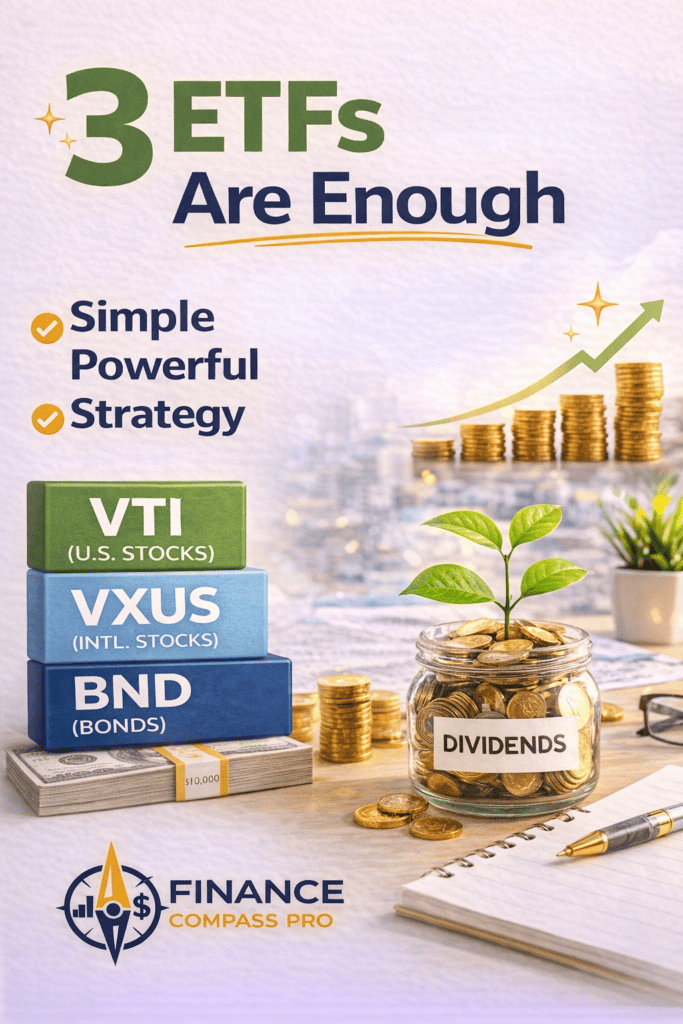
A 3 ETF portfolio – sometimes called a three-fund portfolio – is a diversified investment strategy using just three low-cost index funds to cover the major asset classes:
- U.S. stocks – Large, mid, and small cap companies across the entire American market
- International stocks – Developed and emerging markets outside the U.S.
For the international stock portion of a simple 3-ETF portfolio, many beginners look at VXUS because it provides broad exposure to stocks outside the United States. Our VXUS ETF guide explains what it holds and whether international stocks belong in your portfolio. - Bonds – Fixed-income securities that reduce volatility and preserve capital
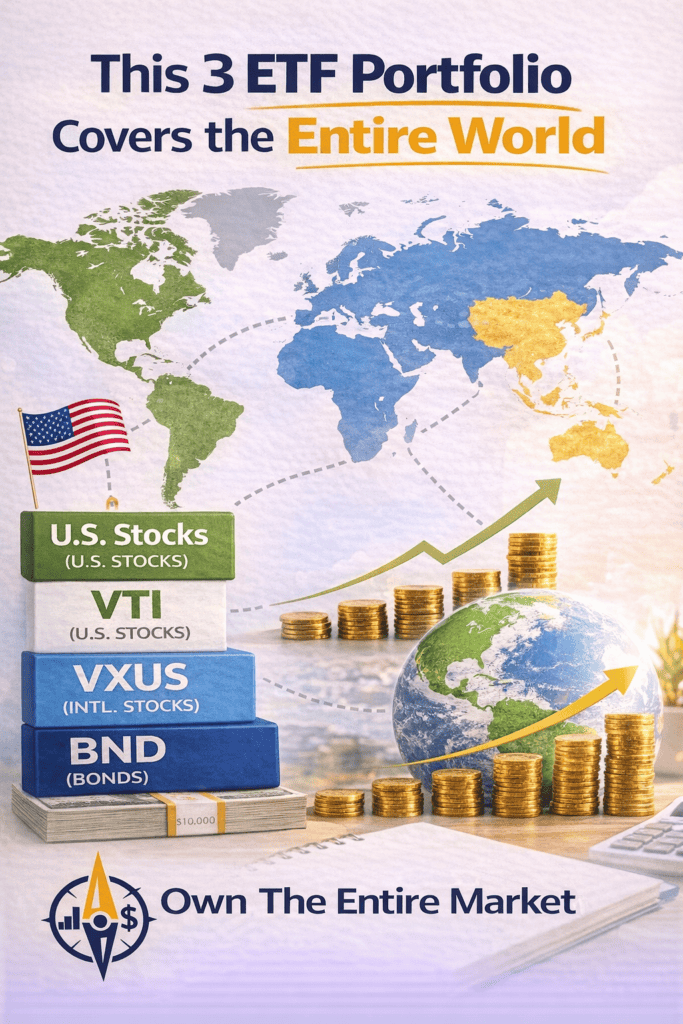
Together, these three funds give you exposure to thousands of companies and assets across the globe. You’re not betting on any single company or sector. You’re owning the whole market.
If you prefer even more simplicity, VT ETF combines the U.S. and international stock components into one fund. If you want to move from the concept to an actual implementation sequence, continue with How to Build a 3-ETF Portfolio Step by Step (Your First 90 Days). For the individual building blocks, see VTI ETF Explained, VXUS ETF Explained, and BND Explained.
This approach was popularized by John Bogle, founder of Vanguard and the father of index fund investing. The philosophy: keep it simple, keep fees low, stay invested long-term.
If you’re new to ETFs, start here:
- What Is an ETF and How Does It Work? A Beginner’s Guide to Smart Investing
- What Is an Index Fund? A Beginner’s Guide to Smart Investing
Why Three ETFs Is Enough
A common question: “Isn’t three funds too simple? Don’t I need more?”
No – and here’s why.
For the U.S. stock portion of a simple three-fund portfolio, many beginners compare VOO and VTI. Our VOO vs VTI guide explains the practical difference between S&P 500 exposure and total U.S. market exposure.VTI alone holds over 3,700 U.S. stocks. You get Apple, Microsoft, Tesla, and thousands of smaller companies in a single fund. Adding more U.S. funds doesn’t increase diversification – it just creates overlap.
VXUS covers 7,700+ stocks across 47 countries. Europe, Japan, China, India, Australia – it’s all there.
Add BND for bond exposure and you have a truly global, multi-asset portfolio. You’d need a spreadsheet of 20+ individual stock picks to even approximate this level of diversification – with much higher fees.
For a complete breakdown of what BND holds, why bonds behave differently from stocks, and how much to allocate by age, see our guide on BND explained. If you are deciding between BND and a similar fund from a different issuer, AGG vs. BND compares the two.
More complexity does not equal better returns. Often, it means the opposite.
For a broader understanding of beginner investing, see:
The Classic 3 ETF Portfolio Setup
Here are the three funds most commonly recommended for this strategy:
| ETF | Full Name | Expense Ratio | Coverage |
|---|---|---|---|
| VTI | Vanguard Total Stock Market ETF | 0.03% | ~3,700 U.S. stocks |
| VXUS | Vanguard Total International Stock ETF | 0.07% | ~7,700 international stocks |
| BND | Vanguard Total Bond Market ETF | 0.03% | ~10,000 U.S. bonds |
The three-fund portfolio is designed to stay simple, but some investors add small satellite positions for specific exposure. For example, a REIT ETF can add real estate exposure on top of a core stock-and-bond portfolio.
Total annual fee on a $10,000 portfolio: roughly $4~7 per year.
Compare that to the average actively managed mutual fund, which charges 0.5-1.0% annually – that’s $50-$100 per year on the same $10,000, for returns that typically underperform the index anyway. To understand exactly how the blended expense ratio on a 3-ETF portfolio compares to other options, see ETF Expense Ratios Explained.
Fidelity alternatives (no minimums, great for beginners):
- FSKAX (Fidelity Total Market Index) = VTI equivalent
- FTIHX (Fidelity Total International Index) = VXUS equivalent
- FXNAX (Fidelity US Bond Index) = BND equivalent
Schwab alternatives:
- SCHB (Schwab US Broad Market ETF)
- SCHF (Schwab International Equity ETF)
- SCHZ (Schwab US Aggregate Bond ETF)
How to Allocate the Three Funds
The right split depends on your age and risk tolerance. Here’s a simple framework:
The 100 Minus Your Age Rule
Subtract your age from 100. That’s your stock allocation. The rest goes to bonds.
| Age | U.S. Stocks (VTI) | International (VXUS) | Bonds (BND) |
|---|---|---|---|
| 25 | 54% | 36% | 10% |
| 35 | 49% | 31% | 20% |
| 45 | 39% | 26% | 35% |
| 55 | 29% | 21% | 50% |
Within the stock allocation, a common split is 60% U.S. / 40% International – though some investors prefer 70/30 or even 80/20 if they believe in U.S. market dominance.
More aggressive version (for younger investors who can tolerate volatility):
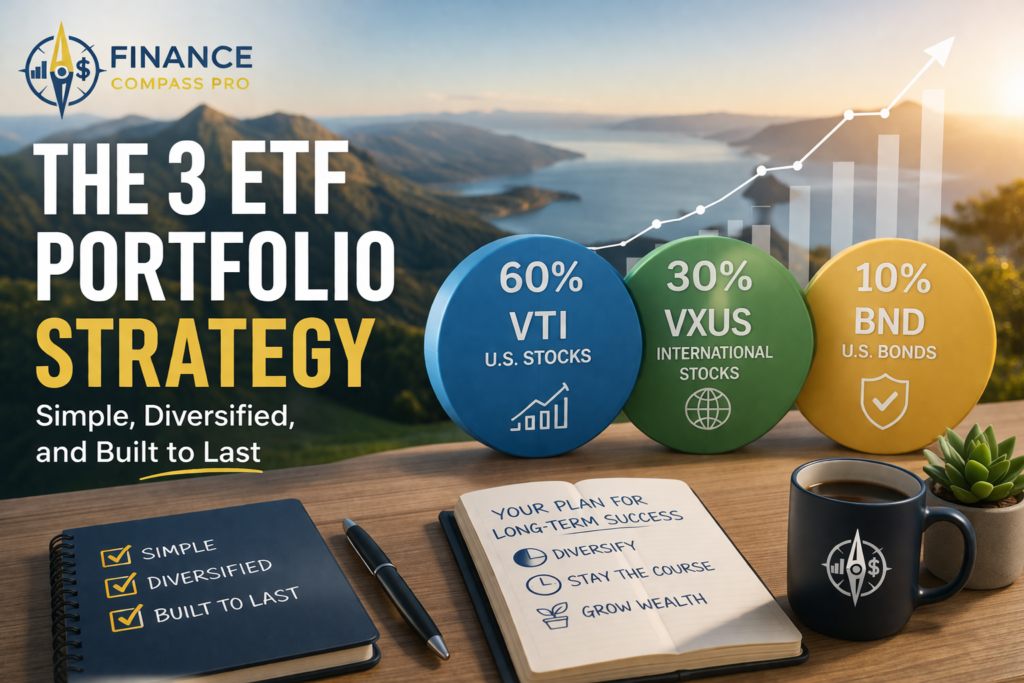
- VTI: 60%
- VXUS: 30%
- BND: 10%
More conservative version (for investors closer to retirement):
- VTI: 40%
- VXUS: 20%
- BND: 40%
There’s no single “correct” answer. The best allocation is one you can stick with through market downturns without panicking and selling.
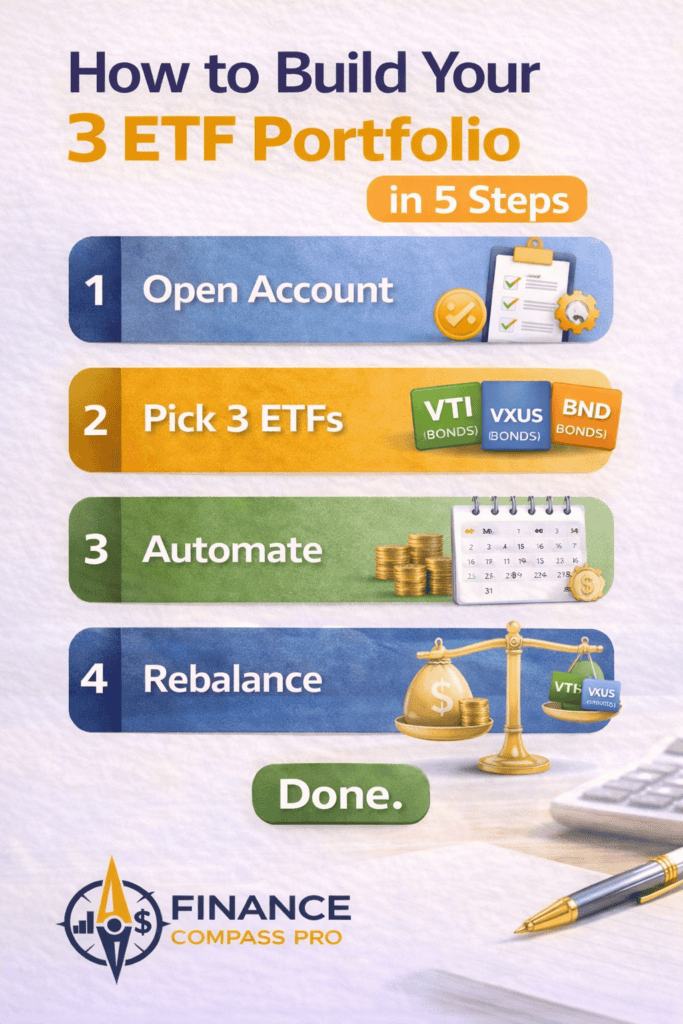
Step-by-Step: How to Build Your 3 ETF Portfolio
Step 1: Open a brokerage account
For tax advantages, start with a Roth IRA or traditional IRA. Once that’s maxed, move to a taxable brokerage account. Fidelity, Schwab, and Vanguard are all excellent choices with $0 minimums and $0 commissions.
Not sure how to open one? How to Open a Brokerage Account in 2026 walks you through the entire process in under 15 minutes.
If you’re unsure which platform to choose, a full comparison guide is coming soon.
Step 2: Decide your allocation
Use the age-based framework above as a starting point. Adjust based on your personal risk tolerance. If seeing a 30% portfolio drop would cause you to sell everything, add more bonds.
Step 3: Buy your three ETFs
This is literally three purchases. Search each ticker (VTI, VXUS, BND), decide how many shares to buy based on your allocation percentages, and execute the trades.
Most platforms now offer fractional shares – so you can invest exactly $100 and split it $60/$30/$10 without worrying about share prices.
If you’re starting with a smaller amount, see:
- How to Start Investing With $100: A Beginner’s Step-by-Step Guide
- How to Start Investing With $500: A Step-by-Step Beginner’s Plan That Actually Works
Step 4: Automate contributions
Set up automatic monthly transfers and auto-invest into your ETFs. This ensures you keep buying on a regular schedule regardless of market conditions.
Step 5: Rebalance once a year
Over time, your allocation will drift as different assets grow at different rates. Once a year (or when an asset class drifts more than 5% from target), rebalance back to your original percentages. For the full process, see How to Rebalance Your Portfolio.
How Rebalancing Works
Imagine you start with:
- VTI: 60% ($6,000)
- VXUS: 30% ($3,000)
- BND: 10% ($1,000)
After one strong year for U.S. stocks, your portfolio might look like:
- VTI: 68% ($7,800)
- VXUS: 25% ($2,900)
- BND: 7% ($800)
Rebalancing means selling some VTI and buying more VXUS and BND to get back to 60/30/10.
Pro tip: In a Roth IRA, rebalancing is tax-free. In a taxable account, selling can trigger capital gains taxes – so in taxable accounts, it’s often smarter to rebalance by directing new contributions toward underweighted funds rather than selling. For a deeper look at tax-efficient investing with ETFs, see ETF Taxes Explained.
Common Questions About the 3 ETF Portfolio
“Should I add a sector ETF like tech or healthcare?”
You don’t need to. VTI already includes all tech and healthcare stocks proportionally. Adding a sector ETF just increases your concentration risk in that sector.
“What about dividend ETFs?”
VTI and VXUS both pay dividends (typically 1.5-2% annually). These are automatically reinvested if you set DRIP (dividend reinvestment plan) on. A separate dividend ETF isn’t necessary for most investors.
“Is the 3 ETF portfolio good for retirement accounts?”
Yes – it’s arguably ideal for retirement accounts. Low fees compound over decades. The simplicity means you’ll stick with it during volatile periods.
“What if I only have $100 to start?”
Start with one fund – VTI. Add VXUS when you have enough to split meaningfully. Add BND as your portfolio grows and your timeline to retirement gets shorter.
3 ETF Portfolio vs. Target-Date Funds
| Feature | 3 ETF Portfolio | Target-Date Fund |
|---|---|---|
| Customization | High | None |
| Complexity | Low | Zero |
| Fees | Very low (0.03–0.07%) | Low (0.10–0.15%) |
| Auto-rebalancing | Manual | Automatic |
| Best for | Hands-on beginners | Truly passive investors |
Both are excellent choices. The 3 ETF portfolio gives you slightly more control and lower fees. A target-date fund is perfect if you never want to think about rebalancing at all.
The Bottom Line
The 3 ETF portfolio strategy is one of the most powerful things a beginner investor can do.
Not because it’s complex. Because it isn’t.
Three funds. Global diversification. Fees so low you’ll barely notice them. A strategy you can explain to anyone in under two minutes.
The hardest part isn’t building it. It’s resisting the urge to tinker with it.
I’ve seen people switch from a 3-fund portfolio to something more “sophisticated” – only to come back two years later with lower returns and higher fees. Simple works. Let it.
Buy VTI, VXUS, and BND. Set automatic contributions. Rebalance once a year. Then let compound interest do the work.
You don’t need more complexity. You need a system you can follow for decades.
For the broader portfolio-building framework around this three-fund concept, continue with How to Build Your First Investment Portfolio.
This article is for informational and educational purposes only and does not constitute financial advice. No affiliate relationships are currently in place for any platforms or tools mentioned in this post. Past performance does not guarantee future results. Always consult a qualified financial professional before making investment decisions.