
Wall Street loves active investing. Financial media loves it. Stock pickers love it.
The data? Not so much.
Active vs. passive investing is one of the most debated topics in personal finance. But for most beginners – and honestly, for most professional investors too – the answer is clearer than the industry wants you to believe.
Let’s break down exactly what each strategy is, how they compare, and which one fits your situation.
The Definitions
Active Investing
Active investing means trying to outperform the market by selecting individual securities, timing trades, or paying a portfolio manager to do it for you. This comparison is about portfolio strategy, not short-term trading rules, so the focus here stays on the long-term active-versus-passive decision.
Goals: Beat the market average
Methods: Individual stock picking, sector rotation, market timing
Examples: Managed mutual funds, hedge funds, individual stock portfolios
Passive Investing
Passive investing means owning a broad slice of the market through index funds or ETFs – and not trying to beat it. Just match it.
Goals: Match the market return, minimized costs
Methods: Buy-and-hold index funds, ETFs
Examples: S&P 500 index fund, total market ETFs, target-date funds
How Each Strategy Actually Performs
Here’s where it gets interesting.
S&P Dow Jones Indices tracks how many actively managed funds beat their benchmark index over time. The results are consistent and striking:
| Time Period | % of Active Funds That Beat the S&P 500 |
|---|---|
| 1 year | ~40–50% |
| 5 years | ~25–30% |
| 10 years | ~15–20% |
| 20 years | ~5–10% |
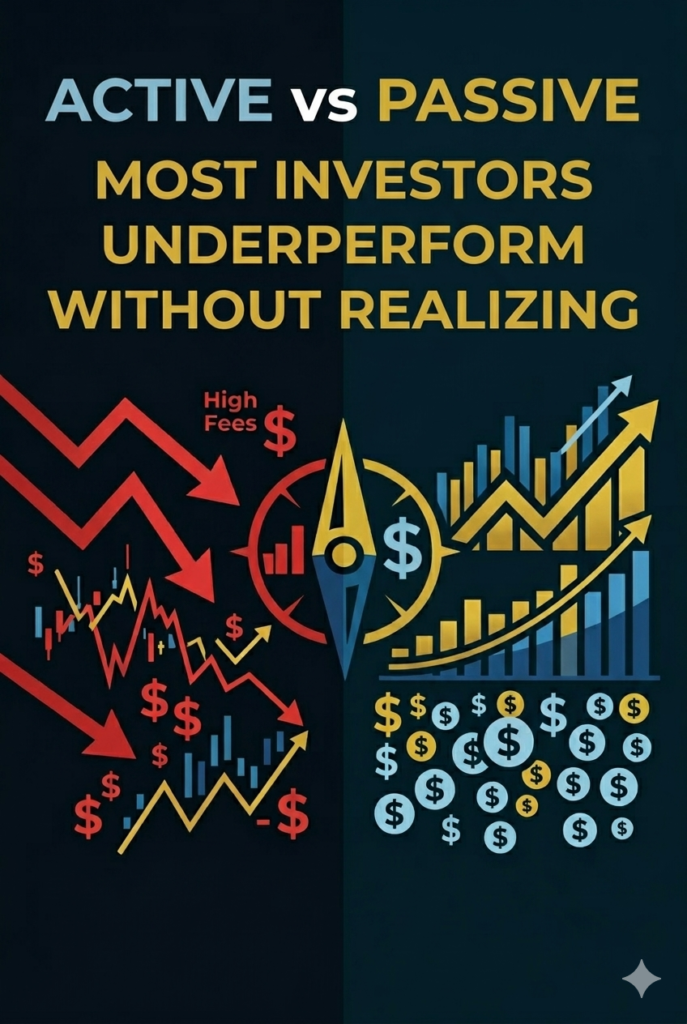
Over long time periods, roughly 90% of actively managed funds underperform simple index funds.
The longer the time horizon, the worse active investing looks compared to passive.
Wait, if the pros struggle to beat the market, how should you approach your own journey? If you are just starting out, it might be helpful to look at a Investing for Beginners: The Complete Guide to Building Wealth in 2026
to see where these strategies fit into your overall plan.
The Cost Problem
Costs are the hidden killer of active investing.
| Strategy | Typical Annual Fee |
|---|---|
| Active mutual fund | 0.50% – 1.50% |
| Actively managed ETF | 0.30% – 1.00% |
| Index ETF (e.g., VOO) | 0.03% – 0.10% |
| Index mutual fund | 0.02% – 0.15% |
The fee difference between passive index funds and actively managed mutual funds is one of the clearest reasons the data consistently favors passive strategies over the long run.
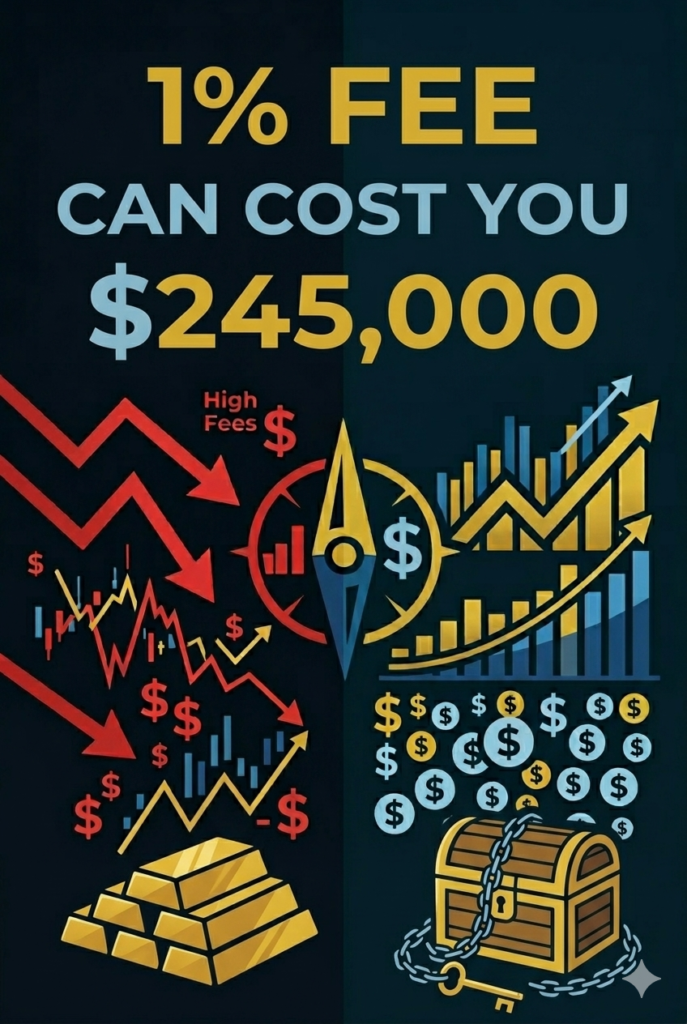
That 1% difference doesn’t sound like much. But compounded over decades, it’s enormous.
On a $100,000 portfolio over 30 years at 8% growth:
- Active fund (1% fee): ~$761,000
- Index fund (0.03% fee): ~$1,006,000
The fee difference alone costs you over $245,000.
This is exactly why avoiding unnecessary fees is one of the most important rules in investing – see 7 Investing Mistakes Beginners Should Avoid.
The Case for Active Investing
To be fair, active investing isn’t without merit in some contexts.
Niche markets: In less-efficient markets (small-cap foreign stocks, emerging markets), skilled managers can sometimes find genuine information advantages.
Specific goals: Some investors want tailored tax management, ESG screening, or concentrated positions that index funds can’t offer.
Talented managers: Yes, some managers consistently outperform. The problem is identifying them in advance – and past performance notoriously does not predict future results.
Downside protection: Some actively managed strategies aim to limit losses during bear markets, which pure passive investors don’t get.
These are real advantages. But for the average beginner investor? The data strongly favors passive.
The Case for Passive Investing
The argument for passive investing is almost embarrassingly simple:
- You can’t know which active managers will outperform going forward
- Even if they outperform, their fees often erase the advantage
- Markets are efficient enough that consistent outperformance is rare
- Index funds give you broad diversification automatically
- Less trading = lower taxes and lower costs,
Pair this with a consistent contribution schedule – What Is Dollar-Cost Averaging? explains exactly how.
“Don’t look for the needle in the haystack. Just buy the haystack.” – Jack Bogle, founder of Vanguard
Passive investors don’t need to research individual companies, follow earnings reports, or predict macroeconomic trends. They simply own the whole market and let time do the work.
For more on how index funds work, see our guide → What Is an Index Fund? A Beginner’s Guide to Smart Investing

Which Approach Is Right for You?
| Consider Passive If… | Consider Active If… |
|---|---|
| You’re a beginner | You have deep market expertise |
| You want low fees | You have access to a proven manager |
| You have a long time horizon | You want downside risk management |
| You don’t want to research stocks | You’re investing in niche markets |
| You want simplicity | You have specific ESG or tax goals |
| You can’t dedicate hours to research | You’re actively learning and accept higher risk |
For most readers of this post – passive wins. The right answer also depends heavily on your personal risk profile — how much volatility you can stomach without making emotional decisions. What Is Risk Tolerance and How to Find Yours connects your risk profile directly to which approach fits your situation. And if any of the terms in this comparison felt unfamiliar, 10 Investing Terms Every Beginner Must Know is worth bookmarking before you open your first brokerage account.
Can You Do Both?
Yes. Many experienced investors use a “core and satellite” strategy:
- Core (70~90%): Passive index funds – the stable, low-cost foundation
- Satellite (10~30%): Active picks, sector bets, or individual stocks for those who enjoy it
This lets you get the efficiency benefits of passive investing while scratching the itch to pick stocks – without betting your whole portfolio on it.
If you want to try active investing, start small. Keep it to a minority of your portfolio. Track your results against a simple index fund benchmark. That honest comparison will tell you whether you’re actually adding value.
Ready to build your own mix? Start here: How to Build Your First Investment Portfolio
The Verdict
The data is clear. For most people, most of the time, passive investing through low-cost index funds and ETFs outperforms active management over the long run. Start with passive investing. Build your portfolio around broad-market ETFs and index funds.
Are you ready to take that first step? Still deciding between picking stocks and going passive? Read Stocks vs ETFs for Beginners: Which Investment Is Better?
This article is for informational and educational purposes only and does not constitute financial advice. Investment projections and figures used in this post are estimates based on historical averages and are not guaranteed. Product, platform, fund, fee, and cost information may change over time. Past performance does not guarantee future results. Always consult a qualified financial professional before making investment decisions.