Disclosure: This article is for informational and educational purposes only. FinanceCompassPro.com may earn compensation through display advertising or affiliate relationships. We may reference third-party products, services, platforms, or tools for educational purposes. These mentions are not paid endorsements unless clearly stated. Nothing in this article constitutes personalized financial, legal, tax, or investment advice.
You’ve heard it on the news and seen it in investing apps.
You’ve probably heard someone say “just invest in the S&P 500.”
But what actually is the S&P 500?
If you’re new to investing, this guide will give you a clear, honest answer – no jargon, no fluff. By the end, you’ll know exactly what the S&P 500 is, why it matters, and how to start investing in it today.
What Is the S&P 500?
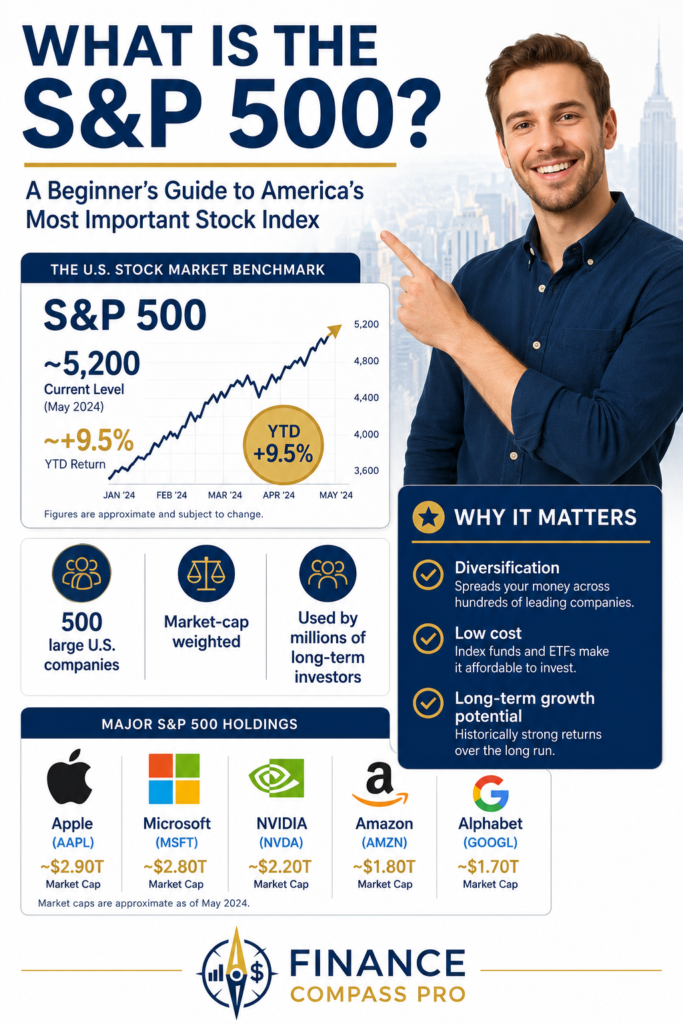
The S&P 500 is a stock market index.
It tracks the performance of 500 of the largest publicly traded companies in the United States. To fully understand what that means, it helps to know what a stock actually is before looking at how an index tracks hundreds of them at once.
“S&P” stands for Standard & Poor’s, the financial company that created and manages the index.
The “500” refers to the approximately 500 companies included.
When you hear someone say “the market went up today,” they’re usually talking about the S&P 500.
What Companies Are in the S&P 500?
The S&P 500 includes some of the most recognizable companies in the world.
Here’s a snapshot of the largest holdings as of 2026:
| Company | Ticker | Approx. Weight |
|---|---|---|
| Apple | AAPL | ~7% |
| Microsoft | MSFT | ~6.5% |
| NVIDIA | NVDA | ~6% |
| Amazon | AMZN | ~3.5% |
| Alphabet (Google) | GOOGL | ~2.5% |
| Meta | META | ~2.5% |
| Berkshire Hathaway | BRK.B | ~1.8% |
| Tesla | TSLA | ~1.5% |
Source: S&P Dow Jones Indices (weights change regularly)
The index covers 11 different sectors – technology, healthcare, financials, consumer discretionary, industrials, and more. This built-in spread is one of the reasons so many investors love it.
The S&P 500 isn’t just 500 stocks. It’s a cross-section of the entire U.S. economy.
How Does the S&P 500 Work?
The S&P 500 is a market-cap weighted index.
That means larger companies have more influence over the index’s performance than smaller ones. If Apple’s stock rises 5% in a day, it moves the S&P 500 more than a smaller company’s 5% gain would.
Companies don’t just “get in” automatically. A committee at S&P Dow Jones Indices reviews and selects companies based on strict criteria.
To qualify for the S&P 500, a company must:
- Be a U.S.-based company listed on a major exchange
- Have a market cap of at least $20.5 billion
- Be financially viable (positive earnings over the most recent quarter and the most recent four quarters combined)
- Have at least 50% of its shares available for public trading
The index is reviewed quarterly. Companies that no longer qualify get removed, and new ones take their place. This keeps the index current and relevant.
Why Does the S&P 500 Matter to Investors?
Here’s why it matters to investors – and why so many financial experts point to it first.
1. It’s the benchmark everyone uses.
When a fund manager says their portfolio “beat the market,” they mean they outperformed the S&P 500. It’s the gold standard for measuring investment performance.
2. It has a long track record of growth.
Since its creation in 1957, the S&P 500 has delivered an average annual return of approximately 10% – before inflation. Even including major crashes like 2008 and 2020, investors who stayed the course came out ahead.
| Period | Avg. Annual Return |
|---|---|
| 10-year (2016–2025) | ~12.4% |
| 20-year (2006–2025) | ~10.1% |
| 30-year (1996–2025) | ~10.6% |
| Since inception (1957) | ~10.2% |
Source: Slickcharts.com / S&P Dow Jones Indices. Past performance does not guarantee future results.
3. It’s nearly impossible to consistently beat it.
Study after study shows that over long periods, 80–90% of actively managed funds underperform the S&P 500. That’s why many financial experts – including Warren Buffett himself – recommend simply investing in the index rather than trying to pick winning stocks.
Warren Buffett’s instruction to his estate trustee: “Put 90% of the cash in a very low-cost S&P 500 index fund.”
Most people understand this in theory – but very few actually act on it. That gap is where the real difference in long-term wealth is made.
What’s the Difference Between the S&P 500 and the Dow Jones?
This is one of the most common questions beginners ask.
| S&P 500 | Dow Jones | |
|---|---|---|
| Number of companies | ~500 | 30 |
| Weighting method | Market cap | Share price |
| Coverage | Broad | Narrow |
| Best as… | Overall market gauge | Snapshot of 30 blue-chips |
The S&P 500 is generally considered the more accurate picture of the U.S. stock market because it covers far more companies across more sectors.
The Dow Jones Industrial Average (DJIA) only tracks 30 companies and is weighted by share price – meaning a company with a higher stock price has more influence, regardless of its actual size.
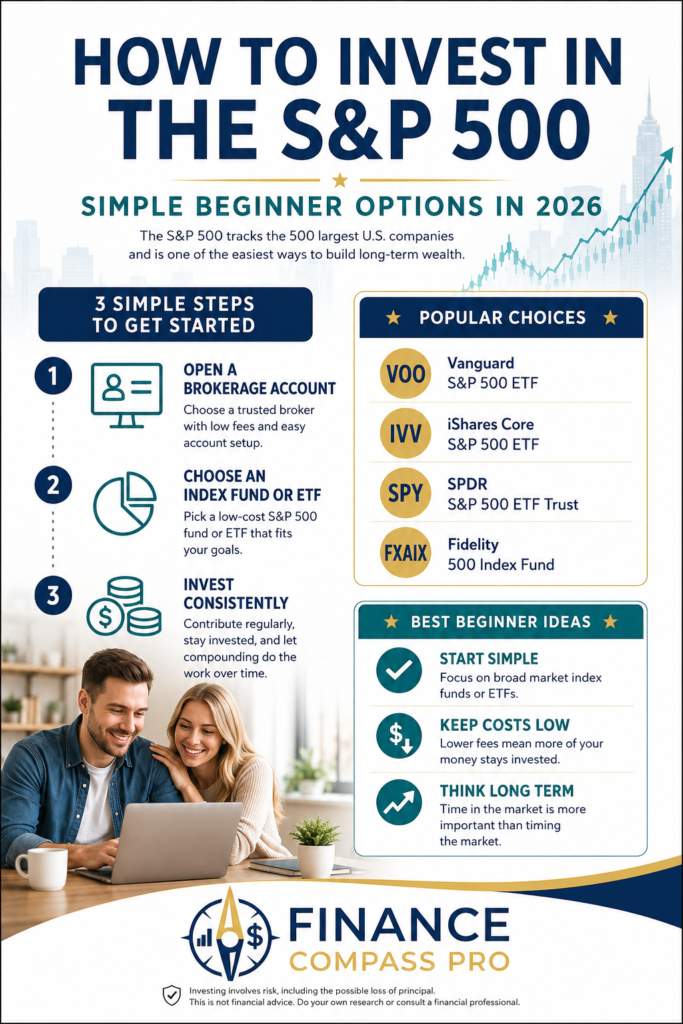
How Do You Actually Invest in the S&P 500?
You can’t buy the S&P 500 directly – it’s an index, not a stock.
But you can invest in funds that track it. These are called index funds or ETFs (Exchange-Traded Funds).
If you are not sure which ETF to choose, our guide to the best ETFs for beginners in 2026 explains how beginners can compare simple, low-cost ETF options.
The most popular options:
If you are deciding between an S&P 500 ETF like VOO and a total U.S. market ETF like VTI, our VOO vs VTI comparison explains how the two Vanguard ETFs differ and which one may suit beginners better.
| Fund | Type | Expense Ratio | Provider |
|---|---|---|---|
| VOO | ETF | 0.03% | Vanguard |
| IVV | ETF | 0.03% | iShares (BlackRock) |
| SPY | ETF | 0.0945% | State Street |
| FXAIX | Index Fund | 0.015% | Fidelity |
| SWPPX | Index Fund | 0.02% | Schwab |
Three of the most widely used S&P 500 ETFs are VOO, SPY, and IVV. They all track the same index, but they differ in cost, structure, issuer, and trading use case. For a full breakdown, see our IVV ETF comparison with VOO and SPY.
These funds buy all 500 stocks in the index in proportion to their weight. When the S&P 500 goes up, your fund goes up. When it goes down, your fund goes down.
The expense ratios above are remarkably low – less than $1 per year for every $1,000 invested. That’s one of the biggest advantages of index investing.
If you’re just getting started, platforms like Fidelity and Schwab let you open a brokerage account with no minimum and buy fractional shares for as little as $1.
If the difference between an ETF and an index fund still feels unclear, start with our guide on what an index fund is.
The S&P 500 vs. Other Indexes
The S&P 500 isn’t the only index worth knowing.
| Index | What It Tracks |
|---|---|
| S&P 500 | 500 large U.S. companies |
| NASDAQ-100 | 100 largest non-financial NASDAQ companies (heavy tech) |
| Russell 2000 | 2,000 smaller U.S. companies (small-cap) |
| Total Stock Market | Nearly all U.S. stocks (~3,500+) |
| MSCI World | Large/mid-cap stocks across 23 developed countries |
Each index has different risk and return characteristics. The S&P 500 sits in the sweet spot: large, stable companies with strong historical returns.
Does the S&P 500 Crash?
Yes. And that’s okay.
The S&P 500 has experienced significant drops throughout its history. Here are the major ones:
| Event | Peak Decline |
|---|---|
| Dot-com Bubble (2000–2002) | -49% |
| Global Financial Crisis (2007–2009) | -57% |
| COVID-19 Crash (2020) | -34% |
| 2022 Bear Market | -25% |
What matters is what happened afterward. In every single case, the S&P 500 eventually recovered and went on to reach new all-time highs.
This is why time in the market beats timing the market.
If you had invested $10,000 in an S&P 500 index fund in January 2009 – right in the middle of the financial crisis – that investment would be worth over $80,000 today.
If you are worried about investing at the wrong time, dollar-cost averaging is one of the simplest ways to invest consistently without trying to predict market bottoms.
Is the S&P 500 the Right Investment for You?
For most beginners, yes – it’s a strong starting point.
Here’s why it works:
- Automatic diversification. You own a tiny piece of 500 companies across every major sector.
- Low cost. Expense ratios are near zero.
- Proven long-term returns. ~10% average annually over decades.
- Simplicity. You don’t need to pick stocks, analyze companies, or time the market.
The S&P 500 isn’t perfect. It doesn’t include international stocks, small-cap companies, or bonds. A truly diversified portfolio might also include a total international fund and a bond fund.
But as a foundation? It’s hard to beat.
If you want to build around the S&P 500 while still adding international stocks and bonds, The 3 ETF Portfolio Strategy explains the concept and allocation logic before you move into execution.
Key Takeaways
- The S&P 500 is an index tracking 500 of the largest U.S. companies.
- It’s market-cap weighted, meaning bigger companies have more influence.
- Historical average annual return: ~10% since 1957.
- You invest through ETFs or index funds like VOO, IVV, SPY, or FXAIX.
- It crashes periodically – but has always recovered.
- For most beginners, it’s one of the smartest, simplest investments available.
FAQ
A. It’s theoretically possible but extremely unlikely. For that to happen, 500 of America’s biggest companies would all have to go to zero simultaneously. What’s more likely is temporary losses during market downturns – which history shows always recovered.
A. As little as $1, if you use a platform like Fidelity or Schwab that offers fractional shares.
A. Trying to time the market is a losing game for most investors. The evidence strongly supports investing consistently over time rather than waiting for the perfect moment.
A. All three track the same index. VOO and IVV have slightly lower expense ratios (0.03% vs. 0.0945% for SPY), making them marginally more cost-efficient for long-term investors.
A. No index goes up in a straight line. But the long-term trend of the S&P 500 has been upward for over 60 years. Short-term dips are normal and expected. Long-term investors who stayed invested have historically been rewarded.
Start Here
The S&P 500 is where many long-term investors begin.
Not because it’s exciting, but because decade after decade, it works.
If you are ready to move beyond understanding the index and actually build a portfolio around it, start with our step-by-step guide on How to Build Your First Investment Portfolio (Step-by-Step Guide).
📋 DISCLAIMER
This article is for informational and educational purposes only and does not constitute financial advice. ETF data, fund structures, and expense ratios referenced reflect publicly available information as of early 2026 and are subject to change. Verify current details at the fund provider’s website before investing. Some tools or platforms may be mentioned for educational purposes to help you take action and begin investing more effectively.