Disclosure: This post is for informational and educational purposes only. FinanceCompassPro.com may earn compensation through display advertising. We may also reference third-party products, services, or platforms by name for educational purposes – these mentions are not paid endorsements unless explicitly stated. Nothing in this post constitutes personalized financial, legal, tax, or investment advice.

BND is the Vanguard Total Bond Market ETF – a single fund that holds thousands of U.S. bonds and pays the interest out as monthly income. Whether it belongs in your portfolio comes down to one question: how much time do you have before you need the money?
If you’ve already built a portfolio around VOO or VTI and added VXUS for international exposure, bonds are usually the last piece left – and BND is the simplest way to add it. That’s why BND shows up so often in a simple three-fund portfolio: one U.S. stock fund, one international stock fund, one bond fund.
This guide explains what BND actually holds, why bonds behave differently from stocks, how much of your portfolio might go toward bonds, and how BND fits into a simple long-term investing structure.
What Is BND?
BND is the Vanguard Total Bond Market ETF. It holds thousands of U.S. investment-grade bonds in a single fund – government bonds, corporate bonds, and mortgage-backed securities, spanning short, intermediate, and long maturities.
In plain terms: where VOO or VTI gives you ownership in companies, BND gives you loans to governments and corporations that pay you interest in return. For official fund details, see the Vanguard BND product page.
| Feature | BND ETF |
|---|---|
| Full name | Vanguard Total Bond Market ETF |
| Issuer | Vanguard |
| Coverage | U.S. investment-grade bond market |
| Bond types | Government, corporate, and mortgage-backed bonds |
| Expense ratio | 0.03% |
| Typical portfolio role | Stability and income allocation |
Fund holdings, expense ratios, and yields can change over time. Verify current figures on the fund sponsor’s website before investing.
For a refresher on what a bond actually is before going further, see our guide on what a bond is and how it works.

Why Bonds Behave Differently Than Stocks
A bond is essentially a loan. When you own a bond – or a fund full of them, like BND – you’re owed regular interest payments and the return of the original amount when the bond matures. That structure makes bonds behave very differently from stocks.
Lower Expected Returns
Over long periods, bonds have historically returned less than stocks. That’s the tradeoff for the lower volatility bonds typically provide. BND is not designed to be a growth engine – it’s designed to be a stabilizer.
Lower Volatility (Usually)
Bond prices move less dramatically than stock prices in most market conditions. This is the main reason investors add bonds: to reduce how much a portfolio swings up and down, especially as they get closer to needing the money.
Interest Rate Sensitivity
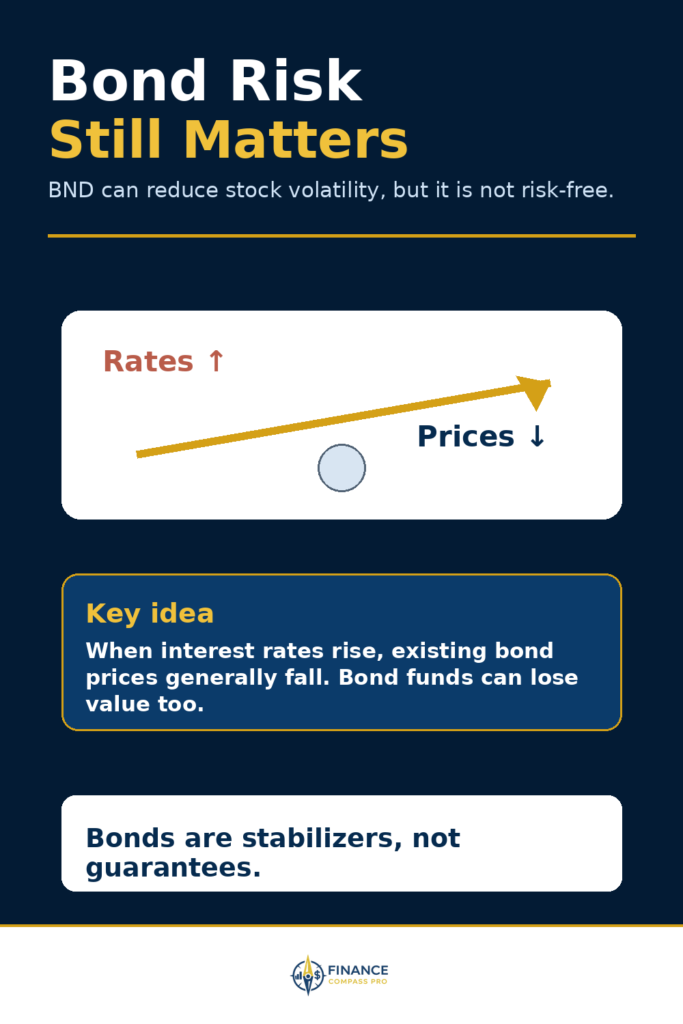
Bond prices move inversely to interest rates. When rates rise, existing bond prices generally fall, because new bonds are issued paying higher rates, making older, lower-rate bonds less attractive. When rates fall, existing bond prices generally rise. BND isn’t immune to this – 2022 was a notable example, when rising rates caused bond funds, including BND, to post unusually large losses for a typically “safe” asset class.
That episode is worth remembering: bonds reduce volatility relative to stocks over most periods, but they aren’t risk-free, and they can lose value too.
Why Add Bonds at All?
Smoother Portfolio Behavior
Bonds often (though not always) move differently than stocks during downturns, which can reduce how far your total portfolio falls during a bad year for stocks. This isn’t guaranteed – bonds and stocks can decline together, as 2022 demonstrated – but historically the relationship has provided some cushioning more often than not.
Income
Bonds pay regular interest, which BND distributes as monthly income. For investors who want cash flow from their portfolio – particularly those approaching or in retirement – this income stream is a meaningful feature, separate from total return.
A Place to Reduce Risk as Goals Get Closer
A 25-year-old investing for retirement decades away has little need to dampen volatility – time will smooth out stock market swings. Someone five years from retirement, or saving for a near-term goal like a house down payment, has much less time to recover from a stock market drop. Bonds give that investor a way to dial down risk without leaving the market entirely.
The Case Against Adding Bonds (For Some Investors)
Bonds aren’t right for every portfolio at every stage, and it’s worth being direct about why.
- Long time horizons may not need them: Investors who are decades from needing the money, and who can tolerate volatility, have historically been better off staying fully invested in stocks rather than holding bonds that drag down long-term returns.
- Lower long-term growth: Adding bonds to a portfolio generally means accepting a lower expected long-term return in exchange for smoother short-term behavior.
- Interest rate risk is real: As 2022 showed, bonds can lose value too – they aren’t a guaranteed safe harbor in every environment.
For these reasons, many young investors with long time horizons choose to skip bonds entirely until they’re closer to needing the money. There’s no universal rule – it depends on your timeline and how you’d react to a significant stock market drop.

How Much Should You Hold in BND?
There’s no single right answer, but a few common reference points show up across the industry:
| Investor Profile | Common Bond Allocation | Reasoning |
|---|---|---|
| 20s-30s, long horizon | 0-10% | Decades to recover from stock volatility |
| 40s-50s | 10-30% | Balancing growth with reduced volatility |
| Near or in retirement | 30-50%+ | Capital preservation and income become priorities |
These are general reference points, not personalized recommendations. The right allocation depends on your goals, risk tolerance, and time horizon.
A simple rule of thumb some investors use as a rough starting point is holding a bond percentage roughly equal to their age – though this is a dated heuristic, and many modern investors with longer life expectancies and higher risk tolerance use a lower percentage than their age would suggest. It’s a starting conversation, not a formula to follow exactly. For a deeper look at how risk tolerance should shape this decision, see our guide on what risk tolerance is and how to find yours.
BND vs. Other Bond Fund Options
BND isn’t the only way to add bond exposure. It is popular because it gives beginners broad U.S. bond market exposure in a single ETF, but other bond funds can serve different roles.
- AGG (iShares Core U.S. Aggregate Bond ETF) – a similar total-bond-market fund from a different issuer, often used as a close alternative to BND. For a full side-by-side comparison, see AGG vs. BND.
- BNDX (Vanguard Total International Bond ETF) – international bonds, often paired with BND for global fixed-income diversification
- SHY / VGSH (short-term Treasury ETFs) – shorter maturities, less sensitive to interest rate changes, but typically lower yield
- TLT / VGLT (long-term Treasury ETFs) – longer maturities, more sensitive to interest rate changes, typically higher yield
For most beginners, BND’s broad, intermediate-duration approach is a reasonable single starting point rather than trying to pick specific bond maturities or sectors individually.

Where BND Fits in a Portfolio
BND is the third piece in one of the most common simple portfolio structures: a U.S. stock fund (like VTI or VOO), an international stock fund (like VXUS), and a bond fund (BND). Together, these three funds can provide broad diversification across asset classes, geographies, and risk levels in just three holdings.
If you want to simplify even further, pairing BND with VT ETF creates a two-fund portfolio. VT covers both U.S. and international stocks in one ticker. Together with BND, that gives you the entire world’s stocks and bonds in just two funds.
For a complete walkthrough of how these three funds work together, see our guide on the 3 ETF portfolio strategy.
BND can be held in a taxable brokerage account, a Roth IRA, or a Traditional IRA. One detail worth knowing: bond interest is generally taxed as ordinary income, not at the lower long-term capital gains rate that applies to qualified stock dividends – which is one reason some investors prefer to hold bond funds inside tax-advantaged accounts like an IRA when possible.
For a broader look at how stocks and bonds should be balanced based on your age and goals, see our guide on stocks vs. bonds.
The Bottom Line
BND gives beginner investors a simple way to own thousands of U.S. bonds in a single, low-cost fund. Its job isn’t to maximize returns – it’s to add stability, income, and a counterweight to stock market volatility.
How much BND belongs in your portfolio – if any – depends heavily on your time horizon. Younger investors with decades ahead of them often hold little to no bonds, while investors approaching a major financial goal typically hold more. There’s no universal answer, but understanding what BND does and doesn’t do is the first step to deciding if and how it fits.
READY TO KEEP BUILDING?
If you want to see how BND works alongside U.S. stocks and international stocks, start with our guide to the 3 ETF portfolio strategy.
If you’re still deciding how much of your portfolio should go into stocks, bonds, and cash, read our guide on what asset allocation is.
For the broader picture of how core, dividend, international, bond, and growth ETFs fit together, see ETFs for Beginners: How to Choose, Compare, and Build a Simple Portfolio.