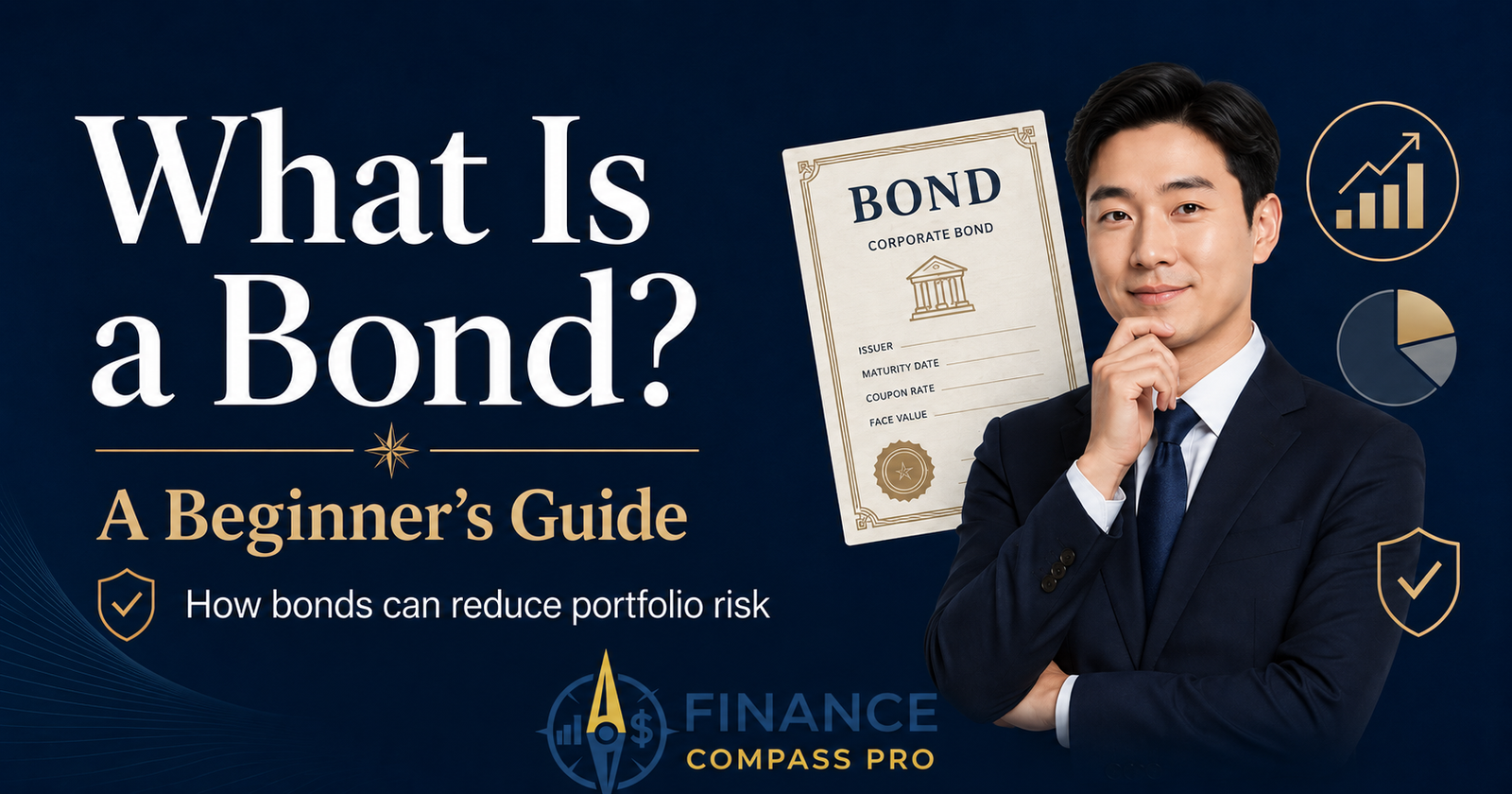
What is a bond? At its simplest, a bond is a loan you make to a government, city, or company in exchange for interest payments and the return of your original money at a future date.
Most people learn about stocks first. Stocks are dramatic, visible, and easy to follow – a ticker goes up, you feel smart; it goes down, you feel sick.
Bonds are quieter. They do not usually create the same excitement as stocks. But they play one of the most important roles in a beginner portfolio: they can reduce volatility, create income, and help investors stay invested when the stock market becomes uncomfortable.
What a Bond Actually Is
A bond is a loan you give to a borrower – usually a government or a company – in exchange for regular interest payments and the return of your original amount at a set future date.
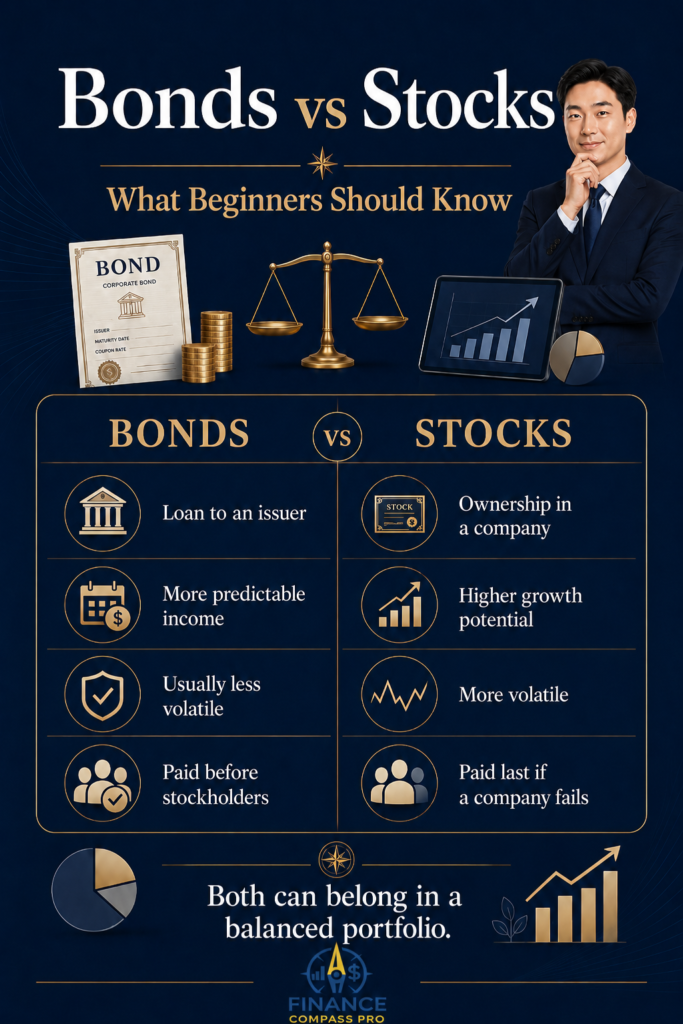
When you buy a stock, you own a small piece of a company. When you buy a bond, you’re a creditor. The company or government owes you money, and they’ve agreed to pay it back with interest.
That distinction matters more than it sounds. That is why many bonds are generally considered less risky than stocks. But less risky does not mean risk-free. Bond prices can fall when interest rates rise, companies can default, and inflation can reduce the real value of your returns.
Stockholders get paid last if a company runs into trouble. Bondholders get paid first. That’s why bonds are generally considered safer – not because they’re guaranteed to make you money, but because you sit higher in the repayment order.
The Three Numbers Every Bond Has
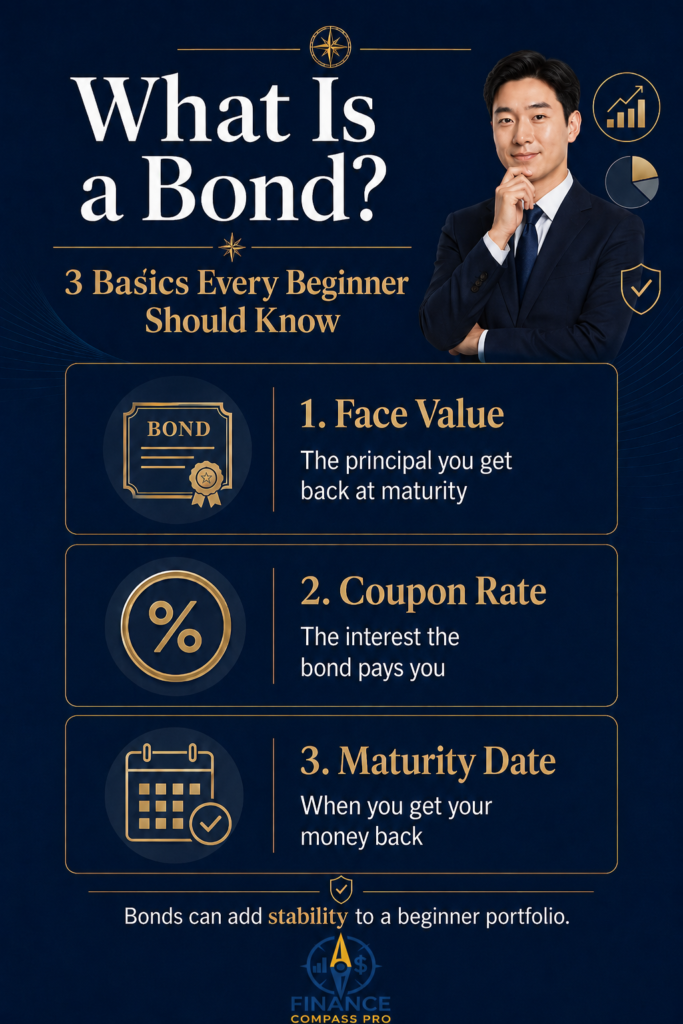
Every bond comes with three defining characteristics:
Face Value (Par Value) – The amount you’ll receive back when the bond matures. Most bonds have a face value of $1,000.
Coupon Rate – The annual interest rate the issuer pays you, expressed as a percentage of face value. A $1,000 bond with a 4% coupon pays you $40 per year, typically split into two payments of $20.
Maturity Date – The date when the borrower returns your original principal. Bonds can mature in 3 months, 2 years, 10 years, or 30 years depending on the type.
Here’s how it plays out in practice. You buy a 10-year U.S. Treasury bond with a face value of $1,000 and a 4.5% coupon. Every year for 10 years, you receive $45 in interest. At the end of year 10, you get your $1,000 back. Total return: $1,450 on a $1,000 investment – without ever touching the stock market.
The Main Types of Bonds
Not all bonds are the same. The borrower determines how much risk you’re taking on.
U.S. Treasury Bonds are issued by the federal government and backed by the full faith and credit of the United States. They’re considered the closest thing to a risk-free investment that exists. Yields are lower than other bonds, but so is the risk.
Municipal Bonds (Munis) are issued by state and local governments to fund infrastructure, schools, and public projects. Interest is typically exempt from federal income tax – and often state tax too – making them particularly attractive for investors in higher tax brackets.
Corporate Bonds are issued by companies to raise capital. They pay higher interest than government bonds because companies carry more default risk than governments. Investment-grade corporate bonds come from financially stable companies; high-yield bonds (sometimes called junk bonds) come from riskier ones and pay higher interest to compensate.
Treasury Inflation-Protected Securities (TIPS) are U.S. government bonds whose principal adjusts with inflation. If inflation rises, your bond’s face value rises with it. They’re one of the few investments explicitly designed to protect purchasing power over time.
Why Bond Prices Move in the Opposite Direction of Interest Rates
This is the part that confuses most beginners – and it’s worth understanding clearly.
When interest rates rise, existing bond prices fall. When interest rates fall, existing bond prices rise. They move in opposite directions, always.
Here’s why. Imagine you own a bond paying 3% interest. Then market rates rise to 5%. New bonds now pay 5%, so nobody wants your 3% bond at full price. To sell it, you’d have to discount it – accept less than face value so the buyer’s effective return matches the new market rate.
The reverse is also true. If rates fall to 1%, your 3% bond suddenly looks very attractive. Investors will pay a premium above face value to own it.
If you plan to hold your bond to maturity, price fluctuations don’t affect you – you get your full face value back regardless. But if you need to sell before maturity, rising rates can mean selling at a loss.
“Bonds don’t make your portfolio exciting. They make it survivable.”
How Bonds Reduce Portfolio Risk
This is where bonds earn their place in a beginner’s portfolio.
A portfolio of 100% stocks can drop 30%, 40%, or even 50% during a severe market downturn. Most people understand that intellectually. Far fewer understand it emotionally until they watch their balance fall by tens of thousands of dollars – and then panic-sell at exactly the wrong moment. To understand what these downturns look like historically, see our guide on what is a bear market. And when markets recover and rise, our guide on what is a bull market explains what to expect and how to stay positioned correctly.
Bonds don’t eliminate that risk. But they reduce it in two important ways.
First, bonds tend to hold their value or even rise when stocks fall. During the 2008 financial crisis, while U.S. stocks lost roughly 50% of their value, U.S. Treasury bonds gained. A portfolio split 60% stocks and 40% bonds lost significantly less than an all-stock portfolio – and that smaller loss meant investors were less likely to panic and sell.
Second, bonds produce regular income through coupon payments. That income continues regardless of what stocks are doing. For investors who need their portfolio to generate cash flow, that predictability has real value.
The right balance between stocks and bonds depends on your age, risk tolerance, and timeline – this is exactly what asset allocation addresses.
The Easiest Way to Own Bonds as a Beginner
You don’t have to buy individual bonds to benefit from them. For most beginners, bond ETFs are a simpler and more accessible entry point.
A bond ETF holds dozens or hundreds of individual bonds in a single fund. You buy one share and instantly own a diversified slice of the bond market – no need to research individual issuers, track maturity dates, or manage reinvestment.
Some widely used bond ETFs, as of this writing, include:
| ETF | What It Covers | Expense Ratio |
|---|---|---|
| BND (Vanguard) | Total U.S. investment-grade bond market | 0.03% |
| AGG (iShares) | U.S. aggregate bond market | 0.03% |
| SCHP (Schwab) | TIPS – inflation-protected bonds | 0.03% |
The same principles that apply to stock ETFs apply here – low expense ratios matter, diversification reduces single-issuer risk, and consistency beats timing. If you’re not yet familiar with how ETFs work in general, What Is an ETF and How Does It Work? covers the foundation clearly.
What Bonds Won’t Do
Bonds are not a path to dramatic wealth accumulation. Their returns are modest by design – that’s the tradeoff for their stability.
Over long periods, stocks have significantly outperformed bonds. If you’re 25 years old with a 40-year investment horizon, loading up heavily on bonds early means trading growth potential for stability you might not need yet.
Bonds also carry inflation risk. If your bond pays 3% and inflation runs at 4%, your real return is negative. You’re technically earning interest, but losing purchasing power.
And corporate bonds carry default risk – the possibility that the issuer can’t repay you. Investment-grade bonds have low historical default rates, but high-yield bonds carry meaningful risk of loss.
Frequently Asked Questions About Bonds
Is a bond safer than a stock?
Generally, yes – but it depends on the bond. U.S. Treasury bonds are among the safest investments on earth. High-yield corporate bonds carry significant default risk. As a category, bonds are less volatile than stocks, but “safe” is always relative to what you’re comparing.
Can you lose money on a bond?
Yes, in two ways. If you sell before maturity and interest rates have risen, you may receive less than face value. And if the issuer defaults – particularly with corporate or junk bonds – you may not get your principal back at all. U.S. government bonds have never defaulted.
How much of my portfolio should be in bonds?
A widely used rule of thumb is to hold your age as a percentage in bonds – a 30-year-old holds 30% bonds, 70% stocks. Many modern advisors suggest a more aggressive starting allocation for younger investors. Your risk tolerance, timeline, and goals matter more than any single formula. What Is Asset Allocation? walks through how to think about this.
What is the difference between a bond and a CD?
Both are loans that pay fixed interest. A CD (Certificate of Deposit) is a loan to a bank, insured by the FDIC up to $250,000. A bond is a loan to a government or corporation, not FDIC-insured. CDs are simpler and carry less risk for most savers; bonds offer more variety, potentially higher yields, and can be traded on the open market.
Do bonds pay monthly income?
Some bond ETFs distribute income monthly, while individual bonds often pay interest semi-annually. Always check the fund’s distribution schedule before assuming how often income will be paid.
What happens to my bonds if interest rates rise?
If you hold to maturity, nothing changes – you receive all coupon payments and your full principal back. If you need to sell before maturity, rising rates mean your bond’s market value has likely fallen, and you may sell at a loss. Longer-duration bonds are more sensitive to rate changes than short-duration bonds.
Are bonds a good investment right now?
Bonds may be more attractive when yields are higher than they were during near-zero-rate periods, but that does not automatically make them right for every investor. The better question is not “Are bonds good this year?” but “Do bonds fit my timeline, risk tolerance, and asset allocation?”
The Bottom Line
A bond is a loan you make to a government or company in exchange for regular interest payments and the return of your principal at maturity.
Bonds tend to be less volatile than stocks, produce predictable income, and often rise when stocks fall – making them a natural stabilizer in a diversified portfolio.
They’re not exciting. They’re not designed to be. Their portfolio role is stability and income. To decide how much bond exposure belongs beside stocks, see Stocks vs. Bonds; for a broad bond-ETF implementation, BND Explained shows how a total U.S. bond fund fills that allocation.
Once you understand the role of bonds, the next step is turning that stock-bond decision into a complete portfolio structure you can maintain over time.
Once you know how bonds fit into the picture, How to Build Your First Investment Portfolio walks through assembling stocks and bonds into a complete portfolio, step by step.
This article is for informational and educational purposes only and does not constitute financial advice. Bond yields and performance figures referenced are based on historical data and are not guaranteed. Always consult a qualified financial professional before making investment decisions.