Disclosure: This post is for informational and educational purposes only. FinanceCompassPro.com may earn compensation through display advertising. We may also reference third-party products, services, or platforms by name for educational purposes – these mentions are not paid endorsements unless explicitly stated. Nothing in this post constitutes personalized financial, legal, tax, or investment advice.
When you open a taxable brokerage account, one of the first choices you may face is whether to use a cash account or a margin account — sometimes searched as the “margin account vs cash account” decision.
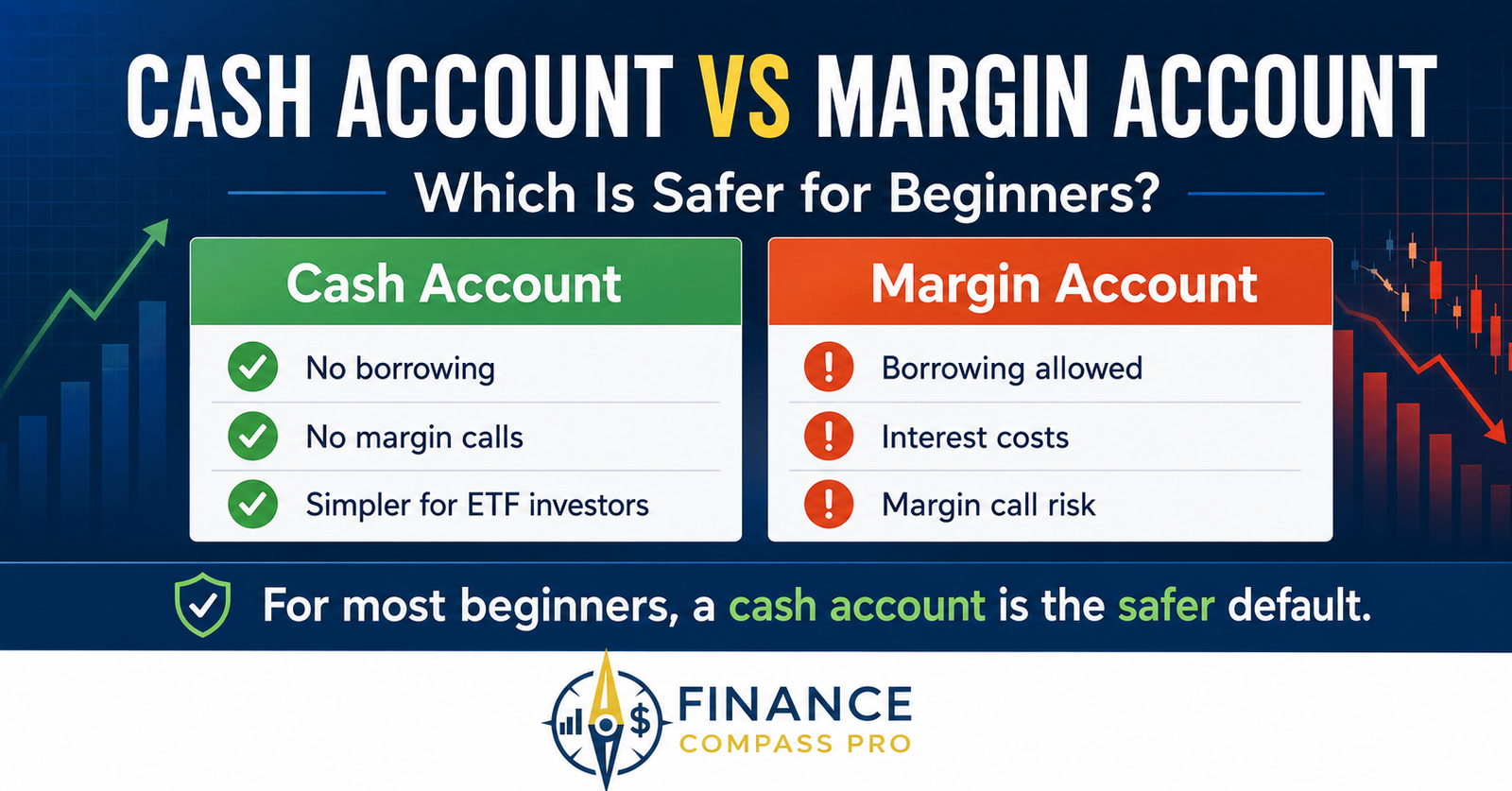
For a beginner buying and holding ETFs, this choice matters more than it might seem. A cash account keeps things simple: you invest with money you already have. A margin account adds borrowing, interest costs, margin call risk, and trading rules that many beginners do not need.
This guide is not about turning margin into a strategy. It is about understanding what you are choosing, so a default setting or optional feature does not quietly expose you to risks you never intended to take.
What Is a Cash Account?
A cash account requires you to fully pay for anything you buy using money you have deposited into the account.
In simple terms, you cannot buy more than your available cash allows. You cannot borrow from the brokerage to increase your position size. If you have $1,000 available to invest, you can buy up to $1,000 worth of investments, subject to normal trading and settlement rules.
For a beginner building a long-term, buy-and-hold ETF portfolio, a cash account usually covers everything needed. You can buy ETFs, hold them for years, reinvest dividends, and add new money over time without borrowing or dealing with margin calls.
That simplicity is the main advantage.
What Is a Margin Account?
A margin account allows you to borrow money from the brokerage using your existing investments as collateral.
That means you may be able to buy more than your cash balance alone would allow. For example, if you deposit $10,000, a margin account may allow you to control a larger amount of investments by borrowing against your portfolio.
But that extra buying power is not free money. It is a loan.
The borrowed amount accrues interest, and if your investments fall enough, the brokerage may require you to add more cash, sell investments, or reduce the borrowed balance. This is called a margin call.
A margin account can also unlock certain features, such as some options strategies or short selling. But those features are not necessary for a beginner who simply wants to buy and hold ETFs.

Cash Account vs Margin Account: Key Differences
| Feature | Cash Account | Margin Account |
|---|---|---|
| Borrowing | Not allowed | Allowed against eligible holdings |
| Interest costs | None from margin borrowing | Charged on borrowed amounts |
| Margin call risk | None | Yes |
| Complexity | Lower | Higher |
| Buy-and-hold ETF investing | Usually sufficient | Not required |
| Short selling | Not available | May be available |
| Some options strategies | Limited | May require margin approval |
| Risk of losing more than deposited cash | Generally lower | Possible in certain situations |
The practical difference is simple: a cash account limits you to money you already have, while a margin account can let you borrow against your portfolio.
That borrowing is what creates both the flexibility and the danger.
How Margin Borrowing Actually Works
When you buy on margin, the brokerage lends you money using your existing portfolio as collateral.
Suppose you have $10,000 in a margin account. If your broker allows you to borrow against your holdings, you might be able to buy more than $10,000 worth of securities. Part of the position would be funded by your own money, and part would be funded by borrowed money.
That borrowed portion must eventually be repaid.
It also accrues interest the entire time it is outstanding, regardless of whether your investments rise or fall. If the investments go up, margin can magnify gains. If they go down, margin can magnify losses.
That is why margin is not just an account feature. It changes the risk profile of the entire portfolio.
What Is a Margin Call?
A margin call happens when your account equity falls below the brokerage’s required maintenance level.
In plain English, the brokerage is saying:
“You no longer have enough equity in this account to support the amount you borrowed.”
When that happens, the brokerage may require you to deposit more cash, transfer in more eligible securities, or sell holdings to reduce the loan balance.
If you do not respond, the brokerage can sell your positions without asking first. That sale may happen at a loss and at a time you would not have chosen.
This is the core risk of margin. A market decline can force a sale at the worst possible moment, turning a temporary paper loss into a realized loss.
A Simple Margin Call Example
Imagine you deposit $10,000 and borrow another $10,000 on margin, giving you $20,000 invested.
If the portfolio rises, the borrowed money helped increase your exposure. But if the portfolio falls sharply, the problem becomes obvious.
Suppose the $20,000 portfolio drops to $14,000. You still owe the borrowed $10,000. That means your equity is only $4,000 before considering interest and any other costs.
At that point, your broker may decide your equity is too low relative to the loan and issue a margin call. If you cannot add money, the broker may sell investments to reduce the loan.
The important point is not the exact percentage. Different securities and brokers can have different requirements. The important point is that borrowing reduces your cushion when markets fall.
Why Margin Interest Matters
Margin interest is charged on the amount you borrow for as long as the borrowed balance remains outstanding.
That cost reduces your net return.
In a strong market, margin interest can eat into gains. In a flat market, it can turn a small gain into a worse result. In a declining market, it adds another cost on top of investment losses.
Unlike an ETF expense ratio, margin interest is not something most beginners naturally think about when they start investing. It depends on your brokerage’s rate, the size of your borrowed balance, and how long you carry the loan.
That makes margin more complex than simply “buying more.”
You are not just investing. You are investing with borrowed money.

Cash Account Trading Restrictions Beginners Should Know
Cash accounts are simpler, but they are not completely free of rules.
The main issue is settlement.
When you sell an investment, the trade may take time to fully settle. If you use unsettled proceeds to buy something else and then sell that new position before the original funds settle, you may trigger a good faith violation. Repeated use of unsettled funds can lead to account restrictions.
Another issue is freeriding, which generally involves buying and selling securities without properly paying for the purchase with settled funds.
For long-term investors making occasional ETF purchases and holding them, these rules rarely become a major issue. They mostly affect frequent trading, quick buying and selling, or trying to move in and out of positions before trades have settled.
For beginners, the practical solution is simple: use settled cash, avoid rapid flipping, and read your brokerage’s warnings before placing trades.
Margin Account Risks Beginners Often Underestimate
The biggest risk of margin is not just that your investments can fall.
The bigger problem is that borrowing can force action when you least want to act.
A normal market decline may be uncomfortable in a cash account, but you can usually hold through it if your investment plan still makes sense. In a margin account, the same decline can trigger a margin call and force a sale.
Margin can also create losses larger than many beginners expect. If borrowed money was used to buy investments that fall sharply, the loan still has to be repaid.
SIPC protection does not protect you from margin losses or investment losses. It is designed for brokerage firm failures and missing customer assets, not bad trades, falling markets, or borrowing decisions.
That distinction matters.
Margin increases complexity in four ways:
- You owe interest.
- Your portfolio is used as collateral.
- Your broker can force sales under certain conditions.
- Losses can be magnified.
For a beginner building a simple ETF portfolio, none of that is usually necessary.
Pattern Day Trading Rules: A Caution, Not a Strategy
Margin accounts have historically been tied to special rules around frequent day trading, and those rules changed significantly in 2026. As of June 4, 2026, FINRA eliminated the long-standing $25,000 pattern day trader minimum entirely, replacing it with a real-time intraday margin standard. See our full breakdown of the FINRA Pattern Day Trader rule change for what replaced it and what it means for your account.
That is why beginners should not rely on a fixed online summary of pattern day trading rules without checking their own brokerage’s current requirements.
For a buy-and-hold investor, this usually does not matter. If you are not making frequent same-day trades, pattern day trading rules should not be central to your account choice.
But if you plan to trade actively, you need to understand your brokerage’s day trading rules before placing trades. Margin accounts can come with rules, buying power calculations, and restrictions that are not obvious when you first open the account.
For most beginners, this is another reason not to treat margin as the default.
When a Margin Account May Be Necessary
A margin account is not inherently reckless. It can be required or useful for specific advanced strategies.
For example, some brokerages may require margin approval for certain options strategies. Short selling generally requires a margin account. Some trading features may also be easier to access in a margin-enabled account.
But needing a margin account for a specific feature is different from needing to borrow money.
An account can be margin-enabled without you actually carrying a margin loan. The danger starts when you use borrowed money without fully understanding the risks, costs, and liquidation rules.
If your goal is simply to buy and hold ETFs, a margin account is usually not necessary.
Which Account Type Should Beginners Choose?
For most beginners building a long-term, buy-and-hold ETF portfolio, a cash account is the simpler and lower-risk default.
It removes borrowing costs, margin call risk, and an entire category of complexity from the investing process. It also forces a useful discipline: you can only invest money you already have.
A margin account may make sense later for investors who understand the risks and need specific features. But it is not something a beginner needs to choose just because the brokerage offers it.
If you are unsure how much risk fits your situation more broadly, see our guide on risk tolerance before making account decisions.
A margin account is a tool. A cash account is usually the cleaner starting point.
For a look at how account choices interact with common early investing mistakes, see Why Beginners Lose Money Investing.
Common Mistakes to Avoid
Assuming margin is free buying power.
Margin is borrowed money. It comes with interest, collateral requirements, and the possibility of forced selling.
Opening a margin account without realizing it.
Some brokerages make margin easy to apply for or enable. Before you start investing, check whether your account is cash-only or margin-enabled.
Using margin for a simple ETF portfolio.
A beginner buying and holding broad ETFs usually does not need margin. The added risk often outweighs the added flexibility.
Ignoring margin interest.
Even if your investments rise, interest costs reduce your net return. If your investments fall, interest makes the result worse.
Confusing SIPC protection with investment protection.
SIPC does not protect you from market losses, margin losses, or investment decisions.
Trading too quickly in a cash account.
Cash accounts are simpler, but settlement rules still matter. Avoid using unsettled funds in ways that create violations.
The Bottom Line
A cash account is usually the simpler and safer default for beginners, especially those building a long-term ETF portfolio.
A margin account introduces borrowing costs, margin call risk, forced-sale risk, and additional trading complexity. It can be useful for certain advanced strategies, but it is not necessary for basic buy-and-hold investing.
When your brokerage asks “cash or margin,” the safest beginner question is not “Which one gives me more buying power?”
It is this:
“Do I actually need to borrow money to follow my investment plan?”
For most beginners, the answer is no.
For how this fits into the account structure more broadly, see Taxable Brokerage Account Explained. For the account opening process itself, see How to Open a Brokerage Account. And if you are deciding how this fits alongside a Roth IRA or 401(k), see Can You Have a Roth IRA and a 401(k) at the Same Time?
FAQ
A. For most beginners building a buy-and-hold ETF portfolio, a cash account is the simpler and lower-risk choice. It avoids borrowing costs, margin calls, and the added complexity that comes with a margin account.
A. A cash account only lets you invest money you have already deposited. A margin account lets you borrow against your holdings, which increases both potential gains and potential losses.
A. Yes, generally. A margin account adds margin call risk, ongoing interest costs, and the possibility of forced sales during a market decline, none of which apply in a cash account.
A. No. A margin account is generally only necessary for specific strategies like short selling or certain options trades. A simple buy-and-hold ETF portfolio does not require one.