
Disclosure: This post is for informational and educational purposes only. FinanceCompassPro.com may earn compensation through display advertising. We may also reference third-party products, services, or platforms by name for educational purposes – these mentions are not paid endorsements unless explicitly stated. Nothing in this post constitutes personalized financial, legal, tax, or investment advice.
Opening a brokerage account is the easy part. However, understanding what happens inside it is where most beginners have gaps.
How is the account protected? What forms show up at tax time? And what kind of account did you actually open? For the step-by-step opening process, see How to Open a Brokerage Account.
This guide covers what happens after you open one. Specifically, it explains how the account is structured, what protects it, and which mistakes to avoid early on.
What Is a Taxable Brokerage Account?
A taxable brokerage account is a standard investing account. It has no retirement tax shelter, no contribution limit, and no retirement withdrawal restrictions.
You can generally sell investments and withdraw cash when needed. However, sales can trigger taxes, losses, and settlement timing.
It’s called “taxable” to distinguish it from retirement accounts like a Roth IRA, where growth can be tax-free.
For how the two compare when deciding where to invest, see Roth IRA vs. Brokerage Account.
Cash Account vs. Margin Account
When you open a brokerage account, you typically choose between a cash account and a margin account. A cash account requires you to pay in full for what you buy. In other words, you can only invest money you’ve actually deposited.
A margin account, however, can allow borrowing against your investments to buy more than your cash covers. That borrowing introduces interest costs and the risk of margin calls. In a margin call, the broker can force you to sell holdings if your account value drops.
Some brokerages offer margin during the application process or make it easy to enable later. Therefore, check whether your account is cash-only or margin-enabled.
If you simply want to buy and hold ETFs, you generally have little reason to borrow. Still, it’s worth reviewing your settings to understand what you actually opened. For a full breakdown of how each account type works, including a margin call example, see Cash Account vs. Margin Account.

What SIPC Protection Does and Does Not Cover
The Securities Investor Protection Corporation (SIPC) protects customers of member brokerage firms up to $500,000. That total includes a $250,000 limit for cash.
The coverage applies when a firm fails and customer assets go missing. However, it does not protect you from normal market losses. If your ETFs decline in value, SIPC does nothing to make up the difference.
The limit applies per “separate capacity.” For example, an individual account and a joint account at the same firm each get their own $500,000 limit.
However, two individual accounts at the same firm share a single limit. Before relying on this coverage, confirm that your brokerage firm is an SIPC member. Also check whether any additional private coverage applies.
Common Brokerage Account Ownership Types
- Individual account. Owned and controlled by one person. Most beginners start here.
- Joint account. Shared ownership, commonly used by married couples or partners. Each owner can typically act on the account independently.
- Custodial account. An adult opens this on behalf of a minor. The assets legally belong to the child. Control then transfers to them at the age of majority in their state.
The ownership type affects both SIPC coverage and what happens to the account if an owner passes away. Therefore, choose deliberately instead of defaulting to whatever the sign-up flow suggests.
What Happens to a Brokerage Account When You Die?
A taxable brokerage account does not disappear when the owner dies. Instead, how it transfers depends on the account title, beneficiary designations, transfer-on-death registration, joint ownership, and state law.
For example, some brokerages allow a transfer-on-death beneficiary, which may help assets pass outside probate. Because estate rules vary by state, this is worth reviewing with a qualified professional.
Tax Forms You May Receive
A taxable brokerage account generates paperwork that retirement accounts don’t.
For example, you may receive a 1099-DIV for dividends, a 1099-B for sales, and a 1099-INT for interest income.
These forms can arrive even if you reinvest dividends or never withdraw money. Brokerages typically issue them by early-to-mid February for the prior tax year. This article focuses on account mechanics rather than tax calculations.
For the full framework on how dividends and capital gains are taxed, see ETF Taxes Explained. For the general rules on how holding period affects your tax rate on any investment sale, see Capital Gains Tax for Beginners. And for how to use investment losses strategically, see ETF Tax-Loss Harvesting Explained.
Can You Have Multiple Brokerage Accounts?
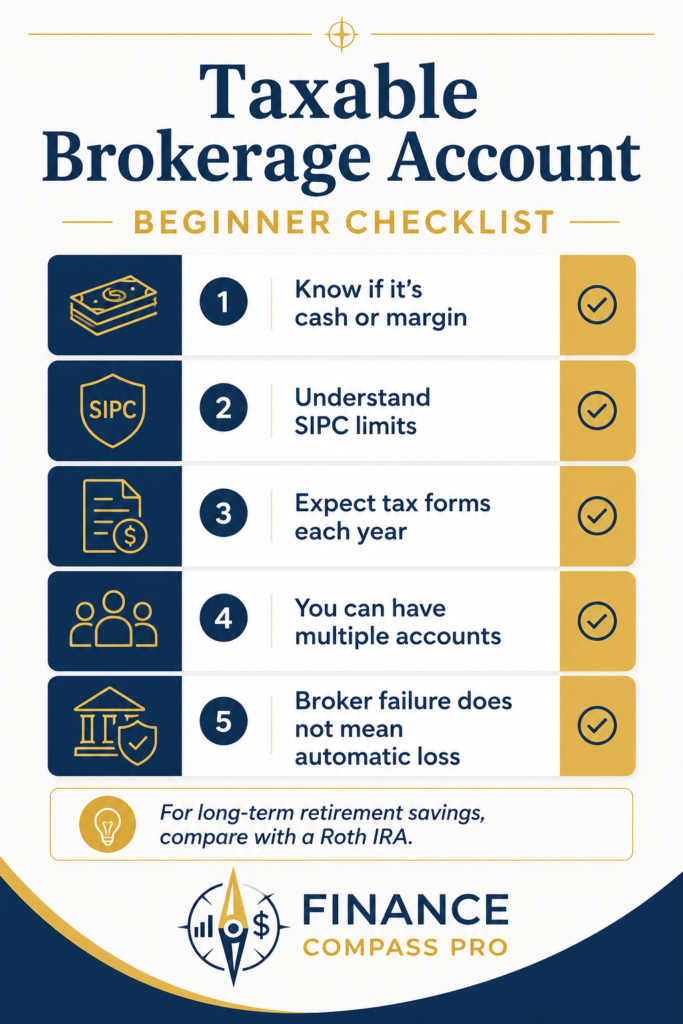
Yes. There’s no rule limiting how many taxable brokerage accounts you can hold, whether at one firm or across several. Some investors consolidate everything in one place for simplicity.
Others, however, split accounts across firms – for example, to explore different investment tools or expand SIPC coverage through separate capacities.
Neither approach is inherently better. It simply depends on how much complexity you’re willing to manage.
What Happens If Your Brokerage Firm Fails?
Broker-dealers generally must keep customer assets separate from the firm’s own assets.
As a result, a brokerage failure does not automatically mean your investments are lost. In most cases, another broker-dealer takes over the failing firm’s accounts with minimal disruption.
SIPC steps in specifically when customer assets are missing and a trustee must sort out claims. That outcome is relatively rare, but the protection exists for that scenario.
Common Mistakes Beginners Should Avoid
Assuming SIPC covers investment losses. It doesn’t. Instead, SIPC exists for firm failures, not market downturns.
Leaving margin enabled without understanding it. A margin-enabled account allows borrowing. As a result, you can face interest costs and margin calls you never intended to take on. It’s also worth knowing that the rules around margin and frequent trading changed in 2026 – FINRA removed the old $25,000 pattern day trader minimum, so a margin account carries different obligations than it used to.
Not knowing your ownership type. This affects both SIPC coverage and what happens to the account after you’re gone.
Being surprised by tax forms. Any dividends, interest, or sales in a taxable account generate reportable income, even if you never withdrew the money.
The Bottom Line
A taxable brokerage account is straightforward to open.
However, it comes with structural details worth understanding early – your account type, its protections, and the paperwork to expect.
None of this needs to be complicated for a beginner holding a simple ETF portfolio. Still, knowing the basics helps you avoid surprises later.
For where to start investing inside the account once it’s open, see Best ETFs for Beginners. For the full retirement account priority order, see Retirement Accounts for Beginners.
FAQ
A. A taxable brokerage account is a standard investing account with no retirement tax shelter, no contribution limit, and no early-withdrawal restrictions. You can invest in stocks, ETFs, and other securities, but dividends, interest, and realized gains are generally reportable for taxes each year.
A. Not exactly. “Taxable brokerage account” describes the tax treatment of the account, while “cash” vs. “margin” describes whether you can borrow inside it. A taxable brokerage account can be opened as either a cash account or a margin account.
A. SIPC coverage protects customers of member firms up to $500,000 (including a $250,000 cash sub-limit) if the firm itself fails. It does not protect against normal market losses in your investments.
A. Not necessarily right away. Many beginners prioritize tax-advantaged accounts first. A taxable brokerage account becomes useful once you want to invest additional money beyond retirement account limits or before retirement age. See Retirement Accounts for Beginners for a suggested order.