Disclosure: This article is for informational and educational purposes only. FinanceCompassPro.com may earn compensation through display advertising or affiliate relationships. We may reference third-party products, services, platforms, or tools for educational purposes. These mentions are not paid endorsements unless clearly stated. Nothing in this article constitutes personalized financial, legal, tax, or investment advice.

You have some money sitting in your bank account. Part of you wants to invest it. Part of you wonders if you’re supposed to keep it as cash first.
That hesitation is common, and it’s not a bad instinct – but the right answer depends on a few specific things about your situation, not a single universal number.
Quick Answer
A common benchmark is to keep enough accessible cash to cover roughly three to six months of essential expenses. But you don’t necessarily need to wait until every dollar of that reserve is complete before investing. If your employer offers a 401(k) match, the value of capturing that match is one factor to weigh alongside your emergency savings and any high-interest debt.
Where you land within that three-to-six-month range, and how you sequence it against debt and your employer match, depends on your income stability, your existing debt, and how easily you could replace your income if something went wrong.
Why a Cash Buffer Comes Before Investing at All
The reasoning isn’t about avoiding risk in general. It’s about avoiding a specific, predictable failure mode: being forced to sell investments during a bad moment because you have no other source of cash.
If your car breaks down, your income stops temporarily, or a medical bill arrives and you don’t have cash set aside, the money has to come from somewhere. Without a buffer, that often means either high-interest credit card debt or selling investments – sometimes during a market downturn, which locks in a loss you didn’t have to take.
A cash buffer removes that pressure. It doesn’t make investing risk-free, but it keeps a temporary financial disruption from becoming a forced, badly-timed investment decision.
Don’t Ignore an Employer Match While Building Your Cash Buffer
If your employer offers a 401(k) match, delaying contributions can mean giving up matching contributions you otherwise could have received. That makes the match worth considering even while you’re still building your emergency fund. Check your plan’s matching formula and vesting rules before deciding how to balance the two – some plans vest matching contributions gradually over several years rather than immediately.
If you’re not sure how your employer match works or whether you’re already capturing it, see What Is a 401(k) Employer Match?
What Changes the Right Number for You
The three-to-six-month range is a starting point, not a rule that applies identically to everyone.
Income stability matters most. Stable income and multiple reliable income sources may mean you’re comfortable toward the lower end of the three-to-six-month range. Variable income, one primary income source, or a longer potential job search may mean a larger reserve makes more sense.
High-interest debt changes the math. If you’re carrying expensive credit card debt, it may deserve priority over additional investing once you’ve established enough cash to handle a basic unexpected expense. The right starter-buffer amount before shifting focus to debt depends on your actual expenses and risks rather than a single universal target.
Job security and field demand play a role. A field with strong hiring demand and a short expected job search generally needs less of a buffer than a field with long hiring cycles or limited openings.

A Simple Decision Framework
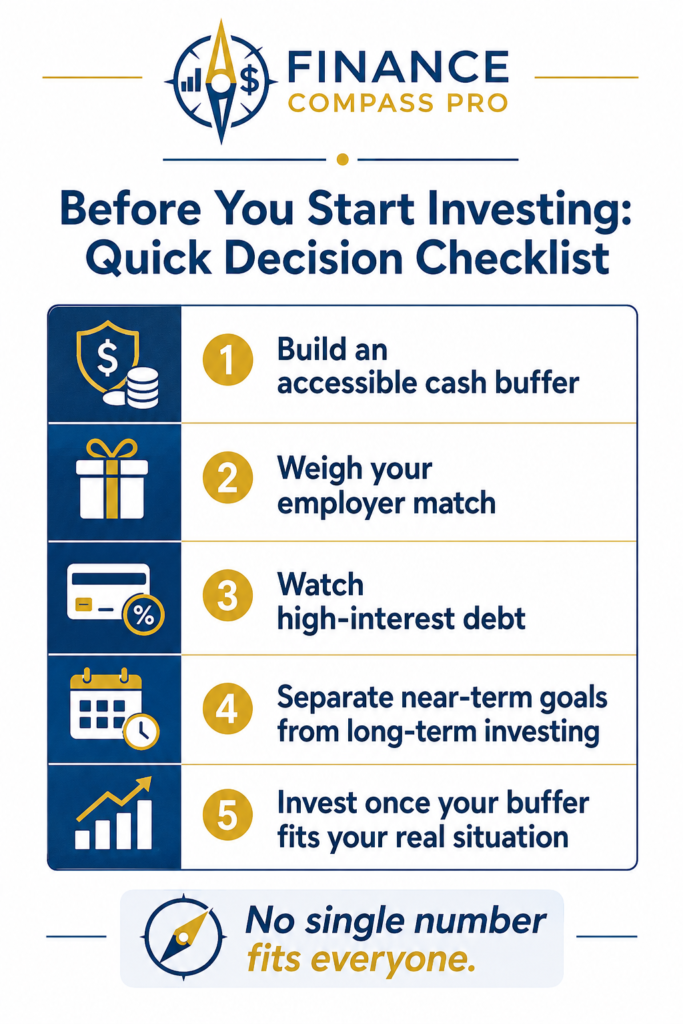
- Employer offers a 401(k) match? Weigh contributing enough to capture it against how urgently you need to build your cash buffer – many people do both at the same time rather than fully delaying one for the other.
- Carrying high-interest debt? Consider building a basic starter buffer first, then prioritizing that debt before completing the full three-to-six-month emergency fund.
- Stable income and multiple reliable income sources? You may be comfortable toward the lower end of the three-to-six-month range.
- Variable income, one primary income source, or a longer potential job search? A larger reserve may make more sense.
- Buffer already fully funded? Before investing additional cash, separate money you’ll need for near-term goals or known expenses. Cash that isn’t needed for emergencies or shorter-term goals can then be evaluated for long-term investing.
A Beginner Mistake to Avoid
One mistake is treating the emergency fund target as a reason to delay investing indefinitely. Keeping substantially more cash than your emergency needs and near-term goals require can also have a trade-off: cash may lose purchasing power to inflation and generally offers less long-term growth potential than investing.
The opposite mistake is skipping the buffer entirely because markets are doing well and investing feels more exciting than saving. That’s the scenario where a temporary income disruption forces a badly-timed sale.
Where This Fits in Your Investing Plan
This decision sits between two other guides on the site. For the mechanics of actually building the cash reserve itself – where to keep it, how to automate contributions, and how to make progress on a tight budget – see How to Build an Emergency Savings Account
For the broader distinction between money that should stay as cash and money that belongs in the market, see The Difference Between Saving and Investing
Once your buffer is in place, Investing for Beginners: The Complete Guide walks through the next steps of actually getting started.
Bottom Line
There’s no single dollar amount that’s correct for everyone. The three-to-six-month range is a reasonable starting point, adjusted up or down based on how stable your income is, whether you’re carrying high-interest debt, and how easily you could replace your income if something went wrong.
Weigh your employer match against your emergency fund timeline rather than treating one as an automatic prerequisite for the other. Beyond that, build the cash reserve that matches your actual situation – not the largest number you can imagine needing, and not zero.
FAQ
A. A common benchmark is three to six months of essential expenses, adjusted based on your income stability and whether you carry high-interest debt. Variable or single-income households may lean toward the higher end of that range.
A. Not necessarily. Many people weigh capturing their employer match against completing their emergency fund and do both at the same time, since delaying 401(k) contributions can mean giving up matching contributions in the meantime.
A. A common approach is to build a basic starter buffer first, then prioritize paying off high-interest debt, then return to building the full three-to-six-month emergency fund. The right sequence depends on your specific debt and expenses.
A. Keeping substantially more cash than your emergency fund and near-term goals require can mean losing purchasing power to inflation and generally offers less long-term growth potential than investing.
This article is for informational and educational purposes only and does not constitute financial, legal, or tax advice. Individual circumstances vary significantly. Always consult a qualified financial professional before making decisions specific to your situation.