

Your credit score is one of those numbers that quietly controls more of your life than most people realize.
It decides whether you get approved for an apartment. What interest rate you pay on a car loan. Whether a lender trusts you enough to hand over a mortgage – and at what cost.
A difference of 50 points on your credit score can mean thousands of dollars over the life of a loan. Not because the system is fair. Because that’s how it’s built.
The good news is that your score isn’t fixed. It’s a calculation. And calculations can be improved – systematically, deliberately, starting right now.
Some of the steps in this guide can show results within a single billing cycle. Others take longer. But if you follow this plan consistently over the next 30 days, you will move the number. Here’s exactly how.
“Your credit score isn’t a judgment of your character. It’s a math problem. And math problems have solutions.”
What Your Credit Score Actually Measures
Before you can improve a number, it helps to understand what’s generating it.
Your credit score – most commonly a FICO score, ranging from 300 to 850 – is calculated from five factors, each weighted differently. Payment history is the largest single factor, accounting for 35 percent of your score. It simply asks: do you pay your bills on time? Credit utilization comes next at 30 percent – how much of your available credit you’re actually using. Length of credit history makes up 15 percent, rewarding accounts that have been open and active for a long time. Credit mix accounts for 10 percent, reflecting whether you have a variety of account types. And new credit inquiries make up the final 10 percent, tracking how recently you’ve applied for new credit.
Understanding these five factors tells you exactly where to focus your energy in the next 30 days – and where not to waste it.
What Is a Credit Score? Everything Beginners Need to Know
Day 1 ~ 3: Know Your Starting Point
You can’t improve what you haven’t measured.
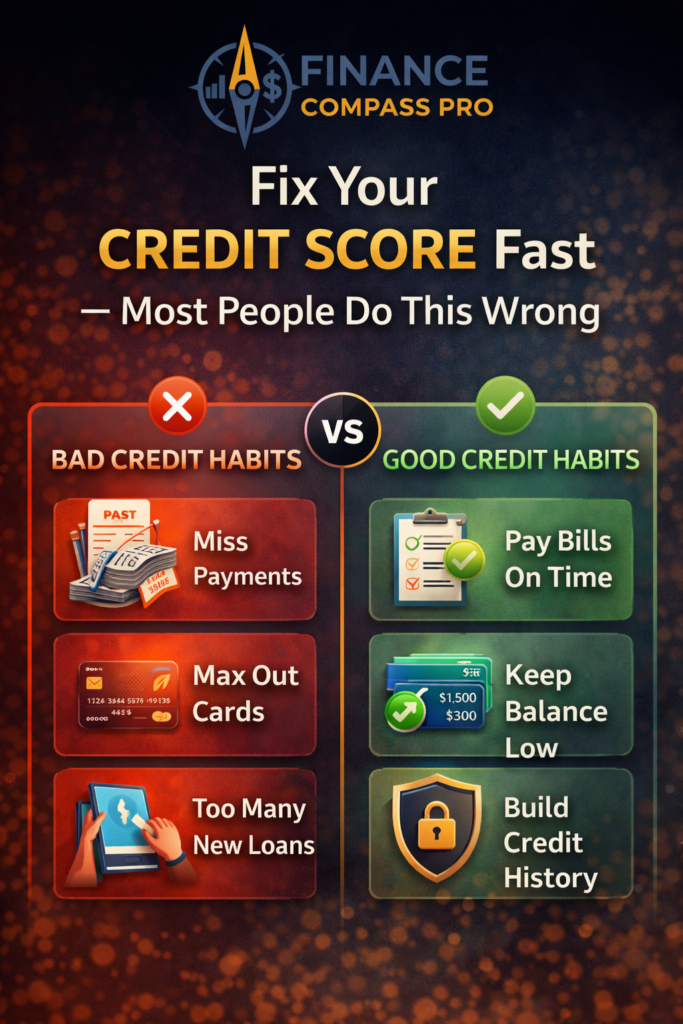
Pull your credit report before you do anything else. In the United States, you’re entitled to a free report from each of the three major bureaus – Equifax, Experian, and TransUnion – once per year through AnnualCreditReport.com.
Go through each report carefully. Look for errors. Accounts you don’t recognize. Balances reported incorrectly. Late payments that weren’t actually late. These mistakes are more common than most people expect – and disputing them directly with the bureau can result in a score increase with no other changes required. That’s the fastest win available to you.
If you want ongoing visibility into your score and what’s affecting it, a credit monitoring tool makes that process significantly easier.
Day 4 ~ 7: Set Up Automatic Payments
This is the single most impactful long-term move you can make – and it takes about ten minutes to set up.
Payment history makes up 35 percent of your FICO score. One missed payment can drop your score by 50 to 100 points. A consistent record of on-time payments, built over months and years, is the foundation everything else sits on.
The simplest system is also the most reliable: automate your minimum payments on every account. Not because paying the minimum is the goal – it isn’t – but because a missed payment due to forgetfulness is a score setback that takes months to recover from. Automate the floor. Pay more whenever you can.
If you already have a late payment on your record, its impact diminishes over time. The most recent 24 months matter most to lenders. Start building a clean record now.
Day 7 ~ 14: Attack Your Credit Utilization
If payment history is the foundation of your credit score, utilization is the lever with the fastest visible results – and it’s where most people can move the needle quickest within 30 days.
Credit utilization is the percentage of your available credit you’re currently using. If your credit limit is $5,000 and your balance is $2,500, your utilization is 50 percent. Most credit experts recommend keeping that number below 30 percent. The highest scorers typically stay below 10 percent.
The reason this matters so much in the short term: utilization is recalculated every single month when your issuer reports to the bureaus. Pay down a balance this week, and the improvement can show up in your score within 30 to 60 days.
| Current Utilization | Impact on Score | Target |
|---|---|---|
| Above 50% | Significant negative impact | Reduce immediately |
| 30–50% | Moderate negative impact | Work toward below 30% |
| 10–30% | Acceptable range | Maintain or improve |
| Below 10% | Optimal range | Ideal target |
Two approaches work well here. Pay down existing balances as aggressively as your budget allows. Or call your card issuer and request a credit limit increase – if granted, your utilization drops immediately without paying a single extra dollar.
If paying down balances is the goal but cash flow is tight, read:
→ How to Build a Simple Budget That Actually Works in 2026
Day 15 ~ 20: Stop Closing Old Accounts
This one runs counter to what most people’s instincts tell them – and it’s a mistake worth avoiding in the next 30 days especially.
When you close a credit card, two things happen that hurt your score. Your total available credit decreases, which pushes your utilization ratio up immediately. And your average account age can drop, which affects the length of credit history factor.
The better move in most cases is to keep older accounts open and use them occasionally for a small recurring charge – a streaming subscription, a monthly bill – something that keeps the account active without building a balance you have to manage.
The exception: if an account carries an annual fee that provides no real benefit, closing it may be the right call. But run the utilization math first.
Day 20 ~ 25: Be Strategic About New Applications
Every time you apply for new credit, a hard inquiry is recorded on your report. One or two hard inquiries have a modest, temporary impact – usually five to ten points, recovering within a few months.
The problem is multiple applications in a short window. Several hard inquiries in quick succession signal financial instability to lenders and can compound into a more meaningful score drop – which is the opposite of what you’re trying to achieve this month.
The practical rule for the next 30 days: don’t apply for any new credit unless it’s absolutely necessary. If you need to check eligibility, use soft inquiry pre-qualification tools that don’t affect your score at all. Most major issuers offer this.
Day 25 ~ 30: Dispute Any Errors You Found
If you spotted errors in your credit report during Days 1–3, now is the time to follow through on disputing them.
Each bureau has an online dispute process. Submit your dispute with any supporting documentation – bank statements, payment confirmations, correspondence – and the bureau is required to investigate, typically within 30 days. If the error is confirmed and removed, the score impact can be immediate and significant.
This is genuinely the fastest path to a higher score for many people. An incorrect late payment or a fraudulent account that doesn’t belong to you can be suppressing your score by 50 points or more.
What to Realistically Expect After 30 Days
Credit improvement isn’t magic. But it’s also not as slow as most people assume.
Some changes show up fast. Paying down a high utilization balance can reflect in your score within one billing cycle. Removing a disputed error can produce a meaningful jump almost immediately. These are the quick wins that make the first 30 days feel real.
Other improvements take longer to appear. Building a consistent payment history. Aging your accounts. Recovering from a serious negative item like a collections account. Those timelines are measured in months, not weeks.
The honest summary: most people who apply these steps consistently can see a meaningful improvement – 50 to 100 points or more – within three to six months. The first 30 days builds the foundation. Everything after that compounds on it.
Your 30-Day Credit Score Checklist
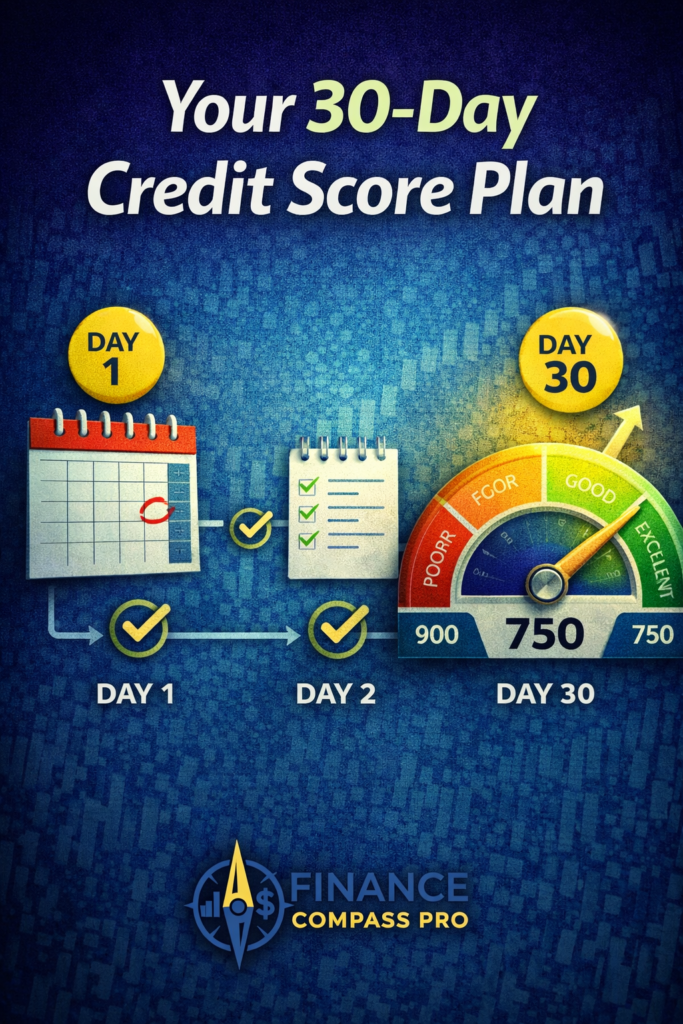
Here’s everything in one place.
- Pull your credit report from all three bureaus and flag any errors
- Set up automatic minimum payments on every account
- Calculate your current utilization and identify which balances to pay down first
- Request a credit limit increase on cards with no recent activity
- Keep old accounts open – don’t close anything this month
- Stop applying for new credit until your score is where you want it
- Submit disputes for any errors you found
None of these require perfect circumstances. They require 30 days of consistent action.
THE BOTTOM LINE
Your credit score is not a permanent judgment.
It’s a number generated by a formula – and formulas respond to inputs you control.
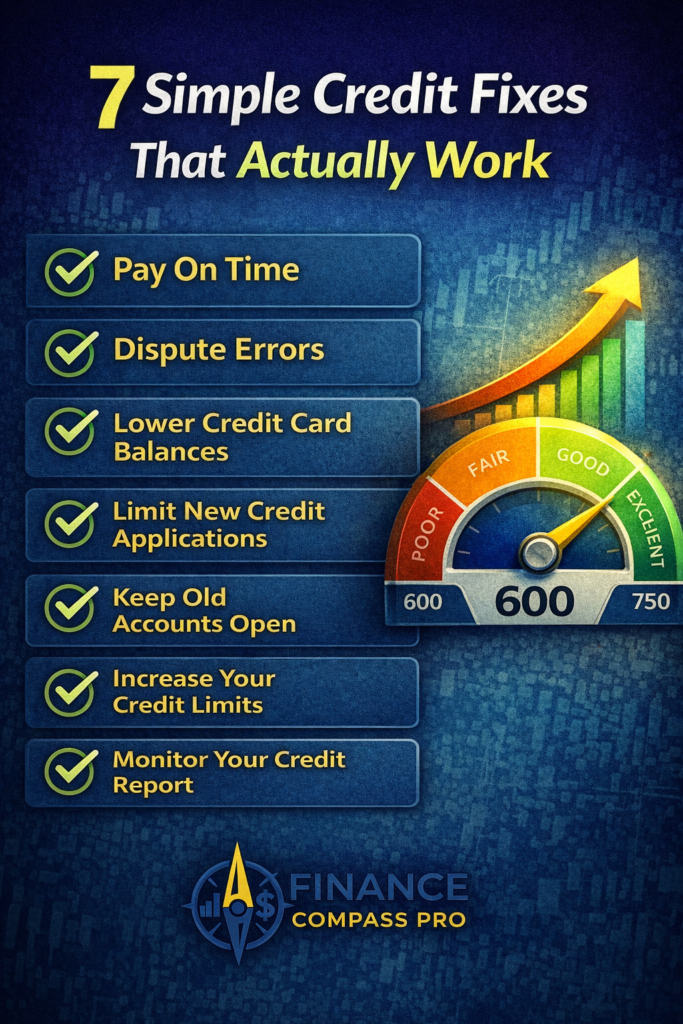
Pay on time. Reduce your utilization. Keep old accounts open. Stop unnecessary applications. Dispute errors that aren’t yours.
None of these require perfect conditions. They require 30 days of consistent action – and then the consistency of continuing.
The score you build over the next 30 days won’t just open doors to better lending terms. It will reduce the cost of borrowing for every major financial decision ahead of you – mortgages, car loans, rental applications, and beyond.
Start with Day 1. Everything else follows.
READY TO KEEP BUILDING?
→ What Is a Credit Score? Everything Beginners Need to Know
→ How Your Credit Score Affects Interest Rates (And Why It Matters More Than You Think)
→ Investing for Beginners: The Complete Guide to Building Wealth in 2026
This article is for informational and educational purposes only and does not constitute financial advice. No affiliate relationships are currently in place for any tools or services mentioned in this post. Always consult a qualified financial professional before making financial decisions.
credit score, improve credit score, credit tips, financial tips, money management, personal finance, credit repair
Pingback: How Your Credit Score Affects Interest RatesHow Your Credit Score Affects Interest Rates (And Why It Matters More Than You Think) -
Pingback: How to Improve Your Credit Score Step by StepHow to Improve Your Credit Score Step by Step -
Pingback: How Your Credit Score Affects Your Financial Future -
Pingback: Psychological Spending Triggers That Make You Spend Without Realizing ItPsychological Spending Triggers That Make You Spend Without Realizing It -