
Most people think investing is for later.
Later, when they have more money. Later, when the timing feels right. Later, when they feel more confident about what they’re doing.
But “later” has a cost most people never calculate.
Every month you wait is a month of compounding growth you permanently miss. And compounding – the process where your returns generate their own returns – is the closest thing investing has to a superpower.
The good news? You don’t need to wait.
With $500, you have enough to begin a real investment strategy. Not a trial run. Not a placeholder. An actual, structured plan that can grow into something meaningful over time.
This guide will walk you through every step.

Why $500 Is a Real Starting Point (Not a Practice Run)
It’s tempting to dismiss $500 as “not enough to matter.”
That’s a mistake – and the math proves it.
If you invest $500 today in a broad market index fund averaging 7% annual returns (the approximate historical average after inflation for the S&P 500), and you add just $100 per month going forward, here’s what that looks like:
What $500 + $100/Month Grows Into (7% Average Annual Return)
| Years | Total Contributed | Estimated Portfolio Value |
|---|---|---|
| 5 years | $6,500 | ~$8,200 |
| 10 years | $12,500 | ~$18,900 |
| 20 years | $24,500 | ~$56,800 |
| 30 years | $36,500 | ~$127,000 |
Figures are estimates based on historical averages. Past performance does not guarantee future results.
$500 doesn’t change your life on its own. But combined with consistent contributions and time, it becomes something far more significant.
The investors who build real wealth over decades aren’t the ones who started with more money. They’re the ones who started earlier.
📌 Related reading: How to Start Investing With $100: A Beginner’s Step-by-Step Guide – If $500 feels like a stretch right now, start here first.
“The best investment you can make is in yourself – but the second best is starting now, with whatever you have.”
Step 1: Open a Brokerage Account (This Takes Less Than 15 Minutes)
Before any of the strategy matters, you need an account that lets you actually buy investments.
A brokerage account is just a financial account – similar to a bank account – that gives you access to buy stocks, ETFs, index funds, and other investments.
The good news: opening one today is fast, free, and requires no minimum deposit on most major platforms.
Here’s what to look for when choosing a brokerage:
No account minimum. You shouldn’t need $1,000+ just to open an account. Most top platforms have dropped this requirement entirely.
Commission-free trading. Paying $5–$10 per trade was standard ten years ago. Today, the best platforms charge nothing per trade.
Access to low-cost index funds and ETFs. This is where your $500 will likely go, so make sure your platform offers them.
Educational resources. If you’re new, a platform with clear guides and tools helps you make better decisions early on.
Two Beginner-Friendly Platforms Worth Considering
- Fidelity (fidelity.com) – $0 account minimum, commission-free trades, index funds with expense ratios as low as 0.015%, and strong educational resources for new investors.
- Charles Schwab (schwab.com) – $0 account minimum, fractional shares available, one of the most intuitive interfaces for beginners.
Both are well-established, SIPC-insured, and consistently rated highly for new investors. Visit each platform directly to compare current account features and terms.
Once your account is open and you’ve transferred your $500, you’re ready for the next step.
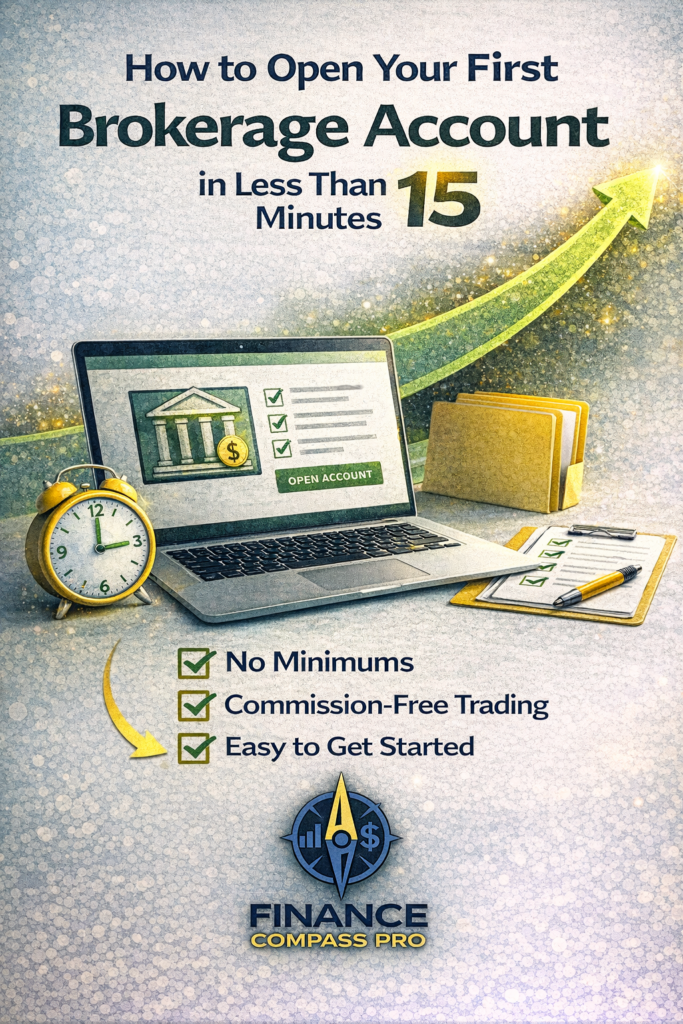
Step 2: Keep Your Strategy Simple (Complexity Is the Enemy)
This is where most beginners go wrong.
They open an account, see hundreds of investment options, and either freeze up or start chasing whatever’s trending. They buy a few shares of a company they’ve heard of, watch the price move, and make emotional decisions from there.
That is not a strategy. That’s gambling with extra steps.
With $500, the most powerful thing you can do is also the simplest: invest in one or two broad, diversified funds and leave them alone.
The vehicle most suited for this? ETFs and index funds.
An ETF (Exchange-Traded Fund) lets you buy a basket of hundreds of companies with a single purchase. Instead of betting on one company to succeed, you spread your $500 across an entire market segment.
For example, a single S&P 500 ETF – like Fidelity’s FZROX or Schwab’s SCHB – gives you exposure to hundreds of the largest U.S. companies at once, with annual fees typically below 0.10%.
That’s powerful diversification at almost zero cost.
📌 Related reading: What Is an ETF and How Does It Work?
📌 Related reading: What Is an Index Fund? The Beginner’s Complete Guide
Step 3: Build a Simple First Portfolio
You don’t need a complex, multi-fund portfolio on day one.
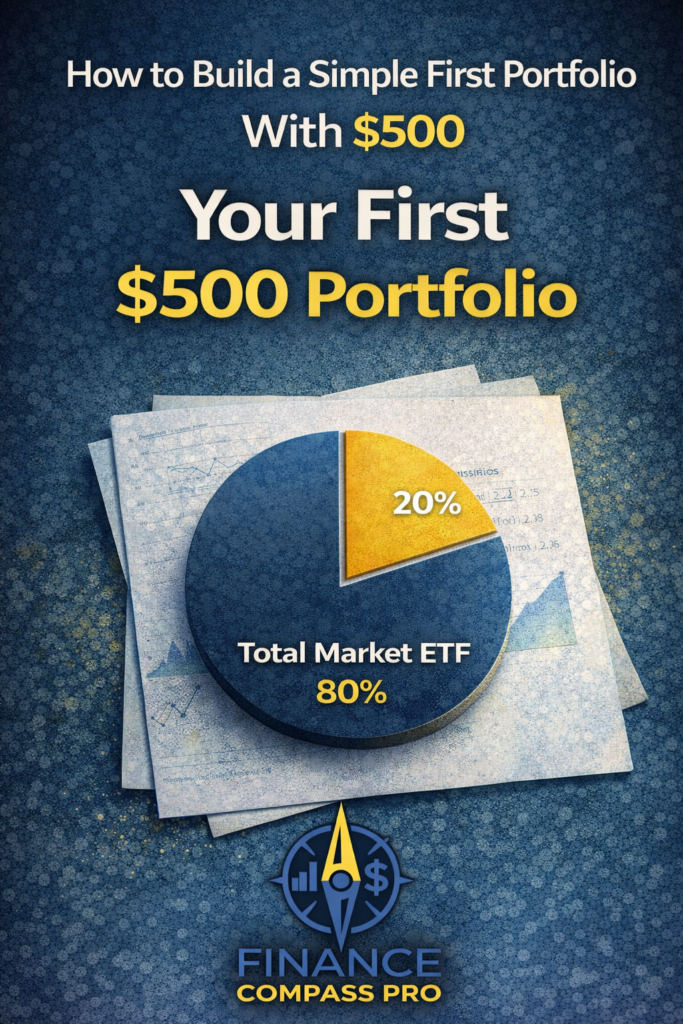
A first portfolio with $500 can be as simple as one fund. One well-chosen, broadly diversified ETF covers most of what a beginner needs: exposure to hundreds of companies, low fees, and automatic diversification.
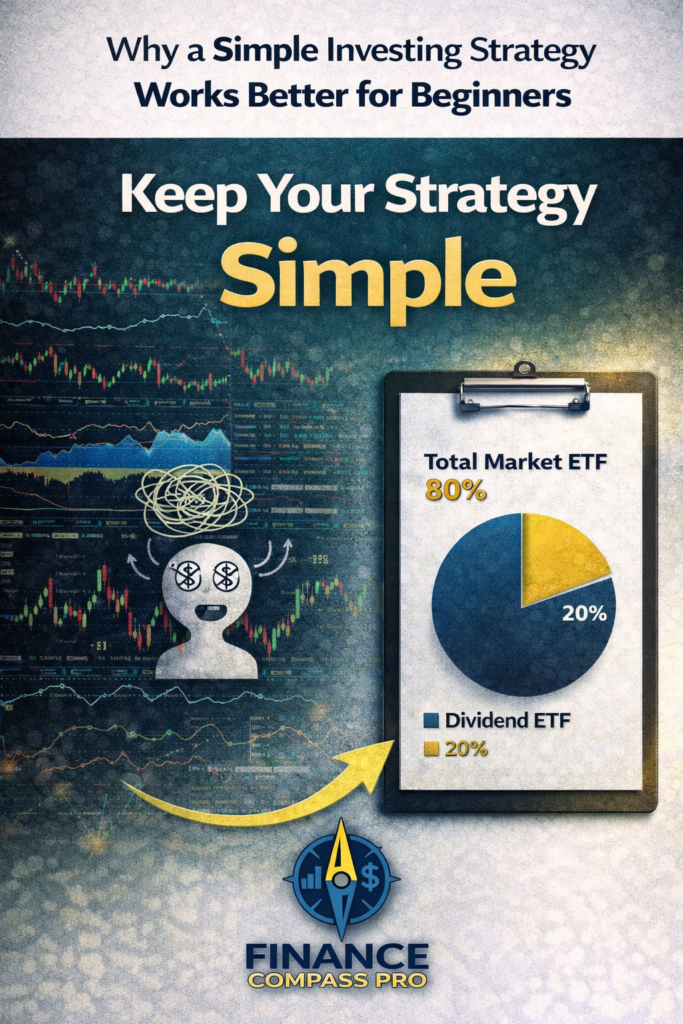
If you want slightly more structure, a two-fund approach works well:
A Simple $500 Starter Portfolio
| Fund Type | What It Holds | Purpose | Approx. Allocation |
|---|---|---|---|
| U.S. Total Market ETF | All U.S. publicly traded companies | Core growth | 80% ($400) |
| Dividend ETF | Companies with regular dividend payouts | Income exposure | 20% ($100) |
This is an example structure, not personalized financial advice. Adjust based on your goals and risk tolerance.
The point is not perfection. The point is structure – getting your money into the market in a logical, low-cost way.
As your portfolio grows and you become more comfortable, you can layer in additional funds: international exposure, bonds, sector-specific ETFs. But at $500, simplicity is the strategy.
📌 Related reading: How to Build Your First Investment Portfolio
Step 4: Invest Consistently – Not Perfectly
Here’s a trap almost every new investor falls into: waiting for the right moment to buy.
They watch prices. They read headlines. They hear that “a correction is coming” or that “now is a great time to buy” and they try to act on it.
The problem is that nobody – not professional fund managers, not financial analysts, not hedge fund traders – can reliably predict short-term market movements. Study after study confirms this.
Trying to time the market is a losing game. Instead, play a different game entirely.
The strategy is called dollar-cost averaging, and it’s one of the most powerful habits a beginning investor can develop.
Here’s how it works: instead of investing your entire $500 at once and then waiting for the “right time” to invest again, you commit to investing a fixed amount on a regular schedule – monthly, bi-weekly, or with every paycheck.
When prices are high, your fixed amount buys fewer shares. When prices are low, it buys more. Over time, your average cost per share smooths out – and you stop worrying about timing altogether.
The psychological benefit is just as important as the mathematical one. Automating your investments removes emotion from the equation. You invest whether the market is up or down, whether headlines are scary or cheerful.
📌 Related reading: What Is Dollar-Cost Averaging and Why Smart Investors Use It
“Consistency beats timing. Every. Single. Time.”
Common Mistakes to Avoid With Your First $500
Starting is essential. But starting well matters too.
Here are the patterns that most reliably derail new investors – and how to avoid them:
Picking individual stocks too early. Individual stocks can have wild short-term swings. Without deep research and a high risk tolerance, single-stock investing with a small account is more stressful than it’s worth. Broad funds first, individual stocks later (if at all).
Concentrating your money in one place. Putting all $500 into a single company – even a company you trust — is a concentrated bet. If that company underperforms, there’s nothing else in your portfolio to offset it. Diversification is insurance against exactly this.
Checking your portfolio every day. This sounds harmless, but it leads to emotional decision-making. A portfolio you check daily is a portfolio you’re more likely to panic-sell during a downturn. Check monthly at most.
Waiting for prices to drop before investing. “I’ll wait until there’s a dip” is one of the most common and costly investing mistakes. While you wait, the market moves. And if a dip does come, the fear of “it might go lower” often stops people from buying anyway.
Comparing your returns to short-term market winners. If someone on Reddit tripled their money in six months on a meme stock, that’s not an investment strategy – it’s luck. Comparing your boring, consistent index fund returns to outlier stories is how people abandon strategies that actually work.
📌 Related reading: 7 Investing Mistakes Beginners Make (And How to Avoid Them)
What to Do After Your First Investment Is Made
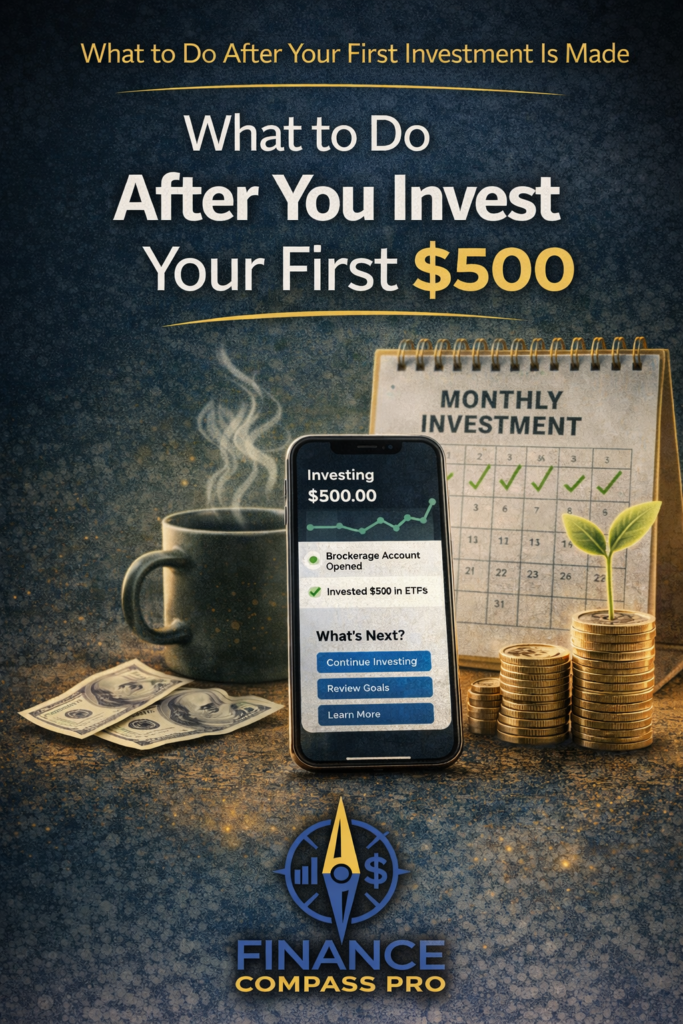
Once your $500 is invested, the next step is momentum.
Set up automatic monthly contributions – even $50 or $100 a month – so investing becomes a habit rather than a decision you revisit every month.
From there, your focus shifts from “how do I start?” to “how do I grow this over time?”
That’s when concepts like passive income start to become relevant. As your portfolio builds, you begin to understand how invested money generates returns that can themselves be reinvested – a compounding cycle that accelerates the longer you participate.
Related reading: How to Build Passive Income With Small Capital
Final Thoughts: The Decision That Changes Everything
$500 won’t make you wealthy overnight.
You know that. This article isn’t about promising a shortcut.
What $500 does – and this matters more than any specific return – is change your relationship with money.
Before you invest, money sits. It waits. It stays where it is.
After you invest, money moves. It participates. It grows. It starts doing something on your behalf even when you’re not thinking about it.
That shift in mindset – from saving to building – is what separates people who struggle financially their entire lives from people who eventually achieve the security and freedom they’re working toward.
The amount isn’t the point. The decision is.
Make it today. Then keep making it, every month, for as long as you can.
That’s the whole strategy.
You Might Also Like:
How to Build Passive Income With Small Capital (Even If You’re Starting From Scratch)
How to Start Investing With $100: A Beginner’s Step-by-Step Guide
What Is an Index Fund? The Beginner’s Complete Guide
What Is an ETF and How Does It Work?
What Is Dollar-Cost Averaging and Why Smart Investors Use It
How to Build Your First Investment Portfolio
7 Investing Mistakes Beginners Make (And How to Avoid Them)
This article is for informational and educational purposes only and does not constitute financial advice. Investment projections and figures used in this post are estimates based on historical averages and are not guaranteed. No affiliate relationships are currently in place for any platforms or tools mentioned. Past performance does not guarantee future results. Always consult a qualified financial professional before making investment decisions.
Pingback: Investing for Beginners: The Complete Guide to Building Wealth in 2026Investing for Beginners: The Complete Guide to Building Wealth in 2026 -
Pingback: How to Start Investing With $1,000: A Simple Beginner’s GuideHow to Start Investing With $1,000: A Simple Beginner’s Guide -
Pingback: How to Build a Simple Budget That Actually Works in 2026How to Build a Simple Budget That Actually Works in 2026 -
Pingback: Smart Credit & Wealth Planning: Strategies for Long-term Prosperity -
Pingback: Passive Income From ETFs: How to Build Monthly Cash Flow With Minimal EffortPassive Income From ETFs: Build Cash Flow Without Managing Individual Stocks -
Pingback: How to Build Your First Investment Portfolio: A Beginner’s Step-by-Step GuideHow to Build Your First Investment Portfolio -
Pingback: 7 Simple Money Habits That Will Transform Your Finances in 20267 Simple Money Habits That Will Transform Your Finances in 2026 -
Pingback: How Your Credit Score Affects Your Financial Future -
Pingback: The 5 Pillars of Smart Investing Every Beginner Should UnderstandThe 5 Pillars of Smart Investing Every Beginner Should Understand -
Pingback: 7 Investing Mistakes Beginners Should Avoid -
Pingback: What Is an ETF and How Does It Work? A Beginner’s Guide to Smart InvestingWhat Is an ETF and How Does It Work? A Beginner’s Guide to Smart Investing -