Dollar-cost averaging is a simple investing strategy that helps beginners stop waiting for the perfect moment and start investing on a consistent schedule. I’ve talked to many people who spent months – sometimes more than a year – waiting for the “right moment” to invest. Most of them did not avoid risk. They simply missed time in the market.
They watched prices move, waited for a better entry point, and held off until conditions felt stable enough to justify taking action. In the process, they spent months – sometimes years – waiting for clarity that never fully arrived.
That hesitation can feel rational. It looks like patience and sounds like prudence.
But the data often tells a different story.
Dollar-cost averaging makes consistency practical. In this guide, we’ll break down exactly how it works, why it is often more practical than trying to time the market, and how to implement it in a way that removes emotion from the equation.
If you want to apply this strategy inside a complete investing system – not just theory, but a real portfolio you can follow – start with Beginner Investment Portfolio: How to Build Your First Portfolio in 7 Steps.
The Timing Problem Nobody Solves Consistently
Here’s the question most beginners spend too much time trying to answer.
When is the right time to invest?
The honest answer – the one that decades of data and the track records of professional fund managers consistently support – is that nobody knows. Not reliably. Not consistently enough to build a strategy around.
Markets are influenced by economic data, geopolitical events, central bank decisions, corporate earnings, investor sentiment, and countless variables that interact in ways no model fully captures. The factors that would theoretically predict market movements are themselves unpredictable. And the analysts who appear to have called a market turn correctly almost always turn out to have been right once – not systematically right over time.
For individual investors, the cost of trying to time the market isn’t just the difficulty of the prediction. It’s the behavior the attempt produces.
Waiting for the right moment keeps investors on the sidelines during recoveries that happen faster than expected. FOMO drives entry near market peaks when confidence finally feels justified. Fear triggers exit near market bottoms when the pressure to stop the losses becomes overwhelming. The pattern repeats – and each cycle slightly worsens the long-term outcome.
“The investors who build the most wealth over time are rarely the ones who found the best entry point. They’re the ones who stopped looking for it – and started investing consistently instead.”
Dollar-cost averaging solves this not by improving the prediction. It solves it by making the prediction irrelevant.
What Dollar-Cost Averaging Actually Is
The concept is simpler than the name suggests.
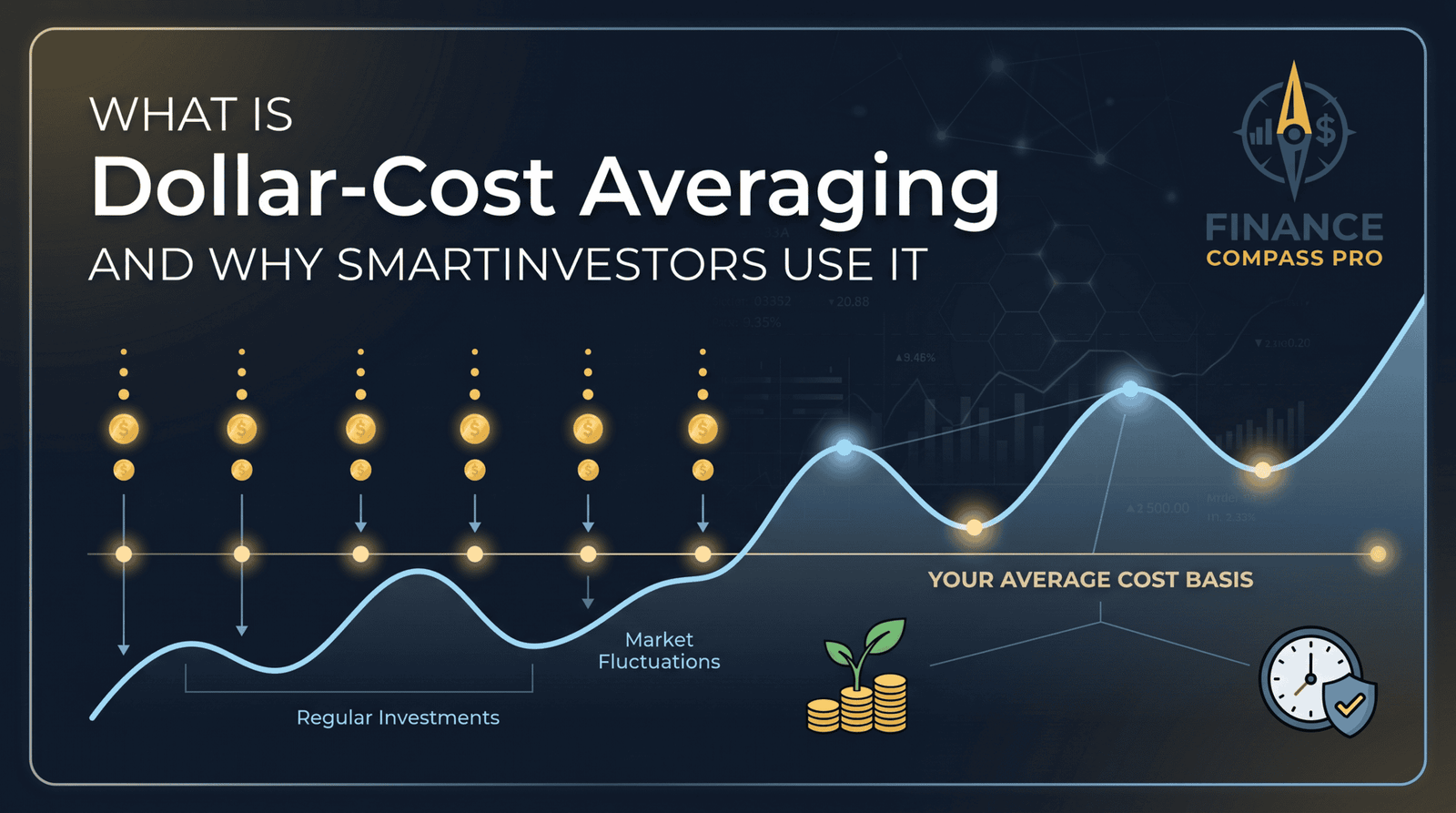
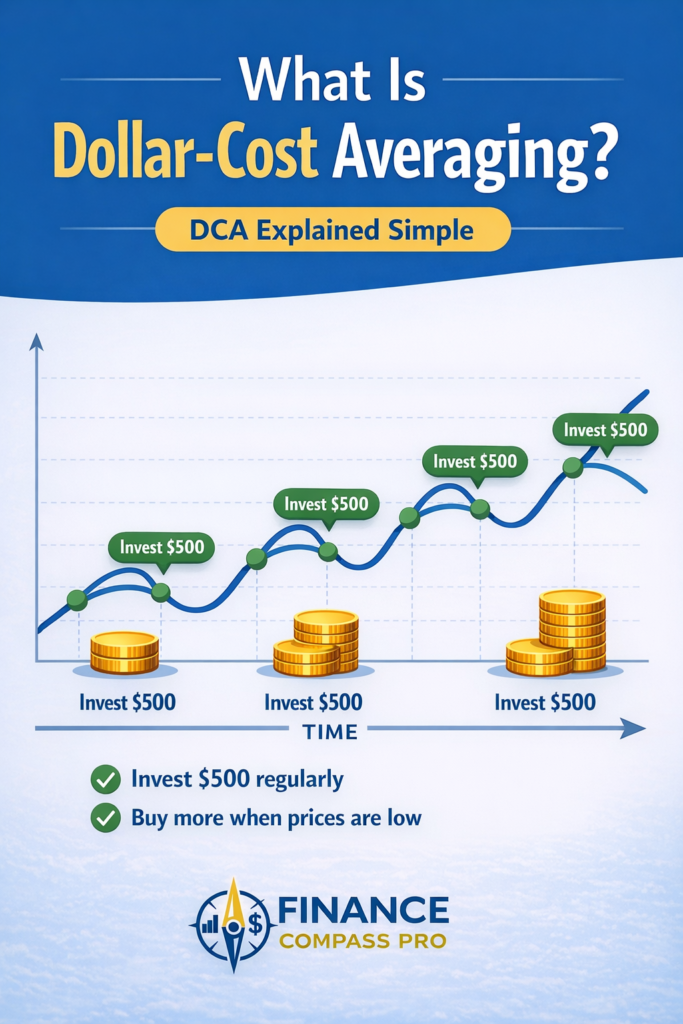
Dollar-cost averaging means investing a fixed amount of money at regular intervals – weekly, bi-weekly, or monthly – regardless of what the market is doing at that moment.
You invest on schedule, even when confidence is low, prices look uncertain, or the economic outlook feels unstable.
Regardless of conditions. Every time. Automatically.
That consistency produces a specific mathematical outcome that works in your favor over time.
When prices are high, your fixed investment buys fewer shares. When prices are low, the same investment buys more shares automatically. Over time, your average cost per share tends to be lower than the average price during the same period – because you purchased more shares during the periods when prices were depressed, without needing to identify those periods in advance.
You don’t need to find the bottom. The strategy finds it for you – passively, through the mechanical act of continuing to invest consistently.
The Math: How It Works in Practice
Let me show you exactly why this works – not with theory, but with numbers.
Imagine you invest $400 per month into a broad market index fund over six months, during a period of significant price movement.
| Month | Share Price | Shares Purchased |
|---|---|---|
| 1 | $80 | 5.0 |
| 2 | $60 | 6.7 |
| 3 | $40 | 10.0 |
| 4 | $50 | 8.0 |
| 5 | $70 | 5.7 |
| 6 | $80 | 5.0 |
Total invested: $2,400. Total shares: 40.4. Average cost per share: $59.40.
The average price during this period was $63.33. By investing consistently through the decline rather than waiting for recovery, you acquired more shares at lower prices automatically – without having to identify the bottom, time the re-entry, or make a single tactical decision.
This is dollar-cost averaging working exactly as designed. Not dramatic. Not exciting. Quietly, mechanically effective.
This is where most beginners stop – they understand the concept, but don’t turn it into a repeatable system.
If you want to see how this fits into a simple, structured portfolio you can actually follow, start here:
→ the 7-step portfolio guide referenced above
Why It Removes Emotion From the Equation
Here’s the benefit most explanations of dollar-cost averaging underemphasize.
The strategy doesn’t just improve the mathematics of your investing. It fundamentally changes your relationship with market volatility.
For most investors, price declines trigger anxiety. Watching portfolio value fall – even temporarily – produces a stress response that rational analysis struggles to override. And that stress response is precisely where the most expensive investing decisions are made. Selling near the bottom. Moving to cash during a recovery. Abandoning a strategy that would have worked if left alone.
Dollar-cost averaging changes the emotional framing of market declines entirely.
When you’re investing a fixed amount every month, a price decline stops being a threat. It becomes a mechanical advantage. Lower prices mean your next scheduled investment buys more shares than it would have at higher prices. The same contribution builds a larger position.
You’re not just tolerating the volatility. You’re systematically benefiting from it – without requiring a decision, a burst of courage, or a prediction about when conditions will improve.
That shift in relationship with market movements is what makes dollar-cost averaging sustainable through the conditions that cause most investors to stop. And staying invested through those conditions is what produces the long-term returns that reactive investors never reach.
Dollar-Cost Averaging vs. Market Timing: The Evidence
Dollar-cost averaging does not promise better returns than a perfectly timed lump-sum investment. In a historically rising market, investing a large amount immediately often produces stronger returns than spreading the money out over time. For a data-backed comparison of the two approaches, read Dollar-Cost Averaging vs. Lump Sum Investing: Which Strategy Wins.
However, perfect timing is not the real-world standard most investors operate under. Most people are not choosing between perfect lump-sum timing and a flawed dollar-cost averaging plan. They are choosing between a simple system they can follow and a timing strategy that often leads to hesitation, second-guessing, and missed time in the market.
That is where dollar-cost averaging becomes useful. It gives beginners a repeatable process: invest on schedule, keep adding through good markets and bad markets, and avoid letting emotions decide when money goes in. To see what consistent investing can look like over time, read our projection guide on $500 in an S&P 500 ETF after 10, 20, and 30 years.
What dollar-cost averaging promises is not perfect timing. It promises something more realistic: a way to avoid the timing mistakes that many investors make repeatedly.
For most people, avoiding those errors – emotional exits, FOMO entries, and the paralysis of waiting for certainty – may matter more than any theoretical advantage from a more sophisticated strategy.
This is why dollar-cost averaging works best when combined with a diversified, low-cost portfolio structure. What Is Diversification in Investing explains how spreading risk across asset classes and geographies can create the stable foundation that makes consistent investing easier to maintain through volatile periods.
When Dollar-Cost Averaging Is Most Effective
Dollar-cost averaging is particularly well-suited to specific investor situations and goals.
Long-term investors benefit most from this strategy because the time horizon gives the mathematical advantages of consistent buying – more shares accumulated during downturns – the time to compound into meaningful differences in final portfolio value.
Investors building from regular income – those contributing from monthly paychecks rather than deploying a lump sum – are already dollar-cost averaging by default when they invest consistently from each paycheck. The strategy formalizes and automates what consistent investors naturally do.
Investors prone to emotional decision-making benefit from the structural removal of monthly timing decisions.
Once the automatic investment is set up, market conditions have no opportunity to influence the decision – because the decision has already been made.
Automating investments is one habit – but it works best alongside a broader set of financial behaviors that reinforce each other. 7 Simple Money Habits That Will Transform Your Finances in 2026 covers the full system.
Beginning investors benefit from the lower stakes of each individual contribution. Starting with $100 or $200 per month feels manageable in a way that a single large commitment doesn’t – making it significantly easier to actually begin rather than continuing to wait for conditions that feel more certain.
If you are starting with a larger first deposit, How to Start Investing With $1,000 shows how to structure an initial position while still building the habit of regular contributions.
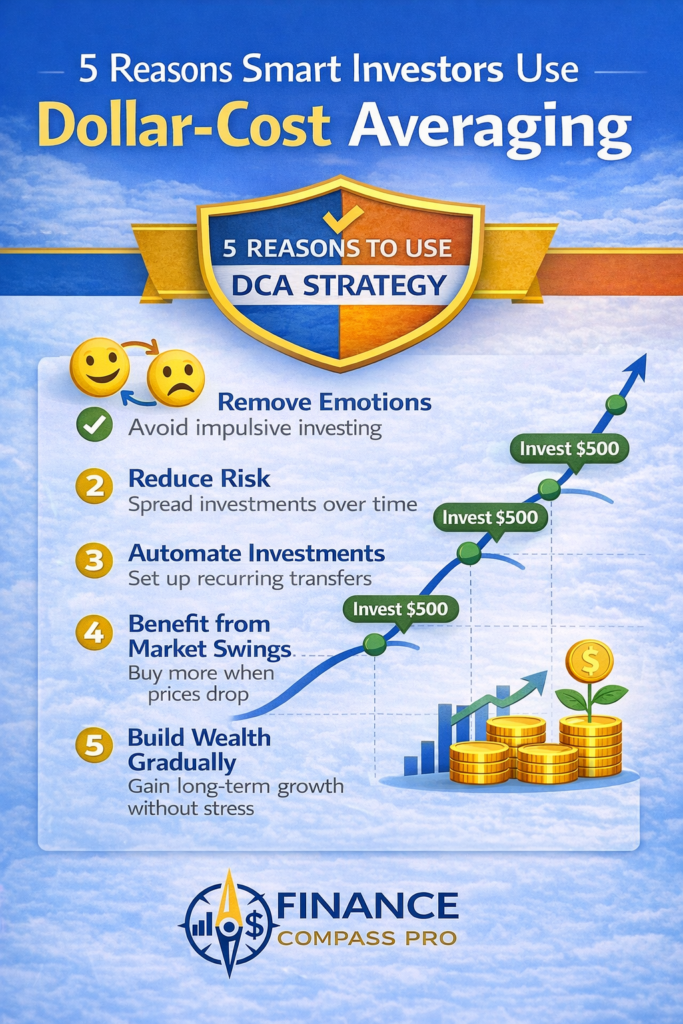
How to Use Dollar-Cost Averaging Step by Step
Here’s the practical truth about dollar-cost averaging.
Its greatest strength isn’t the mathematical outcome it produces in any given period. It’s the decisions it eliminates over time.
Every month that your investment executes automatically is a month you didn’t have to decide whether conditions were favorable enough. A month where short-term market movements had no influence on your behavior. A month where the habit of investing continued regardless of news, sentiment, or how you felt about the economic outlook.
Over a decade, that’s approximately 120 investment decisions that never had to be made – and never had the chance to be made incorrectly.
The practical implementation is straightforward.
1. Choose your investment amount. Start with whatever you can commit to consistently – even $50 or $100 per month. The amount matters far less than the consistency.
2. Choose your investment vehicle. A broad market index fund or ETF provides instant diversification and removes the complexity of individual security selection. What Is an ETF and How Does It Work explains why low-cost index ETFs are the most common vehicle for dollar-cost averaging strategies.
3. Set up automatic recurring investments. Most brokerage platforms allow you to schedule automatic purchases on a weekly, bi-weekly, or monthly basis. Automate it completely – the less it requires active involvement, the more reliably it continues through the periods when motivation fluctuates.
4. Commit to not adjusting based on market conditions. The temptation to pause contributions during declines or increase them during rallies defeats the purpose. The strategy works precisely because it operates independently of market conditions.
5. Review annually – not monthly. Dollar-cost averaging rewards patience and punishes constant monitoring. A quarterly or annual review is sufficient to stay informed without introducing the emotional noise the strategy is designed to eliminate.
The Compounding That Consistency Builds
The final case for dollar-cost averaging isn’t about any single year’s performance.
It’s about what happens when consistent, automatic investing runs uninterrupted across a decade or more.
Each contribution adds to the foundation, and reinvested returns can grow on top of that larger base over time.
For investors who want their contributions to generate income – not just growth – Passive Income From Dividend ETFs shows how to apply the same consistent investing approach to dividend-focused funds.
When markets recover from downturns, the consistent investor is still in the game instead of sitting on the sidelines waiting for an all-clear signal.
To understand what a major market decline can look like and how long downturns can last, read our guide to what a bear market is.
The early years feel underwhelming. The numbers are small. The progress feels invisible. And that’s exactly where most investors lose patience and either stop or start making changes that undermine the system.
But compounding is not linear. It accelerates. The mechanism that produces modest results in years one through five produces dramatically larger results in years fifteen through twenty – not because anything changed, but because the base has grown large enough for the same percentage returns to produce much larger absolute numbers.
“The strategy isn’t exciting. That’s the point. Exciting investing is usually expensive investing.”
The investors who build meaningful wealth through dollar-cost averaging aren’t the ones who found the perfect fund or the optimal contribution amount. They’re the ones who set up the system, left it alone, and let time do the work that no amount of market prediction could replicate.
Dollar-Cost Averaging Checklist for Beginners
- Pick a fixed contribution amount that fits your monthly budget.
- Use a broad, low-cost fund instead of trying to pick short-term winners.
- Automate the schedule so market headlines do not control the decision.
- Review the plan periodically, not every time the market moves.
Understanding dollar-cost averaging is important.
But the real advantage comes from applying it consistently inside a structured investing plan.
This article is for informational and educational purposes only and does not constitute financial advice. Some tools or platforms may be mentioned for educational purposes to help you take action and begin investing more effectively. Past performance does not guarantee future results. Always consult a qualified financial professional before making investment decisions.