
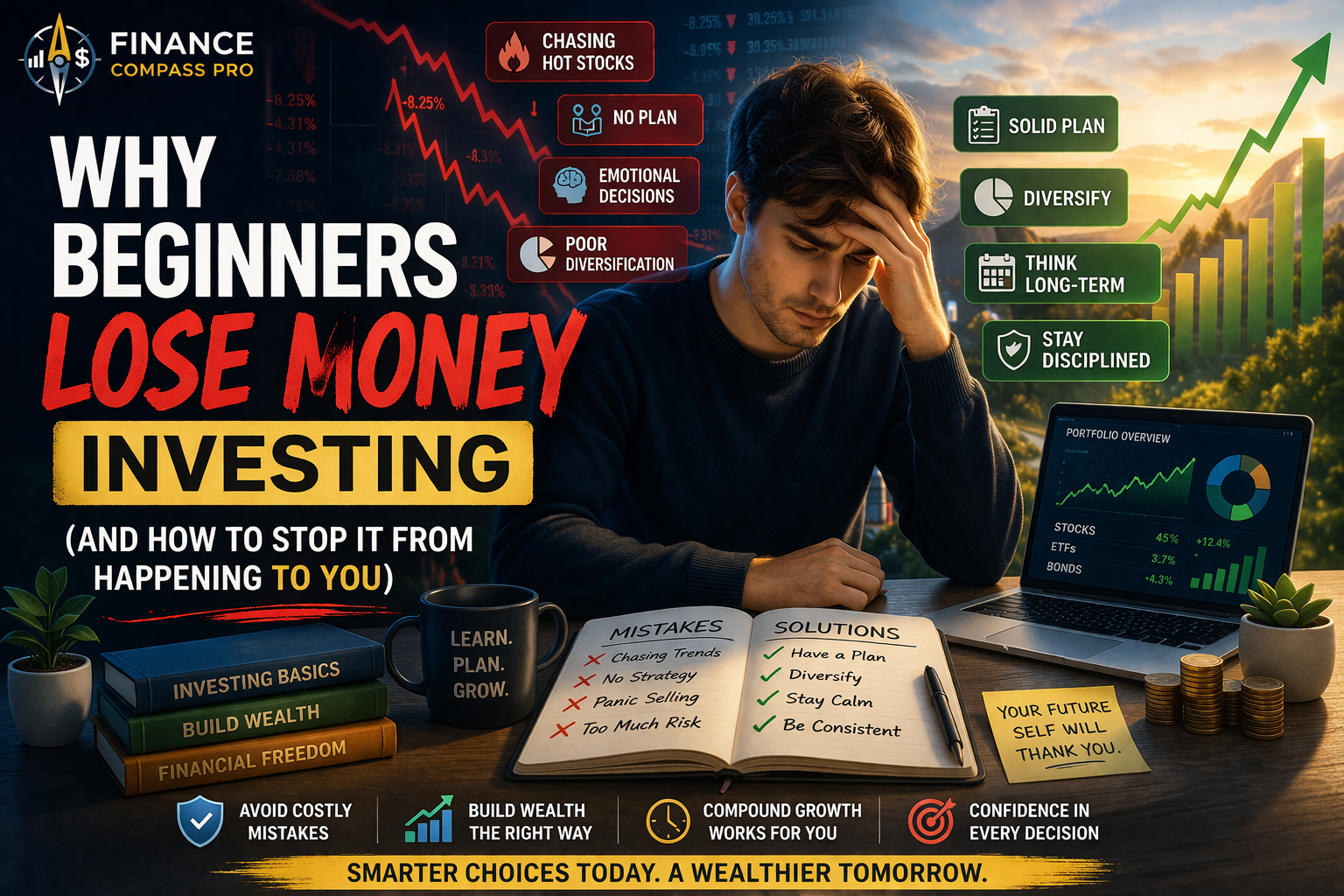
Here’s a statistic that doesn’t get enough attention:
The average individual investor significantly underperforms the market year after year – not because they picked bad stocks, but because of specific, predictable behavioral mistakes.
Research from DALBAR, a financial analysis firm, consistently shows that while the S&P 500 returns around 10% annually over long periods, the average equity investor captures only 6-7% of that. The gap? Pure behavior.
You’re not doomed to repeat these mistakes. But you need to understand what they are first.
Mistake #1: Starting Without a Plan
The most common reason beginners lose money: they start investing without knowing why they’re investing, what they’re investing in, or what they’ll do when things go wrong.
They open an account. They buy something that looked interesting. The market drops. They have no framework for what to do next – so they panic and sell.
The fix: Before investing a dollar, answer these questions:
- What is this money for? (Retirement, house down payment, emergency fund?)
- What is my timeline? (5 years? 20 years? 40 years?)
- How much of a loss can I tolerate without selling? (10%? 20%? 30%?)
- What will I buy and in what proportions?
A written investment plan, even a simple one-page document, dramatically improves your odds of sticking to your strategy when markets get turbulent.
Mistake #2: Panic Selling During Market Downturns
This is the single most expensive mistake beginner investors make.
The market drops 20%. Every headline says it’s going lower. Your portfolio is down thousands of dollars. Every instinct tells you to sell – cut your losses before it gets worse.
So you sell.
Then the market recovers. It almost always does. And you either miss the recovery entirely (because you’re sitting in cash) or you buy back in at higher prices than where you sold.
This pattern – panic selling at bottoms and buying back at tops – is responsible for the majority of the gap between investor returns and market returns.
The 2020 COVID crash saw the S&P 500 drop 34% in about a month. Investors who sold in March 2020 locked in massive losses. Investors who held – or even bought more – recovered everything and went on to massive gains. By the end of 2020, the market was up 16% from the start of the year.
The fix: Before investing, mentally prepare for 20–30% drawdowns. They are normal. They are not emergencies. They are part of the process. Sell only if your life situation fundamentally changes – not because the market scared you.
Mistake #3: Chasing Performance
You hear about a stock that’s up 200% this year. Or a sector that’s “on fire.” Or a new ETF that’s crushing the market.
So you buy it. At the top.
Then it reverts to the mean. It drops 40%. Now you’ve learned a painful lesson.
Chasing past performance is one of the most well-documented behavioral biases in investing. By the time a stock or sector is getting mainstream attention for its gains, much of the upside is already priced in.
The fix: Ignore performance rankings. Choose your investments based on your long-term strategy, not on what performed well recently. Boring, diversified ETFs that rarely make headlines are the foundation of most successful long-term portfolios.
Mistake #4: Trying to Time the Market
“I’ll wait until the market corrects before buying.”
“This feels too high. I’ll wait.”
“I’ll buy after the election / after the Fed meeting / after earnings season.”
Market timing feels logical. It almost never works.
The market’s best days and worst days often cluster together – and the best days frequently happen right in the middle of the scariest headlines. Miss the 10 best days in the S&P 500 over a 20-year period, and your returns drop dramatically. Miss the 20 best days, and you’ve significantly underperformed cash.
The fix: Time in the market beats timing the market. Get invested. Stay invested. Add regularly. Stop trying to predict short-term moves in a system that professional economists with billion-dollar research budgets consistently fail to predict.
Mistake #5: Overconcentration in a Single Stock or Sector
A common pattern with newer investors: they put most or all of their money into a single company they know and like. Their employer’s stock. A brand they use every day. A sector they work in.
This feels smart. You know the company better than you know a random index fund.
But concentration kills. Enron employees who held company stock in their 401(k)s lost virtually everything. Diversified investors lost nothing in that particular bankruptcy.
Any individual stock can go to zero. No index fund of 500+ companies can go to zero unless civilization itself collapses – in which case, your portfolio is the least of your problems.
The fix: No single stock should represent more than 5% of your portfolio. Diversification across hundreds of companies via ETFs is the most reliable form of loss protection available to retail investors.
Mistake #6: Ignoring Fees
It doesn’t sound like much.
An expense ratio of 1% per year. A $4.95 trading commission. A front-end load of 3%.
But fees compound just like returns do – in reverse. On a $50,000 portfolio, the difference between a 1% fee and a 0.05% fee over 30 years is roughly $150,000+ in lost compound growth.
Many actively managed mutual funds charge 0.5-1.5% annually and still underperform the index they’re trying to beat. You’re paying more for worse results.
The fix: Use low-cost index ETFs. Target expense ratios under 0.10% – ideally under 0.05%. Fidelity, Vanguard, and Schwab all offer excellent options in this range. The fees you save will compound alongside your investments for decades.
Mistake #7: Investing Money You Can’t Afford to Lose
This mistake forces panic selling.
If you invest your emergency fund, your rent money, or money you’ll need within 12-24 months – and the market drops 25% right before you need it – you have no choice but to sell at a loss.
Short-term money does not belong in the stock market. Full stop.
The fix: Only invest money you can genuinely leave untouched for at least 5 years, ideally much longer. Keep 3-6 months of expenses in a high-yield savings account as an emergency fund before investing a single dollar in equities.
Mistake #8: Getting Financial Advice From Social Media
Reddit. TikTok. YouTube finance influencers. Discord servers.
Some of these sources contain genuinely useful beginner education. Many do not.
The problem: social media rewards exciting, confident, contrarian predictions. “This stock is going to 10x!” gets 50,000 likes. “Buy a diversified ETF and wait 30 years” gets 200 likes. The incentive structure rewards entertainment over accuracy.
In early 2021, Reddit-driven enthusiasm pushed GameStop to $483 per share. Retail investors who bought the hype at the top held shares worth $15 a year later.
The fix: Base your investing strategy on evidence – academic research, historical data, reputable financial literature (The Little Book of Common Sense Investing, A Random Walk Down Wall Street, The Psychology of Money). Use social media as entertainment, not advice.
What Successful Long-Term Investors Do Differently
The investors who consistently build wealth over decades share a few simple habits:
- They invest consistently, regardless of market conditions
- They own diversified, low-cost ETFs as the core of their portfolio
- They automate contributions to remove emotion from the process
- They don’t check their portfolios daily or weekly
- They’ve mentally accepted that 20-30% drops are part of the journey
- They focus on what they can control: savings rate, fees, time in market
None of these habits require genius. They require discipline.
A Simple Framework to Protect Yourself
Before making any investment decision, ask these three questions:
- Am I buying this because of a plan, or because of emotion/excitement?
- Can I afford to see this drop 30% and still hold?
- Am I paying the lowest reasonable fees for this exposure?
If you can answer those three questions honestly, you’ll avoid the majority of costly beginner mistakes.
The Bottom Line
Beginners lose money investing for predictable, avoidable reasons – not because the market is rigged against them, but because behavior matters as much as strategy.
Panic selling, chasing performance, market timing, overconcentration, ignoring fees – these are the real enemies of long-term wealth building.
The solution isn’t complicated. Build a simple plan. Own diversified ETFs. Automate your contributions. Ignore the noise. Stay invested through downturns.
The market rewards patience. It punishes impatience.
Internal Links Used:
- 7 Investing Mistakes Beginners Should Avoid
- What Is Dollar-Cost Averaging and Why Smart Investors Use It
- Investing for Beginners: The Complete Guide to Building Wealth in 2026
- How to Build Your First Investment Portfolio
This article is for informational and educational purposes only and does not constitute financial advice. No affiliate relationships are currently in place for any platforms or tools mentioned in this post. Past performance does not guarantee future results. Always consult a qualified financial professional before making investment decisions.