Disclosure: This article is for informational and educational purposes only. FinanceCompassPro.com may earn compensation through display advertising or affiliate relationships. We may reference third-party products, services, platforms, or tools for educational purposes. These mentions are not paid endorsements unless clearly stated. Nothing in this article constitutes personalized financial, legal, tax, or investment advice.
You left your job. Somewhere in the paperwork, there was a mention of your 401(k). Then life got busy, and you never dealt with it.
Many old 401(k) accounts remain with former employers, often forgotten or difficult to keep track of over time.
Quick Answer
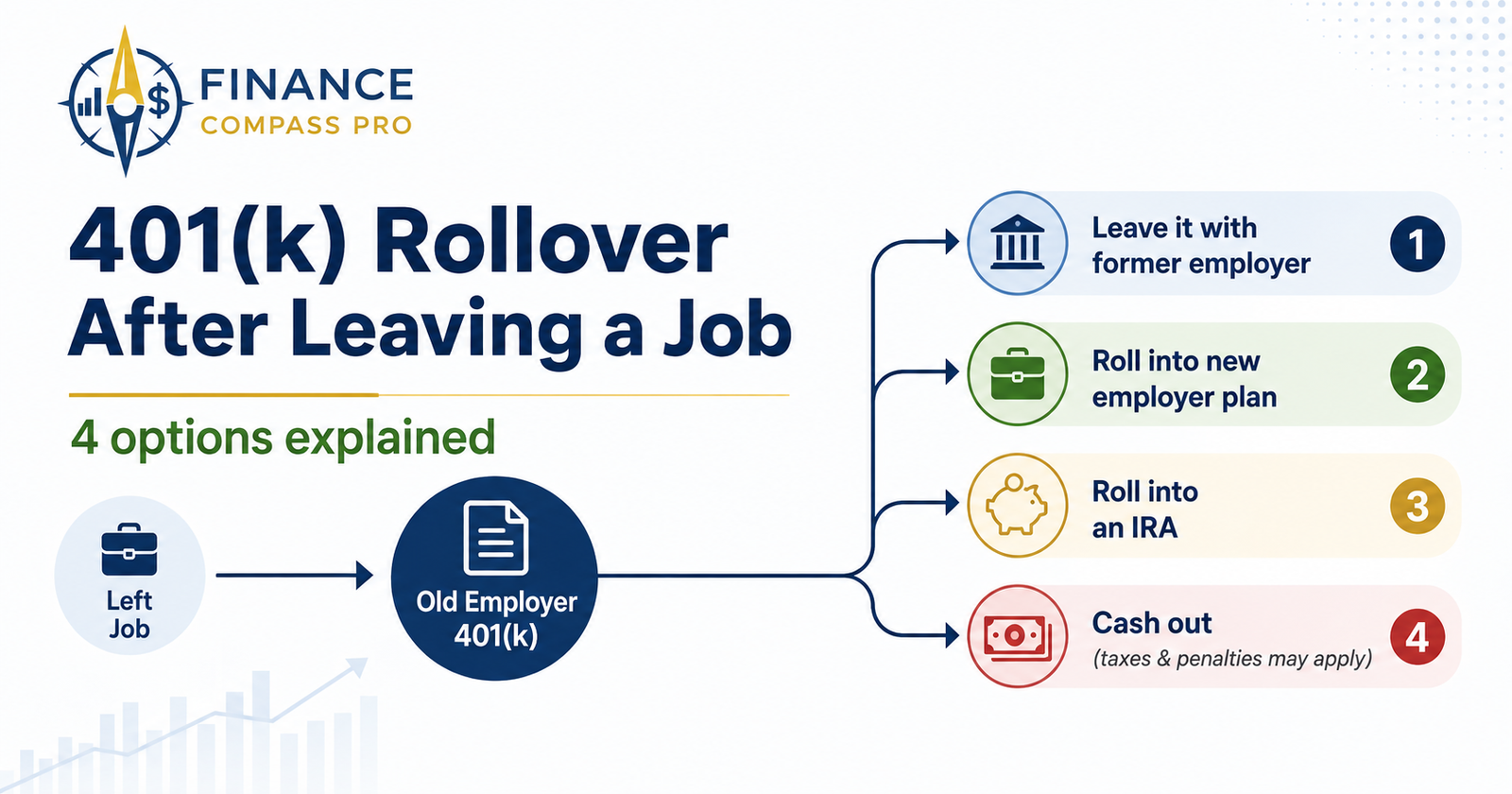
When you leave a job, you generally have four options for an old 401(k): leave it with your former employer’s plan, roll it into your new employer’s plan, roll it into an IRA, or cash it out.
Leaving the money in the old plan or completing an eligible rollover to another tax-deferred account generally does not create an immediate tax bill. A rollover from pre-tax 401(k) money into a Roth IRA is different, since it’s generally taxable as a Roth conversion.
If you don’t need the money for current spending, comparing a direct rollover to an IRA or to a new employer’s plan can be a reasonable starting point.
Option 1: Leave It With Your Former Employer
If your account balance is large enough, many plans allow you to simply leave the money where it is.
This can be the simplest short-term choice, but it comes with a real cost: you can no longer contribute to it, and you’ll need to keep track of a separate account, log-in, and statement for years or decades.
Plans may provide for mandatory distributions when a vested account balance does not exceed $7,000. If a mandatory distribution is more than $1,000 and you make no election, federal rules generally require it to be directly rolled into an IRA selected by the plan administrator. If you have a small balance, don’t assume “leave it alone” is actually available to you – check with your plan administrator for the specific threshold and process that applies to your account.
Option 2: Roll It Into Your New Employer’s Plan
If your new employer offers a 401(k) that accepts rollovers, consolidating your old balance into it keeps your retirement savings in one place.
This can simplify tracking and management. It also keeps the door open for the Rule of 55, which may allow penalty-free withdrawals if you separate from service in or after the year you turn 55. This exception generally applies to distributions from the qualified plan of the employer from which you separated from service; it does not apply to IRAs.
Whether this makes sense also depends on the new plan’s investment options and costs, which can vary significantly between employers.
Option 3: Roll It Into an IRA
Rolling into an IRA often provides access to a much wider range of investment choices than a workplace plan offers.
If you’re rolling a traditional 401(k), rolling into a traditional IRA avoids an immediate tax bill. Rolling into a Roth IRA instead is a Roth conversion, and you’ll generally owe income tax on the converted amount. If you’re considering that route, see What Is a Roth IRA? for how Roth tax treatment works.
There are two ways to execute a rollover, and the difference matters:
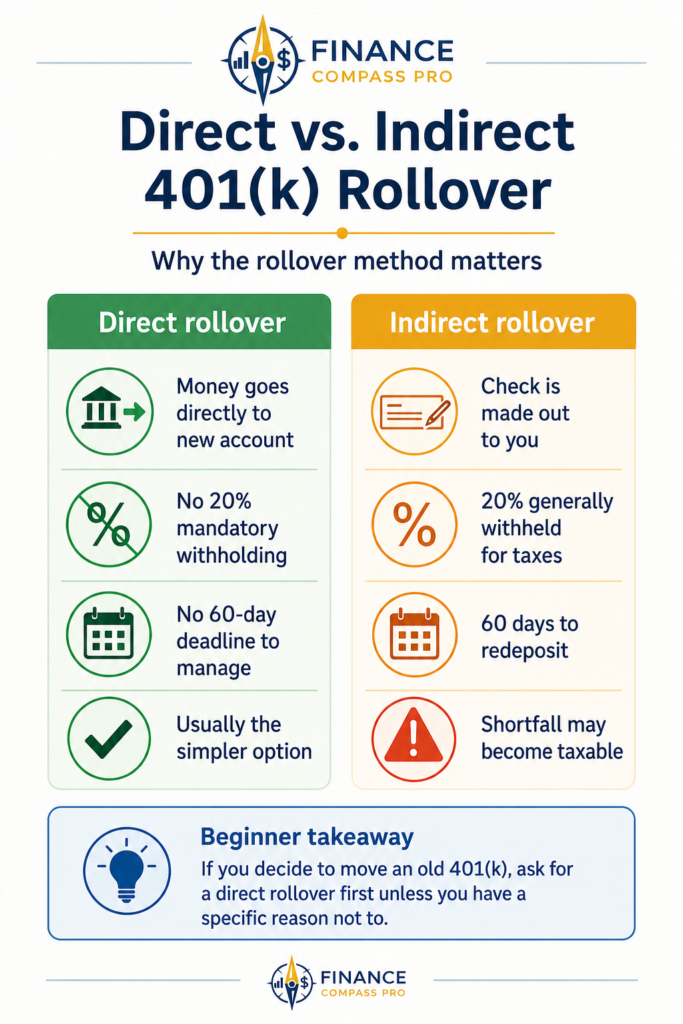
- Direct rollover: Your old plan sends the money straight to your new account. There’s no mandatory withholding and no 60-day deadline to manage.
- Indirect rollover: The check is made out to you. According to the IRS, a retirement plan distribution paid directly to you is generally subject to mandatory 20% withholding, even if you intend to roll it over. You then have 60 days to deposit the full original amount — including the withheld 20%, funded from other money – into a new account to avoid that withheld portion being treated as a taxable distribution.
A direct rollover avoids the 20% mandatory withholding and the 60-day rollover deadline that applies when an eligible distribution is paid directly to you. Ask your plan administrator for a direct rollover unless you have a specific reason not to.
Option 4: Cash It Out
This is generally the option with the most immediate tax consequences and the greatest loss of future tax-advantaged growth.
Cashing out means the distribution is added to your taxable income for the year. If you’re under 59½, the taxable portion may also be subject to a 10% additional tax on early distributions unless an exception applies. On a $20,000 balance, taxes and any applicable additional tax can reduce the amount you actually keep by a meaningful margin.
The Hidden Trade-Off Most Guides Skip
The real decision isn’t really “which option is best.” It’s what you’re optimizing for: simplicity, investment choice, or immediate cash.
Leaving it in place optimizes for doing nothing right now, at the cost of a scattered set of accounts over time. Rolling to a new plan optimizes for consolidation. Rolling to an IRA optimizes for investment flexibility. Cashing out optimizes for cash today, at a real and often underestimated cost.
Because cashing out can create current taxes, possible additional taxes, and the loss of future tax-advantaged growth, it usually deserves the most careful review before you choose it.
A Simple Decision Framework
- New employer’s plan has low costs and options you like? Rolling in for consolidation can be reasonable.
- Want more investment choice than a workplace plan typically offers? An IRA rollover is worth comparing.
- Balance is small and easy to track? Leaving it in place temporarily may be fine, but confirm your plan won’t force it out first.
- Considering cashing out? Calculate the actual tax and additional-tax impact before deciding. The number is often larger than expected.
- Leaving a job at 55 or older? Check whether the Rule of 55 applies to that specific employer’s plan before rolling the balance elsewhere, since rolling it into an IRA generally forfeits that exception for those funds.
A Beginner Mistake to Avoid
One costly mistake is treating a rollover check as spendable cash, especially with an indirect rollover.
If a check arrives made out to you personally, the clock is already running. Miss the 60-day deposit deadline, or deposit less than the full original amount, and the shortfall is treated as a taxable distribution, along with the additional 10% tax if it applies.
A direct rollover avoids this risk by keeping the money moving between institutions, without ever passing through your hands.
Where This Fits in Your Retirement Plan
Rollovers only come up once you’ve already had a 401(k) somewhere. If you’re new to how these accounts work in the first place, start with What Is a 401(k)?
For the broader picture of how a rollover fits alongside an employer match, IRAs, and other retirement accounts, see Retirement Accounts for Beginners.

Bottom Line
None of the four options is universally correct. Leaving the account in place, rolling to a new employer’s plan, and rolling to an IRA (into the same tax treatment) all generally avoid an immediate tax bill, and the right one depends on your new plan’s quality, how many old accounts you’re already tracking, and how much investment flexibility matters to you.
Cashing out deserves the most careful review of the four, given the current taxes, possible additional taxes, and lost future growth it can involve. If you do move forward with a rollover, ask for a direct rollover to sidestep the withholding and 60-day deadline that come with an indirect one.
FAQ
A. If your balance is large enough, it typically stays in your former employer’s plan. Smaller balances may be handled differently – plans can provide for mandatory distributions on vested balances under $7,000, with amounts over $1,000 generally directed into an IRA the plan selects if you don’t make your own election. Check with your plan administrator about the threshold and process that applies to you.
A. In a direct rollover, your old plan sends the money straight to your new account, with no mandatory withholding. In an indirect rollover, the IRS requires plans to generally withhold 20% of a distribution paid directly to you, and you must deposit the full original amount into a new account within 60 days to avoid that withheld portion being taxed as a distribution.
A. Generally no, as long as you roll a traditional 401(k) into a traditional IRA or another traditional account, or a Roth 401(k) into a Roth account. Rolling a traditional 401(k) into a Roth IRA is a taxable Roth conversion.
A. The Rule of 55 may allow penalty-free withdrawals from the qualified plan of the employer you separated from, if that separation occurred in or after the year you turned 55. This exception does not apply to IRAs. Rolling those funds into an IRA generally forfeits access to the Rule of 55 for that money.
This article is for informational and educational purposes only and does not constitute financial, legal, or tax advice. Rollover rules, withholding requirements, and force-out thresholds can change and may vary by plan. Always confirm current rules with your plan administrator and consider consulting a qualified financial or tax professional before moving retirement funds.