Disclosure: This post is for informational and educational purposes only. FinanceCompassPro.com may earn compensation through display advertising. We may also reference third-party products, services, or platforms by name for educational purposes – these mentions are not paid endorsements unless explicitly stated. Nothing in this post constitutes personalized financial, legal, tax, or investment advice.
You’ve probably heard the term “Roth IRA” thrown around in personal finance conversations. Maybe you’ve even meant to look it up – and kept putting it off.
If you’re under 40, this is one retirement account you should seriously understand. The tax advantage it offers is one of the most powerful tools available to everyday investors, and most major brokerages let you open a Roth IRA with no account fee or minimum balance.
Here’s exactly what it is, how it works, and why opening one might be the best financial decision you make this year.
What Is a Roth IRA?
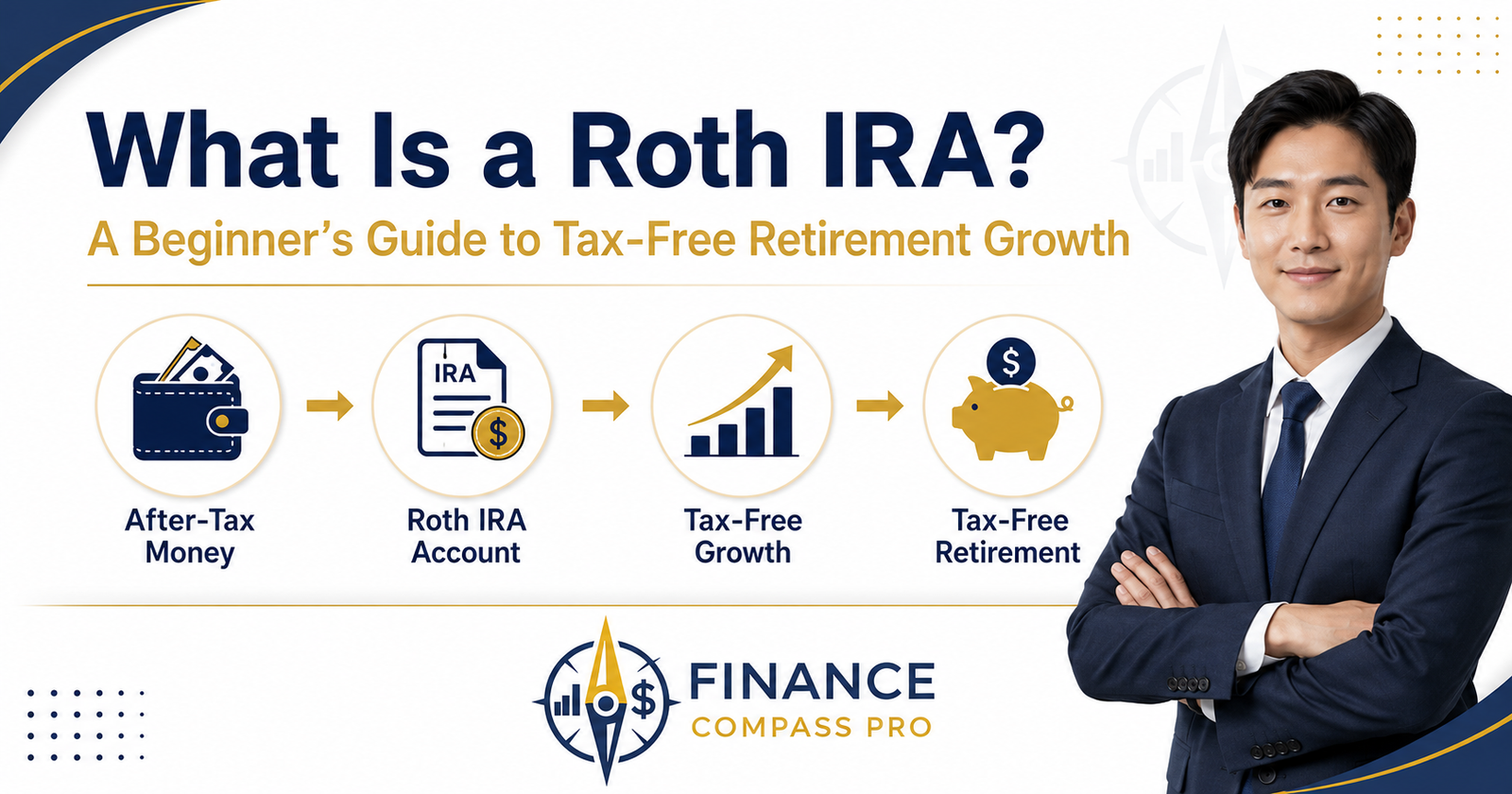
A Roth IRA (Individual Retirement Account) is a personal retirement savings account that lets your investments grow completely tax-free.
You contribute money that you’ve already paid income taxes on. In return, you never pay taxes again – not on the growth, not on the dividends, and not when you withdraw the money in retirement.
That’s the deal. You pay taxes once, upfront, and then the IRS leaves your account alone for the rest of your life.
“With a Roth IRA, you’re essentially trading a small tax bill today for complete tax freedom decades from now – and the math almost always favors the trade.”

How Does a Roth IRA Work?
Here’s the basic mechanics:
- You open an account at a brokerage like Fidelity, Charles Schwab, or Vanguard (all offer free Roth IRAs with no account minimums).
- You contribute after-tax dollars – meaning money from your paycheck after income taxes have been withheld.
- You invest those contributions in whatever you choose: index funds, ETFs, stocks, bonds.
- Your investments grow tax-free for as long as the money stays in the account.
- In retirement (age 59½ or later), you withdraw the money – including all the growth – completely tax-free.
No required minimum distributions during your lifetime. No taxes on qualified withdrawals. But like every tax-advantaged account, Roth IRAs still come with contribution limits, income rules, and withdrawal requirements.
Roth IRA vs. Traditional IRA: What’s the Difference?
This is the question most beginners ask first – and it matters.
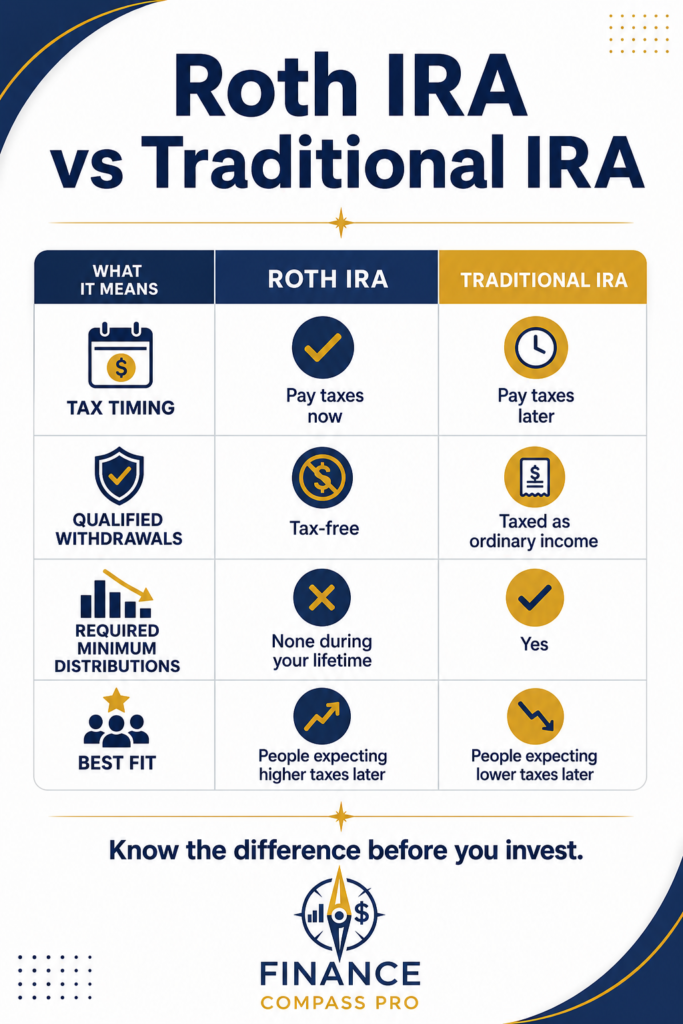
| Roth IRA | Traditional IRA | |
|---|---|---|
| When you pay taxes | Now (contributions are after-tax) | Later (withdrawals are taxed) |
| Tax deduction on contributions? | No | Yes (if eligible) |
| Tax on growth? | None | Taxed at withdrawal |
| Required withdrawals at 73? | No | Yes |
| Best for… | People expecting higher taxes later | People expecting lower taxes later |
The simple rule: If you’re young and currently in a lower tax bracket than you’ll be in retirement, the Roth IRA almost always wins.
For a side-by-side comparison of how the two accounts perform across different income levels and time horizons, see Traditional IRA vs. Roth IRA in 2026: Which One Saves You More Money Over 30 Years?
You lock in today’s low tax rate and never pay taxes on decades of growth.
For most people under 40 with a growing income, this makes the Roth IRA the clear choice.
2026 Roth IRA Contribution Limits
You can’t pour unlimited money into a Roth IRA – the IRS sets annual contribution limits.
For 2026:
- Under age 50: $7,500 per year
- Age 50 or older: $8,600 per year (catch-up contribution)
That’s the maximum you can contribute across all your IRAs combined. If you also have a Traditional IRA, the $7,500 limit covers both accounts together.
Important: You must have earned income (wages, salary, self-employment income) at least equal to what you contribute. One lesser-known way to fund a Roth IRA without new earned income each year: if you or your child has leftover 529 college savings, up to $35,000 can be rolled over into a Roth IRA, subject to this same annual limit.
Income Limits: Can Everyone Open a Roth IRA?
Not quite. The IRS phases out Roth IRA eligibility at higher income levels.
For 2026:
- Single filers: Full contribution allowed below $153,000 MAGI; phase-out between $153,000–$168,000; not eligible above $168,000
- Married filing jointly: Full contribution below $242,000; phase-out between $242,000–$252,000
(Note: These limits adjust annually for inflation – always verify current IRS figures.)
If your income exceeds the limit, there’s still a legal strategy called the Backdoor Roth IRA – see Backdoor Roth IRA Explained for how the process works and what to watch for.
For the most current income limits and official contribution rules, see the IRS Roth IRA page.
What Can You Invest In Inside a Roth IRA?
What Can You Invest In Inside a Roth IRA?
A Roth IRA is an account, not an investment. After contributing money, you still need to choose what to hold inside it.
Common options include:
- Index mutual funds
- Exchange-traded funds
- Individual stocks
- Bond funds
- Target-date funds
Many beginners start with a low-cost, broadly diversified index fund or target-date fund rather than trying to select several individual investments.
The appropriate choice depends on your time horizon, risk tolerance, diversification needs, and the role this account plays in your broader portfolio. Best ETFs for Roth IRA explains how to evaluate fund choices after you have decided that a Roth IRA fits your retirement strategy.
The Power of Tax-Free Growth: A Real Example
The Power of Tax-Free Growth: A Real Example
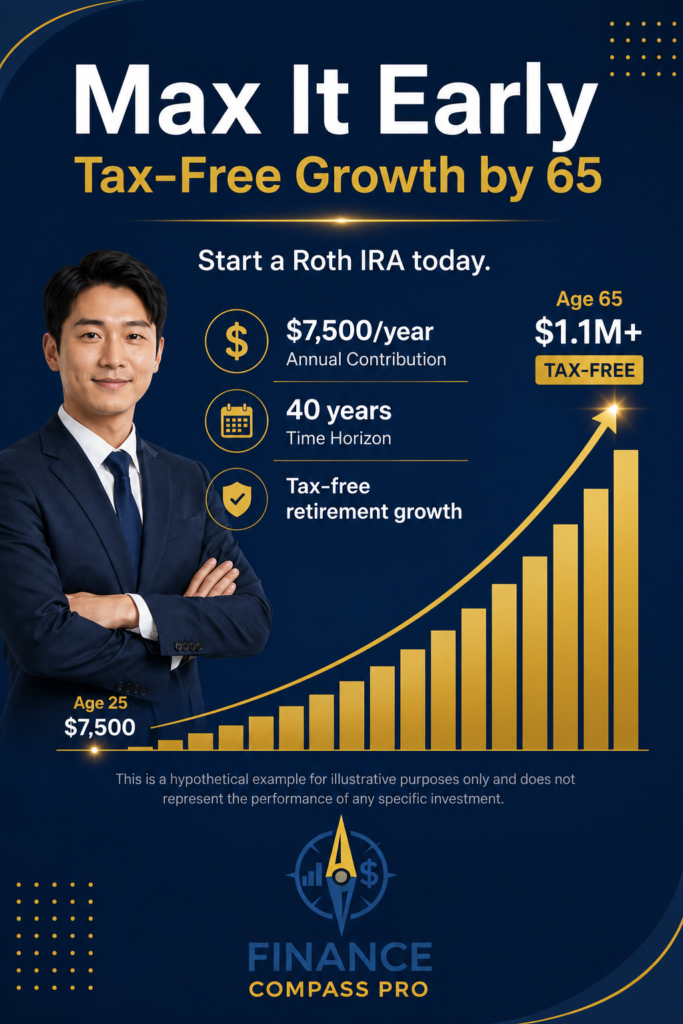
Suppose a 25-year-old contributes $7,500 per year for 40 years and earns an average annual return of 8%.
By age 65, the account could grow to approximately $1.9 million, depending on contribution timing and actual investment returns.
Total contributions would equal $300,000. The remaining balance would come from investment growth.
If the withdrawal qualifies under Roth IRA rules, the accumulated earnings may be withdrawn without federal income tax. Actual returns are not guaranteed, and taxes or rules may change over time, but the example shows why a long investment horizon can make Roth tax treatment valuable.
When Can You Access Your Roth IRA Money?
Regular Roth IRA contributions can generally be withdrawn at any time without federal income tax or the 10% early-distribution penalty.
Earnings and converted amounts follow different rules. Qualified withdrawals of earnings generally require both an eligible event – most commonly reaching age 59½ – and satisfaction of the applicable five-year requirement.
Roth IRA Withdrawal Rules Explained covers the two five-year rules, the ordering rules for contributions, conversions, and earnings, and the situations in which tax or penalties may apply.
Do not use an ordinary withdrawal to correct an ineligible or excessive contribution. Excess Roth IRA Contributions Explained covers the separate correction procedures and deadlines.
How to Open a Roth IRA: 4 Steps
How to Open a Roth IRA: 4 Steps
- Choose a brokerage
Compare account fees, available investments, customer support, automatic contribution tools, and minimum investment requirements.
- Open the Roth IRA
You will generally need your Social Security number, employment information, bank details, and beneficiary information.
- Fund the account
Transfer money from a bank account or set up recurring contributions. Make sure your total Traditional and Roth IRA contributions remain within the annual combined limit.
- Choose investments
Opening the account is not the same as investing the money. After funding it, select investments that fit your time horizon, risk tolerance, and diversification needs.
Common Roth IRA Mistakes to Avoid
Not opening one at all. Every year you delay is a year of tax-free compounding you can never get back.
Leaving it in cash. Many people open a Roth IRA and forget to actually invest the money. The account earns nothing sitting in cash – you must choose investments inside the account.
Withdrawing earnings early. The penalty and taxes can be significant. Treat Roth IRA earnings as untouchable until retirement.
Contributing more than the limit. The IRS charges a 6% penalty on excess contributions. Track what you put in each year.
Is a Roth IRA Worth It?
Is a Roth IRA Worth It?
A Roth IRA may be valuable when you qualify to contribute, expect the current tax cost to be manageable, and value the possibility of qualified tax-free withdrawals later.
It is not automatically the first account every beginner should fund. An available employer match, current tax deductions, household income, investment options, fees, liquidity needs, high-interest debt, and whether you are eligible for a tax-advantaged Health Savings Account (HSA) can all change the order.
Retirement Accounts for Beginners explains how a 401(k) match, Roth IRA, Traditional IRA, and additional workplace-plan contributions may fit together.
You can generally contribute to both a 401(k) and a Roth IRA in the same year because their contribution limits are separate.
Can You Have a Roth IRA and a 401(k) at the Same Time? explains how eligibility and limits interact.
If you are choosing between Roth tax advantages and the flexibility of a taxable account, Roth IRA vs. Brokerage Account compares the two account types.
The Bottom Line
A Roth IRA is a retirement account funded with after-tax contributions. Investments can grow without annual federal taxation inside the account, and qualified withdrawals may be tax-free.
Its value depends on eligibility, current and future tax circumstances, investment choices, and whether another account – such as a matched 401(k) or deductible Traditional IRA – should come first.
Before contributing, confirm the annual limit, income eligibility, and how much you have already contributed to other IRAs. After funding the account, make sure the money is actually invested rather than left unintentionally in cash.
Disclaimer: This article is for educational purposes only and does not constitute personalized financial or tax advice. Contribution limits and income thresholds are subject to annual IRS adjustments. Consult a qualified financial professional for advice specific to your situation.