Disclosure: This post is for informational and educational purposes only. FinanceCompassPro.com may earn compensation through display advertising. We may also reference third-party products, services, or platforms by name for educational purposes — these mentions are not paid endorsements unless explicitly stated. Nothing in this post constitutes personalized financial, legal, tax, or investment advice.
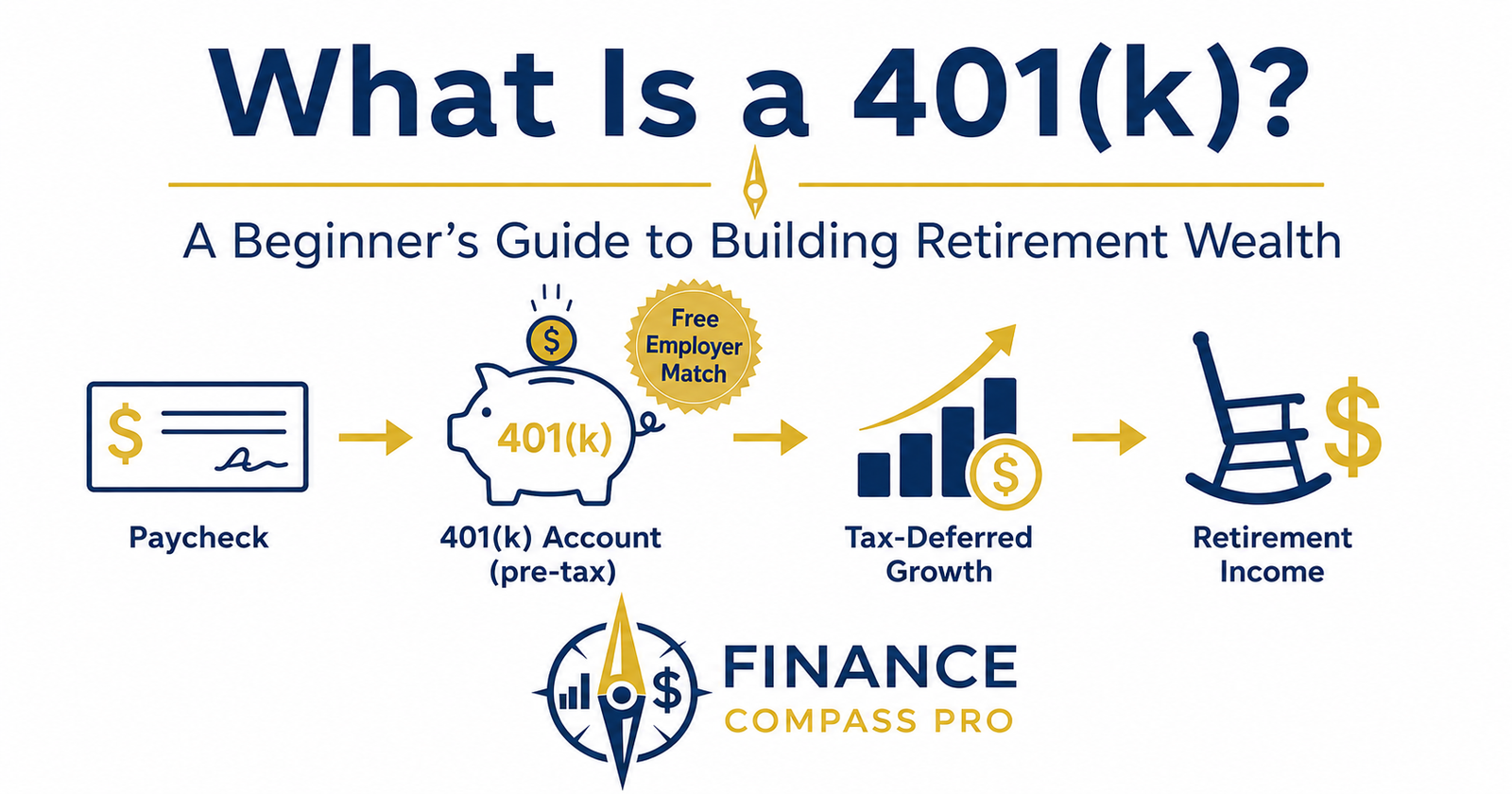
If your employer offers a 401(k) and you’re not using it to its full potential, you’re likely leaving tens of thousands of dollars on the table. Possibly much more.
Most people know they’re supposed to have a 401(k). Far fewer understand how it actually works – or how much it can do for them over time.
Here’s a complete, plain-English breakdown of what a 401(k) is, how it works, and why it’s one of the most powerful tools an ordinary earner has for building serious long-term wealth.
What Is a 401(k)?
A 401(k) is a retirement savings account offered through your employer. The name comes from the section of the U.S. tax code that created it – Section 401(k).
You contribute a portion of each paycheck directly into the account before you ever see the money. Those contributions are invested, grow over time, and become your retirement income.
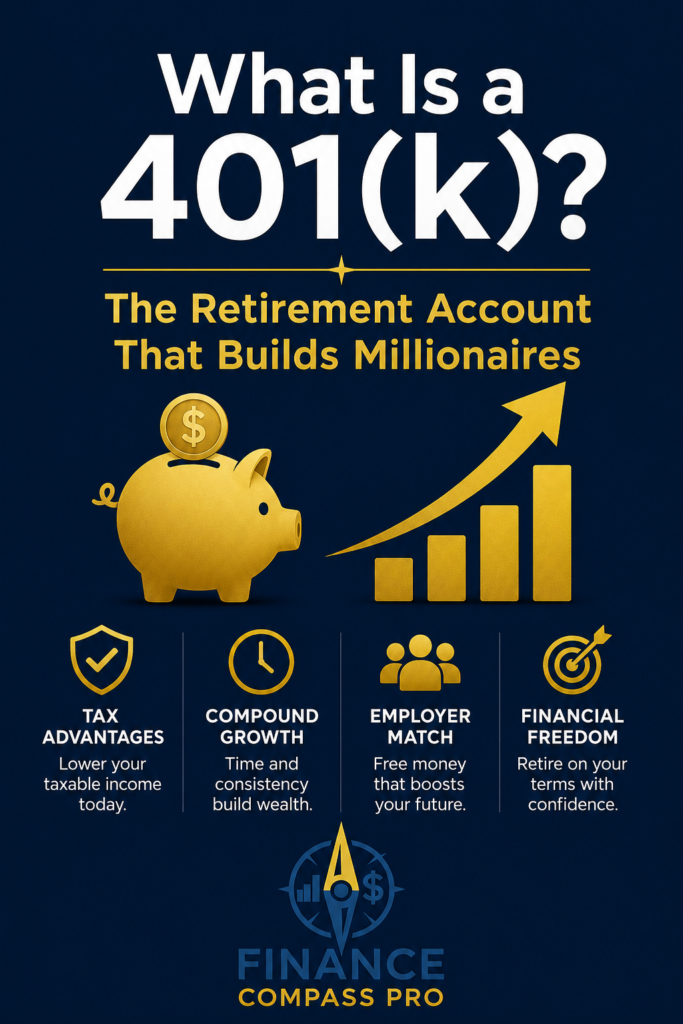
The key advantage: your contributions are made before income taxes are taken out, which means you reduce your taxable income today and let your investments compound for decades without annual tax drag.
“A 401(k) is one of the few places where the government actually helps you build wealth – by letting you invest before taxes and delay the bill until retirement.”
How Does a 401(k) Work?
Here’s the basic flow:
- You enroll through your employer’s HR or benefits portal.
- You choose a contribution percentage – typically 3%–15% of your paycheck.
- The money is deducted automatically from each paycheck before taxes.
- You choose how to invest it from the funds your plan offers (usually a mix of index funds, target-date funds, and sometimes company stock).
- Your investments grow tax-deferred – no taxes owed on gains until withdrawal.
- At retirement (age 59½ or later), you withdraw funds and pay ordinary income tax on what you take out.
The automatic nature of 401(k) contributions is one of its biggest advantages. You never see the money in your checking account, so you never miss it – and it compounds quietly for decades.
Traditional 401(k) vs. Roth 401(k): What’s the Difference?
Many employers now offer both options. The difference comes down to when you pay taxes.
| Traditional 401(k) | Roth 401(k) | |
|---|---|---|
| Contributions | Pre-tax (reduces taxable income now) | After-tax (no deduction now) |
| Tax on growth | Tax-deferred | Tax-free |
| Withdrawals | Taxed as ordinary income | Tax-free (if qualified) |
| Best for… | Those expecting lower taxes in retirement | Those expecting higher taxes in retirement |
Simple rule: If you’re early in your career and expect your income (and tax rate) to rise, the Roth 401(k) option may be worth considering. If you are in a higher tax bracket today and expect a lower tax rate in retirement, the traditional 401(k)’s upfront deduction may be more valuable.
The better option depends on your current marginal tax rate, expected retirement tax rate, plan features, and whether you value a tax benefit now or the potential for qualified tax-free withdrawals later.
2026 401(k) Contribution Limits
The IRS sets annual limits on how much you can contribute.
- Under age 50: $24,500 per year
- Age 50 or older: $32,500 per year, including an $8,000 catch-up contribution
- Ages 60 to 63: up to $35,750 per year if the plan allows the higher SECURE 2.0 catch-up contribution – see 2026 401(k) Catch-Up Rules for the full breakdown, including a new Roth requirement for high earners
These limits apply to employee elective deferrals. Employer contributions are subject to separate plan and overall contribution rules, so the amount deposited into the account can be higher than the employee deferral limit alone.
(Note: Contribution limits adjust periodically for inflation – always verify current IRS figures on the IRS website.)
The Employer Match: The Most Important Benefit You Might Be Ignoring
Many employers match a portion of your 401(k) contributions. This is often called a 401(k) employer match, and it is one of the most valuable parts of many workplace retirement plans.
A common formula might look like this: your employer matches 100% of the first 4% of your salary that you contribute, or 50% of your contributions up to 6% of your salary. The exact formula depends on your employer’s plan rules.
What Is the Average 401(k) Match?
The average 401(k) match varies by employer, industry, and plan design, so there is no single number that applies to every worker. Still, many employer match formulas fall somewhere in the range of 3% to 6% of salary.
For example, an employer might match 50% of your contributions up to 6% of your salary, or match 100% of your contributions up to 3% or 4% of your salary. These formulas look different, but both are common ways companies encourage employees to save for retirement.
What Is a Good 401(k) Match Percentage?
A good 401(k) match percentage is one that meaningfully increases your retirement savings without requiring you to take additional investment risk. In practical terms, many workers view a match in the 3% to 6% range as a valuable benefit, especially if the employer contributions are fully vested or become vested over a reasonable schedule.
The match percentage matters because it changes the real value of your own contribution. If your employer adds money when you contribute, you are receiving additional retirement savings before market returns even begin.
What Is the Minimum 401(k) Match You Should Contribute?
At a minimum, many workers should try to contribute enough to receive the full employer match. If your employer matches contributions up to 5% of your salary, contributing less than 5% may mean leaving part of that benefit unused.
For example, if you earn $60,000 and your employer matches 100% of contributions up to 4% of your salary, your 4% contribution would be $2,400 per year. Your employer would add another $2,400, giving you $4,800 going into the account before investment returns.
Not contributing enough to capture the full match is one of the most costly mistakes workers make. Before trying to optimize advanced investment choices, make sure you are not missing the basic match your employer already offers.
For a deeper step-by-step explanation of match formulas, vesting schedules, and contribution examples, see our full guide on what a 401(k) employer match is.
After confirming the match formula, How to Maximize Your 401(k) explains how to raise your contribution rate, review plan fees, and improve the way the account is invested.
What Can You Invest In Inside a 401(k)?
Unlike a brokerage account, you don’t pick individual stocks in most 401(k) plans. Your investment choices are limited to whatever funds your employer’s plan includes – typically:
- Target-date funds (e.g., “Target Retirement 2055”) – automatically shift from stocks to bonds as you near retirement
- Index funds – low-cost funds tracking the S&P 500 or total market
- Bond funds – lower risk, lower return
- Company stock – available in some plans (use with caution; concentration risk)
For many participants, a low-cost diversified index fund or an appropriately dated target-date fund can be a practical starting point. Compare each option’s expense ratio, diversification, asset allocation, and risk level rather than choosing solely by recent performance.
If you are not sure how to turn the available fund choices into an actual allocation, How to Build Your First Investment Portfolio walks through the basic structure step by step.
The Power of a 401(k): A Real Example
Let’s put numbers to this.
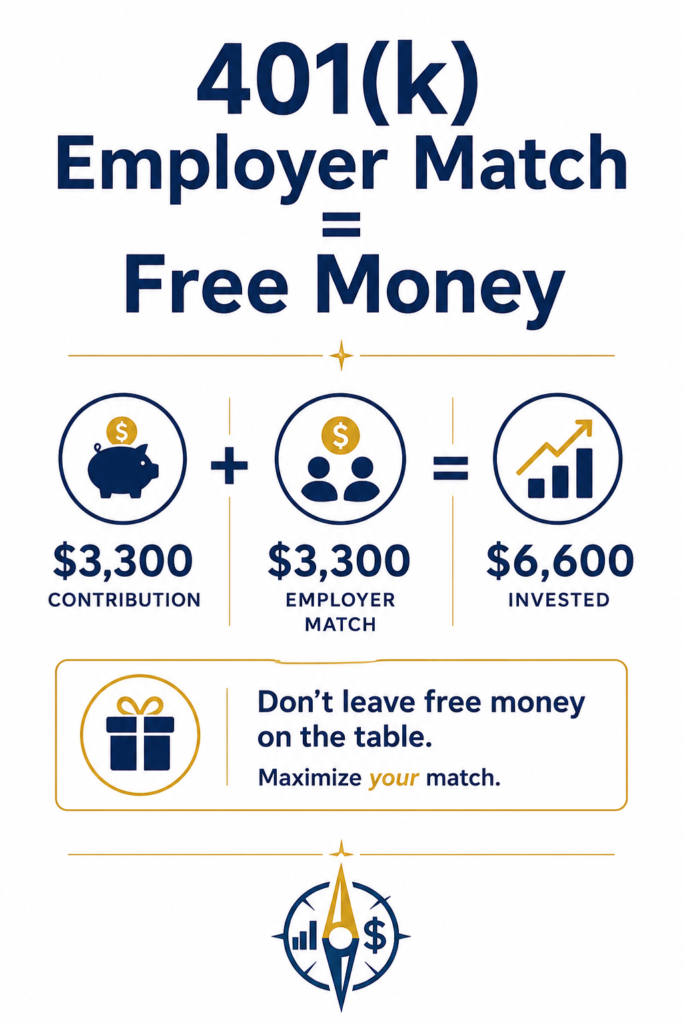
Assume you’re 25, earn $55,000 per year, and contribute 6% to your 401(k). Your employer matches 100% of that 6%.
- Your contribution: $3,300/year
- Employer match: $3,300/year
- Total invested annually: $6,600
- Average annual return: 8%
- Balance at age 65: approximately $1,750,000
You contributed $132,000 over 40 years. The rest – over $1.6 million – came from employer matching and compound growth, all growing tax-deferred inside the account.
That’s the math behind why a 401(k) can turn an ordinary salary into extraordinary retirement wealth.

When Can You Access 401(k) Money?
Standard withdrawal: Age 59½ or older – pay ordinary income tax, no penalty.
Early withdrawal (before 59½): Typically triggers a 10% penalty plus ordinary income taxes. This can mean losing 30%–40% of the withdrawal to taxes and penalties combined. Avoid early withdrawals whenever possible.
Required Minimum Distributions (RMDs): Starting at age 73 or 75 depending on your birth year, the IRS requires you to begin withdrawing a minimum amount each year from a traditional 401(k). (Roth 401(k)s are no longer subject to RMDs during the owner’s lifetime, as of 2024.) See Required Minimum Distributions Explained for the full deadlines and penalties.
Exceptions to the early withdrawal penalty exist for certain hardships, disability, and other qualifying circumstances – but these should be treated as last resorts.
What Happens to Your 401(k) If You Leave Your Job?
This is one of the most practical questions workers face – and the answer matters.
You have four options when you leave an employer:
- Leave it in your former employer’s plan – simple, but limits your fund choices
- Roll it over to your new employer’s plan – consolidates your accounts
- Roll it over to an IRA – usually the most flexible option, more fund choices, often lower fees
- Cash it out – almost always the worst option (taxes + 10% penalty if under 59½)
Rolling the balance into an IRA may provide broader investment choices, but leaving it in the plan or moving it to a new employer’s plan can be preferable when fees, creditor protections, withdrawal rules, or future backdoor Roth planning matter. For a full walkthrough of these four options, including the direct-vs-indirect rollover rules and the Rule of 55, see 401(k) Rollover After Leaving a Job.
401(k) vs. IRA: Which Comes First?
A 401(k) and an IRA usually work in sequence rather than as competing accounts.
For many employees, a practical starting order is to contribute enough to receive the available employer match, compare a Roth or deductible Traditional IRA with additional 401(k) contributions, and then return to the 401(k) if more retirement savings are available.
Retirement Accounts for Beginners provides the full account-priority framework, including the factors that can change this order.
You can also contribute to a 401(k) and an IRA in the same year because the two account types have separate contribution limits. Can You Have a Roth IRA and a 401(k) at the Same Time? explains how the limits and eligibility rules work together.
After receiving the employer match, the IRA decision often comes down to whether you qualify for a valuable Traditional IRA deduction or prefer Roth tax treatment. Traditional IRA vs. Roth IRA compares those trade-offs in detail.
Common 401(k) Mistakes to Avoid
Not enrolling at all. Some plans auto-enroll you; many don’t. If you haven’t checked, do it today.
Contributing less than the employer match. Leaving any employer match unclaimed is giving up part of your compensation.
Cashing out when you change jobs. The taxes and penalties can wipe out years of growth in a single transaction.
Ignoring your investment selection. Money sitting in the default money market fund isn’t working for you. Choose an appropriate index fund or target-date fund.
Never increasing your contribution rate. Start with what you can afford, but aim to raise your contribution percentage with every salary increase.
The Bottom Line
A 401(k) is an employer-sponsored retirement account that lets you invest pre-tax dollars, grow them tax-deferred for decades, and potentially retire with far more wealth than you could accumulate in a regular savings account.
An employer match can be one of the most valuable benefits available to workers because it adds employer money to eligible contributions before investment returns are even considered. The tax deferral gives your investments room to compound without being interrupted by annual taxes. And the automatic payroll deduction removes the need for willpower.
If your employer offers a 401(k), it is usually worth understanding and using carefully – especially if your plan includes an employer match.
Disclaimer: This article is for educational purposes only and does not constitute personalized financial or tax advice. Contribution limits and tax rules are subject to change. Consult a qualified financial professional for advice specific to your situation.