
Disclosure: This article is for informational and educational purposes only. FinanceCompassPro.com may earn compensation through display advertising or affiliate relationships. We may reference third-party products, services, platforms, or tools for educational purposes. These mentions are not paid endorsements unless clearly stated. Nothing in this article constitutes personalized financial, legal, tax, or investment advice. Tax and health-plan rules are complex and change over time – always confirm current figures with the IRS or a qualified tax professional.
Most beginners hear about the 401(k) and the Roth IRA long before anyone mentions a Health Savings Account.
That is easy to understand. An HSA starts out as a way to pay medical bills, so it does not look like part of a long-term wealth plan.
But for people who qualify, an HSA stacks three separate federal tax benefits into one account: tax-advantaged contributions, tax-free investment growth, and tax-free withdrawals for qualified medical expenses. That combination can make an HSA one of the most tax-efficient accounts available to eligible U.S. savers.
Quick Answer
A Health Savings Account (HSA) is a personal, tax-advantaged account that eligible individuals can use to save, invest, and pay for qualified medical expenses. The account belongs to you. Unused money rolls over every year, and the balance moves with you if you change jobs.
| Coverage | 2026 Contribution Limit | Age 55+ Maximum |
|---|---|---|
| Self-only | $4,400 | $5,400 |
| Family | $8,750 | $9,750 |
One 2026 change matters here. Federal law now treats certain bronze and catastrophic health plans as HSA-compatible, regardless of whether you bought the plan through an Exchange, even when they do not meet the traditional deductible and out-of-pocket tests. So do not assume your plan fails, or qualifies, based on the deductible number alone.
What Is an HSA, Exactly?
An HSA is an account that you own. You, your employer, or someone else can contribute to it, subject to the annual limit.
The money can then pay or reimburse qualified medical expenses for you and, under applicable rules, your spouse and dependents.
Unlike money in many employer benefit arrangements, an HSA does not disappear when you leave your job. It stays with you. That portability is one reason an HSA can grow into something bigger than a medical spending account over time.
Why People Call the HSA “Triple Tax-Advantaged”
The phrase refers to three separate federal tax benefits, and each one works a little differently.

1. Contributions can receive favorable tax treatment
If your HSA contributions go through a Section 125 cafeteria plan at work, sometimes called a salary-reduction arrangement, they generally avoid federal income tax as well as Social Security and Medicare (FICA) taxes.
If you contribute directly to your HSA instead, outside of payroll, you can generally deduct eligible contributions on your federal return even without itemizing. That deduction lowers your federal income tax, but it does not avoid payroll (FICA) tax the way a payroll contribution does. Payroll contributions and direct personal contributions are not identical for tax purposes.
2. Investment growth is generally tax-free federally
Many HSA providers let you invest part or all of your balance, often after you keep a required amount in cash. Interest, dividends, and capital gains inside the account generally are not taxed federally while they stay in the HSA.
3. Qualified medical withdrawals are tax-free
When you use HSA money for a qualified medical expense, the withdrawal is generally free from federal income tax. That holds true at any age.
This is what sets the HSA apart. A Traditional retirement account gives you a tax break going in but taxes withdrawals later. A Roth IRA uses after-tax contributions in exchange for tax-free qualified withdrawals. An HSA can potentially offer favorable tax treatment at all three stages, as long as you follow the rules.
Important: these are federal rules. State tax treatment of HSA contributions and growth can differ, so do not assume your state mirrors the federal treatment.
Who Is Eligible for an HSA in 2026?
The traditional starting point is enrollment in an HSA-qualified High-Deductible Health Plan (HDHP), combined with no disqualifying additional coverage. For 2026, the general HDHP thresholds are:
| 2026 Requirement | Self-Only | Family |
|---|---|---|
| Minimum annual deductible | $1,700 | $3,400 |
| Maximum out-of-pocket | $8,500 | $17,000 |
However, 2026 also introduced a genuine expansion. Beginning January 1, 2026, certain bronze and catastrophic health plans are treated as HSA-compatible, regardless of whether they were purchased through an Exchange, even when they do not meet the traditional deductible or out-of-pocket tests above. Federal law also expanded HSA compatibility for certain direct primary care arrangements, subject to specific limits.
So neither of these old shortcuts is reliable anymore on its own: assuming your deductible number automatically qualifies you, or assuming it automatically disqualifies you. Confirm your specific plan’s HSA status through your plan documents, benefits administrator, insurer, or current IRS guidance.
Other Coverage Can Affect Your Eligibility
A qualifying health plan is only part of the test. Certain other coverage can make you ineligible to contribute, even with an otherwise qualifying plan.
A general-purpose health FSA that reimburses expenses before you meet your deductible will generally interfere with HSA eligibility. A limited-purpose FSA, usually restricted to dental and vision costs, can be compatible instead. Medicare enrollment also affects your eligibility, which becomes especially important around age 65.
Do not evaluate your health plan in isolation. Your other coverage can change the answer.
2026 HSA Contribution Limits
- Self-only coverage: $4,400
- Family coverage: $8,750
- Additional catch-up at age 55 or older: $1,000
The annual limit covers contributions from every source combined. Your own contributions and any employer contribution share the same cap.
For example, if your employer puts in $1,000 and you have self-only coverage, you do not get $4,400 on top of that. The employer contribution simply uses up part of your $4,400 limit.
If you are only HSA-eligible for part of the year, your limit may be prorated, though an IRS “last-month rule” can sometimes allow a larger contribution subject to a testing period. Beginners do not need to master this before opening an account, but should not assume they automatically qualify for the full annual limit when eligibility starts or ends mid-year.
What If Both Spouses Are 55 or Older?
The catch-up contribution belongs to the individual, not the household. If both spouses are 55 or older and otherwise eligible, each generally needs their own separate HSA to make their own $1,000 catch-up. You cannot put both catch-up amounts into one spouse’s account.
What Happens If You Contribute Too Much?
Excess HSA contributions do not just sit there quietly. Uncorrected excess amounts can trigger a 6% excise tax, potentially for every year they remain in the account.
This happens more easily than beginners expect. Common triggers include:
- Both you and your employer contribute without tracking the combined total.
- You change health plans partway through the year.
- You lose HSA eligibility before the year ends.
So your contribution total is worth checking during the year, not only at tax time.
HSA vs. FSA: Why Beginners Confuse Them
An HSA and a Flexible Spending Account can both help pay medical costs with a tax advantage. Structurally, though, they work very differently.
| Feature | HSA | General-Purpose Health FSA |
|---|---|---|
| Ownership | Individual | Employer-established |
| Unused balance | Rolls over | Generally use-it-or-lose-it |
| Job change | Stays with you | Usually does not follow you |
| Investing | Often available | Not an investment account |
The biggest mistake beginners make is treating these as two versions of the same account. They are not. If your employer offers both, confirm exactly which type of FSA is on the table before you enroll in either.
Can You Invest Money Inside an HSA?
Often, yes. Many providers let you invest part of your balance once you clear a required cash threshold. That creates a real choice, and the right answer depends on your situation.
If you expect near-term healthcare costs
Keeping enough cash to cover expected expenses or part of your deductible is reasonable. Investing money you might need next month adds market risk at exactly the wrong moment.
If you can cover near-term costs elsewhere
Money you are unlikely to need for years can potentially be invested for long-term growth. This is where an HSA starts to function more like a retirement account.
There is no universal rule that every HSA dollar should be invested. The right split depends on your expected medical costs, your emergency savings, your deductible, and your tolerance for investment losses.
You Can Reimburse Yourself Later
Suppose you pay a qualified medical expense out of pocket today. You do not have to reimburse yourself from the HSA right away. Current federal rules generally do not require reimbursement in the same year the expense happened.
That lets you pay out of pocket now, leave the HSA invested, keep the receipt, and reimburse yourself years later. But there is one hard condition: the expense must have happened after your HSA was already established. You cannot open an HSA today and later use it to reimburse a medical bill from before the account existed.
Good recordkeeping matters here. Keep documentation showing when the expense happened, what it was for, who received the care, and that it was not already reimbursed somewhere else.
What Happens to an HSA After Age 65?
Age 65 changes one important rule. Before 65, a non-qualified withdrawal generally triggers ordinary federal income tax plus an additional 20% tax.
After 65, that extra 20% tax goes away. A non-medical withdrawal is still generally taxed as ordinary income, which makes it behave similarly to a Traditional IRA distribution. Qualified medical withdrawals, however, can remain tax-free at any age.
So after 65, an HSA effectively offers two paths: a qualified medical expense stays tax-free, while any other withdrawal is taxable but no longer penalized. This flexibility is one reason an HSA can complement a Roth IRA or 401(k) instead of functioning only as a current-year medical account.
Medicare Changes the Contribution Rules
Once you enroll in Medicare, you generally can no longer contribute to an HSA. You do not lose the account, though. You keep it, keep any investments already inside it, and can still use the money for qualified medical expenses.
The timing gets tricky if you delay Medicare past 65. Premium-free Medicare Part A can begin retroactively, up to six months back, once you apply for Medicare or Social Security. That retroactive coverage can overlap with HSA contributions you already made and turn them into excess contributions after the fact.
If you apply for Medicare six or more months after turning 65, Medicare advises stopping HSA contributions six months before the month you apply, to help avoid excess contributions. Different timing can apply in other enrollment situations, so confirm your exact Medicare effective date before making your final HSA contribution.
A Beginner Mistake to Avoid
A common mistake is treating an HSA as one of two extremes: either a checking account for this year’s doctor visits, or an investment account you should never touch. That is a false choice. An HSA can do both jobs at once.
Someone who expects significant medical costs may reasonably keep more of the balance in cash. Someone with solid emergency savings and the cash flow to cover current medical bills elsewhere may choose to invest more of it. The goal is not to maximize investment exposure no matter what. It is to decide how much needs to stay available for healthcare now, and how much can stay invested for later.
Where Does an HSA Fit With a 401(k) and Roth IRA?
An HSA usually does not replace a 401(k) or Roth IRA. Each one solves a different problem: a 401(k) may come with an employer match, a Roth IRA has its own withdrawal rules, and an HSA offers unusually favorable tax treatment specifically for healthcare costs.
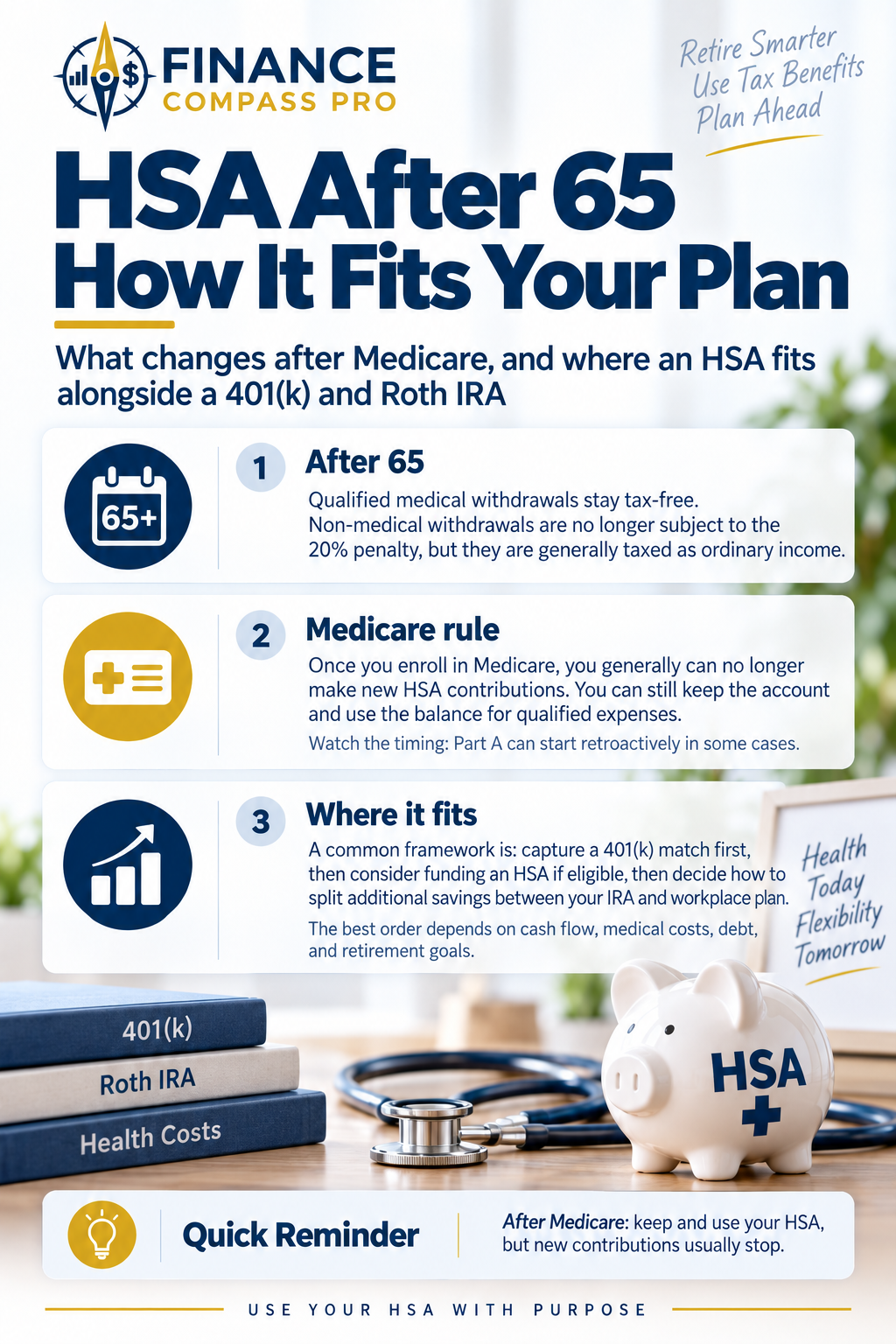
One common sequencing framework looks like this, though it is a starting point rather than a fixed rule:
- Keep enough cash reserved for near-term needs.
- Capture any available 401(k) employer match first, since it is generally difficult to beat a guaranteed match.
- Fund the HSA if you are eligible and the account fits your expected healthcare needs.
- Split any remaining retirement savings between your HSA, IRA, and workplace plan based on your own priorities.
The right order for you can shift based on high-interest debt, emergency savings, expected medical costs, available investment options and fees, and your overall retirement timeline. If you are still deciding how your accounts fit together, Retirement Accounts for Beginners walks through the full picture.
Bottom Line
An HSA is more than a medical spending account. For eligible people, it can combine tax-advantaged contributions, tax-free growth, and tax-free qualified withdrawals in one portable account.
For 2026, the limits are $4,400 for self-only coverage and $8,750 for family coverage, plus a $1,000 catch-up for those 55 and older. But the tax benefits should not distract from the first question: are you actually eligible? The 2026 bronze and catastrophic plan expansion means the answer is broader than the traditional HDHP test alone.
Once eligibility is confirmed, the real decision is not simply whether to max the account out. It is how much you need for healthcare today, how much you can afford to leave invested, and how the HSA fits alongside the rest of your retirement plan.
FAQ
A Health Savings Account is a personal, tax-advantaged account that eligible people use to save, invest, and pay qualified medical expenses. The account belongs to you, unused money rolls over, and qualified medical withdrawals can be federally tax-free.
For 2026, the federal limit is $4,400 for self-only coverage and $8,750 for family coverage. Eligible individuals age 55 or older can add $1,000 more. Employer contributions count toward the same annual limit.
Generally, yes, HSA eligibility is tied to qualifying health coverage. For 2026, a traditional HSA-qualified HDHP needs a minimum deductible of $1,700 self-only or $3,400 family, with out-of-pocket maximums of $8,500 and $17,000. However, federal law expanded eligibility in 2026 so that certain bronze and catastrophic health plans also qualify, regardless of whether they were bought through an Exchange, even when they do not meet those traditional tests.
Nothing. Unused funds stay in your account and roll over year after year. The HSA also stays with you if you leave your employer.
Many HSA providers offer investment options, often once you keep a required amount in cash. Whether investing makes sense depends on how much of the balance you may need for near-term medical expenses.
Yes, but the tax treatment depends on your age. Before 65, a non-qualified withdrawal generally means ordinary income tax plus an additional 20% tax. After 65, the extra 20% tax no longer applies, though the withdrawal is still generally taxed as ordinary income.
Generally, yes. Current federal rules do not require reimbursement in the same year as the expense. But the expense must have happened after your HSA was established, and you should keep records showing it was a qualified expense that was not reimbursed elsewhere.
Yes. You keep the account and its existing balance. Medicare enrollment generally ends your ability to make new contributions. If you delay Medicare past 65, be careful, since Part A coverage can start retroactively and create excess contributions.
This article is for informational and educational purposes only and does not constitute personalized financial, legal, tax, insurance, or investment advice. HSA eligibility, contribution limits, HDHP thresholds, Medicare rules, and tax treatment can change and can depend on individual circumstances. Federal figures in this article reflect 2026 rules and IRS guidance current as of publication. State tax treatment may differ from the federal treatment described here.