
Disclosure: This post is for informational and educational purposes only. FinanceCompassPro.com may earn compensation through display advertising. We may also reference third-party products, services, or platforms by name for educational purposes – these mentions are not paid endorsements unless explicitly stated. Nothing in this post constitutes personalized financial, legal, tax, or investment advice.
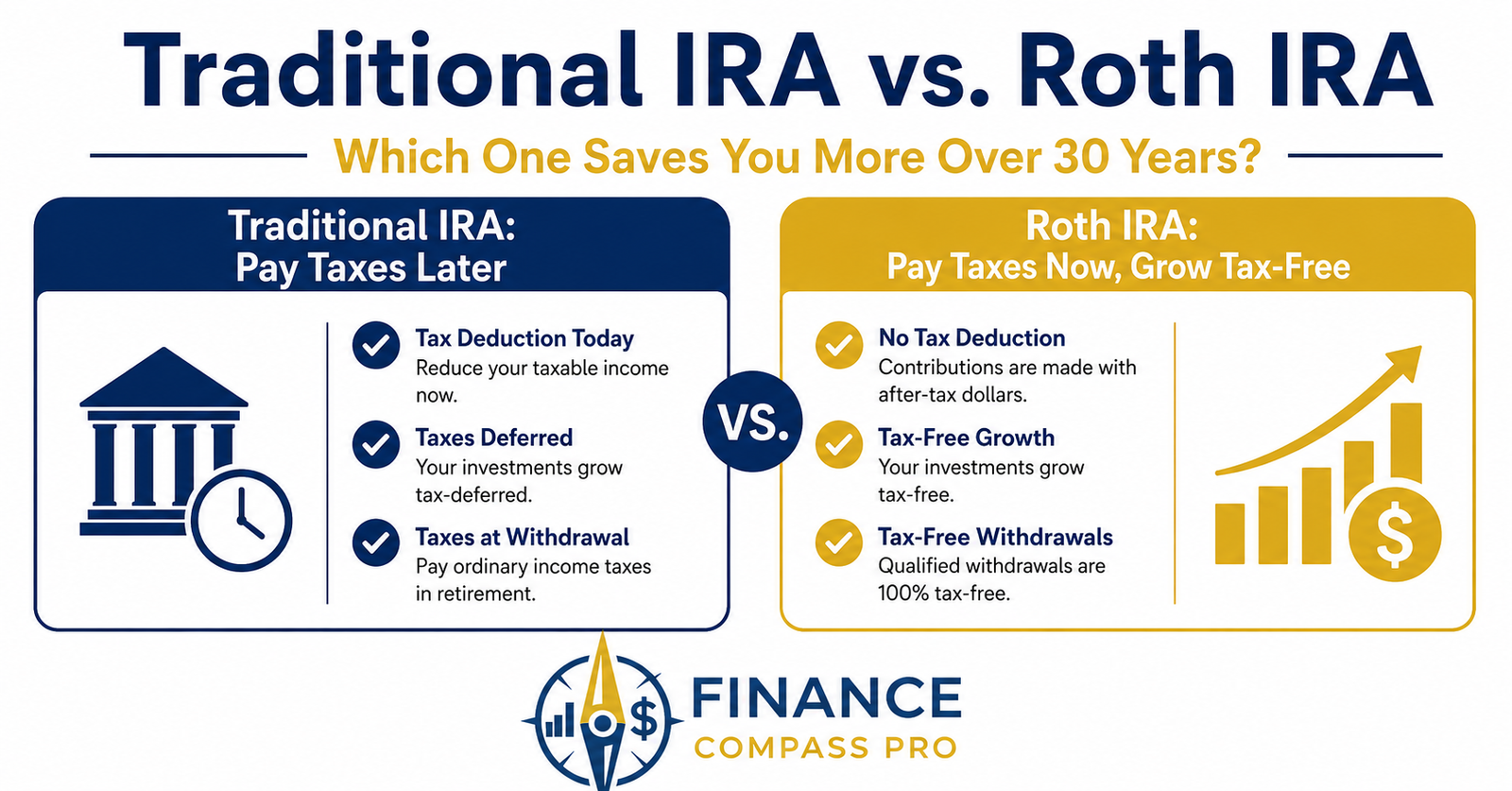
Traditional IRA vs. Roth IRA is one of the most searched questions in personal finance, and for good reason. The account you choose today could mean a difference of tens of thousands of dollars by the time you retire.
Both accounts offer powerful tax advantages, and both let you invest in many of the same types of assets. But they work in fundamentally different ways. One gives you a potential tax break today. The other gives you the possibility of tax-free qualified withdrawals later.
The real question is not simply which account is “better.” It is which account is better for your current tax bracket, future income, retirement timeline, and flexibility needs.
Here is a clear comparison of how each account works, who each one is best for, and how to think about which one may save you more money over a thirty-year horizon.
What Is a Traditional IRA?
A Traditional IRA is a retirement account that may allow you to deduct eligible contributions. Investments generally grow tax-deferred, and taxable withdrawals are usually treated as ordinary income.
The potential benefit is a current-year tax deduction when you qualify, combined with tax-deferred growth.
For 2026, the IRA contribution limits are:
- Under age 50: $7,500 per year maximum contribution
- Age 50 or older: $8,600 per year (includes catch-up contribution)
Whether your Traditional IRA contributions are tax-deductible depends on your income and whether you (or your spouse) have access to a workplace retirement plan like a 401(k). For 2026, if you are covered by a workplace retirement plan, the deduction phases out for single filers between $81,000 and $91,000 MAGI, and for married couples filing jointly between $129,000 and $149,000. Different phase-out rules may apply if you are not covered by a workplace plan but your spouse is, so it is worth checking current IRS rules or consulting a tax professional.
What Is a Roth IRA?
A Roth IRA is a retirement savings account where you contribute money you’ve already paid taxes on. Your investments grow completely tax-free, and qualified withdrawals in retirement are tax-free as well – including all the accumulated growth.
The core benefit: you pay taxes upfront, and qualified withdrawals in retirement can be completely tax-free.
For 2026, the contribution limits match the Traditional IRA:
- Under age 50: $7,500 per year maximum contribution
- Age 50 or older: $8,600 per year (includes catch-up contribution)
Roth IRA contributions are subject to income limits. For 2026, single filers begin to phase out at $153,000 MAGI and married filing jointly at $242,000. Above $168,000 (single) or $252,000 (married), you cannot contribute directly to a Roth IRA. For the most current limits, see the IRS IRA contribution and deduction limits.
For a full breakdown of how the Roth IRA works, see our guide on what is a Roth IRA.
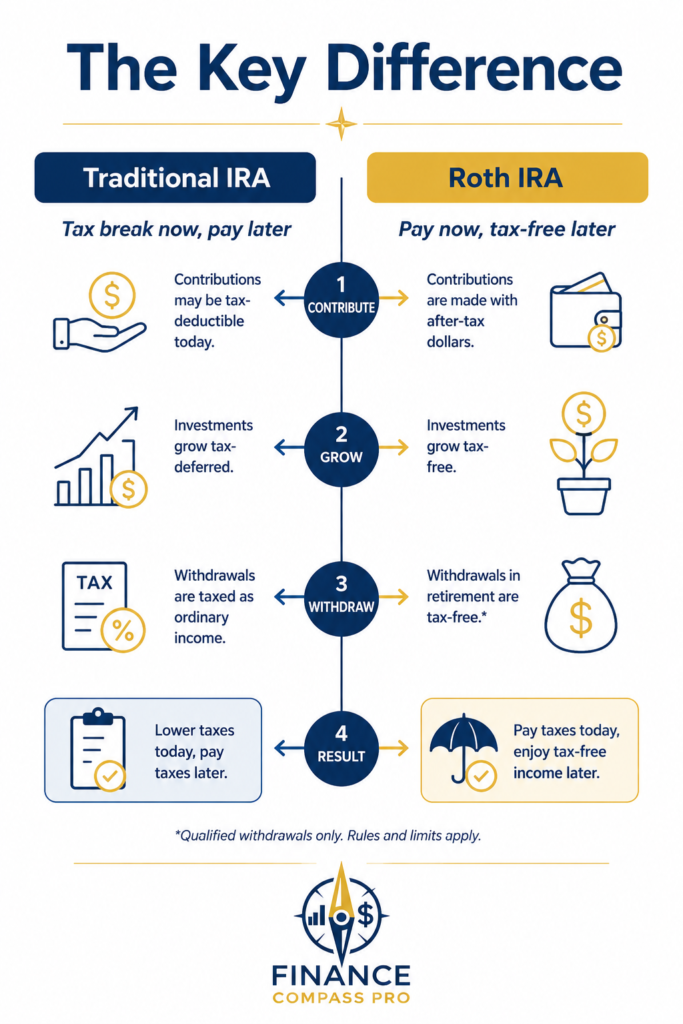
Traditional IRA vs. Roth IRA: Side-by-Side Comparison
| Traditional IRA | Roth IRA | |
|---|---|---|
| Contributions | May be deductible, depending on income and workplace-plan coverage | After-tax; not deductible |
| Tax on growth | Tax-deferred | Tax-free |
| Withdrawals | Taxed as ordinary income | Tax-free (if qualified) |
| Required minimum distributions | Yes – generally beginning at age 73 or 75, depending on birth year | No lifetime RMDs for the original owner under current law |
| Early withdrawal penalty | 10% + taxes before age 59.5 | Contributions can generally be withdrawn anytime; earnings may be taxed or penalized unless qualified |
| Income limits | None for contributions | Yes – phases out above $153K (single) |
| Best for | People who qualify for a valuable deduction today and expect a lower tax rate in retirement | People who qualify to contribute and value qualified tax-free withdrawals later |
The Core Question: When Do You Pay Taxes?
The entire Traditional IRA vs. Roth IRA decision comes down to one question: when will your tax rate be higher – now, or in retirement?
Choose Traditional IRA if:
- Your current tax rate is higher than you expect it to be in retirement
- You want to reduce your taxable income today
- You’re in your peak earning years (typically 40s-50s)
- You expect lower income and a lower tax bracket in retirement
Choose Roth IRA if:
- Your current tax rate is lower than you expect it to be in retirement
- You’re early in your career with income likely to grow
- You value the potential for qualified tax-free withdrawals under current law
- You value flexibility (no RMDs, contributions accessible anytime)
A Roth IRA may be attractive to younger workers who currently face relatively low tax rates and expect their taxable income to rise, but age alone does not determine the better account. A deductible Traditional IRA may be more attractive when your current marginal tax rate is relatively high and you expect a lower rate in retirement, but the deduction may be limited if you or your spouse are covered by a workplace plan.
The 30-Year Math: Which One Actually Saves You More?
Let’s use real numbers to compare. Assume:
- Age 30, investing $7,500 per year for 30 years
- Average annual return: 8%
- Current tax rate: 22%
- Retirement tax rate: 22% (same, to make it a fair comparison)
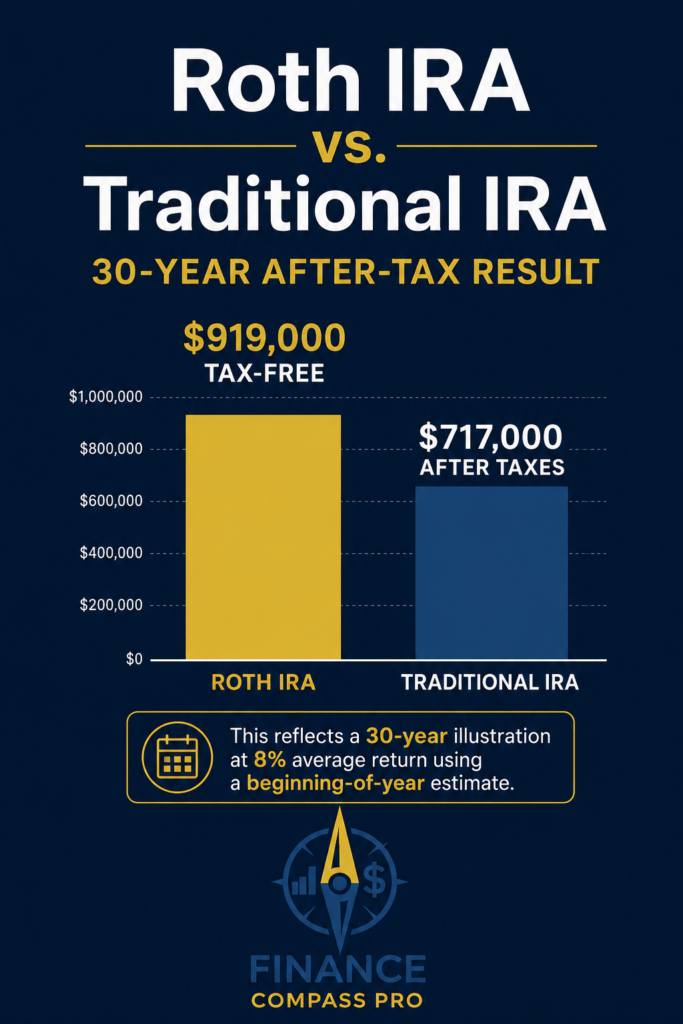
Depending on whether contributions are made at the beginning or end of each year, $7,500 invested annually for 30 years at an 8% average annual return grows to roughly $850,000-$918,000. Using $919,000 as the beginning-of-year estimate:
Traditional IRA:
- You save $1,650 in taxes per year on contributions (22% of $7,500)
- Account grows to approximately $919,000 by age 60
- You pay 22% tax on withdrawals – net value: approximately $717,000
- Plus you had $1,650/year in tax savings available to invest elsewhere
Roth IRA:
- You pay taxes upfront – no deduction
- Account grows to approximately $919,000 by age 60
- You pay $0 in taxes on withdrawals – net value: $919,000
When current and retirement tax rates are the same, the Traditional IRA and Roth IRA can produce similar after-tax results – if the Traditional IRA tax savings are invested consistently. This account-balance comparison is not fully tax-equivalent, because funding a Roth IRA with $7,500 requires more pre-tax income than making a deductible $7,500 Traditional IRA contribution. A fair comparison must either invest the Traditional IRA tax savings or hold the investor’s total pre-tax cost constant. The Roth IRA looks stronger when comparing only the account balances, because qualified withdrawals are tax-free. But the Traditional IRA generates tax savings today. If those annual savings are spent rather than reinvested, the Roth IRA often comes out ahead. If they are invested, the gap narrows significantly.
When Traditional IRA wins: If your tax rate drops significantly in retirement (say from 24% to 12%), the upfront deduction is worth more than the future tax exemption.
When Roth IRA wins: If your tax rate stays the same or rises, or if the Traditional IRA tax savings are not reinvested, the Roth IRA produces a better after-tax outcome.
The Flexibility Advantage: Roth IRA
Beyond the math, the Roth IRA has several practical advantages that the Traditional IRA doesn’t:
1. No Required Minimum Distributions (RMDs)
Traditional IRA owners generally must begin required minimum distributions at age 73 or 75, depending on birth year – see Required Minimum Distributions Explained for the deadlines and penalties. Roth IRAs do not require lifetime RMDs for the original owner under current law, allowing invested assets to remain in the account longer.
2. Contribution Withdrawal Flexibility
You can withdraw your Roth IRA contributions (not earnings) at any time, at any age, with no taxes and no penalties. This makes the Roth IRA a useful financial safety net in ways the Traditional IRA is not. For the full rules on earnings and conversions specifically, see Roth IRA Withdrawal Rules Explained.
3. Tax Diversification in Retirement
Having both taxable and tax-free income sources in retirement gives you more control over your tax situation. You can draw from Roth funds in years when your other income is high, avoiding pushing yourself into a higher bracket.
4. Estate Planning Benefits
Roth IRAs can provide heirs with tax-free qualified distributions, although most non-spouse beneficiaries are still subject to inherited-account distribution deadlines.
The Income Limit Problem – and the Backdoor Roth
If your income exceeds the Roth IRA limits, you still have a legal option: the Backdoor Roth IRA.
The process works like this:
- Contribute to a non-deductible Traditional IRA (no income limits on contributions)
- Convert that Traditional IRA to a Roth IRA
- If you have no other pre-tax IRA balances, tax may be limited largely to growth before conversion. Existing pre-tax Traditional, SEP, or SIMPLE IRA balances can make part of the conversion taxable under the pro-rata rule.
This strategy allows high earners to access Roth IRA benefits despite the income limits. Consult a tax professional before attempting this. For the full mechanics of the process, see Backdoor Roth IRA Explained.
Can You Have Both a Traditional IRA and a Roth IRA?
Yes – but the contribution limit applies across all your IRAs combined.
In 2026, you can contribute a total of $7,500 (or $8,600 if 50+) split between Traditional and Roth IRAs in any combination. You cannot contribute $7,500 to each.
Many investors split contributions between both accounts to diversify their tax exposure – putting some money into pre-tax accounts and some into tax-free accounts, giving themselves flexibility in retirement.
Traditional IRA vs. Roth IRA vs. 401(k): How They Fit Together
A Traditional IRA, Roth IRA, and 401(k) often work in sequence rather than as competing accounts.
For many employees, a practical starting point is to contribute enough to receive an available employer match, compare a Roth IRA with a deductible Traditional IRA based on eligibility and tax circumstances, and then consider additional workplace-plan contributions if more retirement savings are available.
Retirement Accounts for Beginners explains the full account-priority framework and the factors that can change this order.
Which One Is Right for You? A Simple Decision Framework
You’re likely better off with a Roth IRA if:
- You’re under 40 with income likely to grow
- You’re currently in the 12% or 22% tax bracket
- You want maximum flexibility and no RMDs
- You value paying taxes at today’s known rate rather than relying entirely on future tax rates
You’re likely better off with a Traditional IRA if:
- You’re in a high tax bracket now (32%+) and expect lower taxes in retirement
- You want to reduce your taxable income this year
When in doubt: When future tax rates are uncertain, the decision often comes down to whether you value a possible deduction today or qualified tax-free withdrawals later.
The Bottom Line
Both the Traditional IRA and the Roth IRA are powerful retirement tools. The right choice depends primarily on whether you expect your tax rate to be higher now or in retirement.
For people who currently face relatively low tax rates and qualify to contribute, a Roth IRA may provide valuable long-term tax-free growth and withdrawal flexibility. A deductible Traditional IRA may be more attractive when the current deduction is valuable and retirement tax rates are expected to be lower.
Using an appropriate tax-advantaged account consistently can improve long-term retirement-saving potential, although investment returns are not guaranteed.
Disclaimer: This article is for educational purposes only and does not constitute personalized financial or tax advice. Contribution limits and income thresholds are subject to annual IRS adjustments. Tax laws may change. Consult a qualified financial or tax professional for advice specific to your situation.