Disclosure: This post is for informational and educational purposes only. FinanceCompassPro.com may earn compensation through display advertising. We may also reference third-party products, services, or platforms by name for educational purposes – these mentions are not paid endorsements unless explicitly stated. Nothing in this post constitutes personalized financial, legal, tax, or investment advice.

If you’ve spent more than five minutes researching ETFs, you’ve probably run into this question.
VOO or VTI?
Both are from Vanguard. Both have rock-bottom expense ratios. Both are recommended constantly by personal finance communities. And both look, on the surface, almost identical.
So which one should you actually buy?
The honest answer is: for most beginners, it doesn’t matter as much as you think. But understanding the difference will help you make a more intentional decision – and give you confidence that you chose the right one for your goals.
What Is VOO?
VOO is the Vanguard S&P 500 ETF. It tracks the S&P 500 Index, which is a collection of approximately 500 of the largest publicly traded companies in the United States. For a full individual breakdown of what VOO holds, how it is structured, and how it compares to SPY and IVV, see VOO ETF Explained.
When you buy VOO, you are buying a small piece of companies like Apple, Microsoft, Amazon, Nvidia, Alphabet, and roughly 495 others – all weighted by market capitalization.
VOO is often compared with VTI for broad U.S. market exposure, but some beginners also compare it with QQQ when deciding between a diversified S&P 500 fund and a more concentrated Nasdaq-100 fund. For that comparison, see our full guide to QQQ vs VOO.
Key facts about VOO:
- Expense ratio: 0.03%
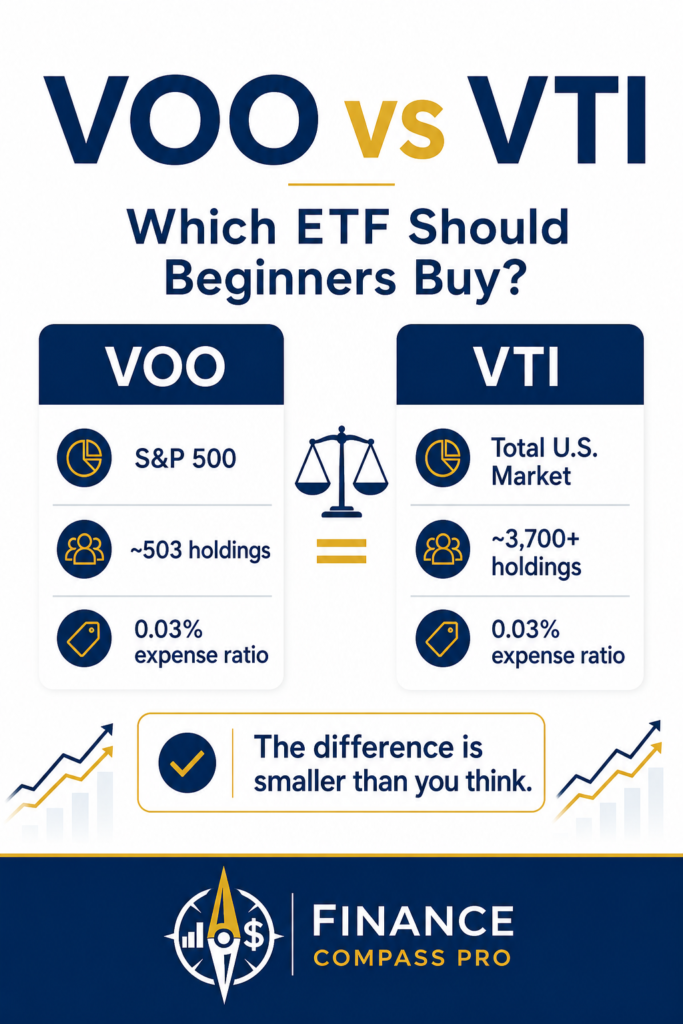
- Number of holdings: ~500
- Tracks: S&P 500 Index
- Covers: Large-cap U.S. stocks
The S&P 500 is the most widely followed stock market benchmark in the world. When people say “the market is up 10% this year,” they are often referring to the S&P 500.
If you want to understand what VOO is actually tracking, our guide on what the S&P 500 is covers the full breakdown.
What Is VTI?
VTI is the Vanguard Total Stock Market ETF. It tracks the CRSP US Total Market Index, which includes a much broader slice of the U.S. stock market – not just the largest companies.
When you buy VTI, you are buying a piece of the entire U.S. stock market: large-cap, mid-cap, and small-cap companies combined.
Key facts about VTI:
- Expense ratio: 0.03%
- Number of holdings: ~3,500+
- Tracks: CRSP US Total Market Index
- Covers: Large, mid, and small-cap U.S. stocks
The difference is scope. VOO gives you the largest U.S. companies in the S&P 500. VTI gives you the broader U.S. market, including smaller companies that are not in the S&P 500.
Both VOO and VTI are ETFs, which means they trade like stocks while holding a basket of underlying investments. If that structure still feels unclear, start with our guide on what an ETF is and how it works.

The Key Differences
Holdings
This is the most important structural difference.
VOO holds roughly 500 stocks. VTI holds thousands of stocks.
However, there is a catch: both are still heavily weighted toward large-cap stocks. The top holdings in VOO and VTI are very similar, and large companies still drive a large share of VTI’s performance because both funds are market-cap weighted.
This means that even though VTI holds far more companies, its performance is often driven by many of the same large-cap stocks as VOO.
Performance
Historically, VOO and VTI have produced very similar long-term returns.
That does not mean they are identical. In some periods, VOO may outperform because large-cap stocks lead the market. In other periods, VTI may benefit from its added mid-cap and small-cap exposure.
But for most long-term beginners, the performance gap between the two has usually been much smaller than the emotional weight investors give to the decision.
The reason is simple: both are dominated by the same large-cap companies.
Small-Cap Exposure
VTI’s key differentiator is its exposure to small and mid-cap stocks. Some academic research suggests that small-cap stocks may outperform large-cap stocks over very long periods, though that outcome is far from guaranteed and often comes with greater volatility.
VTI gives you broader exposure because it includes small and mid-cap companies in addition to large-cap stocks. If you are new to the concept, our guide on what diversification in investing means explains why spreading money across more companies can reduce single-company risk.
If you believe in total U.S. market exposure over the long term, VTI gives you that automatically. VOO does not.
Expense Ratio
Both VOO and VTI have an expense ratio of 0.03%. There is no meaningful cost difference between them. To understand how expense ratios affect your returns over time, see ETF Expense Ratios Explained.
VOO vs VTI: Side-by-Side Comparison
Here is a quick summary of the biggest differences between VOO and VTI:
| VOO | VTI | |
|---|---|---|
| What it tracks | S&P 500 | Broader U.S. stock market |
| Number of holdings | ~500 | ~3,500+ |
| Expense ratio | 0.03% | 0.03% |
| Large-cap exposure | Pure large-cap focus | Large-cap dominant, plus mid/small caps |
| Small/mid-cap exposure | None directly | Included |
| Long-term performance | Very similar | Very similar |
| Best for | S&P 500 exposure | Broader U.S. market exposure |

Which One Should You Choose?
Here is the practical breakdown.
Choose VOO if:
- You want to track the S&P 500 specifically
- You are comfortable with pure large-cap exposure
- You want one of the most widely followed market benchmarks
- Simplicity matters more than marginal diversification
Choose VTI if:
- You want broader U.S. market exposure
- You want automatic small and mid-cap diversification
- You prefer total market investing over S&P 500-only investing
- You are investing for a very long time horizon
Still not sure which one to choose? VTI is often the simpler default for beginners who want the broadest U.S. stock market exposure in one fund. But VOO is also a perfectly reasonable core holding for investors who specifically want S&P 500 exposure.
The important thing is to choose a clear strategy and start investing consistently.
Some investors skip this debate entirely by choosing VT ETF, which combines U.S. and international stocks in one fund. For the individual VTI side of this comparison, continue with VTI ETF Explained. For the broader decision framework across core, international, bond, dividend, and growth ETFs, use ETFs for Beginners.
If you’re specifically comparing VOO against SPY – another popular S&P 500 ETF – the real differences come down to cost, fund structure, and liquidity rather than underlying exposure. See our guide on VOO vs. SPY for that comparison.
Once the core U.S. equity choice is settled, add another ETF only when it serves a clearly different portfolio role.
Can You Hold Both?
Technically yes, but there is no strong reason to.
Because VTI already includes the stocks in VOO and many more, holding both creates overlap rather than meaningful additional diversification.
If you want large-cap and broader market exposure, VTI alone already does that job. If you specifically want the S&P 500 benchmark experience, VOO alone does that job.
Holding both usually just means you own more of the same large-cap companies twice.
What About Fees and Taxes?
Both VOO and VTI have the same expense ratio of 0.03%. That works out to about $3 per year for every $10,000 invested, before accounting for portfolio growth. In practical terms, the cost difference between the two is not a deciding factor.
Both are also generally tax-efficient because ETFs often distribute fewer taxable capital gains than many actively managed mutual funds. This can make them useful in both taxable brokerage accounts and tax-advantaged accounts like a Roth IRA.
If you are deciding whether VOO or VTI belongs in a taxable brokerage account, Roth IRA, or 401(k), our guide on asset allocation explains how different assets fit together inside a portfolio.
Where Does VOO or VTI Fit in a Portfolio?
Either ETF can serve as the core holding in a simple portfolio. The classic beginner approach is to use a broad U.S. stock market ETF as the foundation and build from there.
For example, the popular 3-ETF portfolio strategy typically uses either VTI or VOO as its U.S. equity component, paired with an international ETF and a bond ETF.
You do not need a complicated portfolio to build long-term wealth. A single position in VOO or VTI, held consistently over decades, is a legitimate strategy for many long-term investors.
If you are still building the foundation, our complete guide to investing for beginners explains how ETF selection, account type, risk tolerance, and long-term consistency fit together.
FAQ About VOO vs. VTI
A. Neither is objectively better. VOO tracks the S&P 500’s roughly 500 largest U.S. companies, while VTI adds thousands of small- and mid-cap stocks on top of nearly the same large-cap core. Both charge 0.03% and have produced very similar long-term returns, so the choice comes down to how much small- and mid-cap exposure you want.
A. VOO holds about 500 large-cap U.S. stocks tracking the S&P 500. VTI holds roughly 3,500+ stocks across large-, mid-, and small-cap companies, tracking the CRSP US Total Market Index. That broader coverage is the key structural difference between the two funds.
A. No. Both VOO and VTI charge an identical 0.03% expense ratio, so cost is not a deciding factor between them.
A. Generally, no. Because VTI already includes the same large-cap companies found in VOO, holding both mostly creates overlap rather than meaningful additional diversification. Choosing one is usually enough.
A. Their long-term returns have been very similar, since both are dominated by the same large-cap stocks. In some periods VOO has led; in others VTI’s added small- and mid-cap exposure has helped. Neither has shown a consistent, reliable edge over the other.
The Bottom Line
VOO and VTI are two of the most widely used low-cost U.S. stock market ETFs available to long-term investors. The difference between them is real but small – and for many investors, it may not meaningfully affect long-term outcomes.
- VOO: S&P 500, roughly 500 holdings, pure large-cap focus
- VTI: Broader U.S. stock market, thousands of holdings, includes small and mid-cap stocks
Both cost 0.03%. Both are from Vanguard. Both have long operating histories, though past performance never guarantees future results.
If you still cannot decide, do not let that decision delay you. For most long-term beginners, choosing either VOO or VTI and investing consistently is far more important than trying to make the perfect choice between them.
The bigger risk for many beginners is not choosing the imperfect ETF. It is waiting so long to choose that they never start investing at all.
This article is for informational and educational purposes only and does not constitute financial advice. Nothing in this post constitutes personalized financial, legal, tax, or investment advice.