Disclosure: This post is for informational and educational purposes only. FinanceCompassPro.com may earn compensation through display advertising. We may also reference third-party products, services, or platforms by name for educational purposes – these mentions are not paid endorsements unless explicitly stated. Nothing in this post constitutes personalized financial, legal, tax, or investment advice.
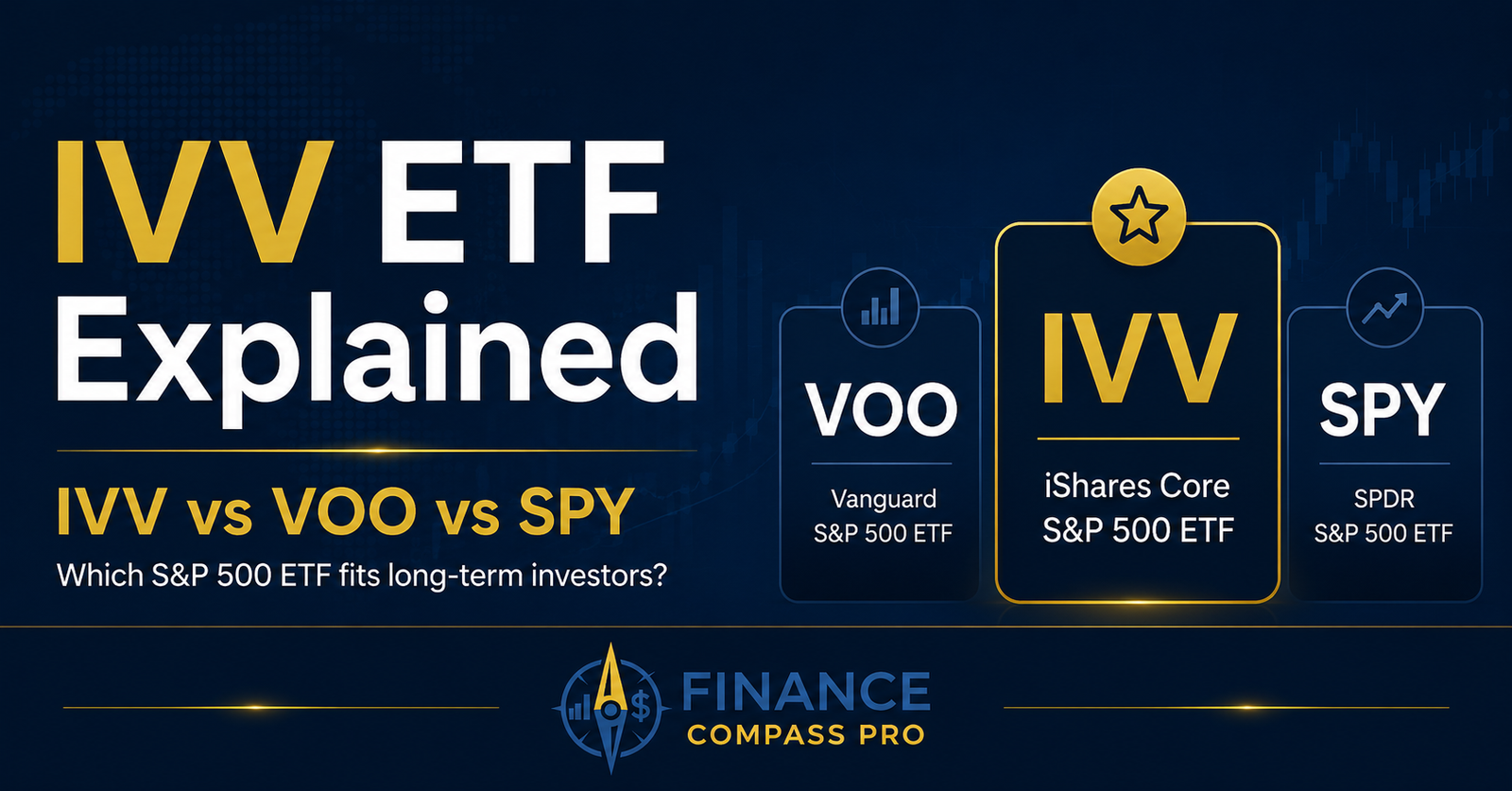
IVV charges the same 0.03% expense ratio as VOO and less than a third of SPY’s 0.0945% – yet it’s the S&P 500 ETF most beginners skip simply because it’s less well-known. If you’re comparing S&P 500 ETFs, you’ve probably already looked at VOO and SPY. IVV is the third major option – and for many investors, it’s the one that gets overlooked simply because it’s less familiar.
This guide explains what IVV is, what it holds, how its cost and fund structure work, and who it tends to fit best as a core S&P 500 holding.
What Is IVV?
IVV is the iShares Core S&P 500 ETF, issued by BlackRock. It tracks the S&P 500 index – the same index as VOO and SPY – and has been available to investors since 2000, making it one of the oldest broad-market ETFs in existence.
For official fund details, see the iShares IVV product page.
| Feature | IVV ETF |
|---|---|
| Full name | iShares Core S&P 500 ETF |
| Issuer | BlackRock (iShares) |
| Index tracked | S&P 500 |
| Expense ratio | 0.03% |
| Fund structure | Standard open-end ETF |
| Launched | 2000 |
| Typical portfolio role | Core S&P 500 holding |
Fund details can change over time. Verify current figures on the fund sponsor’s website before investing.
For a deeper look at what the S&P 500 index itself represents, see our guide on what the S&P 500 is.
IVV’s Closest Alternatives
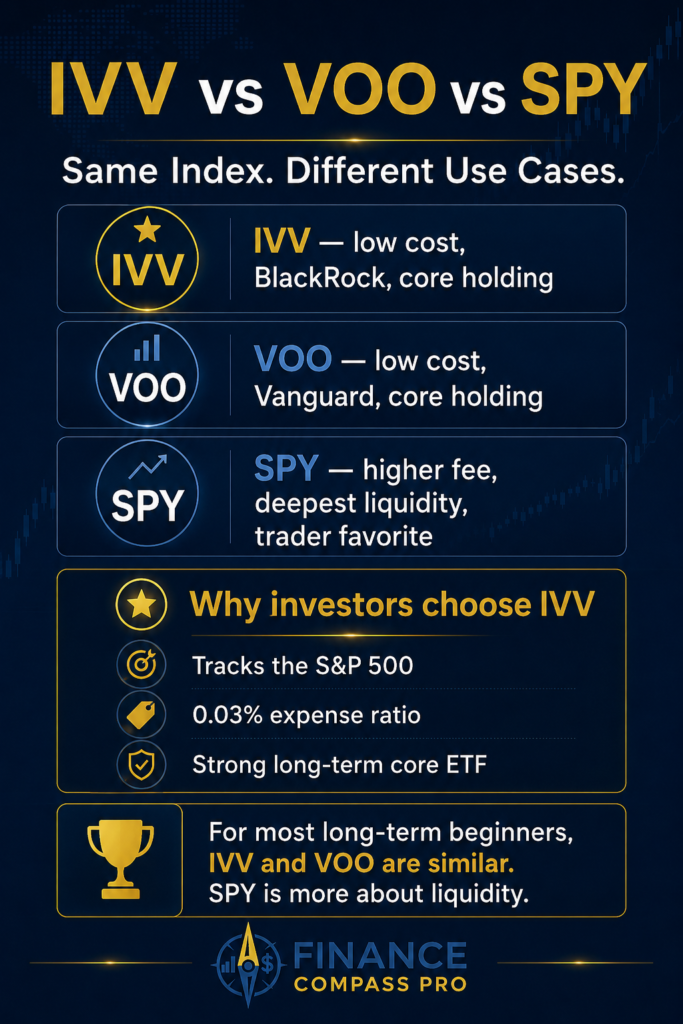
IVV, VOO, and SPY all track the S&P 500, so their underlying stock exposure is very similar. The practical differences are mostly issuer, fund structure, fee, trading liquidity, and which platform you use.
For most long-term investors, IVV and VOO are close substitutes. SPY is more distinct because its higher trading volume and options market are more relevant to active traders. For the dedicated VOO/SPY decision, see VOO vs. SPY.

What Makes IVV Distinct in Practice?
IVV’s main appeal is straightforward: low-cost S&P 500 exposure in a standard open-end ETF structure. Its 0.03% expense ratio keeps ongoing costs low, while the fund’s scale and long operating history make it a familiar core holding for buy-and-hold investors.
VOO offers a very similar long-term holding profile, while SPY is more often chosen for trading liquidity and options depth. Those alternatives are useful context, but they do not change IVV’s primary role: a simple, low-cost way to own the S&P 500. For the VOO/SPY comparison itself, see VOO vs. SPY.
Who Should Consider IVV?
- Long-term, buy-and-hold investors who want low-cost S&P 500 exposure.
- Investors who prefer the iShares / BlackRock ETF lineup.
- Investors who already hold IVV and do not have a strong reason to switch.
- Anyone who wants a well-established S&P 500 ETF with a long track record dating back to 2000.
Does It Matter Which One You Pick?
Between IVV and VOO – not meaningfully, for most investors. Both share the same expense ratio, the same fund structure, and track the same index. Your brokerage platform and any commission differences are the most practical deciding factors.
Between IVV and SPY – yes, modestly. IVV costs less and uses a structurally superior fund format for long-term holders. SPY’s edge is liquidity and options depth, which matters to a different type of investor.
If you already hold any of the three in a taxable account, the case for switching is generally weak – triggering capital gains to move from one S&P 500 fund to another identical one rarely makes financial sense.
For a direct comparison of VOO and VTI – which unlike IVV vs. VOO does involve a meaningful index difference – see our guide on VOO vs. VTI.
FAQ About IVV, VOO, and SPY
A. IVV tracks the S&P 500, giving investors exposure to roughly 500 large U.S. companies across major sectors through one ETF.
A. IVV currently charges a 0.03% expense ratio. Fund fees can change, so verify the current figure on the iShares product page before investing.
A. IVV is commonly used as a core U.S. large-cap holding because it provides broad S&P 500 exposure at a low ongoing cost.
A. Yes. IVV distributes dividends received from the companies in the S&P 500. The amount varies over time with the distributions paid by the underlying holdings.
A. The underlying stock exposure is very similar because the major funds track the same index. Differences are mainly issuer, fee, fund structure, trading liquidity, and brokerage availability.
The Bottom Line
IVV is a low-cost, well-structured S&P 500 ETF that’s effectively equivalent to VOO for most long-term investors. The most common reason to choose IVV over VOO is simply which brokerage you use – IVV is the natural commission-free default on Fidelity and Schwab, while VOO is associated with Vanguard.
Neither IVV nor VOO is meaningfully better than the other for a buy-and-hold investor. The more important question is whether an S&P 500 fund is the right core holding for your portfolio – and if it is, either one gets the job done.
Ready to Keep Building?
If you are building a full portfolio around a core S&P 500 holding, see our guide to the 3 ETF portfolio strategy.
For the full picture of how core, dividend, international, bond, and growth ETFs fit together, see ETFs for Beginners: How to Choose, Compare, and Build a Simple Portfolio.