Disclosure: This post is for informational and educational purposes only. FinanceCompassPro.com may earn compensation through display advertising. We may also reference third-party products, services, or platforms by name for educational purposes – these mentions are not paid endorsements unless explicitly stated. Nothing in this post constitutes personalized financial, legal, tax, or investment advice.

Can you move unused 529 money into a Roth IRA? Yes. Since 2024, you can roll over up to $35,000 from a 529 plan into a Roth IRA for the same beneficiary. It’s tax-free and penalty-free, as long as several conditions are met. No more choosing between “waste it” and “pay a penalty” if a 529 account has money left over.
If you’re in your 20s with leftover money in a 529 your parents opened for you, or if you’re a parent worried about overfunding your kid’s account, this is worth understanding. It’s one of the more genuinely useful provisions to come out of the SECURE 2.0 Act, and it’s still not widely known.
But it comes with real strings attached – a 15-year waiting period, annual caps, and an earned income requirement that trips people up more than anything else. Let me walk through how it actually works.
If you’re new to Roth IRAs generally, What Is a Roth IRA? covers the basics this builds on.
Quick Answer
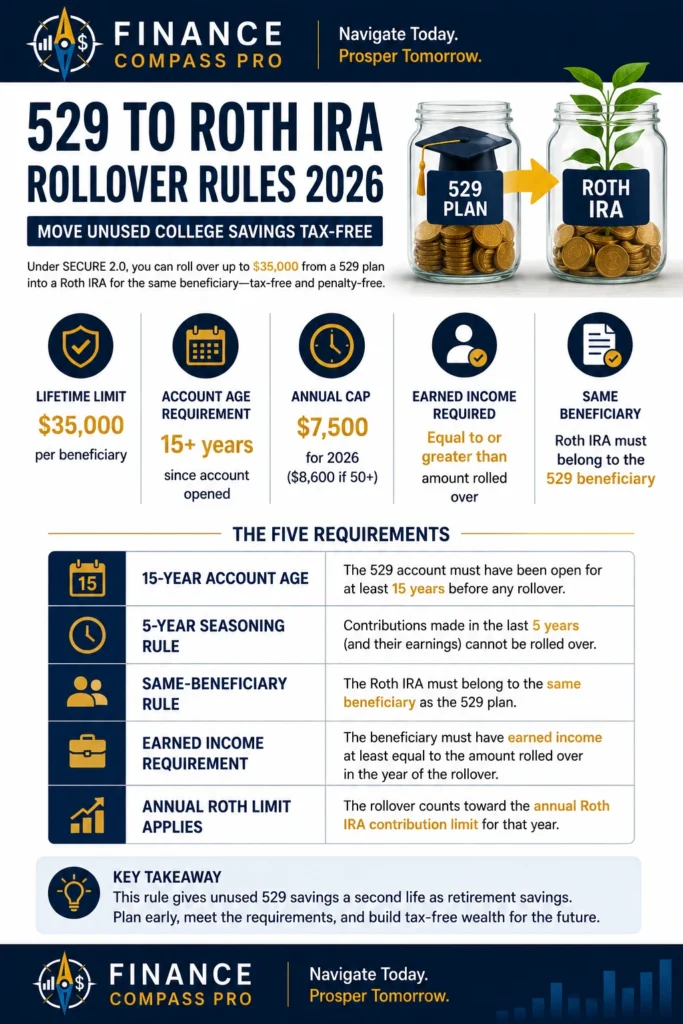
Under SECURE 2.0, you can roll over up to $35,000 (lifetime, per beneficiary) from a 529 plan into a Roth IRA owned by that same beneficiary. The rollover is tax-free and penalty-free when the statutory requirements are met. The 529 account must be at least 15 years old, the rollover must exclude contributions and attributable earnings from the most recent five-year period, and the amount moved each year is subject to the Roth IRA annual contribution limit ($7,500 for 2026, or $8,600 if 50+). Because that annual IRA limit is also capped by taxable compensation when lower, the beneficiary generally needs enough taxable compensation for the amount rolled over.
Official IRS source: IRS Topic No. 313, Qualified Tuition Programs (QTPs) confirms the direct trustee-to-trustee requirement, Roth IRA annual limit, $35,000 lifetime cap, 15-year account rule, and five-year contribution/earnings exclusion. The IRS also points readers to Publication 970, Tax Benefits for Education and Publication 590-A for additional details.
- Lifetime limit: $35,000 per beneficiary
- Account age requirement: 529 must be open 15+ years
- Annual cap: limited to that year’s Roth IRA contribution limit
- Must have earned income equal to or greater than the amount rolled over
Why This Rule Exists
Before this provision, leftover 529 money put families in an awkward spot. If the beneficiary got a scholarship, went to a cheaper school, or skipped college entirely, taking the money out for anything other than qualified education expenses meant paying ordinary income tax plus a 10% penalty on the earnings.
That penalty discouraged some families from fully funding a 529 in the first place. After all, nobody wants to save aggressively for something that might turn into a tax problem. SECURE 2.0’s Section 126 gives that money a second life as retirement savings instead. As a result, it removes a lot of the downside of over saving.
The Five Requirements You Have to Meet
This isn’t a simple “click a button and transfer” situation. Every one of these five conditions has to be true.
| Requirement | What It Means |
|---|---|
| 15-year account age | The 529 must have been open at least 15 years before any rollover |
| 5-year seasoning rule | You can’t roll over money contributed in the last 5 years (or its earnings) |
| Same-beneficiary rule | The Roth IRA must belong to the 529’s beneficiary – not the account owner |
| Earned income requirement | The beneficiary needs earned income at least equal to the amount rolled over that year |
| Annual Roth limit applies | The rollover counts toward the beneficiary’s normal annual Roth IRA contribution limit |
The 15-year clock starts from when you opened the account. It does not start from when the beneficiary was named or when contributions began. For example, if you’re a parent with a newborn, opening a 529 now starts that clock immediately, even with just a small deposit. This is true whether or not you end up needing the rollover option later.
One detail worth noting: current IRS guidance has not fully clarified whether changing beneficiaries restarts the 15-year clock. Many practitioners take a conservative approach and assume it could. So, if you’re counting on this option down the road, it’s worth confirming with a tax professional before making beneficiary changes.
Can You Roll Over? Quick Check
| Situation | Allowed? |
|---|---|
| 529 account open 15+ years | Yes |
| Money contributed 3 years ago | No – too recent |
| Beneficiary has no earned income this year | No |
| Rolling into the same beneficiary’s Roth IRA | Yes |
| Rolling into the account owner’s (parent’s) Roth IRA | No |
The Earned Income Rule Trips Up More People Than Anything Else
Just like a regular Roth IRA contribution, a 529-to-Roth rollover requires the beneficiary to have earned income – wages, salary, or self-employment income – equal to or greater than the amount being rolled over that year. Earned income generally means wages, salary, tips, or self-employment income – not investment income or gifts.
This means a recent graduate with no job yet can’t roll anything over until they’re actually earning income. Similarly, a college student with a $4,000 summer job can only roll over $4,000 that year. That’s true even though the cap itself is higher, since it’s not the full annual limit.
This is exactly why the strategy is usually spread across several years rather than done all at once. At the 2026 limit of $7,500 a year, reaching the full $35,000 lifetime cap takes a minimum of about five years of maxing out the annual rollover.
The Part Most People Miss: It Skips Roth Income Limits
Here’s what makes this provision genuinely unusual. Normal Roth IRA contributions phase out once you earn too much:
| Filing Status | Phaseout Starts | No Direct Contribution Above |
|---|---|---|
| Single | $153,000 | $168,000 |
| Married Filing Jointly | $242,000 | $252,000 |
A 529-to-Roth rollover isn’t subject to those income limits at all. That means a young professional who lands a high-paying job right out of school can still receive 529 rollover dollars. This is exactly the person who’d normally get phased out of contributing to a Roth IRA directly. In other words, it’s one of the few ways a high earner can still get money into a Roth account through the front door.
How to Actually Do the Rollover
The rollover has to happen as a direct, trustee-to-trustee transfer. In other words, the money moves straight from the 529 plan provider to the Roth IRA custodian. You can’t withdraw the funds yourself and then deposit them into a Roth IRA. Doing so would trigger the exact tax and penalty this provision aims to prevent.
In practice, that means contacting both the 529 plan administrator and the Roth IRA custodian to coordinate the transfer. The 529 program generally reports the distribution on IRS Form 1099-Q, while the Roth IRA custodian reports the Roth IRA contribution information on Form 5498. Keep those records with your tax documents and confirm the reporting treatment for your situation with the plan administrator or a qualified tax professional.
One more thing worth checking before you start: most states follow the federal treatment. However, a small number have not fully conformed and may tax the rollover at the state level, even though it’s federally tax-free. Confirm your state’s current treatment before initiating a transfer.

Is This Actually Worth Doing?
If the beneficiary has no expected qualified education use for the funds and the rollover requirements are satisfied, a 529-to-Roth rollover may be a valuable option.
That means no graduate school plans and no other family member who could use it. A young beneficiary who receives even a modest rollover has decades of tax-free compounding ahead of them. That’s exactly the kind of head start that’s hard to replicate any other way.
But don’t treat it as the automatic first move. The beneficiary might still use the money for graduate school, a certification program, or a different degree path. Or a sibling or other family member could use the funds instead.
If either applies, those options are worth considering first. That’s because changing a 529 beneficiary to another family member is generally tax-free. It also doesn’t require any of the waiting periods this rollover does.
FAQ
A. No. The Roth IRA must belong to the designated beneficiary of the 529 plan – typically your child – not the account owner. Parents cannot roll funds into their own Roth IRA using this provision.
A. Yes. The rollover shares the same annual limit as regular Roth IRA contributions. If the beneficiary already contributed $3,000 on their own this year, they can only roll over the remaining amount up to that year’s limit.
A. No rollover can happen that year. The earned income requirement works exactly like a regular Roth IRA contribution – without qualifying income, no rollover is allowed, regardless of how much money is sitting in the 529.
A. Current IRS guidance does not clearly answer this question. Because the 15-year rule can affect eligibility, do not assume a beneficiary change preserves or restarts the clock without confirming the current treatment with the 529 plan administrator and a qualified tax professional.
A. Yes, if the grandchild is the designated beneficiary of the 529 plan and every other requirement is satisfied – the 15-year account age, the 5-year seasoning rule, and the grandchild’s own earned income.
The Bottom Line
A 529-to-Roth rollover turns what used to be a stuck, penalty-prone problem into one of the more useful planning tools SECURE 2.0 created. But it only works if the account is old enough, the money has seasoned long enough, and the beneficiary has real earned income to support it. A 529 plan doesn’t have to become a tax problem just because college costs less than expected.
If you’re a parent with a young child, the single most useful thing you can do today is simply open the 529 account now, even with a small deposit. That starts the 15-year clock immediately, regardless of whether you ever use the rollover. If you’re the beneficiary with leftover funds today, check your account’s age and your own earned income first. Only then should you assume the rollover is available to you this year. For how this option fits alongside a 401(k), Roth IRA, and other retirement savings, see Retirement Accounts for Beginners.
After the rollover reaches the beneficiary’s Roth IRA Withdrawal Rules Explained covers how contributions, converted amounts, and earnings are treated when money is later withdrawn.
Disclaimer: This article is for educational purposes only and does not constitute personalized financial, legal, or tax advice. Rollover rules, contribution limits, and state tax treatment are subject to change and can vary. Verify current requirements with the IRS and a qualified tax professional before initiating any rollover. Primary official source: IRS Topic No. 313, Qualified Tuition Programs (QTPs). The IRS also directs readers to Publication 970, Tax Benefits for Education and Publication 590-A for additional details.