
Disclosure: This post is for informational and educational purposes only. FinanceCompassPro.com may earn compensation through display advertising. We may also reference third-party products, services, or platforms by name for educational purposes – these mentions are not paid endorsements unless explicitly stated. Nothing in this post constitutes personalized financial, legal, tax, or investment advice. Tax rules are complex and individual circumstances vary – always consult a qualified tax professional before making decisions based on your specific situation.
Many beginners assume all Roth IRA money can come out tax-free at any time. The truth is more layered. Your contributions can indeed come out at any time, with no taxes or penalties. However, earnings, conversions, and what counts as a “qualified” withdrawal follow stricter rules than most people expect.
This guide focuses specifically on withdrawal mechanics: the five-year rules, the order the IRS assumes your money comes out in, and the penalty exceptions that may apply before retirement age. For the basic contribution, income-limit, and account rules, see What Is a Roth IRA?
Quick Answer: You can withdraw your Roth IRA contributions at any time, tax- and penalty-free. Earnings are different. To withdraw earnings tax-free, you generally need to be 59½ or older and satisfy a five-year holding rule. Converted amounts follow their own separate five-year clocks. Therefore, which layer your money comes out of determines what you owe.
Roth IRA Contributions Are Generally the Easiest Money to Access
Start with the simplest rule. Because Roth IRA contributions are made with money you already paid income tax on, your regular contribution basis can generally be withdrawn tax- and penalty-free at any time, at any age, for any reason.
This applies only to your contributions, not to investment growth. If you contributed $7,500 and your account has grown to $9,000, you can withdraw the original $7,500 freely. The remaining $1,500 in earnings is where the more complex rules apply.
There Are Actually Two Five-Year Rules
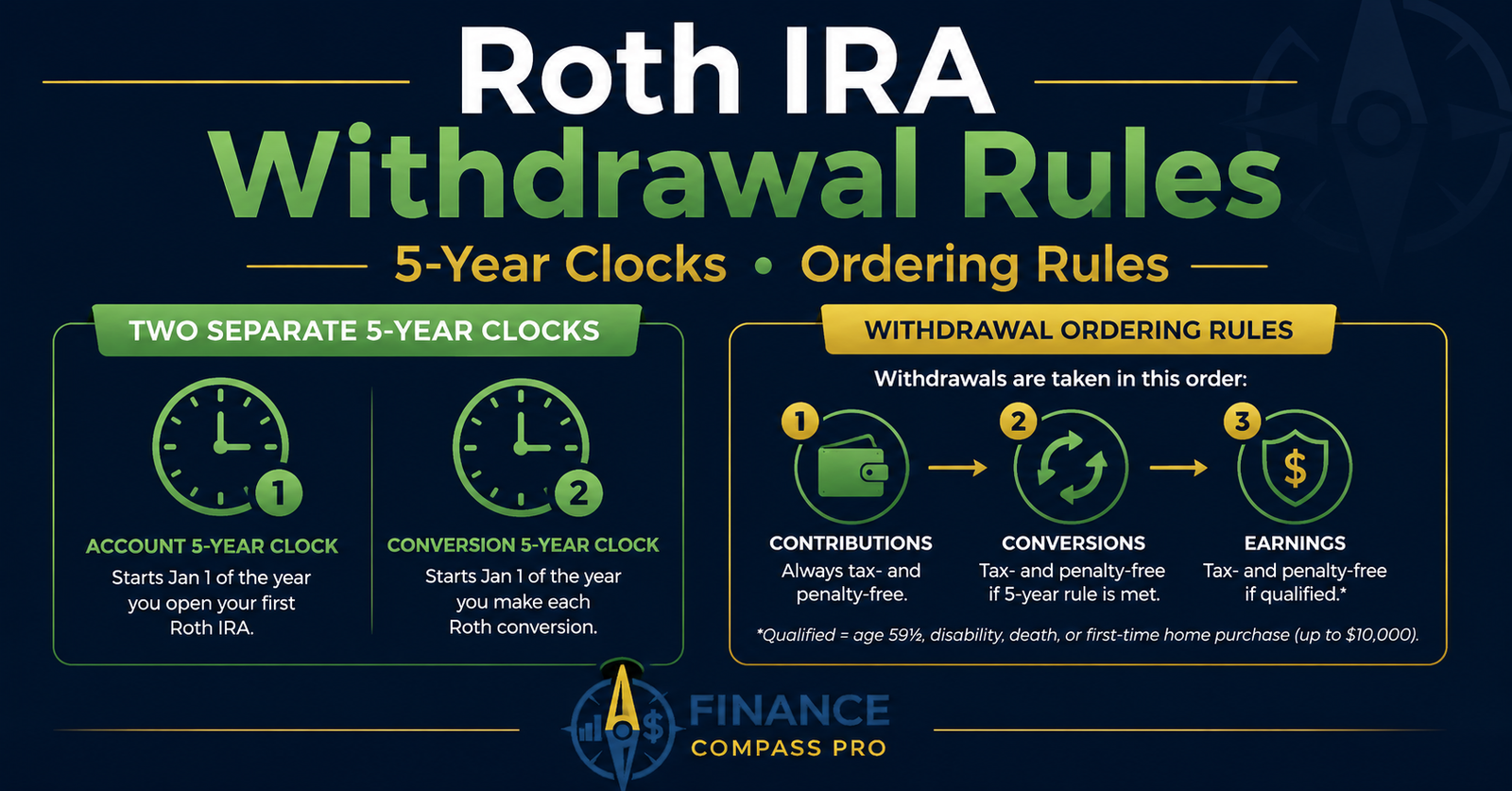
Most people refer to “the five-year rule” as if there is only one. In practice, there are two separate five-year clocks, and mixing them up is one of the most common sources of confusion.
The Five-Year Rule for Contributions and Earnings
This clock starts on January 1 of the tax year of your very first Roth IRA contribution – not the date the money actually landed in the account. It governs whether your earnings can be withdrawn tax-free. This clock only needs to be started once. Every Roth IRA you ever open shares the same clock, based on your first contribution to any Roth IRA.
The Five-Year Rule for Each Conversion
This is a separate clock that applies to taxable amounts moved into a Roth IRA through a conversion. Unlike the general Roth IRA qualification clock, a separate five-year penalty period can apply to each conversion if you withdraw taxable converted amounts before age 59½.
If your Roth IRA was funded through a nondeductible Traditional IRA contribution followed by a conversion, Backdoor Roth IRA Explained covers how that process works and why basis tracking matters.

What Counts as a “Qualified Distribution”?
A qualified distribution is completely tax-free and penalty-free, including on earnings. Two conditions must be met at the same time. First, at least five years must have passed since the contribution clock started. Second, the withdrawal must occur under a qualifying condition. Generally, that means you are 59½ or older. However, disability, a first-time home purchase up to a $10,000 lifetime limit, or payment to a beneficiary after death can also qualify.
Meeting only one condition is not enough. For example, consider an investor who is 65 but made their first Roth IRA contribution only three years ago. They meet the age requirement but not the five-year requirement. As a result, a withdrawal of earnings would still be taxable. However, no 10% penalty would apply, because they are over 59½.
The Withdrawal Ordering Rules
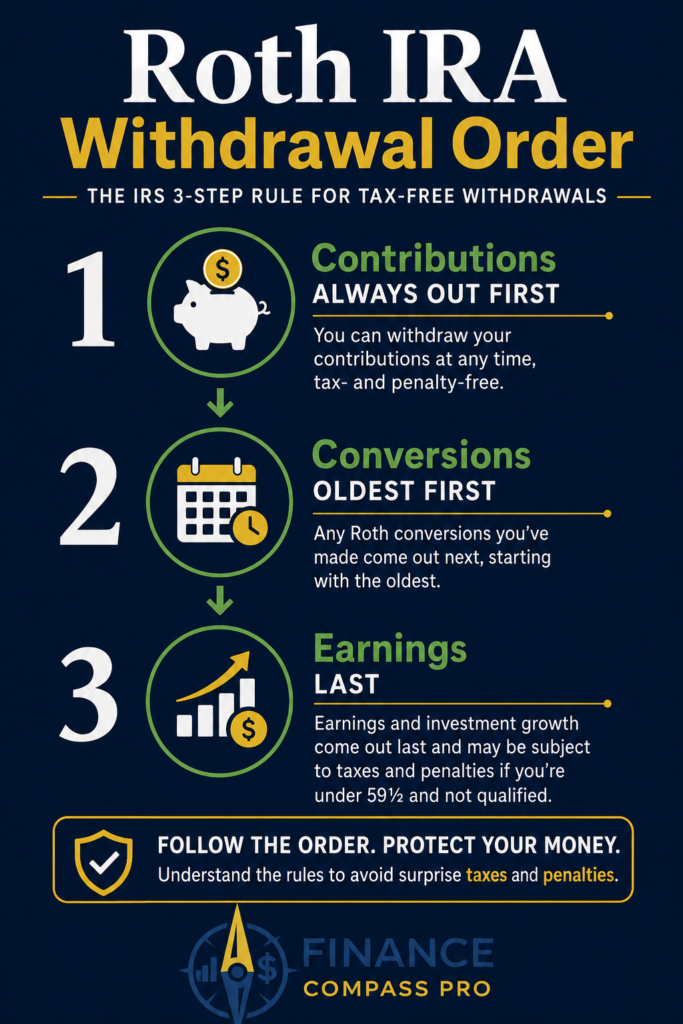
When you take money out of a Roth IRA, the IRS does not let you choose whether it comes from contributions, conversions, or earnings. Instead, a fixed order applies automatically:
- Contributions come out first. These are always tax-free and penalty-free, regardless of your age or how long the account has been open.
- Converted amounts come out next, oldest first. Each conversion is tracked separately and follows its own five-year clock for penalty purposes.
- Earnings come out last. This is the portion most likely to trigger tax and a penalty if withdrawn before you meet the qualified distribution requirements.
For beginner purposes, it is enough to remember that conversions generally come out before earnings, and older conversions are treated before newer ones.
This ordering works in your favor in most situations. For example, imagine an investor with $80,000 in contributions and $115,000 total in their Roth IRA. They can withdraw up to $80,000 without touching conversions or earnings at all. As a result, they owe no tax or penalty on any of it.
Exceptions to the 10% Early Withdrawal Penalty
Sometimes a withdrawal of earnings does not qualify as fully tax-free. Even then, several situations can still avoid the 10% early withdrawal penalty. However, income tax on the earnings portion may still apply. Commonly cited exceptions include:
- A first-time home purchase, up to a $10,000 lifetime limit
- Qualified higher education expenses
- Birth or adoption expenses, up to certain limits
- Total and permanent disability
- Certain unreimbursed medical expenses above a percentage of income
- Health insurance premiums during a period of unemployment
A common misconception is that these exceptions make the whole withdrawal tax-free. They do not. The exceptions apply to the penalty, not necessarily to income tax on the earnings portion. Also, this is not a complete list, and some exceptions have specific documentation and dollar-limit rules. Because those details can change, confirm current rules with a tax professional before relying on one of these exceptions.
Roth IRA vs. Traditional IRA Withdrawal Rules
Roth IRA and Traditional IRA withdrawal rules differ in several important ways.
Regular Roth IRA contributions generally come out first under the ordering rules and can usually be withdrawn without tax or penalty. Traditional IRA withdrawals, by contrast, are generally taxable to the extent they consist of pre-tax contributions and earnings.
Roth IRAs also do not require lifetime required minimum distributions for the original owner under current law. Traditional IRAs generally require distributions beginning at an age determined by the owner’s birth year and current law.
For the broader tax and contribution differences between the two account types, see Traditional IRA vs. Roth IRA.
Common Mistakes to Avoid
Assuming age 59½ alone makes withdrawals tax-free. The five-year rule applies separately from the age requirement. Both must be satisfied for a qualified distribution.
Treating all five-year rules as one clock. The contribution clock and each conversion’s clock are tracked separately. Withdrawing converted funds early can trigger a penalty even if your original contribution clock is long satisfied.
Assuming a penalty exception makes earnings tax-free. Penalty exceptions avoid the 10% penalty. They do not necessarily avoid income tax on the earnings portion of a non-qualified withdrawal.
Not tracking contribution history. Because contributions come out first under the ordering rules, knowing your total lifetime contributions helps you understand how much you can access without triggering tax or penalty questions.
Using a normal withdrawal to fix an excess contribution. A return of excess contribution is not handled the same way as an ordinary Roth IRA withdrawal. If you contributed more than allowed or became ineligible because of income, see Excess Roth IRA Contributions Explained before requesting a distribution.
Frequently Asked Questions About Roth IRA Withdrawals
A. Generally, yes. Contributions are made with money you already paid tax on. Therefore, your contribution basis can typically come out at any age, tax- and penalty-free. However, this applies only to contributions. Earnings and converted amounts follow separate rules, so knowing your lifetime contribution total matters.
A. The contribution clock starts on January 1 of the tax year of your first Roth IRA contribution. It only needs to start once. Every Roth IRA you ever open shares that same clock. Conversions are different, however. Each conversion starts its own separate five-year clock for penalty purposes.
A. Often, yes. Withdrawing earnings before 59½ and before meeting the five-year rule usually triggers income tax plus a 10% penalty. However, exceptions exist – for example, disability or a first-time home purchase up to $10,000. Because the details vary, consider confirming your situation with a tax professional first.
A. The IRS applies a fixed order automatically. Contributions come out first, always tax- and penalty-free. Converted amounts come out next, oldest conversion first. Earnings come out last. As a result, most early withdrawals draw from the safest layer first, which works in your favor.
A. No, not during the original owner’s lifetime. This is a key structural advantage over a Traditional IRA, which generally requires minimum distributions later in retirement. Therefore, a Roth IRA can keep growing untouched if you do not need the money. Rules for inherited Roth IRAs differ, however.
A. Not automatically. Age is only one of two conditions. The five-year contribution clock must also be satisfied. For example, someone who opens their first Roth IRA at 63 must still wait five years before earnings come out tax-free. Both conditions together create a qualified distribution.
The Bottom Line
Roth IRA contributions are generally the most accessible layer of the account because regular contribution basis can usually be withdrawn without tax or penalty.
Converted amounts and earnings follow more complex rules. The result depends on the withdrawal ordering rules, the applicable five-year period, your age, and whether a qualified-distribution or penalty-exception rule applies.
Before withdrawing, confirm how much of your Roth IRA consists of regular contributions, conversions, and earnings. Brokerage records and prior tax returns can help establish that history.
For the broader retirement-account framework – including when Roth IRA money may fit alongside a 401(k), Traditional IRA, and other savings – see Retirement Accounts for Beginners.