Disclosure: This post is for informational and educational purposes only. FinanceCompassPro.com may earn compensation through display advertising. We may also reference third-party products, services, or platforms by name for educational purposes – these mentions are not paid endorsements unless explicitly stated. Nothing in this post constitutes personalized financial, legal, tax, or investment advice.
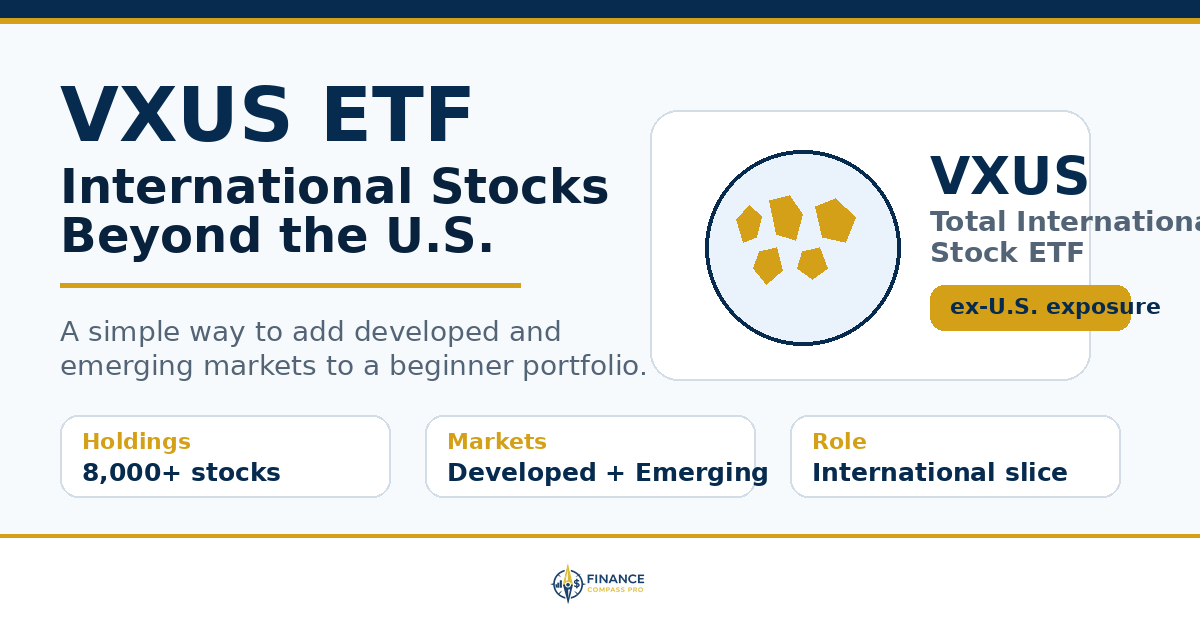
If your entire portfolio is U.S. stocks, you don’t actually own “the market.” You own one country’s slice of it – a large slice, but still just one.
VXUS is the most common way beginner investors add the rest of the world to their portfolio in a single fund.
This guide explains why international diversification matters, the case for and against adding it, how it’s performed compared to U.S. stocks, and how to decide how much of your portfolio – if any – should go toward it. For a detailed breakdown of what VXUS itself holds and how it compares to VT as a one-fund alternative, see VXUS ETF Explained.
What Is VXUS?
VXUS is the Vanguard Total International Stock ETF – the most common single-fund way beginners add non-U.S. companies to their portfolio. For the full breakdown of what it holds and how it compares to VT, see VXUS ETF Explained.
In plain terms: if VTI or VOO gives you U.S. companies, VXUS gives you almost everything else.
For a refresher on what an ETF actually is before going further, see our guide on what an ETF is and how it works.
What’s Actually Inside VXUS?
VXUS splits roughly into two buckets:
Developed Markets (the larger share)
Countries with established economies and mature stock markets – Japan, the United Kingdom, Canada, France, Germany, Switzerland, and Australia among the largest.
These markets tend to behave somewhat similarly to U.S. markets in terms of stability, though they don’t move in perfect sync.
Emerging Markets (the smaller share)
Countries with faster-growing but less mature economies – China, India, Taiwan, and Brazil are typically among the largest weights.
Emerging markets can offer higher growth potential but usually come with more volatility, currency risk, and political risk than developed markets.
Because VXUS blends both categories into one fund, you get exposure to international growth and international stability in a single purchase, without having to pick individual countries.

Why Add International Stocks at All?
Diversification Beyond One Country’s Economy
A 100% U.S. portfolio is concentrated in a single country’s regulatory environment, currency, interest rate policy, and economic cycle.
International stocks don’t always move in the same direction as U.S. stocks at the same time, which can smooth out some portfolio swings – though this benefit is not guaranteed and global markets have become more correlated over time.
U.S. Outperformance Isn’t Guaranteed Forever
U.S. stocks have significantly outperformed international stocks over much of the past 15 years. But market leadership rotates over long periods. During the 2000s, international stocks outperformed the U.S. for an extended stretch. There’s no guarantee either region leads indefinitely.
Access to Companies and Economies the U.S. Doesn’t Have
Some of the world’s largest companies in sectors like luxury goods, certain semiconductors, and global manufacturing are headquartered outside the U.S. International exposure captures businesses and growth opportunities a U.S.-only portfolio simply doesn’t include.
The Case Against Adding International Stocks
It’s worth being fair to the other side of this debate, since it’s genuinely contested among long-term investors.
- Recent track record: U.S. large-cap stocks have meaningfully outperformed international stocks over the trailing 10-15 years.
- Implicit global exposure already exists: Many large U.S. companies generate a substantial share of their revenue internationally, so a U.S.-only portfolio isn’t entirely disconnected from the global economy.
- Currency risk: International returns are affected by currency fluctuations between the U.S. dollar and foreign currencies, which adds a layer of volatility unrelated to company performance.
- Simplicity: Some investors prefer the simplicity of a single U.S. total market fund and accept the concentration as a tradeoff.
Neither position is automatically wrong. The key is understanding which tradeoff you’re choosing.
This is one of the more genuinely debated questions in long-term portfolio construction, and reasonable, well-informed investors land on different answers.

How Much International Exposure Makes Sense?
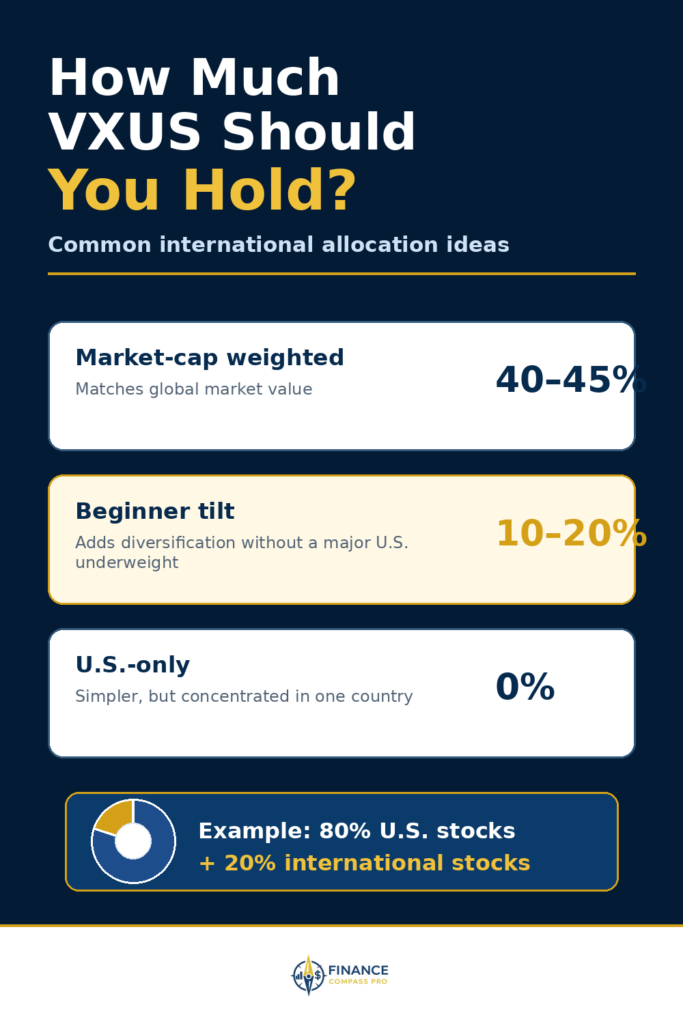
There’s no single correct allocation, but a few common reference points show up across the industry:
| Approach | International Allocation | Reasoning |
|---|---|---|
| Market-cap weighted | ~40-45% | Matches the non-U.S. share of total global stock market value |
| Common beginner tilt | 10-20% | Meaningful diversification without major U.S. underweight |
| U.S.-only approach | 0% | Accepts concentration in exchange for simplicity and recent track record |
These are general reference points, not personalized recommendations. The right allocation depends on your goals, risk tolerance, and time horizon.
A common, simple structure many beginners use is 80% U.S. stocks (VTI or VOO) and 20% international stocks (VXUS) – a starting point that’s easy to implement and easy to explain, not a rule.
For a complete walkthrough of building a simple multi-fund portfolio, see our guide on the 3 ETF portfolio strategy, which uses VXUS as one of its three core building blocks.
VXUS vs. Other International Fund Options
VXUS is not the only way to get international stock exposure. It is popular because it combines developed and emerging markets in one fund, but beginners may also see a few similar ETF options.
- VEA (Vanguard FTSE Developed Markets ETF) – focuses on developed markets only and excludes emerging markets such as China and India.
- VWO (Vanguard FTSE Emerging Markets ETF) – focuses on emerging markets only and does not include developed market exposure.
- IXUS (iShares Core MSCI Total International Stock ETF) – a broad total-international stock ETF from iShares and often used as a close alternative to VXUS.
For most beginners, the appeal of VXUS is simplicity. Instead of buying separate developed-market and emerging-market funds, VXUS combines both into one international holding.
VXUS vs U.S. Stocks: Why Performance Looks Different
One reason many beginners hesitate to buy VXUS is simple: U.S. stocks have outperformed international stocks over much of the past decade.
That recent performance gap is real. U.S. large-cap companies, especially technology-heavy names, have delivered unusually strong returns compared with many non-U.S. markets. A strong U.S. dollar has also reduced the dollar-based returns of international holdings during some periods.
But the lesson isn’t that international stocks are useless. The lesson is that global leadership changes over long periods. There have been stretches, including parts of the 2000s, when international stocks held up better than U.S. stocks.
VXUS isn’t designed to beat U.S. stocks every year. Its job is to reduce single-country concentration and give your portfolio exposure to companies, currencies, and economies outside the United States.
Where VXUS Fits in a Portfolio
VXUS is generally used as a diversification slice alongside a U.S. core holding – not as someone’s only fund. It pairs naturally with a broad U.S. fund like VTI or VOO, and often with a bond fund for investors who also want fixed-income exposure.
If you prefer to skip managing VXUS separately, VT ETF combines U.S. and international stocks in a single fund. It is a simpler alternative for investors who want global exposure without choosing their own allocation split.
For a broader look at how international and domestic holdings fit together within an overall portfolio structure, see our guide on what asset allocation is.
VXUS can be held in a taxable brokerage account, a Roth IRA, or a Traditional IRA. One detail worth knowing: international funds held in taxable accounts may be eligible for the foreign tax credit, which can offset some foreign taxes withheld on dividends – though the rules are detailed enough that it’s worth confirming with a tax professional if it affects your situation.
The Bottom Line
VXUS gives beginner investors a simple way to own thousands of companies outside the U.S. in a single, low-cost fund. Whether you need it depends on how much concentration risk you’re comfortable carrying in one country’s stock market.
There’s no universally correct answer here – some respected long-term investors skip international exposure entirely, while others treat it as a core piece of a properly diversified portfolio. If you’re unsure, a modest allocation (10-20%) is a reasonable middle ground that adds diversification without dramatically changing your portfolio’s overall behavior.
READY TO KEEP BUILDING?
If you’re deciding how VXUS fits next to a U.S. stock fund, start with VOO vs VTI to understand the difference between S&P 500 and total U.S. market exposure.
Then see our guide to the 3 ETF portfolio strategy to see how U.S. stocks, international stocks, and bonds can work together in one simple structure.
For the broader picture of how core, dividend, international, bond, and growth ETFs fit together, see ETFs for Beginners: How to Choose, Compare, and Build a Simple Portfolio.
Disclaimer: This article is for educational purposes only and does not constitute personalized financial or investment advice. Past performance does not guarantee future results. Fund holdings, expense ratios, and country weightings change over time – verify current figures on the fund sponsor’s website before investing. Consult a qualified financial or tax professional for advice specific to your situation.