Disclosure: This post is for informational and educational purposes only. FinanceCompassPro.com may earn compensation through display advertising. We may also reference third-party products, services, or platforms by name for educational purposes – these mentions are not paid endorsements unless explicitly stated. Nothing in this post constitutes personalized financial, legal, tax, or investment advice.
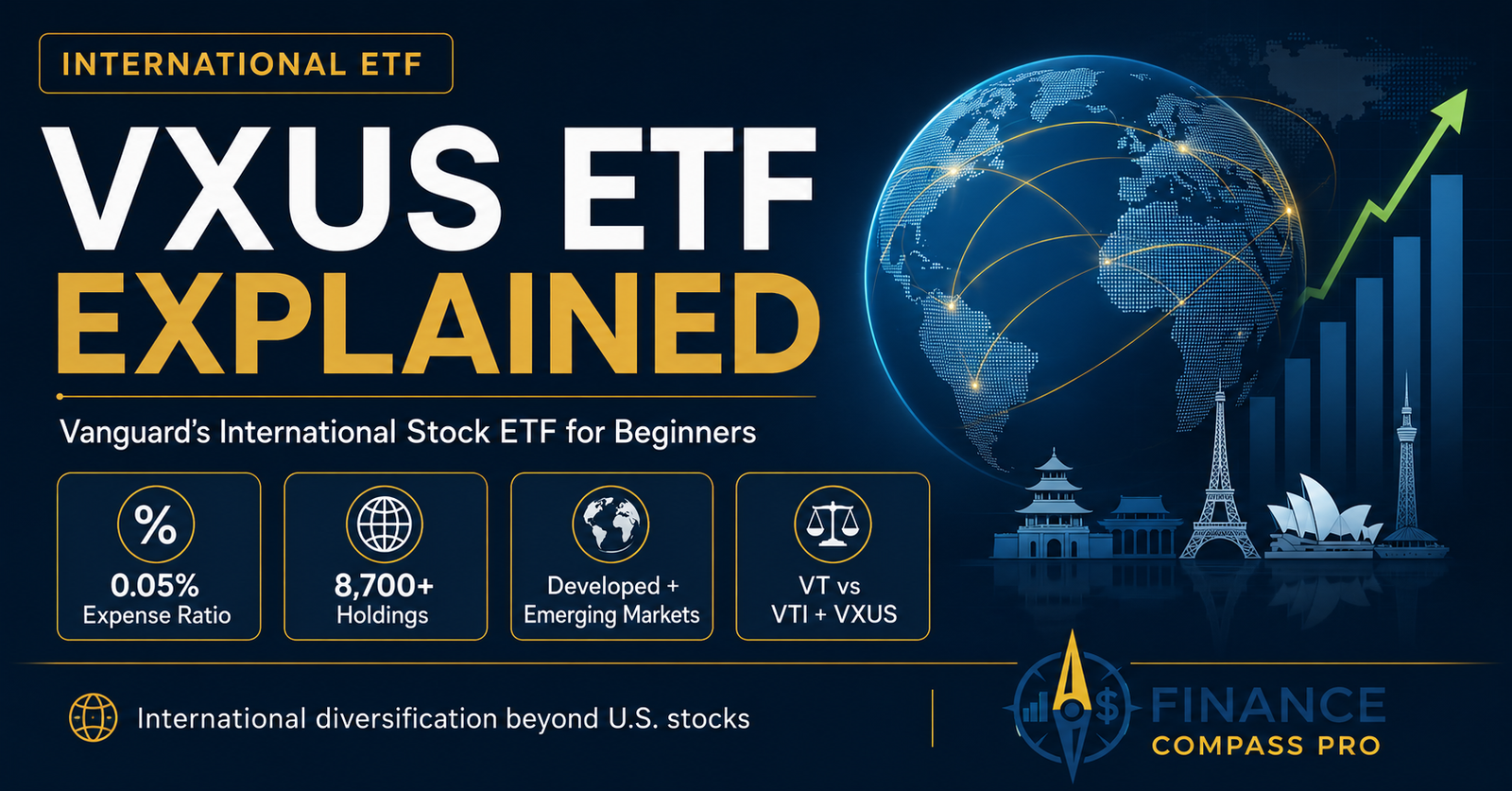
Many beginners skip international stocks entirely, assuming U.S. funds already cover everything that matters. The numbers tell a different story. Most beginners start with U.S. stocks. VOO, VTI, or SPY – all U.S. companies, all dollar-denominated. However, the U.S. represents roughly 60% of global stock market capitalization.
The remaining share sits outside U.S. borders, and that percentage changes over time.
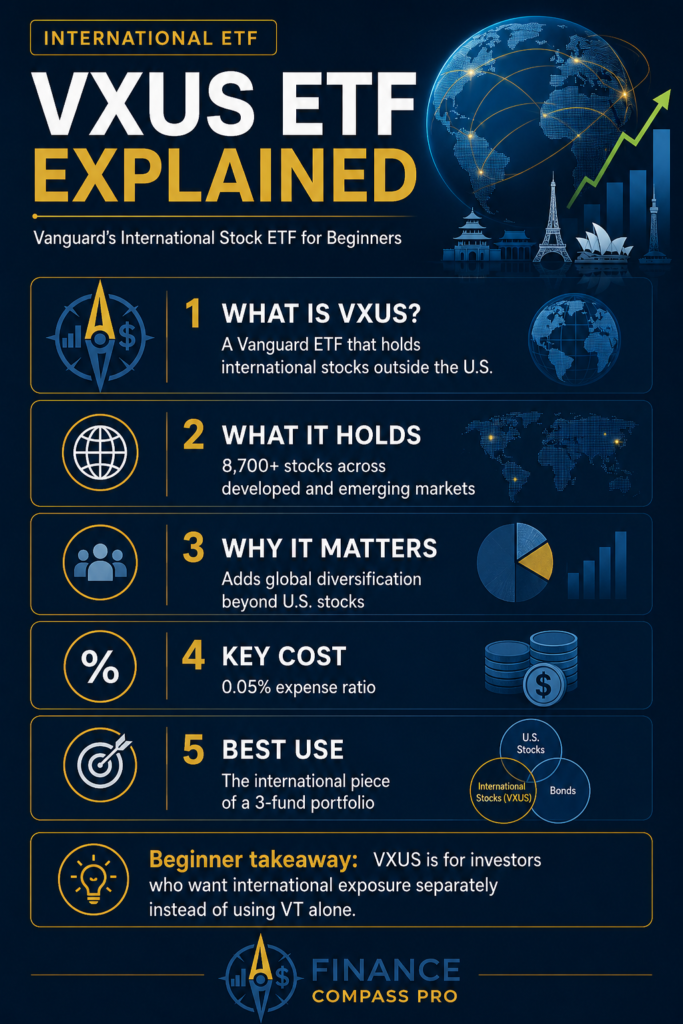
VXUS is how Vanguard covers that other 40%. In a single ETF, it gives you access to over 8,700 stocks from developed and emerging markets around the world – Japan, the UK, Canada, China, Taiwan, France, Switzerland, and dozens of other countries.
This guide covers what VXUS actually holds, how it relates to VT, and how to decide whether to hold international stocks through VXUS separately or simply use VT as a one-fund global solution.
If you are new to how ETFs work, see What Is an ETF? before reading on.
Quick Answer: VXUS is the Vanguard Total International Stock ETF. It holds over 8,700 stocks from developed and emerging markets outside the U.S. for a 0.05% expense ratio. It is the international half of a classic VTI + VXUS pairing. Alternatively, VT combines both in one fund at market-cap weights.
What Is VXUS?
VXUS is the Vanguard Total International Stock ETF. It tracks the FTSE Global All Cap ex US Index – a broad index covering large, mid, and small-cap stocks in developed and emerging markets outside the United States.
The “ex US” in the index name is the key phrase. VXUS specifically excludes all U.S.-listed stocks. Its only job is to cover the non-U.S. portion of the global equity market.
That makes it the natural international complement to a U.S.-focused fund like VOO or VTI. For how VOO and VTI compare as the U.S. equity component, see VOO vs. VTI.
| Feature | VXUS ETF |
|---|---|
| Full name | Vanguard Total International Stock ETF |
| Index tracked | FTSE Global All Cap ex US Index |
| Coverage | Developed and emerging markets outside the U.S. |
| Expense ratio | 0.05% |
| Issuer | Vanguard |
| Number of holdings | ~8,700+, varies over time |
| Dividend yield | around 2.5-3%, varies over time |
| Launched | January 2011 |
For official fund details, see the Vanguard VXUS product page. Holdings, yields, and country weights fluctuate over time – verify current figures before investing.
What Does VXUS Actually Hold?
VXUS holds over 8,700 stocks across dozens of countries. That makes it one of the most broadly diversified single ETFs available.
Japan is typically the largest country allocation, followed by the United Kingdom, Canada, China, and Taiwan. The top 10 holdings usually represent only a modest share of the fund compared with more concentrated U.S. large-cap ETFs – a sign of broad diversification across the portfolio.
Top holdings have recently included Taiwan Semiconductor Manufacturing (TSMC), Samsung Electronics, ASML, Tencent, and Novartis. These are global companies most U.S. investors recognize, but they are not accessible through a U.S.-only fund like VOO or VTI.
In terms of market segment, VXUS covers large, mid, and small-cap stocks in both developed markets (Europe, Japan, Canada, Australia) and emerging markets (China, Taiwan, India, Korea, Brazil).
That all-cap, all-geography approach is what makes it a true total international fund rather than a developed-markets-only alternative.
VXUS vs. VT: What Is the Difference?
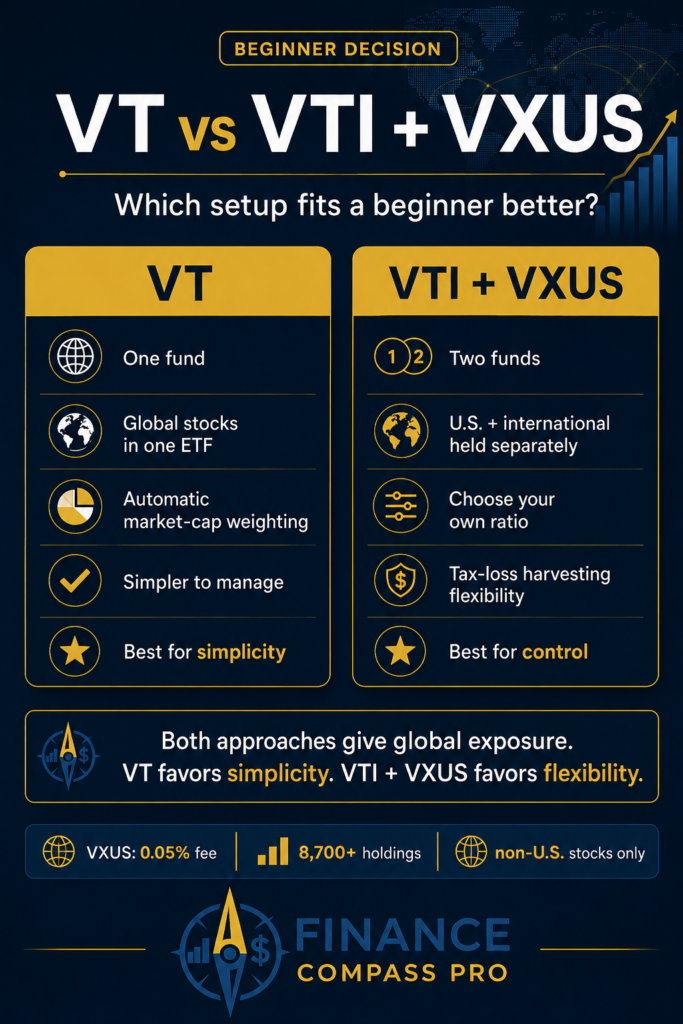
This is the most common question beginners have when they discover VXUS. VT is the Vanguard Total World Stock ETF – it holds both U.S. and international stocks in one fund. VXUS holds only the international portion.
In fact, VT is essentially VTI plus VXUS combined. When you hold VT, you are getting U.S. exposure (roughly 60%) and international exposure (roughly 40%) in a single fund.
When you hold VTI and VXUS separately, you are building the same portfolio yourself – with the ability to adjust the ratio between them.
| VT | VTI + VXUS | |
|---|---|---|
| Coverage | Global stocks (U.S. + International) | Global stocks (U.S. + International) |
| Expense ratio | 0.06% | 0.03% (VTI) + 0.05% (VXUS) |
| Number of funds to manage | 1 | 2 |
| U.S. / International ratio | Fixed to market cap weights | Adjustable by investor |
| Tax-loss harvesting | Not possible within VT | Possible on each component separately |
| Foreign tax credit | Partially available | More fully available in taxable accounts |
For a full breakdown of VT and how the one-fund approach works, see VT ETF Explained.
VXUS vs. Other International ETFs
VXUS is not the only international stock ETF available. The closest alternatives are VEU, IXUS, VEA, and VWO.
VEU is another Vanguard international ETF, but it tracks a narrower index and generally holds fewer stocks than VXUS. IXUS is iShares’ broad international stock ETF and plays a similar role to VXUS.
VEA focuses only on developed markets, while VWO focuses only on emerging markets.
For most beginners, VXUS is the broadest single-fund international option because it includes both developed and emerging markets across large, mid, and small-cap stocks.
Investors who want to separate developed and emerging markets may prefer VEA plus VWO, but that adds another decision point. A direct comparison of VEU and VXUS is covered in a separate guide.
The Case for Holding VXUS Separately
If VT does the same job in one fund, why would anyone hold VXUS separately? There are several practical reasons.
You can adjust your international allocation. VT’s ratio of U.S. to international stocks is determined by global market capitalization – currently roughly 60/40. Some investors want more or less international exposure than that.
Holding VTI and VXUS separately lets you set your own ratio.
Tax-loss harvesting is easier. If international stocks decline while U.S. stocks hold up, you can sell VXUS to realize the loss and replace it with a similar fund – capturing a tax deduction without abandoning your international allocation.
Inside VT, you cannot harvest losses on just the international component. For more on how this strategy works, see ETF Taxes Explained.
The foreign tax credit may be more accessible. When VXUS is held in a taxable account as a standalone fund, investors may be able to claim a foreign tax credit on foreign taxes withheld from dividends.
When international stocks are held inside VT, the credit may be less fully available. This is a nuanced tax point – consult a tax professional for guidance specific to your situation.
The Case for Just Using VT
For many beginners, VT is the more practical choice. It handles both U.S. and international allocation automatically. There is nothing to rebalance between two funds, and no decision to make about how much international exposure to hold.
The slightly higher blended expense ratio of a VTI+VXUS combination versus VT is minimal in practice.
Additionally, the tax-loss harvesting and foreign tax credit advantages of holding VXUS separately are more relevant to investors with larger taxable accounts and more complex tax situations.
The right choice depends on your preference for simplicity versus flexibility – not on one option being objectively better.
Expense Ratio and Cost
VXUS charges 0.05% per year. On a $10,000 investment, that is $5 annually. This is significantly lower than the average international fund and puts VXUS among the cheapest ways to buy diversified international exposure available anywhere.
For more on how expense ratios compound over time, see ETF Expense Ratios Explained.
Tax Considerations
VXUS generates dividends that are typically higher than a U.S.-only ETF like VOO or VTI, because many international companies distribute a larger share of earnings as dividends.
However, a portion of VXUS dividends may be classified as non-qualified, since some foreign dividends do not meet the holding-period requirements for the qualified dividend tax rate.
One tax advantage specific to VXUS in a taxable account is the potential foreign tax credit. Foreign governments withhold taxes from dividends paid to U.S. investors.
When VXUS is held in a taxable brokerage account, you may be able to claim some or all of that withheld amount as a credit against your U.S. tax bill. This credit is generally not available when international stocks are held inside a tax-advantaged account like a Roth IRA.
This is one reason VXUS is often discussed in asset-location decisions for taxable accounts, especially by investors who care about the foreign tax credit.
Your Form 1099-DIV each year will reflect the relevant dividend and foreign tax information – and a tax professional can help you determine if the credit applies to your situation.
For investors with taxable accounts, the VTI+VXUS structure also enables tax-loss harvesting flexibility that a single VT fund does not. For a full explanation, see ETF Tax-Loss Harvesting Explained.
Where VXUS Fits in a Portfolio
VXUS is the international component of a classic 3-fund portfolio. The standard structure pairs a U.S. equity fund (VTI or VOO), an international equity fund (VXUS), and a bond fund (BND).
Together, these three cover the global stock market plus investment-grade bonds. For the full framework, see The 3-ETF Portfolio Strategy.
How much to allocate to VXUS is a separate question from whether to hold it at all. Some investors match the market’s current global weight (roughly 40% international), while others prefer a home-country bias with a smaller international allocation.
Neither is definitively correct – it depends on your goals and risk tolerance. For a broader framework on this decision, see our guide on asset allocation. And if you are still deciding whether international diversification is worth it at all – rather than how much – see Should You Add International Stocks to Your Portfolio? for the case on both sides.
Beginner Decision: VT or VTI + VXUS?
This is the most practical decision VXUS creates for beginners. Here is how to think about it.
| If you prioritize… | Consider… |
|---|---|
| Maximum simplicity (one fund for the whole world) | VT |
| Flexibility to set your own U.S./international ratio | VTI + VXUS |
| Tax-loss harvesting potential in a taxable account | VTI + VXUS |
| Foreign tax credit access in a taxable account | VXUS separately |
| Just starting out with a small account | VT (simpler to manage) |
Neither VT nor VTI+VXUS is objectively superior. They represent the same underlying exposure in different packaging. The decision is about how much control and flexibility you want – not which one will produce better returns.
FAQ About VXUS
A. For investors who want international diversification, VXUS is one of the most efficient options available. It covers over 8,700 stocks across developed and emerging markets for just 0.05% per year. However, international stocks have underperformed U.S. stocks in some periods, so it works best as a long-term diversifier rather than a short-term bet.
A. VXUS holds only non-U.S. stocks. VT holds the entire global market, U.S. and international combined, at market-cap weights. In practice, VT is roughly VTI plus VXUS in one fund. Holding the two pieces separately gives you control over the ratio; VT gives you simplicity.
A. There is no single correct answer. Global market-cap weights currently imply roughly 40% international. However, many U.S. investors hold less due to home-country bias. Common allocations range from 20% to 40% of the stock portion. Therefore, the right number depends on your goals and comfort with non-U.S. exposure.
A. Yes. VXUS typically yields more than U.S.-only funds like VOO or VTI, because many international companies pay out a larger share of earnings. However, a portion of those dividends may be non-qualified, and foreign taxes are withheld. Your Form 1099-DIV reports the details each year.
A. Many investors discuss holding VXUS in a taxable account for one specific reason: the potential foreign tax credit. That credit is generally not available inside a Roth IRA. However, this is a nuanced asset-location decision, so consult a tax professional for guidance specific to your situation.
A. VXUS covers dozens of countries. Japan is typically the largest allocation, followed by the United Kingdom, Canada, China, and Taiwan. It includes both developed markets like Europe and Australia and emerging markets like India, Korea, and Brazil. Country weights shift over time with market values.
The Bottom Line
VXUS is one of the most efficient ways to add international diversification to a U.S.-focused portfolio. At a 0.05% expense ratio, it provides exposure to more than 8,700 stocks across developed and emerging markets outside the United States.
The key decision is not simply whether to own international stocks. Many long-term investors already recognize the value of diversifying beyond the U.S. The more practical question is whether to buy VXUS alongside a U.S. fund like VTI or choose VT as a single global solution.
VT ETF Explained explores the one-fund approach for investors who prioritize simplicity. If you prefer greater flexibility, potential tax-loss harvesting opportunities, or access to the foreign tax credit, pairing VXUS with VTI is often the more practical choice.
The 3-ETF Portfolio Strategy shows how U.S. stocks, international stocks, and bonds can work together in a simple, diversified long-term portfolio.
For the broader picture of how core, dividend, international, bond, and growth ETFs fit together, see ETFs for Beginners: How to Choose, Compare, and Build a Simple Portfolio.