Disclosure: This post is for informational and educational purposes only. FinanceCompassPro.com may earn compensation through display advertising. We may also reference third-party products, services, or platforms by name for educational purposes – these mentions are not paid endorsements unless explicitly stated. Nothing in this post constitutes personalized financial, legal, tax, or investment advice.
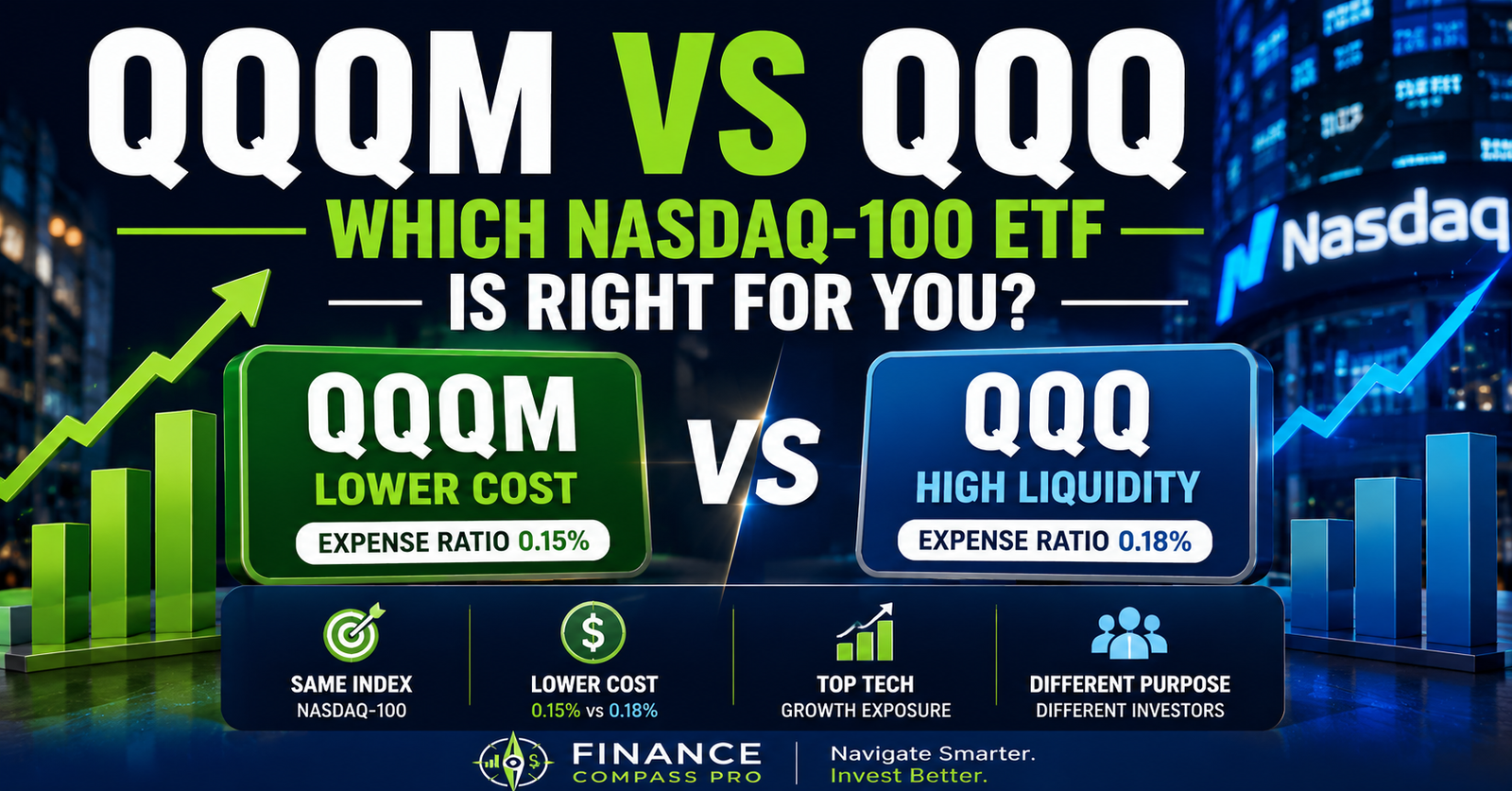
Many investors pay QQQ’s higher fee for decades without realizing a cheaper twin exists. QQQ is one of the most recognizable ETF tickers in the world.
Then Invesco launched QQQM. This fund tracks the exact same index, but with a lower expense ratio.
That raises an obvious question. If QQQM is cheaper and tracks the same index, why does QQQ still exist? And which one should you actually buy?
The answer comes down to who each fund was designed for. This guide explains the difference clearly.
Quick Answer: QQQ and QQQM track the identical Nasdaq-100 index with identical holdings. QQQM charges 0.15% versus QQQ’s 0.18% and trades at a lower share price. Therefore, most long-term buy-and-hold investors are better served by QQQM. QQQ remains the choice for options traders, large orders, and existing holders facing capital gains if they switch.
What Do QQQ and QQQM Actually Track?
Both QQQ and QQQM track the Nasdaq-100 Index. That index holds the 100 largest non-financial companies listed on the Nasdaq exchange.
It is heavily weighted toward technology – companies like Apple, Microsoft, Nvidia, Amazon, and Meta make up a large share of both funds.
Because both funds track the same index, their holdings are identical. Their day-to-day performance is essentially the same before fees as a result.
However, the differences are entirely structural – expense ratio, share price, trading volume, and intended audience.

QQQ vs. QQQM: Side-by-Side Comparison
| QQQ | QQQM | |
|---|---|---|
| Full name | Invesco QQQ Trust | Invesco Nasdaq 100 ETF |
| Index tracked | Nasdaq-100 | Nasdaq-100 |
| Expense ratio | 0.18% | 0.15% |
| Launched | 1999 | 2020 |
| Average daily volume | Very high (institutional favorite) | Lower (retail-focused) |
| Share price | Higher | Lower |
| Primary audience | Institutional traders | Long-term retail investors |
| Fund structure | Open-ended ETF (converted in late 2025) | Open-ended ETF |
The 0.03% expense ratio difference is the most important structural distinction for long-term investors. On a $10,000 investment held for 30 years, QQQM’s lower fee can add up to a meaningful difference in final value.
Why Does QQQ Still Exist?
QQQ was launched in 1999. For over two decades, it was the only way to buy Nasdaq-100 exposure in ETF form. Naturally, institutional traders such as hedge funds, market makers, and options desks built entire strategies around it.
QQQ’s trading volume is extraordinary. On a typical day, more than 30 million shares change hands. That liquidity makes it ideal for traders who need to enter and exit large positions quickly without moving the market price.
For institutional traders, the bid-ask spread matters more than the expense ratio. Because of its volume, QQQ’s spread is razor thin. That is why institutions still use QQQ even though it costs more to hold annually.
In late 2025, QQQ also converted from its original unit investment trust (UIT) structure to an open-ended ETF. That conversion allowed it to use in-kind redemptions, which reduce taxable capital gains distributions.
This structural improvement also lowered its expense ratio from 0.20% to 0.18%. For more on how that fee compares across ETFs, see ETF Expense Ratios Explained.
Why Did Invesco Launch QQQM?
Invesco launched QQQM in 2020 specifically to serve long-term retail investors. Specifically, the logic was straightforward.
Retail investors do not need the extreme liquidity that institutions require. Instead, they buy and hold. The expense ratio matters far more to them than the bid-ask spread. So Invesco created a cheaper version of the same fund. It also gave that version a lower share price, which makes fractional investing easier.
QQQM also trades at a lower per-share price than QQQ. That makes it more accessible for investors using dollar-cost averaging with smaller monthly contributions. Even without fractional shares, the lower price makes it easier to invest round amounts.
The Expense Ratio Difference: Does 0.03% Matter?
QQQM charges 0.15% per year. QQQ charges 0.18%. The gap is 0.03%.
On a $10,000 investment, QQQM costs $15 per year. QQQ costs $18 per year. That is a $3 annual difference.
However, fees compound over time just like returns do. Over 30 years, that small annual difference grows into a real gap in final portfolio value. For a long-term investor planning to hold for decades, this makes QQQM the more cost-efficient choice.
| Scenario | Initial Investment | Annual Return (before fees) | 30-Year Value (after fees) |
|---|---|---|---|
| QQQM (0.15%) | $10,000 | 8% | ~$93,800 |
| QQQ (0.18%) | $10,000 | 8% | ~$93,000 |
The difference is modest but real. As investors add regularly over decades, the gap compounds further.
The Case for Choosing QQQM
For most individual investors, QQQM is the better choice. Here is why.
Lower expense ratio. QQQM costs 0.15% versus QQQ’s 0.18%. Over long holding periods, lower fees preserve more of your return.
Lower share price. QQQM trades at a lower per-share price, making it easier to invest small, consistent amounts without needing fractional shares.
Same underlying exposure. QQQM tracks the identical Nasdaq-100 index. You get the same holdings, the same sector weights, and the same performance, minus the extra 0.03% in annual fees.
Open-ended ETF structure. Like QQQ after its 2025 conversion, QQQM has always been an open-ended ETF. That structure allows securities lending and in-kind redemptions, which can reduce taxable distributions.
The Case for Choosing QQQ
QQQ still makes sense in specific situations.
Options trading. QQQ has one of the deepest and most liquid options markets in the world. Common strategies include covered calls, protective puts, and spreads. For all of these, QQQ’s options liquidity is far superior to QQQM’s.
Frequent trading. Institutional-level volume means tighter bid-ask spreads for large trades. For active traders moving in and out of positions, that spread efficiency can offset the higher expense ratio.
Existing QQQ holders. Switching to QQQM from an existing QQQ position in a taxable account would trigger a taxable event. The 0.03% annual savings may not justify the immediate tax cost of selling.
QQQ vs. QQQM vs. VOO: The Bigger Question
Before deciding between QQQ and QQQM, it is worth stepping back to ask whether Nasdaq-100 exposure is right for you at all.
Both QQQ and QQQM are concentrated funds. The Nasdaq-100 is heavily weighted toward a small number of large technology companies.
That concentration has driven exceptional returns in recent years, but it also means higher volatility and less diversification than a broad market fund like VOO.
| QQQM / QQQ | VOO | |
|---|---|---|
| Index | Nasdaq-100 | S&P 500 |
| Holdings | ~100 | ~500 |
| Sector focus | Tech-heavy | Broad market |
| Expense ratio | 0.15% / 0.18% | 0.03% |
| Volatility | Higher | Lower |
| Includes financials | No | Yes |
For a deeper look at how QQQ and VOO compare on strategy and risk, see QQQ vs. VOO.

Which Should You Buy?
The answer depends on how you invest.
Buy QQQM if: you are a long-term buy-and-hold investor who wants Nasdaq-100 exposure at the lowest possible cost. Specifically, you plan to hold for years or decades, you do not trade options, and you contribute regularly while wanting a lower share price.
Stick with QQQ if: you trade options on the Nasdaq-100 or you are an active trader who needs maximum liquidity. Likewise, if you already hold QQQ in a taxable account, switching would trigger capital gains.
For the vast majority of individual investors who buy and hold for the long term, QQQM is the rational choice. Same index, same exposure, lower cost.
FAQ About QQQ vs. QQQM
A. They hold the same stocks because both track the Nasdaq-100 Index. However, they are separate funds with different expense ratios, share prices, and trading volumes. QQQM charges 0.15%; QQQ charges 0.18% and offers far deeper liquidity and options markets.
A. Invesco built QQQM in 2020 specifically for long-term retail investors, who care more about annual fees than trading liquidity. QQQ serves institutional traders and options users, who value its enormous volume and tight spreads. As a result, the two funds are priced for different audiences.
A. It depends on the account. In a tax-advantaged account like an IRA, switching triggers no tax, so the lower fee usually wins. In a taxable account, however, selling QQQ may create a capital gains bill that outweighs years of fee savings. Run the numbers, or consult a tax professional, before switching.
A. For investors who want Nasdaq-100 exposure, QQQM is the cost-efficient long-term vehicle. However, remember what it holds: roughly 100 tech-heavy companies with no financials. That concentration means higher volatility than a broad fund like VOO, so many investors use it as a tilt rather than a core.
A. Nearly the same. Both funds receive identical dividends from the same underlying stocks. QQQM’s slightly lower expense ratio means marginally more of that income reaches shareholders. Either way, the Nasdaq-100’s yield is low, since many of its companies reinvest earnings rather than pay large dividends.
The Bottom Line
QQQ and QQQM are two versions of the same fund. For a full individual breakdown of QQQ – what it holds, why it costs more, and who it is designed for – see QQQ ETF Explained. They track the identical Nasdaq-100 index. Consequently, their holdings are the same, and their daily performance is essentially the same.
The difference is structural. QQQ was built for institutional traders who need extreme liquidity. By contrast, QQQM was built for retail investors who plan to hold for the long term and want to minimize fees. This same liquidity-versus-cost tradeoff plays out in the S&P 500 space too – see SPY ETF Explained for how SPY’s trading liquidity compares to VOO.
For most individual investors, QQQM is the better choice. The lower expense ratio, the lower share price, and the identical underlying exposure make it the more cost-efficient option for long-term portfolios.
If you are still deciding whether Nasdaq-100 exposure belongs in your portfolio at all, the QQQ vs. VOO comparison above covers the broader trade-off between concentrated tech exposure and broad market diversification. And for a look at how all major beginner ETFs compare side by side, see Best ETFs for Beginners.