Disclosure: This post is for informational and educational purposes only. FinanceCompassPro.com may earn compensation through display advertising. We may also reference third-party products, services, or platforms by name for educational purposes – these mentions are not paid endorsements unless explicitly stated. Nothing in this post constitutes personalized financial, legal, tax, or investment advice.
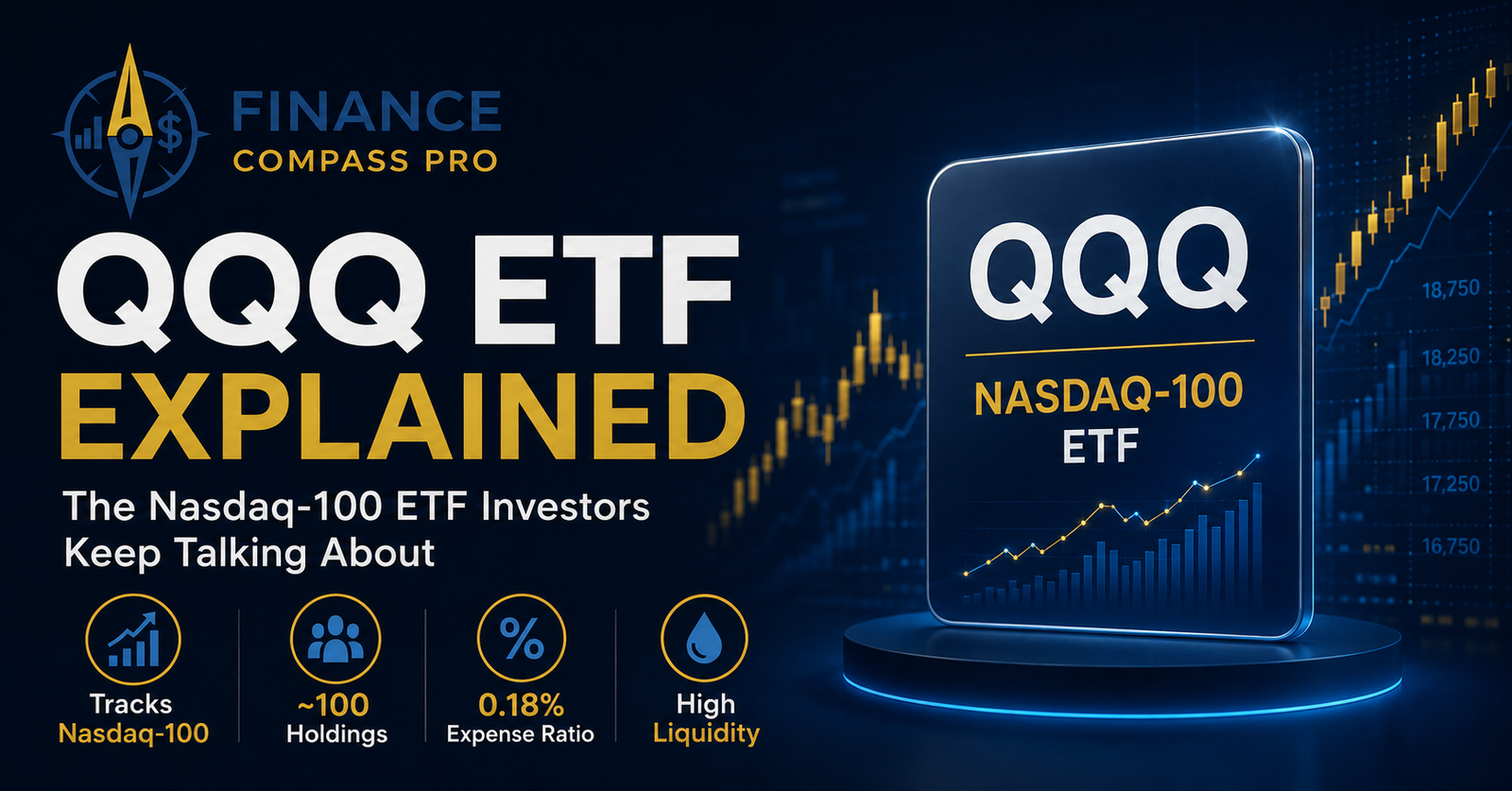
Many beginners buy QQQ simply because it is famous – often without realizing a cheaper twin exists. QQQ is one of the most recognized ETF tickers in the world. It tracks the Nasdaq-100 and holds roughly 100 of the largest non-financial companies listed on the Nasdaq. Its exceptional long-run returns have been driven heavily by mega-cap technology.
However, QQQ is not the only way to buy Nasdaq-100 exposure. It is also not the cheapest. Its lower-cost sibling, QQQM, tracks the same Nasdaq-100 Index at a lower expense ratio. So why does QQQ still matter – and is it the right choice for you?
This guide covers what QQQ actually holds and why it costs more than QQQM despite tracking the same index. It also helps you decide whether QQQ – or something else entirely – belongs in your portfolio. If you are new to how ETFs work, see What Is an ETF? before reading on.
Quick Answer: QQQ is the Invesco QQQ Trust, a Nasdaq-100 ETF with a 0.18% expense ratio. Its sibling QQQM tracks the same index for 0.15%. For long-term buy-and-hold investors, QQQM is usually the more cost-efficient choice. However, QQQ remains the standard for options trading, large orders, and existing holders facing capital gains if they switch.
What Is QQQ?
QQQ is the Invesco QQQ Trust. It tracks the Nasdaq-100 Index, a modified market-cap-weighted index of 100 of the largest non-financial companies on the Nasdaq Stock Market. The index includes U.S. and international companies. However, large U.S. technology firms dominate it.
QQQ launched in March 1999, making it one of the oldest ETFs still trading. It has long been known for its legacy trust structure, massive trading volume, and deep options market.
QQQ’s total expense ratio is currently 0.18%. Historically, QQQ was commonly discussed as a 0.20% fund. Invesco has also introduced QQQM as a lower-cost Nasdaq-100 ETF designed more directly for long-term buy-and-hold investors.
Here are QQQ’s key facts at a glance.
| Feature | QQQ ETF |
|---|---|
| Full name | Invesco QQQ Trust |
| Index tracked | Nasdaq-100 Index |
| Issuer | Invesco |
| Expense ratio | 0.18% |
| Number of holdings | ~100, varies over time |
| Legal structure | Trust (originally UIT; structure should be verified in current prospectus) |
| Launched | March 1999 |
| Typical trading volume | Among the highest of any ETF globally |
For official fund details, see the Invesco QQQ product page. Holdings, yields, and AUM fluctuate over time – verify current figures before investing.

What Does QQQ Actually Hold?
QQQ holds roughly 100 companies – all non-financial companies listed on the Nasdaq, weighted by market capitalization. Technology dominates the portfolio. Companies like NVIDIA, Apple, Microsoft, Amazon, Meta, and Alphabet have historically made up a large share of the fund.
Because QQQ is market-cap weighted, its performance is heavily driven by its largest positions. The top 10 holdings often represent roughly 50% or more of the fund – significantly more concentrated than the S&P 500.
When large-cap technology leads the market, that concentration has driven QQQ’s strong long-run returns. When it does not, the same concentration becomes a key risk factor.
Beyond technology, QQQ also includes healthcare companies, consumer discretionary names, and industrial firms – all listed on Nasdaq. However, the index’s methodology explicitly excludes financials.
That exclusion distinguishes the Nasdaq-100 from broader market indexes like the S&P 500.
QQQ vs. the S&P 500: A More Concentrated Bet
Many beginners ask how QQQ differs from VOO or VTI. The answer comes down to diversification, sector exposure, and concentration. In short, QQQ trades broad diversification for concentrated growth exposure.
| QQQ | VOO (S&P 500) | |
|---|---|---|
| Index | Nasdaq-100 (~100 stocks) | S&P 500 (~500 stocks) |
| Financials included | No | Yes |
| Technology weighting | Very high | High, but lower than QQQ |
| Top 10 concentration | ~50%+ of fund | ~35-37% of fund |
| Expense ratio | 0.18% | 0.03% |
| Best for | Tech growth exposure | Broad U.S. large-cap exposure |
QQQ is more concentrated, more technology-heavy, and more volatile than VOO. In technology-led bull markets, that concentration has driven exceptional performance.
In broader selloffs or value-led markets, QQQ has historically underperformed more diversified alternatives. For the full comparison, see QQQ vs. VOO.
The Expense Ratio Question: Why Does QQQ Cost More Than QQQM?
QQQ charges 0.18% per year. QQQM – Invesco’s newer, lower-cost version of the same fund – charges 0.15%. On a $10,000 investment, that gap is about $3 per year. Over decades, it compounds into a real difference.
The reason QQQ charges more comes down to its history and purpose.
QQQ was designed for institutional traders who value its extraordinary trading volume and options market depth above cost efficiency.
Long-term buy-and-hold investors may find QQQM more cost-efficient because it tracks the same index at a lower expense ratio. For more on how expense ratios compound over time, see ETF Expense Ratios Explained.
Why QQQ Still Matters Despite the Higher Cost
Despite its higher expense ratio, QQQ remains one of the most heavily traded ETFs in the U.S. – and that extraordinary liquidity serves specific purposes that QQQM cannot easily replicate.
Options market depth. QQQ has one of the deepest and most active options markets of any ETF. Therefore, traders who use covered calls, protective puts, or other Nasdaq-100 options strategies almost always choose QQQ. QQQM’s options liquidity simply cannot compare.
Institutional trading. Large institutions that need to move in and out of Nasdaq-100 positions quickly benefit from QQQ’s tight bid-ask spreads at high volume. For these traders, the 0.03% annual cost difference matters far less than execution quality.
Existing holders. Investors who already hold QQQ in a taxable account face a potential capital gains event if they sell to switch to QQQM. For them, the annual fee savings may not justify the immediate tax cost of switching.
Tax Considerations
QQQ has historically been tax-efficient for many shareholders, but its structure and tax treatment should be verified in the current prospectus. Like other equity ETFs, QQQ’s taxable distributions depend mainly on dividends and any capital gains distributions reported by the fund.
QQQ’s dividend yield is low because many Nasdaq-100 companies reinvest earnings rather than pay large dividends. That low yield can reduce annual dividend tax drag compared with higher-yield equity funds.
However, taxable investors should still rely on Form 1099-DIV each year. For the full framework on ETF taxes and account placement, see ETF Taxes Explained.
Beginner Decision: QQQ, QQQM, or VOO?
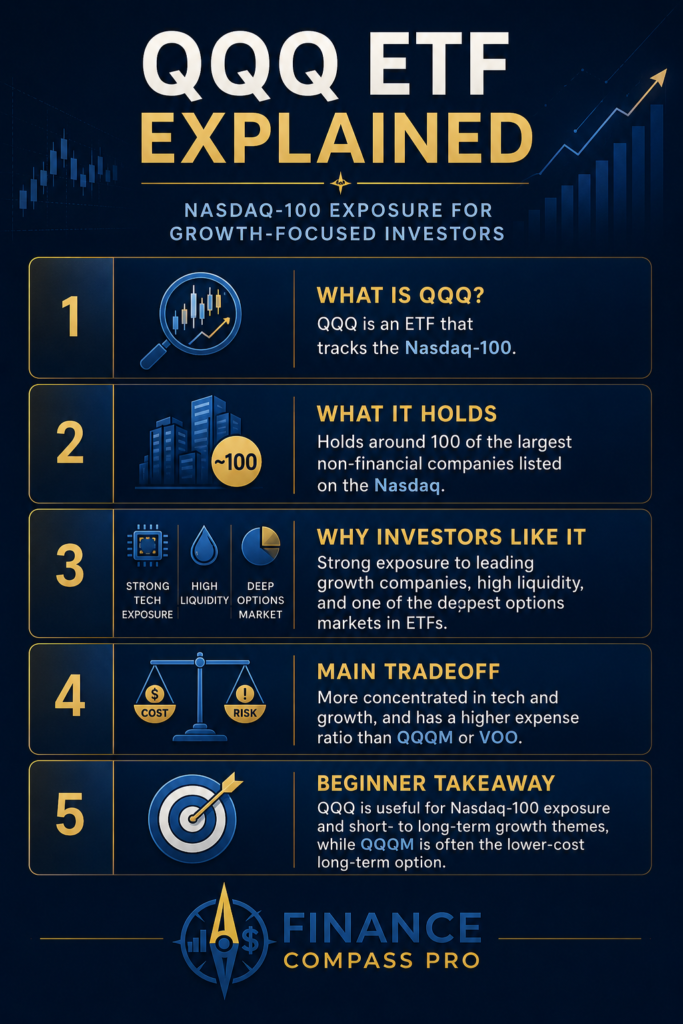
For most beginners, the decision is not just QQQ versus QQQM. The bigger question is whether Nasdaq-100 concentration makes sense at all versus a broader S&P 500 fund. This table summarizes which fund fits which situation.
| If you… | Consider… |
|---|---|
| Want Nasdaq-100 exposure and plan to hold long-term | QQQM (lower cost, same index) |
| Use options strategies on the Nasdaq-100 | QQQ (deeper options market) |
| Trade actively or in large size | QQQ (tighter spreads at volume) |
| Already hold QQQ in a taxable account | Evaluate before switching — selling may trigger capital gains |
| Want broad U.S. market with less concentration | VOO or VTI (lower cost, more diversified) |
The decision between QQQ and QQQM is primarily structural – same index, different cost and liquidity profile. For the full side-by-side, see QQQ vs. QQQM.
Where QQQ Fits in a Portfolio
One mistake new investors often make is treating QQQ as a diversified core holding. It is not a sector ETF, but it behaves like a concentrated growth-tilted fund. The reason is its heavy exposure to large Nasdaq-listed technology and communication companies.
Because it excludes financials and overweights technology, it behaves differently from broad-market funds like VOO or VTI.
Adding QQQ alongside VOO does not double your U.S. equity diversification – it increases your technology and Nasdaq-listed company concentration. Similarly, pairing QQQ with VTI adds Nasdaq-100 concentration on top of total-market exposure rather than broadening it.
Some investors use QQQ or QQQM as a satellite alongside a broad-market core to tilt their portfolio toward Nasdaq-100 growth names.
Others use it as their primary U.S. equity holding, accepting the higher concentration in exchange for greater exposure to technology-driven growth. Neither approach is inherently right or wrong—it depends on your goals, risk tolerance, and time horizon.
If you’re building a simple long-term portfolio, The 3-ETF Portfolio Strategy shows how broad market, international, and bond ETFs can work together.
QQQ can also play a role inside a tax-advantaged retirement account. Best ETFs for Roth IRA explains when growth-focused ETFs make sense in a Roth IRA.
Not sure how much of your portfolio should be allocated to U.S. stocks? Our Asset Allocation guide walks through the broader framework for balancing stocks, bonds, and other asset classes.
FAQ About QQQ
A. It can be, but with a caveat. QQQ offers concentrated exposure to large Nasdaq growth companies, not broad diversification. As a result, it tends to be more volatile than an S&P 500 fund. Many beginners therefore start with a broad-market core and consider QQQ or QQQM as a smaller tilt.
A. Both track the same Nasdaq-100 Index. The difference is cost and liquidity. QQQ charges 0.18% and offers enormous trading volume plus a deep options market. QQQM charges 0.15% and targets long-term buy-and-hold investors. For most beginners holding for decades, the cheaper QQQM usually makes more sense.
A. Yes, but the yield is low. Many Nasdaq-100 companies reinvest earnings instead of paying large dividends. That low yield keeps QQQ’s annual dividend tax drag modest in a taxable account. However, distributions still appear on Form 1099-DIV each year, so they remain reportable income.
A. Neither is universally better. QQQ concentrates in about 100 Nasdaq growth names and excludes financials. VOO spreads across roughly 500 companies at a much lower 0.03% expense ratio. In tech-led markets, QQQ has often outperformed. In broader or value-led markets, VOO’s diversification has typically held up better.
A. QQQ holds roughly 100 of the largest non-financial companies on the Nasdaq. Historically, names like NVIDIA, Apple, Microsoft, Amazon, Meta, and Alphabet have dominated the fund. The top 10 holdings often represent about half of the portfolio. Holdings change over time, so verify current data before investing.
A. Growth funds like QQQ are commonly discussed for Roth IRA placement. The logic is simple: their long-term appreciation potential compounds tax-free there, and qualified withdrawals avoid capital gains tax entirely. However, the right fit depends on your account mix and goals. See Best ETFs for Roth IRA for the framework.
The Bottom Line
QQQ is one of the most important ETFs in the market. That status does not come from being the cheapest or most diversified. Instead, it comes from two decades as the defining vehicle for Nasdaq-100 exposure. QQQ remains the standard for options and institutional trading in that index.
For long-term buy-and-hold investors who simply want Nasdaq-100 exposure, QQQM offers the same index at a lower cost. For traders, options users, and existing QQQ holders in taxable accounts, QQQ’s structural advantages can outweigh that fee difference.
Before deciding, ask the more important question first: does Nasdaq-100 concentration fit your portfolio at all, or is a broader S&P 500 fund the better starting point? If you take one step today, compare your current technology exposure with your comfort level for volatility.
QQQ vs. VOO explores whether a concentrated Nasdaq-100 portfolio or a broader S&P 500 approach is the better fit for your goals.
If you’ve already decided on Nasdaq-100 exposure, QQQ vs. QQQM explains the key differences between the two funds and when paying the higher expense ratio may – or may not – make sense.
For the broader picture of how core, dividend, international, bond, and growth ETFs fit together, see ETFs for Beginners: How to Choose, Compare, and Build a Simple Portfolio.