Disclosure: This post is for informational and educational purposes only. FinanceCompassPro.com may earn compensation through display advertising. We may also reference third-party products, services, or platforms by name for educational purposes – these mentions are not paid endorsements unless explicitly stated. Nothing in this post constitutes personalized financial, legal, tax, or investment advice.
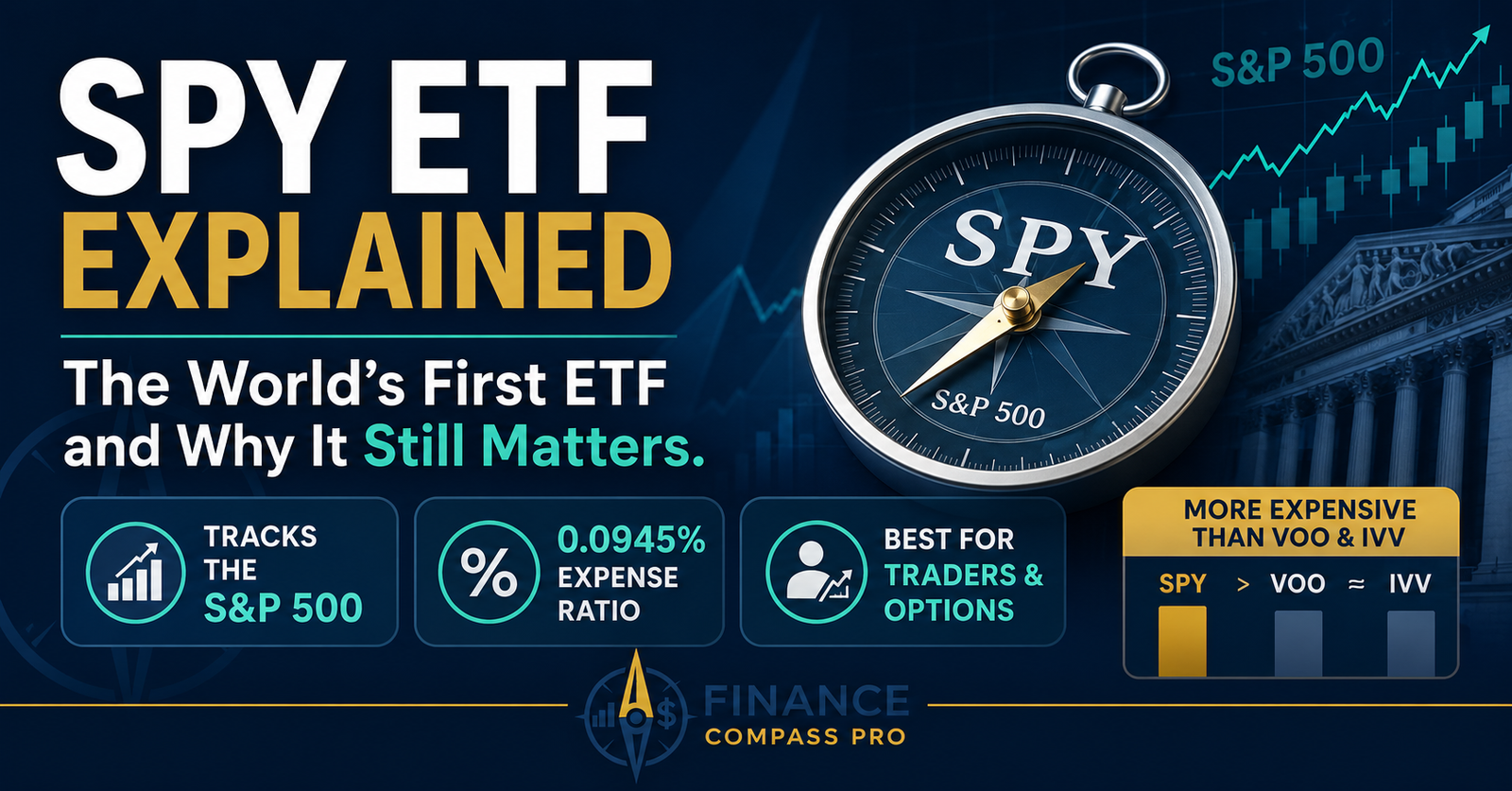
SPY is the fund that started it all. Launched in January 1993, it was the first ETF ever listed in the United States – and for decades, it was the only way most investors could buy the entire S&P 500 in a single trade.
Today, SPY is no longer the cheapest S&P 500 ETF. VOO and IVV both track the same index at a fraction of SPY’s cost. So why does SPY still matter? And who should actually consider holding it?
This guide covers what SPY holds, why its higher expense ratio exists, and what role it tends to play in different investors’ portfolios today.
What Is SPY?
SPY is the SPDR S&P 500 ETF Trust. It tracks the S&P 500 Index – a market-cap-weighted index of 500 large U.S. companies selected by a committee at S&P Dow Jones Indices. The fund uses full replication, meaning it holds all 500 stocks in the index in proportion to their weight.
State Street Global Advisors manages SPY. The fund was listed on January 22, 1993 – over a decade before VOO (2010) or QQQM (2020) existed. That first-mover advantage has made SPY the largest and most heavily traded ETF in the world.
| Feature | SPY ETF |
|---|---|
| Full name | SPDR S&P 500 ETF Trust |
| Index tracked | S&P 500 Index |
| Replication method | Full replication |
| Expense ratio | 0.0945% |
| Issuer | State Street Global Advisors (SPDR) |
| Number of holdings | ~500 |
| Launched | January 1993 |
| Legal structure | Unit Investment Trust (UIT) |
For official fund details, see the State Street SPY product page. Holdings, yields, and AUM fluctuate over time – verify current figures before investing.

What Does SPY Actually Hold?
SPY holds all 500 companies in the S&P 500, weighted by market capitalization. The largest holdings are the biggest U.S. companies by market value. Technology dominates the top of the list – NVIDIA, Apple, Microsoft, Amazon, and Alphabet collectively make up a significant share of the fund.
Because SPY is market-cap weighted, its performance is driven heavily by its largest positions. The top 10 holdings together represent roughly 36% of the fund, which means SPY is more concentrated in large-cap technology than its 500-stock count might suggest.
In terms of sector exposure, technology typically makes up the largest allocation, followed by financials, healthcare, and consumer discretionary. This sector mix closely mirrors the composition of the U.S. large-cap equity market at any given time.
The Expense Ratio Question: Why Does SPY Cost More?
SPY’s expense ratio is 0.0945% – roughly three times higher than VOO’s 0.03% or IVV’s 0.03%. On a $10,000 investment, that means paying about $9.45 per year for SPY versus $3 for VOO or IVV.
The cost difference comes from SPY’s legal structure. SPY is structured as a Unit Investment Trust (UIT), a legacy legal form from 1993. UITs carry certain constraints – they cannot reinvest dividends during the period before quarterly distributions, which creates a small cash drag. They also pay S&P licensing fees and face other UIT-specific costs that open-ended ETFs like VOO avoid.
Over decades of compounding, this fee gap is meaningful. However, State Street has not converted SPY to an open-ended structure – the UIT format is part of the original trust agreement. That is why newer, cheaper alternatives now exist. For more on how expense ratios compound over time, see ETF Expense Ratios Explained.
SPY vs. VOO vs. IVV: Same Index, Different Cost
All three funds track the S&P 500 Index. Their day-to-day performance is nearly identical before fees. However, the structural and cost differences matter depending on how you invest.
| SPY | VOO | IVV | |
|---|---|---|---|
| Issuer | State Street (SPDR) | Vanguard | BlackRock (iShares) |
| Expense ratio | 0.0945% | 0.03% | 0.03% |
| Legal structure | Unit Investment Trust | Open-ended ETF | Open-ended ETF |
| Launched | 1993 | 2010 | 2000 |
| Typical daily volume | Very high (60M+ shares) | High | High |
| Best for | Active traders, options | Long-term buy-and-hold | Long-term buy-and-hold |
For a direct comparison of VOO and IVV for long-term investors, see our guide on IVV ETF Explained. And for the most common beginner comparison – VOO versus the total U.S. market – see VOO vs. VTI.

Why SPY Still Dominates Trading Volume
Despite its higher fee, SPY trades more than 60 million shares on a typical day – far more than VOO or IVV. That extraordinary volume matters for specific types of investors.
For active traders, the tighter bid-ask spread that comes with SPY’s liquidity can offset the higher expense ratio on short-term trades. Every time you enter and exit a position, the spread is a real cost. SPY’s spread is consistently tighter than VOO’s or IVV’s for large trades – which is why institutional traders, hedge funds, and options desks have built entire strategies around it.
SPY also has one of the deepest and most liquid options markets of any ETF. Investors who use covered calls, protective puts, or other S&P 500 options strategies almost always use SPY for those positions, not VOO – because SPY’s options liquidity is unmatched. This mirrors the dynamic seen with QQQ vs. QQQM in the Nasdaq-100 space – see QQQ vs. QQQM for that parallel.
The UIT Structure: What It Means in Practice
SPY’s Unit Investment Trust structure has a few practical implications beyond the higher expense ratio.
No dividend reinvestment. SPY holds dividends in a non-interest-bearing account until the quarterly distribution date, rather than reinvesting them immediately. In a rising market, this creates a small performance drag compared to open-ended funds like VOO that can reinvest or lend securities.
No securities lending. Open-ended ETFs can earn additional income by lending securities to short sellers. SPY’s UIT structure prohibits this. As a result, it cannot use securities-lending revenue to offset costs the way newer funds can.
Tax efficiency is similar in practice. Despite these structural differences, SPY has historically produced very few capital gains distributions – the S&P 500’s low turnover means capital gains events are rare regardless of structure. For a full breakdown of how ETF taxes work, see ETF Taxes Explained.
Who Should Consider SPY?
- Active traders who enter and exit S&P 500 positions frequently and benefit from SPY’s tighter bid-ask spread
- Options traders who need SPY’s deep, liquid options market for covered calls, hedging, or other strategies
- Institutional investors who require maximum liquidity for large position sizing
- Existing SPY holders in a taxable account, where switching to VOO would trigger a taxable gain
For long-term buy-and-hold investors with no options strategy, VOO or IVV offer the same S&P 500 exposure at a lower annual cost. The 0.06% fee gap compounds meaningfully over decades.
Where SPY Fits in a Portfolio
For most beginners, SPY and VOO serve the same purpose: broad, passive exposure to large-cap U.S. equities. Both are core holdings, not satellite positions. Neither requires combining with the other – they do the same job.
If you are building a simple long-term portfolio around the S&P 500, the choice between SPY, VOO, and IVV matters less than deciding how much to allocate to U.S. equities in the first place. For that decision, see our guide on asset allocation. For a full framework on building a simple portfolio around a core holding like SPY or VOO, see The 3-ETF Portfolio Strategy.
The Bottom Line
SPY pioneered the ETF industry and remains one of the most important financial instruments ever created. However, its legacy UIT structure means it charges more than newer S&P 500 ETFs that do the same job for less.
For active traders and options investors, SPY’s unmatched liquidity and options market depth make it the right tool. For long-term buy-and-hold investors, VOO or IVV deliver the same exposure at a lower annual cost – and that difference compounds meaningfully over decades.
If you are comparing the main S&P 500 ETF options, see VOO vs. SPY for a full side-by-side breakdown. For a complete individual guide to VOO’s structure, holdings, and where it fits for long-term investors, see VOO ETF Explained. For how VOO compares against a total U.S. market fund, see VOO vs. VTI.
For the broader picture of how core, dividend, international, bond, and growth ETFs fit together, see ETFs for Beginners: How to Choose, Compare, and Build a Simple Portfolio.