
Disclosure: This post is for informational and educational purposes only. FinanceCompassPro.com may earn compensation through display advertising. We may also reference third-party products, services, or platforms by name for educational purposes – these mentions are not paid endorsements unless explicitly stated. Nothing in this post constitutes personalized financial, legal, tax, or investment advice.

“Do I really need $25,000 to start day trading?”
If you’ve searched that question recently, you’ve probably found completely different answers. That’s because one of the biggest trading rules in the United States changed in 2026.
For more than 25 years, traders needed at least $25,000 in a margin account to avoid the Pattern Day Trader restriction. That requirement is now gone. But that doesn’t mean anyone can suddenly day trade without limits.
Here’s what actually changed, what your broker may still be doing differently, and why most beginners probably shouldn’t change their investing strategy because of it. If you haven’t decided between a cash account and a margin account yet, our guide on Cash Account vs Margin Account covers that decision first.
Quick Answer: No. Since June 4, 2026, FINRA no longer requires $25,000 to day trade in a margin account. Instead, brokers now monitor real-time intraday margin exposure. A separate $2,000 minimum to open a margin account still applies.
- $25,000 pattern day trader rule: removed
- $2,000 margin minimum: still applies
- Broker implementation: may continue phasing in until October 2027
What Was the Pattern Day Trader Rule?
Think of the old rule like a simple test: do you have $25,000 in your account? If yes, you could day trade (buy and sell the same stock on the same day) as often as you wanted. If no, you were capped at three day trades every five business days – trade a fourth time, and your account got restricted from day trading until you topped back up.
| Question | Before | Now |
|---|---|---|
| Need $25,000? | Yes | No |
| Limited to 3 day trades in 5 days? | Yes | No |
| “Pattern day trader” label? | Yes | Removed |
| Risk monitoring | End-of-day snapshot | Real-time, throughout the day |
For over twenty years, that $25,000 line decided who was “allowed” to trade actively and who wasn’t. Have $24,999? Blocked. Have $25,001? No problem. Same person, same strategy, completely different treatment – all because of one number that never moved since 2001.
This only ever applied to margin accounts – accounts where you can borrow money to invest – never to plain cash accounts. And it only covered U.S. stocks and options, not crypto or forex.
The rule came from 2001, right after the dot-com crash, when regulators were worried about inexperienced traders blowing up their accounts. It made sense at the time. But two decades later, a lot of people – including brokers themselves – felt like a flat $25,000 number didn’t really reflect how risky someone’s trading actually was.
Why Was the Rule Removed?
FINRA concluded that a fixed $25,000 threshold no longer reflected actual trading risk. Instead of treating every trader the same regardless of what they were actually doing, the new framework measures the risk created by open positions throughout the trading day – a trader with a small, low-risk position gets treated differently than one with a large, leveraged one, regardless of their account size.
What Changed on June 4, 2026
Regulators made this official on April 14, 2026, and set June 4, 2026 as the date it takes effect. Two things happened at the same time: the $25,000 minimum got removed, and the “pattern day trader” label itself went away too – brokers aren’t even allowed to flag accounts that way anymore. For the official rule text, see FINRA’s regulatory notices.
So what replaced it? Instead of one big number everyone has to hit, your broker now looks at how much actual risk you’re carrying during the trading day, in real time. Think of it less as “do you have enough money in the bank” and more as “is what you’re doing right now too risky for the money you actually have.”
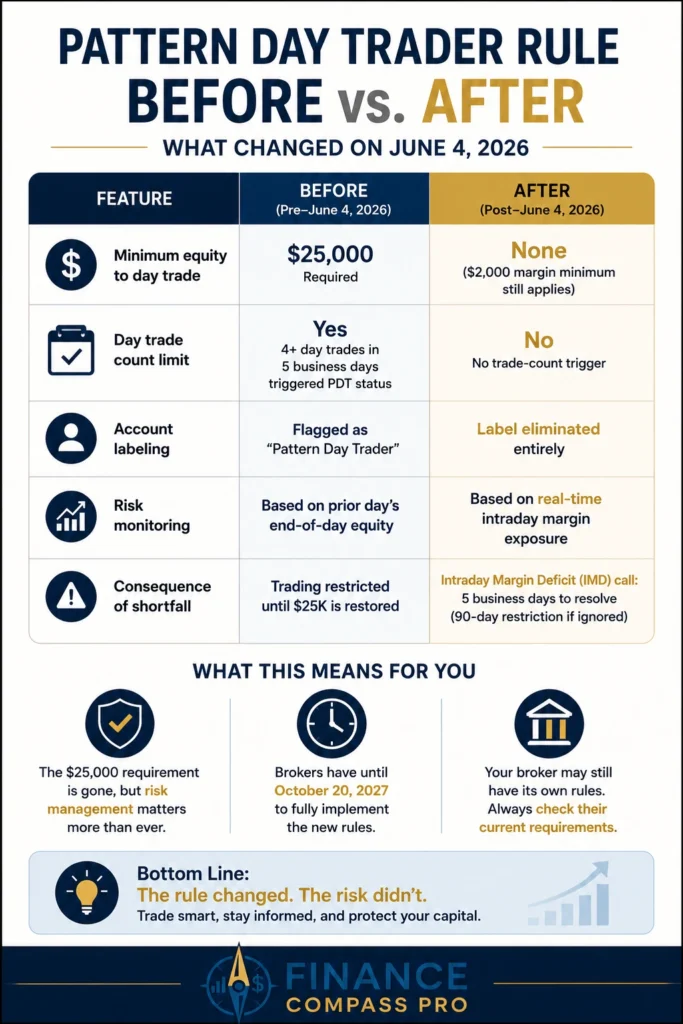
| Feature | Old Rule (Pre-June 2026) | New Rule (Post-June 2026) |
|---|---|---|
| Minimum equity to day trade | $25,000 | None (separate $2,000 margin minimum still applies) |
| Day trade count limit | 4+ trades in 5 days triggered PDT status | No trade-count trigger |
| Buying power calculation | Based on prior day’s end-of-day equity | Based on real-time intraday margin exposure |
| Account labeling | Flagged as “pattern day trader” | Label eliminated entirely |
| Consequence of a shortfall | Trading restricted until $25K restored | Intraday margin deficit (IMD) call, 5 business days to resolve |
That last row is the part to remember. This isn’t “anything goes now” – it’s a swap from one blunt rule to a smarter one. If you take on too much risk without enough to cover it, you’ll get what’s called an intraday margin deficit: basically a warning that says “add money or cut your position, and you’ve got 5 business days to do it.” Ignore it, and your account gets restricted for 90 days. There’s a small exception if the shortfall is tiny (under $1,000 or 5% of your account, whichever is smaller).
Why Your Broker’s Timeline Might Not Match FINRA’s
Here’s something that trips people up: June 4, 2026 is when the rule changed – not necessarily when your broker changed. Brokers have until October 2027 to catch up, and some are moving a lot faster than others.
So if you log into your account and still see the old $25,000 warning or a “pattern day trader” label, don’t panic. It just means your broker hasn’t flipped the switch yet – not that something’s wrong.
My advice: check your broker’s website or give them a call for their specific timeline, instead of assuming June 4 automatically applied to you. Also worth knowing – your broker can still set their own stricter rules than the new baseline. This change sets a floor, not a ceiling.
Does This Affect Cash Accounts?
Nope. This rule never touched cash accounts, and it still doesn’t. If you’re using a cash account – paying for everything with money you actually have, no borrowing – none of this changes anything for you.
Cash accounts still have their own rules to know about, mainly around how fast your money “settles” after a sale. If you’re not sure which account type fits your situation, Cash Account vs Margin Account walks through the tradeoffs in full.
One small thing worth knowing: some people used to keep a cash account specifically to dodge the $25,000 day trading rule. That specific reason is basically gone now. But every other reason to like a cash account better – no interest charges, no margin calls, less complexity – still holds up exactly like before.
What Beginners Should Actually Do With This Information
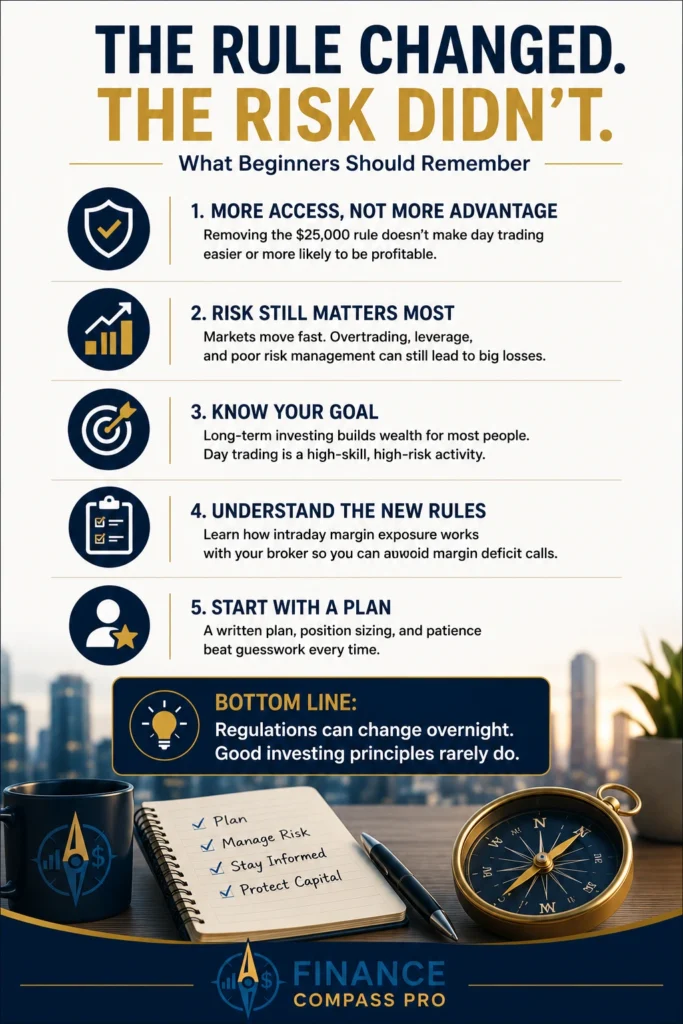
Here’s the honest, senior-to-junior advice part: just because the $25,000 wall came down doesn’t mean you should walk through it.
Should Beginners Start Day Trading Now?
Probably not.
Nothing about this rule change improves the odds of making money through day trading. It only changes who is allowed to do it. If your goal is building long-term wealth, learning how to invest consistently over time is still far more important than making multiple trades every day.
I’ve watched this exact pattern play out before – commission-free trading, fractional shares, and now this. Each time, a real barrier came down. And each time, the actual math of day trading stayed exactly the same: most people who try it lose money, expensive account or not. If you want to understand why that happens so consistently, Why Beginners Lose Money Investing covers the behavioral side of it in detail.
If you’re building a simple, long-term portfolio – buying good ETFs and holding them for years – this whole rule change barely touches you. You were never close to hitting the old PDT rule in the first place unless you were actively trading in and out of positions every day. The real question isn’t “can I day trade with less money now.” It’s whether you actually need to day trade at all to reach your goals. For most beginners, a simple long-term portfolio gets you there without any of this risk.
FAQ
A. No. The $25,000 pattern day trader minimum was fully eliminated, not lowered. A separate, pre-existing $2,000 minimum to trade on margin at all still applies, and your broker’s own house requirements may be stricter.
A. No. The four-trades-in-five-days threshold that defined a pattern day trader has been removed entirely. Your trading is now governed by intraday margin exposure limits instead of a trade count.
A. Brokers have until October 20, 2027 to fully implement the new framework. If your broker hasn’t rolled out the change yet, your account may still reflect the old rules. Contact your broker directly for their specific timeline.
A. No. The pattern day trader rule and its replacement apply only to U.S. equities and equity options traded through FINRA member broker-dealers. Futures, forex, and cryptocurrency markets operate under different rules entirely.
A. Yes. FINRA removed the federal requirement, but individual brokers may still adopt stricter internal policies of their own.
The Bottom Line
FINRA getting rid of the $25,000 rule is a real, meaningful change – a 25-year-old barrier that a lot of people found unfair just disappeared. But it’s a change to who’s allowed to day trade, not proof that day trading is suddenly a good idea.
If you’re already trading actively, check with your broker about their specific timeline and learn how the new margin deficit system works – it’s different from the old one. If you’re a long-term investor who was never anywhere near that $25,000 line, this is good-to-know information, not a reason to change what you’re doing.
For where account type fits into your broader investing decisions, see Taxable Brokerage Account Explained and How to Open a Brokerage Account.
Regulations can change overnight. Good investing principles rarely do.
Disclaimer: This article is for educational purposes only and does not constitute personalized financial, legal, or tax advice. Regulatory rules and broker implementation timelines can change. Verify current requirements with FINRA and your own brokerage before making trading decisions. Consult a qualified financial professional to discuss your specific situation.