
Disclosure: This article is for informational and educational purposes only. FinanceCompassPro.com may earn compensation through display advertising or affiliate relationships. We may reference third-party products, services, platforms, or tools for educational purposes. These mentions are not paid endorsements unless clearly stated. Nothing in this article constitutes personalized financial, legal, tax, or investment advice.
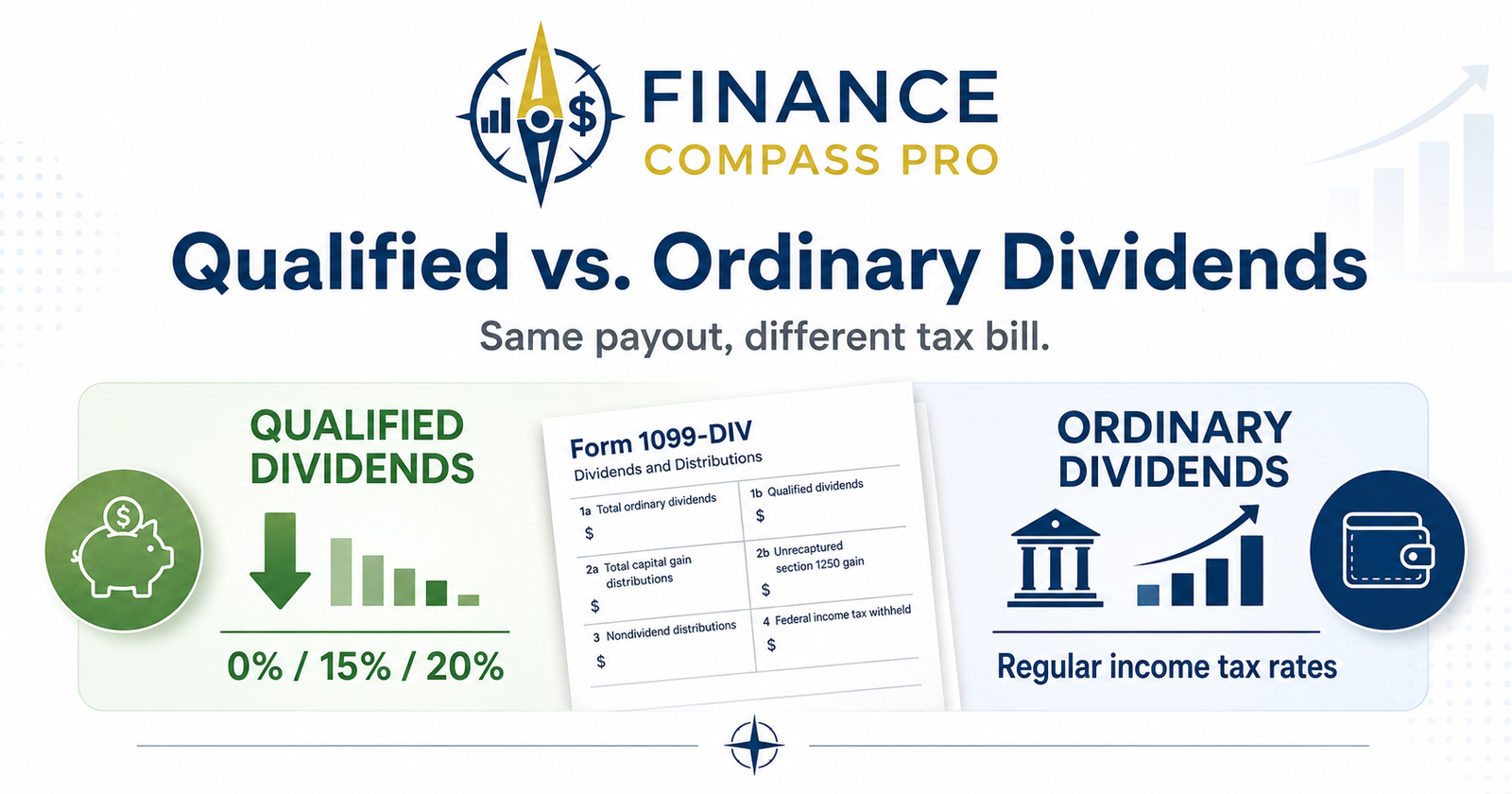
Your dividend ETF paid out $2,000 this year. Great – except the amount you actually keep depends on something most beginners never check: whether those dividends were qualified or ordinary.
Same $2,000. Two very different tax bills.
Quick Answer
For federal tax purposes, dividends reported as ordinary dividends may include a portion that qualifies for the lower qualified-dividend tax rates. Your Form 1099-DIV shows total ordinary dividends in Box 1a and the qualified portion in Box 1b.
Qualified dividends are taxed at the same rates as long-term capital gains – 0%, 15%, or 20%, depending on your taxable income. The rest of your ordinary dividends are taxed at your regular federal income tax rate, which can run as high as 37%.
Whether a dividend qualifies generally depends on two things: the type of payer, and how long you held the underlying shares.
What Makes a Dividend “Qualified”?
Two conditions generally need to be met.
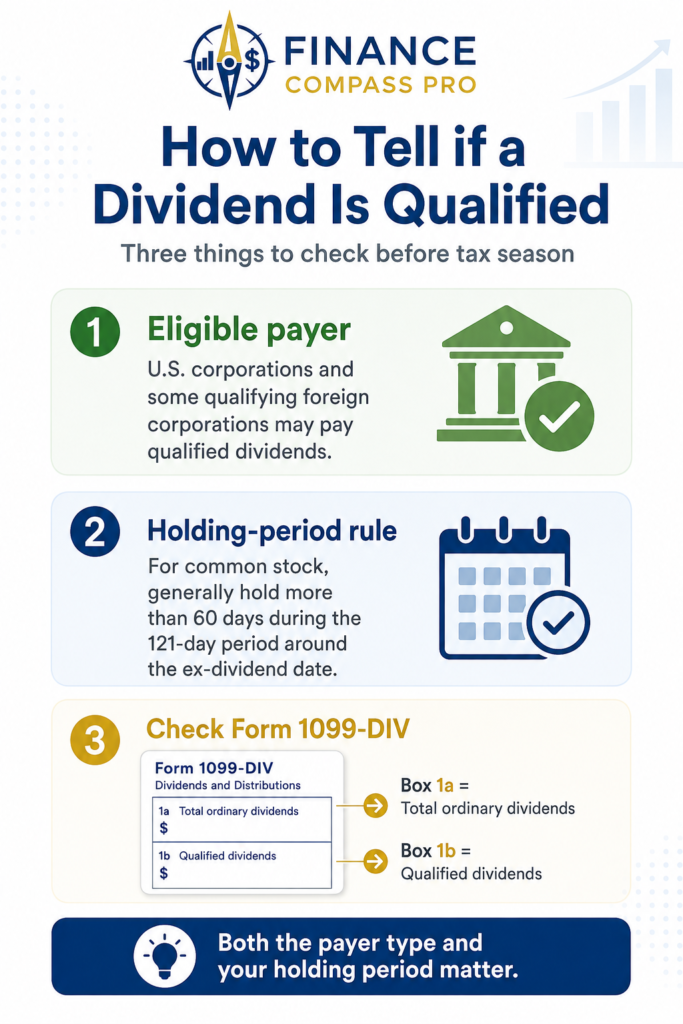
The payer has to be eligible. Dividends from a U.S. corporation, or a qualifying foreign corporation, are generally eligible for qualified treatment. Certain payers are structurally excluded from most of their distributions qualifying – most notably, REITs.
You have to meet the holding-period rule. For common stock, you generally need to hold the shares for more than 60 days during the 121-day period that begins 60 days before the ex-dividend date. Miss that window, and even a dividend from an otherwise-qualifying payer is taxed as ordinary income instead.
Both conditions have to be satisfied. A dividend from an eligible company doesn’t qualify on its own if you sold too soon. Similarly, meeting the holding period doesn’t help if the payer’s distributions aren’t eligible in the first place.
Why the Difference Is Larger Than It Looks
The gap between the two tax treatments isn’t small.
Ordinary-rate dividends are taxed at your regular federal bracket. In 2026, that bracket runs from 10% up to 37%. Qualified dividends are taxed differently. They use the same 0%, 15%, or 20% brackets that apply to long-term capital gains.
For many middle-income investors, that means qualified dividends are taxed at 15%, while the identical dollar amount as ordinary income could be taxed at 22%, 24%, or more. Higher-income investors may also owe the 3.8% Net Investment Income Tax on top of either category, once modified adjusted gross income crosses the applicable threshold.
None of this changes what you actually received in cash. What changes is how much of it you keep after taxes.
Which ETFs Tend to Pay Which Kind?
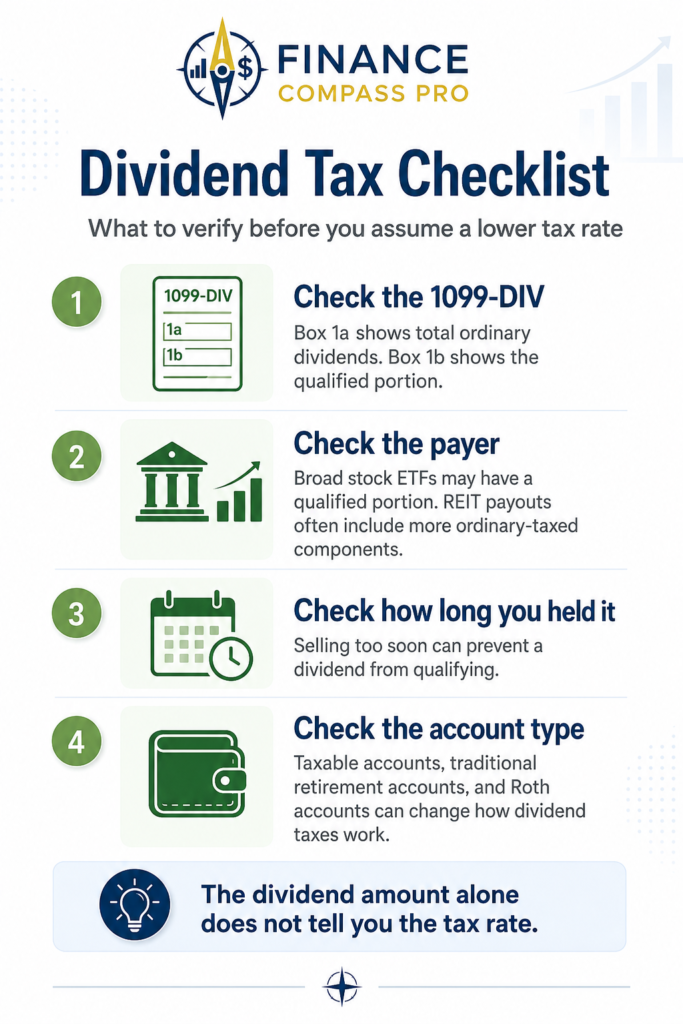
Many broad stock ETFs may distribute a substantial qualified-dividend portion, but the actual percentage varies by fund and year. Your Form 1099-DIV is the final place to confirm the qualified amount for any specific holding.
REIT-focused ETFs are the clearest exception, though the picture is more layered than a simple qualified-or-not split. REIT distributions often do not qualify for the lower qualified-dividend rates. However, REIT payouts can include several separate components. These include ordinary dividends, Section 199A dividends, and capital gain distributions. Section 199A dividends are reported in Box 5 and may be eligible for a deduction of up to 20%, subject to applicable tax rules. Some REITs also pay nondividend distributions. Check your Form 1099-DIV rather than assuming the entire payout receives one tax treatment.
Bond funds are different from stock-dividend funds. Their distributions are largely driven by interest earned on the bonds they hold, but the tax reporting may still appear on Form 1099-DIV as ordinary dividends or, for certain municipal-bond funds, as exempt-interest dividends.
If you’re building a portfolio that includes real estate exposure, this is worth knowing before you decide which account to hold it in.
The Hidden Trade-Off: Account Location Changes Everything
Everything above assumes the shares are held in a taxable brokerage account. Inside a retirement account, the picture changes.
In a traditional IRA or 401(k), dividends generally are not taxed when received inside the account. Taxable withdrawals are generally taxed as ordinary income later, subject to the account’s specific tax rules.
Inside a Roth IRA or Roth 401(k), qualified withdrawals are tax-free, so the qualified-versus-ordinary distinction that applies in a taxable account doesn’t come into play.
This is one reason some investors prefer to hold ordinary-taxed assets, like REITs and bond funds, inside tax-advantaged accounts, and hold broad qualified-dividend-paying stock ETFs in a taxable account instead. – That said, the right placement depends on your overall account mix and goals.
A Simple Decision Framework
- Holding a broad-market dividend ETF in a taxable account? A meaningful share of its dividends may be qualified, though the exact split varies by fund – check the 1099-DIV.
- Holding a REIT ETF? Expect a mix of ordinary dividends, Section 199A dividends, and capital gain distributions, most of which won’t get the qualified-dividend rate.
- Trading frequently around dividend dates? Check the holding-period rule before assuming a dividend will qualify – short holding periods can turn a qualified dividend into an ordinary one.
- Deciding where to hold REITs or dividend ETFs? Consider whether a tax-advantaged account might reduce the tax drag from ordinary-taxed distributions, based on your specific account mix.
A Beginner Mistake to Avoid
A common beginner misunderstanding is assuming all dividends automatically qualify for the lower tax rate.
Your broker’s Form 1099-DIV separates the two: total ordinary dividends appear in Box 1a, and the qualified portion appears in Box 1b. Some investors don’t check the split at all and are surprised at tax time by how much of their dividend income was taxed at their full ordinary rate.
Where This Fits in Your Investing Plan
Dividend taxes are one half of the investment-tax picture. For the other half — what happens when you sell an investment for a gain – see Capital Gains Tax for Beginners.
If you’re comparing specific dividend ETFs, see Best Dividend ETFs for Passive Income for how this fits into fund selection.
For the account-type decision itself, Taxable Brokerage Account Explained covers what makes this account different from a retirement account in the first place.
Bottom Line
The dollar amount of a dividend doesn’t tell you how it’s taxed. Whether it’s qualified or ordinary depends on the payer and how long you held the shares – and that distinction can create a meaningful difference in the federal tax rate applied to the same amount of dividend income.
Check your Form 1099-DIV rather than assuming, and remember that account type can override the whole distinction: inside a traditional retirement account, dividends aren’t separated into qualified and ordinary at all – withdrawals are simply taxed as ordinary income when you eventually take them out.
FAQ
A. Qualified dividends are the portion of your total ordinary dividends that’s taxed at the same 0%, 15%, or 20% rates as long-term capital gains. The remaining ordinary dividends are taxed at your regular federal income tax rate, which can run up to 37%.
A. Your broker’s Form 1099-DIV reports total ordinary dividends in Box 1a and the qualified portion in Box 1b. Generally, the payer needs to be an eligible U.S. or qualifying foreign corporation, and you need to have held the shares for more than 60 days during the 121-day period surrounding the ex-dividend date.
A. Usually not for the bulk of the payout, though REIT distributions can include several components — ordinary dividends, Section 199A dividends (reported separately in Box 5), and capital gain distributions — so it’s worth checking your 1099-DIV rather than assuming one uniform treatment.
A. Not in the same way. Qualified withdrawals from a Roth IRA are tax-free, so the qualified-versus-ordinary distinction that applies in a taxable account doesn’t come into play.
This article is for informational and educational purposes only and does not constitute financial, legal, or tax advice. Dividend tax rules, thresholds, and rates referenced here reflect 2026 federal figures and are subject to change. Always confirm current figures with the IRS or a qualified tax professional before making decisions based on your specific situation.