Disclosure: This post is for informational and educational purposes only. FinanceCompassPro.com may earn compensation through display advertising. We may also reference third-party products, services, or platforms by name for educational purposes – these mentions are not paid endorsements unless explicitly stated. Nothing in this post constitutes personalized financial, legal, tax, or investment advice. Tax rules are complex and individual circumstances vary – always consult a qualified tax professional before making decisions based on your specific situation.
Many beginners open a Roth IRA and simply buy the same ETF they hold everywhere else. That works, but it often wastes the account’s biggest advantage. A Roth IRA is one of the most powerful accounts available to individual investors.
Contributions go in after tax, but growth and qualified withdrawals are completely tax-free. As a result, the investments inside can compound for decades without ever generating a tax bill.
The key principle is straightforward. The ETFs that generate the most taxable income belong in your most tax-advantaged account. A high-dividend ETF or a bond ETF creates a tax bill every year in a regular brokerage account.
By contrast, the same ETF inside a Roth IRA generates no tax at all. The shelter is most valuable where the tax would otherwise be highest.
This guide explains which ETF types belong in a Roth IRA and why the choice matters. It also shows how to build a sensible Roth IRA portfolio using common ETFs. For the basics of how a Roth IRA works, see What Is a Roth IRA?
If you also have a workplace 401(k), see Can You Have a Roth IRA and a 401(k) at the Same Time? for how the two accounts work together.
Quick Answer: The ETFs that benefit most from a Roth IRA are the ones that generate the most taxable income – high-dividend funds like SCHD and VYM, REIT ETFs, and bond ETFs. Growth ETFs with long horizons also fit well. In contrast, tax-efficient broad-market funds like VOO give up less by sitting in a taxable account instead.
Why Account Placement Matters
The core principle is simple: put the investments that generate the most taxable income into your most tax-advantaged account. The Roth IRA is usually the strongest tax shelter most individual investors can access.
Therefore, it makes sense to prioritize it for ETFs that would otherwise create the highest ongoing tax costs.
Tax costs come from two main sources in an ETF portfolio. First, dividends – which are taxed in the year they are paid when held in a taxable account. Second, capital gains – though broad index ETFs rarely distribute capital gains, thanks to in-kind redemptions. For most ETF investors, dividends are the primary ongoing tax drag to manage.
The higher an ETF’s dividend yield, the more annual tax drag it creates in a taxable account. As a result, higher-yield funds benefit more from the Roth IRA’s tax-free shelter. For the full framework on how ETF taxes work, see ETF Taxes Explained.

ETFs That Tend to Benefit Most from a Roth IRA
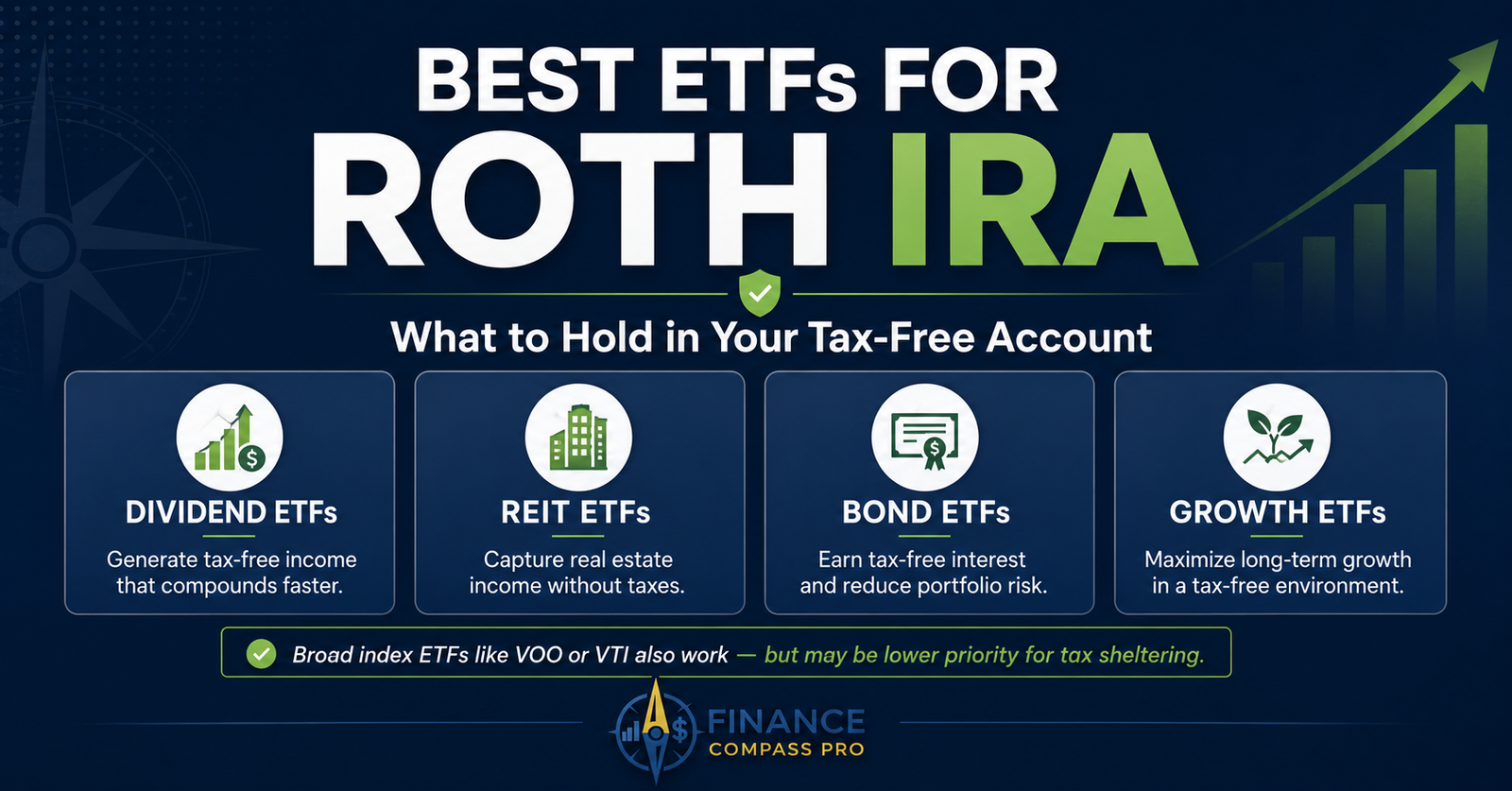
The following ETF types are commonly prioritized for Roth IRA placement. The reason is simple: they tend to generate more taxable income when held outside a tax-advantaged account. This is not a recommendation to buy any specific ETF. Instead, it is a framework for thinking about which ETF types benefit most from tax-free compounding.
High-Dividend ETFs
Dividend ETFs like SCHD, VYM, and DGRO distribute income regularly. In a taxable account, those distributions are taxed each year – even if you reinvest them. Inside a Roth IRA, the same distributions compound completely tax-free. The higher the yield, the more valuable the Roth shelter becomes. For a comparison of major dividend ETFs, see SCHD vs. VIG.
REIT ETFs
Real estate investment trust ETFs like VNQ distribute income that is generally taxed as ordinary income rather than at the lower qualified-dividend rate. That means their tax drag in a taxable account can be meaningfully higher than broad equity ETFs. For this reason, REIT ETFs are a common example in account-placement discussions.
Bond ETFs
Bond ETFs like BND and AGG pay interest income taxed as ordinary income. Holding bond ETFs inside a Roth IRA shelters that ongoing income from taxation. The right account for a bond ETF also depends on your overall account mix and withdrawal timeline – a tax professional can help here. For more on AGG and BND, see AGG vs. BND.
Growth-Oriented ETFs with Long Time Horizons
ETFs like QQQ or QQQM that focus on Nasdaq-100 growth companies pay very little in current dividends. However, they may appreciate significantly over a long holding period. Inside a Roth IRA, gains on these funds are not taxed at withdrawal. For investors with decades until retirement, placing high-growth ETFs in a Roth IRA is a commonly discussed approach. However, the right fit depends on your overall account structure and goals.
ETFs That Are Less Critical to Shelter
Some ETFs generate relatively low taxable income in a regular account. Specifically, broad U.S. equity index ETFs like VOO, VTI, and VXUS tend to be relatively tax-efficient outside a Roth IRA. There are two reasons: their dividend yields are moderate, and they rarely distribute capital gains.
A common misconception is that tax-efficient ETFs are wasted inside a Roth IRA. They are not. Holding them inside is perfectly fine, and their long-term growth compounds tax-free regardless.
However, Roth IRA space is limited. If you must choose which ETFs to shelter, prioritizing higher-income funds makes more sense than defaulting to the most broadly diversified ones.
Additionally, VXUS deserves a specific note. When held in a taxable account, VXUS may make you eligible for the foreign tax credit.
That benefit disappears inside a Roth IRA or any tax-advantaged account. For some investors, that makes VXUS a better candidate for taxable account placement. For more detail, see VXUS ETF Explained.

A Simple Roth IRA ETF Framework
Here is how investors often think about ETF placement across account types. In short, the higher the annual income an ETF produces, the higher its Roth IRA priority. This is an illustrative framework, not personalized advice.
| ETF Type | Example ETFs | Roth IRA priority | Reason |
|---|---|---|---|
| High-dividend equity | SCHD, VYM, DGRO | High | Regular dividend income taxed annually in taxable accounts |
| REIT ETFs | VNQ | High | Distributions often taxed as ordinary income |
| Bond ETFs | BND, AGG | High to moderate | Interest income taxed as ordinary income |
| High-growth equity | QQQ, QQQM | Moderate to high | Low current yield but high long-term appreciation potential |
| Broad U.S. equity | VOO, VTI | Lower relative priority | Moderate yield; relatively tax-efficient outside Roth |
| International equity | VXUS | Lower relative priority | Foreign tax credit available in taxable accounts |
This table reflects general principles that many investors apply. Individual circumstances, account balances, and investment goals vary. Verify with a qualified tax professional before making account placement decisions.
Beginner Decision: What Should Go in Your Roth IRA?
The most common question beginners ask is: should I just put VOO in my Roth IRA? VOO works fine inside a Roth IRA – it will compound tax-free regardless. However, suppose you also hold SCHD or bond ETFs and have limited Roth space. In that case, prioritizing the higher-income ETFs makes the Roth shelter work harder for you overall.
The beginner decision comes down to three questions:
- Which ETFs in my portfolio generate the most annual taxable income? Start there when deciding what to shelter in the Roth IRA.
- Do I hold VXUS? If so, consider whether the foreign tax credit benefit makes taxable account placement more valuable for that specific fund.
- How much Roth space do I have? If your Roth IRA is large enough to hold everything, placement matters less. If space is limited, prioritize high-income and high-growth ETFs. If your income is too high to contribute directly at all, see Backdoor Roth IRA Explained for a legal alternative path to Roth IRA eligibility.
FAQ About ETFs in a Roth IRA
A. There is no single best ETF for everyone. However, the funds that gain the most from Roth placement are income-heavy ones – high-dividend ETFs like SCHD, REIT ETFs, and bond ETFs. Their income would otherwise be taxed every year. Inside a Roth IRA, it compounds completely tax-free instead
A. Yes, VOO works fine in a Roth IRA and compounds tax-free there. However, VOO is already quite tax-efficient in a taxable account. Its yield is moderate, and it rarely distributes capital gains. So if your Roth space is limited, higher-income funds usually benefit more from the shelter.
A. Many investors do, and the logic is straightforward. High-yield dividend ETFs create annual tax drag in a taxable account, even when dividends are reinvested. Inside a Roth IRA, those same distributions compound tax-free. As a result, dividend ETFs are among the most common Roth IRA holdings discussed.
A. No, not while the money stays inside the account. Dividends, interest, and capital gains all accumulate tax-free in a Roth IRA. Qualified withdrawals in retirement are generally tax-free as well. This is exactly why income-heavy ETFs benefit so much from Roth IRA placement.
A. Yes. Bond ETFs like BND and AGG pay interest that is taxed as ordinary income in a taxable account. A Roth IRA shelters that income entirely. However, the right account for bonds also depends on your withdrawal timeline and overall mix, so consider reviewing it with a professional.
The Bottom Line
The Roth IRA’s tax-free compounding is most valuable for ETFs that generate the most taxable income. Therefore, high-dividend equity funds, REIT ETFs, and bond ETFs tend to benefit most from that shelter. Low-income, tax-efficient ETFs like VOO or VTI work fine inside a Roth IRA but give up less by being held outside it.
The goal is not to find the “best” ETF for a Roth IRA in isolation. Rather, it is to match each ETF to the account where it creates the least tax drag.
If you take one step today, list your holdings by dividend yield. The highest-income funds on that list are usually your strongest Roth IRA candidates.
Roth IRA Withdrawal Rules Explained covers what happens when you later access contributions, conversions, or earnings.
Still comparing account types? Roth IRA vs. Brokerage Account explains how a Roth IRA differs from a taxable brokerage account.
For fund-level follow-up, use the comparison that matches the ETF type you are actually considering rather than opening several sibling comparisons at once. REIT ETFs Explained is the relevant next step for real estate exposure.
Once you have decided which ETFs go where, How to Build Your First Investment Portfolio walks through assembling those funds into a complete portfolio. And for the full picture of how core, dividend, international, bond, and growth ETFs fit together, see ETFs for Beginners: How to Choose, Compare, and Build a Simple Portfolio.