
Disclosure: This post is for informational and educational purposes only. FinanceCompassPro.com may earn compensation through display advertising. We may also reference third-party products, services, or platforms by name for educational purposes – these mentions are not paid endorsements unless explicitly stated. Nothing in this post constitutes personalized financial, legal, tax, or investment advice.
What is a bull market? Most investors only start asking that question after stock prices have already been rising for months.
By then, prices are higher, confidence is back, and the window to position yourself well has narrowed considerably. Understanding what a bull market is – and what typically signals one is beginning – puts you in a position to act thoughtfully rather than reactively.
Here’s what every beginner needs to know about bull markets, how they start, how long they last, and how to make the most of them without taking on more risk than you realize.
What Is a Bull Market?
A bull market is a period when a major stock market index – such as the S&P 500 – rises 20% or more from a recent low, typically sustained over a period of months or years.
The 20% threshold mirrors the definition used for bear markets in reverse. Just as a bear market is defined by a 20% decline, a bull market is defined by a 20% recovery and sustained upward trend.
The term “bull” comes from the way a bull attacks: thrusting its horns upward. Rising prices, growing investor confidence, and expanding economic activity are the hallmarks of a bull market.
“Bull markets don’t announce themselves. They’re usually only recognized clearly in hindsight – which is exactly why patient, consistent investors tend to benefit most.”
How Often Do Bull Markets Happen?
More often than you might expect – and they last significantly longer than bear markets.
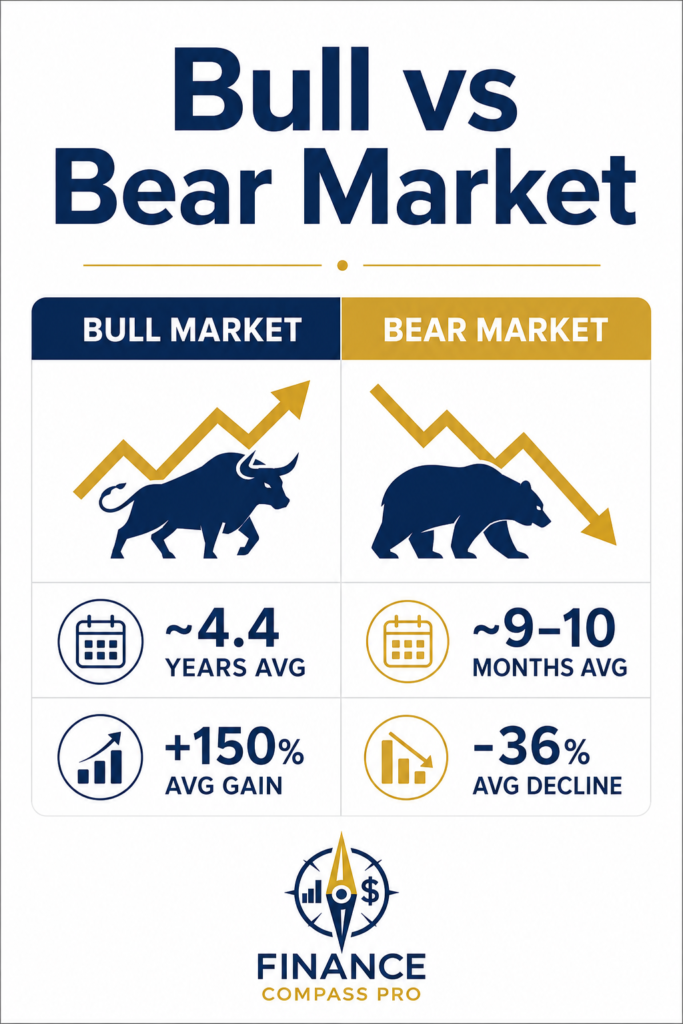
Historically, bull markets have lasted much longer than bear markets and produced far larger cumulative gains, though the exact averages vary depending on the time period and methodology used. Since World War II, bull markets have often lasted several years and generated very strong cumulative gains – estimates commonly place the average duration at around 4 to 5 years. For more on how markets are measured over time, see the investor education resources at SEC’s Investor.gov.
| Metric | Bull Market | Bear Market |
|---|---|---|
| Average duration | ~4–5 years | ~9–10 months |
| Average gain/loss | ~+150% | ~-36% |
| Frequency | Most of the time | Every ~3.5–4 years |
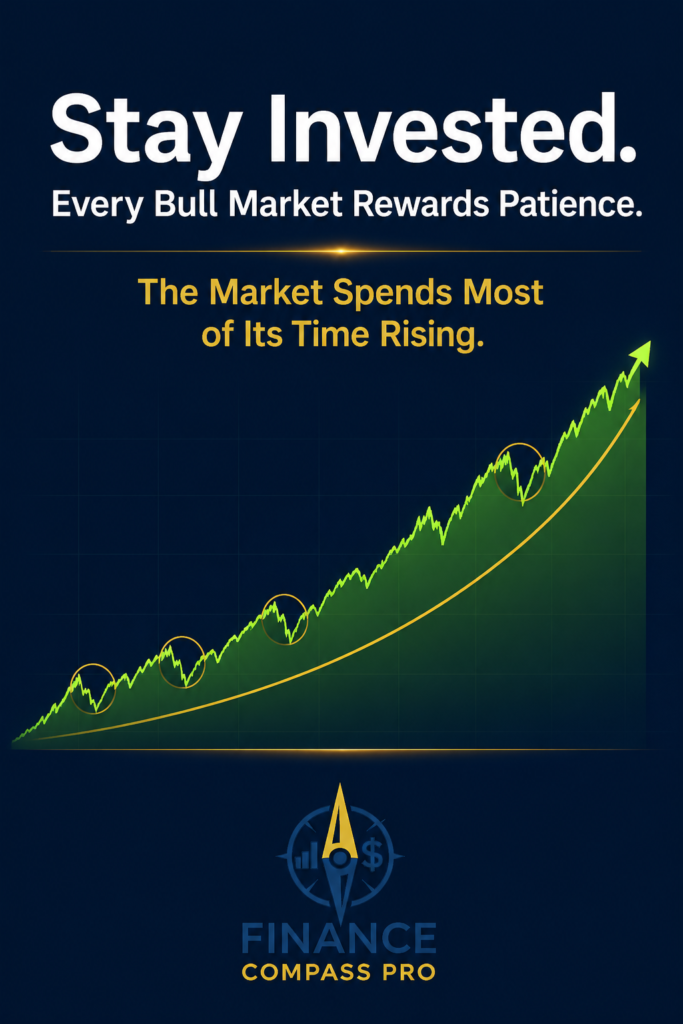
The stock market spends far more time rising than falling. This is one of the most important facts in long-term investing – and one of the strongest arguments for staying invested rather than trying to time market cycles.
What Causes a Bull Market?
Bull markets typically emerge from a combination of economic and psychological factors:
- Economic growth – rising GDP, low unemployment, and strong corporate earnings create the foundation for sustained price increases
- Low or falling interest rates – cheaper borrowing costs encourage business expansion and make stocks relatively more attractive than bonds
- Investor confidence – as prices rise and economic conditions improve, more investors enter the market, driving prices higher
- Government stimulus fiscal or monetary policy that injects money into the economy can accelerate bull market conditions
- Technological innovation – productivity gains and new industries can fuel prolonged periods of market expansion
Bull markets often begin during or shortly after a recession, when prices are at their lowest and economic recovery is just starting. By the time most investors feel confident enough to invest, the early gains have already occurred.
Famous Bull Markets in History
Looking at historical bull markets helps set realistic expectations for both duration and magnitude.
1990–2000 – The Dot-Com Bull Market
One of the longest bull markets in U.S. history, lasting approximately 10 years. The S&P 500 gained roughly 417% during this period, driven by the explosion of the internet and technology sector. It ended with the dot-com crash in 2000.
2009–2020 – The Longest Bull Market on Record
Following the 2008 financial crisis, the S&P 500 entered a bull market that lasted nearly 11 years. The index gained approximately 400% before the COVID-19 pandemic ended the run in February 2020.
2020–2022 – The Post-COVID Bull Market
After the fastest bear market in history (just 33 days), stocks recovered sharply. The S&P 500 gained over 100% from its March 2020 low to its January 2022 peak, fueled by massive fiscal stimulus and low interest rates.
Every one of these bull markets eventually ended – but investors who stayed the course through each full cycle built substantial wealth.
How to Recognize a Bull Market Early
Timing markets perfectly is impossible. But there are conditions that historically precede or accompany the early stages of a bull market:
1. The Market Has Already Declined Sharply
Bull markets are born from bear markets. When prices have fallen 20–40% or more from recent highs, the conditions for a recovery are often building – even if confidence is at its lowest.
2. The Federal Reserve Signals Rate Cuts
Falling interest rates reduce borrowing costs and tend to boost stock valuations. When the Fed pivots from raising rates to cutting them, it often precedes sustained market gains.
3. Economic Data Begins to Stabilize
Unemployment stops rising, GDP contraction slows, and corporate earnings begin to recover. These are often early signals that the worst is behind the economy.
4. Market Breadth Improves
When a growing number of stocks – not just a handful of large companies – begin rising together, it suggests broad-based buying rather than isolated speculation.
What Should You Do During a Bull Market?
1. Stay Invested
The single most important thing during a bull market is to remain invested. Missing even a handful of the market’s best days – which often cluster near the beginning of a recovery – can dramatically reduce long-term returns.
2. Continue Dollar-Cost Averaging
A bull market doesn’t mean you should change your investing strategy. Continuing to invest a fixed amount on a regular schedule – regardless of whether the market is up or down – is one of the most reliable ways to build wealth over time.
For a full breakdown of this approach, see our guide on dollar-cost averaging explained.
3. Review Your Asset Allocation
Bull markets can cause your portfolio to drift toward a higher stock allocation than you originally planned. If stocks have grown from 70% to 85% of your portfolio, you may be carrying more risk than you intended. Annual rebalancing keeps your allocation in line with your goals.
To understand how allocation should work across market cycles, see our guide on what is asset allocation.
4. Avoid FOMO-Driven Decisions
Late-stage bull markets are when investor overconfidence peaks. Prices feel like they’ll rise forever, and the temptation to concentrate in high-flying sectors or take on more risk can be strong. History shows this is precisely when caution matters most.
5. Use the Gains to Build Your Foundation
A bull market is a good time to review your emergency fund, pay down high-interest debt, and ensure your retirement accounts – including your Roth IRA and 401(k) – are being funded consistently.
Bull Market vs. Bear Market: Key Differences
| Bull Market | Bear Market | |
|---|---|---|
| Definition | 20%+ rise from a recent low | 20%+ decline from a recent high |
| Average duration | ~4–5 years | ~9–10 months |
| Investor sentiment | Confidence, optimism | Fear, pessimism |
| Economic backdrop | Growth, low unemployment | Contraction, rising unemployment |
| Best investor response | Stay invested, rebalance | Stay invested, keep buying |
For a deeper look at what happens when markets decline, see our guide on what is a bear market.
When Does a Bull Market End?
Bull markets don’t end on a schedule. They end when conditions shift – and often when investor sentiment has become so optimistic that prices have moved far ahead of underlying economic reality.
- Rising interest rates – as rates climb, borrowing becomes more expensive, corporate profits compress, and bonds become more competitive with stocks
- Inflation – sustained high inflation erodes purchasing power and often forces central banks to raise rates
- Recession – falling economic activity reduces corporate earnings and investor confidence
- Market bubble bursting – when valuations in specific sectors become disconnected from fundamentals, a correction often follows
Trying to predict exactly when a bull market will end is nearly impossible – and for most long-term investors, not worth attempting. The more reliable approach is maintaining a diversified, well-allocated portfolio that can weather both bull and bear conditions.
The Bottom Line
A bull market is a sustained rise of 20% or more in stock prices, typically lasting several years and generating substantial gains for investors who remain invested throughout.
Bull markets are the dominant state of the stock market over time. They begin quietly, often when confidence is still low, and they end when optimism has reached its peak. The investors who benefit most are not those who perfectly time the cycle – they’re the ones who stay consistent through all of it.
Understanding your risk tolerance before markets move in either direction is the best preparation you can do. See our guide on what is risk tolerance to build that foundation now.
For the complete framework on building a portfolio that can handle both bull and bear conditions, see How to Build Your First Investment Portfolio.
Disclaimer: This article is for educational purposes only and does not constitute personalized financial or investment advice. Past market performance does not guarantee future results. Consult a qualified financial professional for advice specific to your situation.