
Disclosure: This post is for informational and educational purposes only. FinanceCompassPro.com may earn compensation through display advertising. We may also reference third-party products, services, or platforms by name for educational purposes – these mentions are not paid endorsements unless explicitly stated. Nothing in this post constitutes personalized financial, legal, tax, or investment advice.

Most budgets fail for the same reason.
You look at what came in last month, subtract what went out, and check whether the number at the bottom is positive or negative. If it is positive, you tell yourself you did fine. If it is negative, you make a vague promise to spend less next month.
Then next month arrives and nothing has changed.
Why does this cycle happen so consistently?
Usually, it is not because you are careless with money. It is because your money does not have clear direction. When cash sits in your account without a specific purpose, it tends to disappear into small purchases that feel reasonable in the moment but are hard to explain at the end of the month.
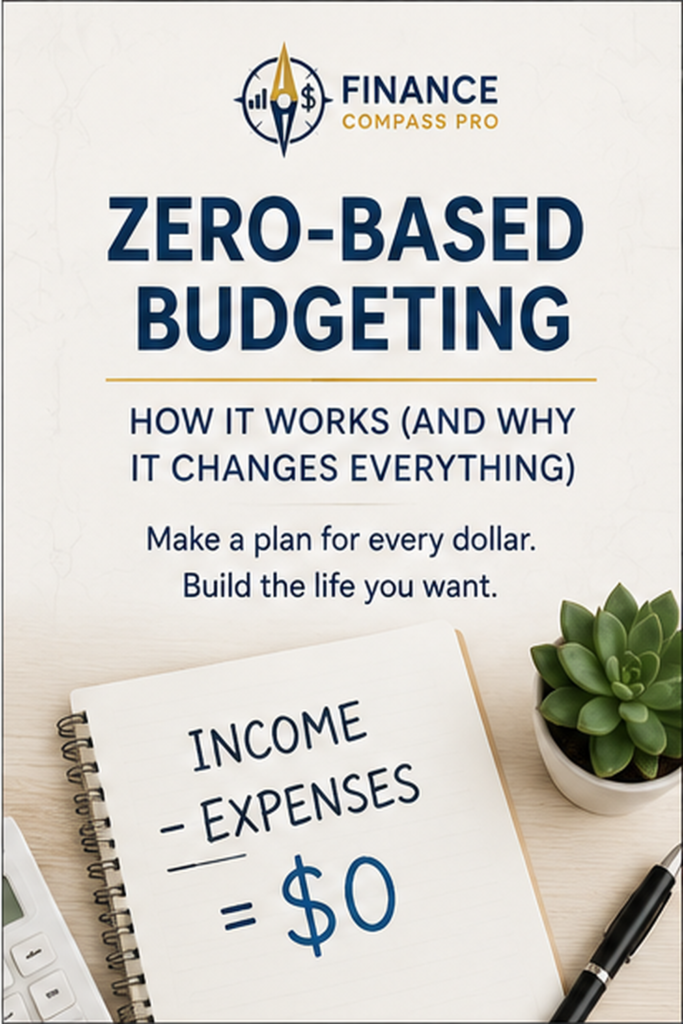
Zero-based budgeting works differently. In short, it means your income minus your expenses equals zero – every dollar assigned a job before the month begins, not spent on autopilot. For many people who try it, it is the first budgeting method that feels concrete enough to stick.
What Is Zero-Based Budgeting?
Zero-based budgeting is a system where you assign every single dollar of your income a specific purpose before the month begins. The goal is to end the month with zero dollars unassigned – not zero dollars in your account, but zero dollars without a plan.
The formula is simple:
Income − Expenses = $0
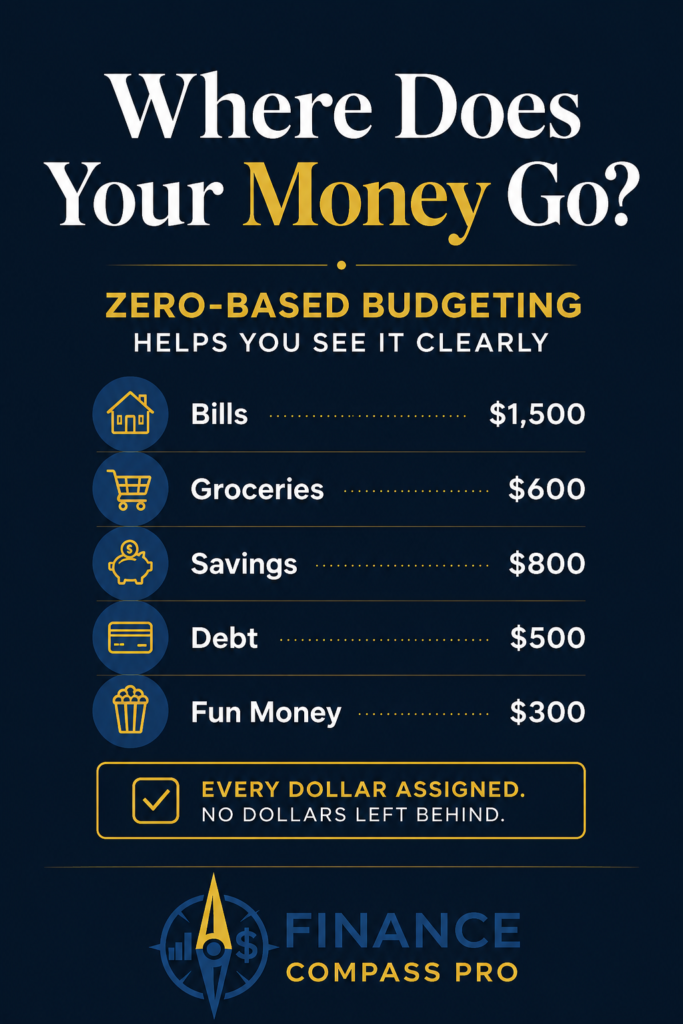
That does not mean you spend everything you earn. It means every dollar is accounted for – whether it goes to rent, groceries, savings, investing, or a specific goal.
The dollar you put into your emergency fund counts. The dollar you set aside for a vacation counts. Every dollar gets a job.
This is fundamentally different from most budgeting approaches, where money that is not actively needed just sits in your account and gradually disappears on things you cannot fully explain at the end of the month.
How Zero-Based Budgeting Differs From Other Methods
If you have tried the 50/30/20 rule, you already understand the value of giving your money structure.
The 50/30/20 Budget Rule is an excellent starting framework because it divides your income into three broad categories and works well for people who want simplicity.
Zero-based budgeting goes a level deeper. Instead of broad categories, every specific expense gets its own line – your streaming subscription, your pet food, your coffee budget, all accounted for individually.
This level of detail is both zero-based budgeting’s biggest advantage and the reason some people find it intimidating at first. But once it is set up, it gives you a level of clarity that more passive tracking methods cannot match.
Why Zero-Based Budgeting Works
There is a psychological reason this method is so effective.
When you see money sitting in your checking account, your brain does not automatically categorize it. It just sees available money. And available money has a way of becoming spent money – on things that feel reasonable in the moment but add up to a month of unexplained leaks.
Zero-based budgeting eliminates that gray zone. When every dollar is assigned, there is no ambiguity. You either have money in a category or you do not. That clarity removes the space where most spending decisions go wrong.
It also forces a conversation with yourself at the beginning of each month – what actually matters, what you’re saving for, and what you’re willing to cut. These are not always comfortable questions, but they are the right ones.
If you have ever been surprised by how much you are spending on things that do not actually reflect your priorities, that is exactly the problem zero-based budgeting is designed to solve. Hidden monthly expenses – subscriptions you forgot about, recurring charges you stopped noticing – become impossible to ignore when every dollar needs a name.
How to Set Up a Zero-Based Budget (Step by Step)
Step 1: Calculate Your Monthly Income
Start with what actually hits your bank account each month after taxes and automatic deductions. If your income varies, use your lowest month from the past three to six months as your baseline. It is better to budget conservatively and have money left over than to plan for income that does not arrive.
Step 2: List Every Fixed Expense
Fixed expenses are the ones that do not change much from month to month:
- Rent or mortgage
- Car payment
- Insurance premiums
- Loan minimums
- Subscriptions such as streaming, gym, or software
Write down each one with its exact amount. These are your non-negotiable line items.
Step 3: List Your Variable Expenses
Variable expenses change from month to month, but they are still predictable categories:
- Groceries
- Gas or transportation
- Utilities
- Eating out
- Personal care
- Entertainment
- Clothing
For each category, assign a specific dollar amount based on your recent spending history. Be honest, not aspirational. If you spent $400 on groceries last month, budgeting $150 this month is not realistic; it is wishful thinking.

Step 4: Add Your Savings and Financial Goals
This is where zero-based budgeting separates itself from passive money management. Savings are not what is left over. Savings are a line item – a bill you pay yourself before anything else.
- Emergency fund contributions
- Retirement or investment accounts
- Specific savings goals such as a vacation, car, or home down payment
If you have not started your emergency fund yet, this is the moment to build that into your plan. Building an emergency savings account does not require a large income. It requires a specific monthly commitment, treated as a non-negotiable expense.
Step 5: Make the Numbers Equal Zero
Add up everything: fixed expenses, variable expenses, savings, investments, and any sinking funds for irregular costs.
A sinking fund is money you set aside monthly for expenses that do not come every month, such as car registration, holiday gifts, annual subscriptions, or insurance premiums.
Subtract the total from your income. If the result is positive, you have unassigned dollars – assign them to savings, debt payoff, or an upcoming expense. Every remaining dollar needs a job. If the result is negative, you are over budget and need to decide which category gets cut.
Step 6: Track Throughout the Month
Creating the budget is only half the work. The other half is checking in regularly, ideally weekly, to see where each category stands. When you spend money, subtract it from the relevant category. When a category runs out, it is done for the month.
This tracking step is what transforms zero-based budgeting from a document into an actual habit. Without it, you have a plan on paper that has no connection to your daily decisions.
Common Mistakes to Avoid
Forgetting irregular expenses. Annual subscriptions, car registration, holiday gifts, and insurance premiums are not monthly, but they still need to be budgeted for monthly. Divide the annual cost by 12 and set that amount aside each month in a sinking fund.
Making the budget too tight. A budget that does not include any flexibility – no eating out, no entertainment, no personal spending – is a budget you may abandon by week two. Build in a realistic personal spending or fun money category. Budgets that acknowledge human nature last longer than budgets that try to override it.
Starting mid-month. Zero-based budgeting works best when it covers a full month from the beginning. If you are starting mid-month, use the rest of this month to track your spending and build your first complete budget for next month.
Not adjusting when things change. Your budget is not a permanent document. An unexpected expense, a change in income, or a new financial goal may require you to revisit and reallocate. The budget should reflect your real life, not the other way around.

Zero-Based Budgeting and the Bigger Picture
Getting your spending under control is a foundation, not a destination.
Once you know where every dollar is going – and you are consistently directing money toward savings and goals – the next step is making that money grow. Understanding compound interest is what shows you why the savings discipline you build now matters so much over time.
And once your emergency fund is funded and your budget is stable, the money you have freed up can start working harder. That is when conversations about investing – and setting clear financial goals before you invest – start to make real sense.
Zero-based budgeting is not the end of your financial journey. It is the foundation that makes everything else possible.
Is Zero-Based Budgeting Right for You?
It works best for people who:
- Feel like money disappears without explanation
- Want total control and visibility over their finances
- Are working toward a specific financial goal
- Have struggled to stick with other budgeting methods
It requires more setup and attention than simpler approaches like the 50/30/20 rule. But for people who are serious about changing their financial situation, not just tracking it, the extra effort is worth it.
The goal is not to restrict your life. The goal is to make sure your money is doing exactly what you want it to do, every single month. That level of intentionality, applied consistently, is what separates people who feel in control of their finances from people who always seem to be one unexpected expense away from stress.
You already know where your money comes from. Zero-based budgeting finally tells you where it is going – and makes sure that answer is one you actually chose.
Start with next month. Write down your income tonight, and give every dollar a name before it arrives.
A zero-based budget works best when each dollar has a clear job. For a focused short-term goal, you can use it to save $1,000 in 30 days without guessing where the money should come from.
Ready to Keep Building?
Once your budget has a clear plan, the next step is understanding the behavior behind the numbers with our guide on psychological spending triggers that make you spend without realizing it.
Finally, once your monthly cash flow is under control, learn the difference between saving and investing so you know where each dollar should go next.
If you’d rather start with a simpler framework before moving to zero-based budgeting, see How to Build a Simple Budget That Actually Works.
If debt payments are part of the problem, keep them inside the budget as explicit line items. The purpose of this article is to build a cash-flow system first rather than branch into a separate credit-repair workflow.
This article is for informational and educational purposes only and does not constitute financial advice. Nothing in this post constitutes personalized financial, legal, tax, or investment advice.