Disclosure: This post is for informational and educational purposes only. FinanceCompassPro.com may earn compensation through display advertising. We may also reference third-party products, services, or platforms by name for educational purposes – these mentions are not paid endorsements unless explicitly stated. Nothing in this post constitutes personalized financial, legal, tax, or investment advice.
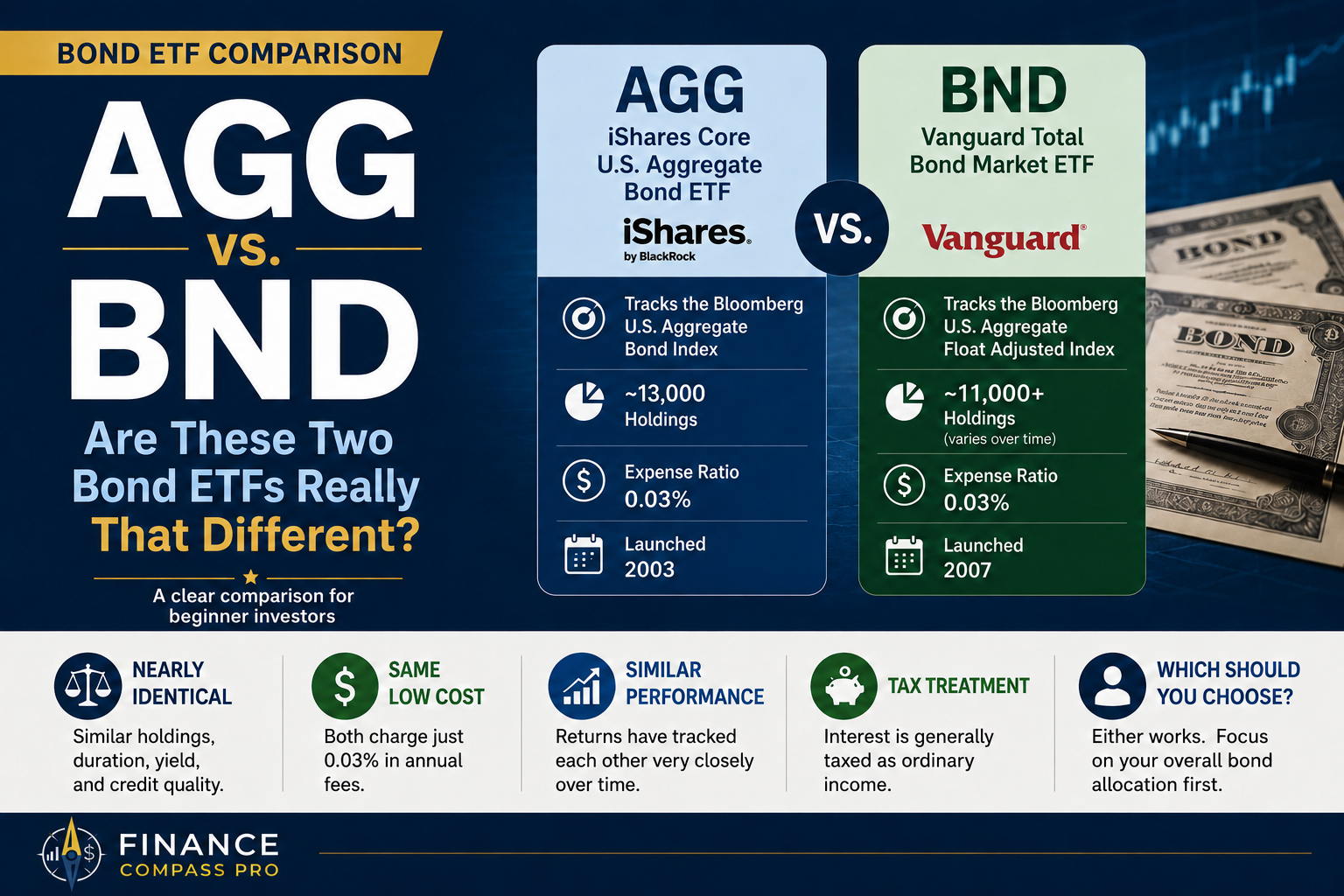
AGG and BND are two of the most widely used core bond ETFs among individual investors. Both aim to do the same job: give you broad exposure to the U.S. investment-grade bond market in a single fund.
They track nearly identical indexes, charge the same rock-bottom fee, and hold thousands of overlapping bonds. So why does it matter which one you pick?
This guide breaks down what each fund actually holds, where the small differences show up, and whether the choice between them is worth spending any time on at all.
What Do AGG and BND Actually Track?
Both AGG and BND track versions of the Bloomberg U.S. Aggregate Bond Index, often called “the Agg.” That index is the standard benchmark for the U.S. investment-grade bond market. It includes Treasury bonds, government agency bonds, investment-grade corporate bonds, and mortgage-backed securities.
Because both funds track essentially the same underlying index, their holdings overlap heavily. Sector weights, average maturity, and credit quality are all very similar between the two funds.
| AGG | BND | |
|---|---|---|
| Full name | iShares Core U.S. Aggregate Bond ETF | Vanguard Total Bond Market ETF |
| Issuer | BlackRock (iShares) | Vanguard |
| Index tracked | Bloomberg U.S. Aggregate Bond Index | Bloomberg U.S. Aggregate Float Adjusted Index |
| Expense ratio | 0.03% | 0.03% |
| Launched | 2003 | 2007 |
| Number of holdings | ~13,000+ (varies over time) | ~11,000+ (varies over time) |
| Typical portfolio role | Core bond holding | Core bond holding |
For official fund details, see the iShares AGG product page and the Vanguard BND product page. If you’re new to what a bond fund actually does, this guide covers the basics of how bonds behave differently from stocks.

AGG vs. BND: Key Differences
Despite tracking nearly the same index, a few structural differences separate the two funds.
Index Construction
AGG tracks the standard Bloomberg U.S. Aggregate Bond Index. BND tracks a float-adjusted version of the aggregate bond index, which makes some additional adjustments for bonds not readily available to public investors, including certain securities held by the Federal Reserve. In practice, this makes BND’s index slightly more representative of bonds actually available to investors in the open market – though the practical difference in performance has historically been small.
Fund Size and Liquidity
AGG is one of the largest and most heavily traded bond ETFs, with consistently high trading volume and tight spreads. BND is also highly liquid, but typically trades at somewhat lower daily volume than AGG.
For long-term buy-and-hold investors, this difference rarely matters. Both funds have tight bid-ask spreads and ample liquidity for routine buying and selling. The liquidity gap is more relevant to institutional traders moving very large positions.
Tracking Approach
Both funds use a sampling strategy rather than holding every single bond in their benchmark index – the aggregate bond market contains far too many individual issues to hold each one cost-effectively. This sampling approach can introduce minor tracking error in either fund, though both have historically tracked their respective indexes closely.
Expense Ratio: A Genuine Tie
Both AGG and BND charge a 0.03% expense ratio. On a $10,000 investment, that works out to $3 per year for either fund. There is no cost advantage to choosing one over the other.
This wasn’t always the case. AGG historically charged a higher fee than BND, and iShares lowered it over time to stay competitive. Today, the fee gap that used to favor BND as the clearly cheaper option no longer exists. For more on how expense ratios affect returns over time, see ETF Expense Ratios Explained.
Yield and Duration: Nearly Identical
Because both funds track close versions of the same index, their yield, duration, and credit quality profiles are very similar at any given point in time.
| Metric | AGG | BND |
|---|---|---|
| Average maturity | ~8 years | ~8 years |
| Effective duration | ~5.8 years | ~5.7 years |
| Credit quality | Investment-grade | Investment-grade |
| Distribution frequency | Monthly | Monthly |
Yields, duration, and credit metrics fluctuate over time. Verify current figures on each fund sponsor’s website before investing.
Both funds carry similar interest rate sensitivity, since duration is largely a function of the underlying index rather than the fund issuer. When interest rates rise, both AGG and BND will see comparable price declines. When rates fall, both will see comparable price gains.
Does the Issuer Matter?
AGG is managed by BlackRock under the iShares brand. BND is managed by Vanguard. Both are massive, well-established asset managers with decades of experience running passive index funds. Neither issuer has a meaningful track record advantage over the other for a fund this straightforward.
Some investors have a general preference for one fund family over another – often based on which brokerage they use, or which other funds they already hold. If you already hold VTI, VXUS, or VOO from Vanguard, adding BND keeps your portfolio under one issuer, which can simplify account statements. If you hold iShares funds like IVV elsewhere, AGG offers similar consistency. Neither preference is wrong; it’s a matter of convenience rather than a meaningful financial difference.
Tax Treatment: The Same for Both
Bond interest from both AGG and BND is generally taxed as ordinary income, not at the lower long-term capital gains rate that applies to qualified stock dividends. This is a structural feature of how bond income is taxed – it applies equally regardless of which fund or issuer you choose.
Because of this tax treatment, some investors prefer to hold bond funds like AGG or BND inside a Roth IRA or Traditional IRA rather than a taxable brokerage account. For a complete breakdown of how bond ETF taxes work alongside other ETF types, see ETF Taxes Explained. For investors who do hold BND or AGG in a taxable account, ETF Tax-Loss Harvesting Explained covers how AGG and BND can serve as replacement ETFs for each other in a loss-harvesting strategy. Because bond ETF interest income is taxed as ordinary income, both funds are often discussed as strong candidates for Roth IRA placement – see Best ETFs for Roth IRA for the full framework.
Performance: Practically the Same
Because AGG and BND track such closely related indexes and charge identical fees, their total returns over any meaningful period have historically tracked each other closely – typically within a fraction of a percent annually. Minor differences arise from index construction, sampling methodology, and timing of rebalancing, but none of these factors have produced a consistent, meaningful performance edge for either fund.
This is a useful reminder for beginners: when two funds track nearly the same index at the same cost, the choice between them matters far less than the decision to hold bonds at all, and how much of your portfolio to allocate there. If you are still deciding how much of your portfolio should be in bonds versus stocks, our guide on asset allocation explains how investors think about risk, time horizon, and portfolio balance.
How to Choose Between AGG and BND
For the vast majority of investors, the honest answer is: it doesn’t matter much. Both funds do the same job at the same cost.
A few practical tie-breakers can guide the decision:
- Already hold Vanguard funds? BND keeps your portfolio consistent with VTI, VXUS, or VOO.
- Already hold iShares funds? AGG pairs naturally with IVV or other iShares ETFs.
- Trading frequently or in large size? AGG’s typically higher trading volume may offer a marginal liquidity edge.
- No strong preference? Either fund is a reasonable, low-cost choice for the bond portion of a diversified portfolio.
What matters far more than AGG versus BND is the decision of how much to allocate to bonds in the first place, and whether bonds belong in your portfolio at your current stage of life. For a deeper look at that question, see whether you should add bonds to your portfolio and why bonds behave differently from stocks — both matter more than the AGG-vs-BND choice itself.
Where AGG or BND Fits in a Portfolio
Whichever fund you choose, the role is the same: the bond piece of a simple three-fund portfolio, alongside a U.S. stock fund and an international stock fund. Together, these three pieces provide broad diversification across asset classes and geographies in just three holdings. For the full framework, see The 3-ETF Portfolio Strategy.
If you prefer maximum simplicity, pairing either bond fund with VT ETF creates a two-fund portfolio covering the entire world’s stocks and bonds.
The Bottom Line
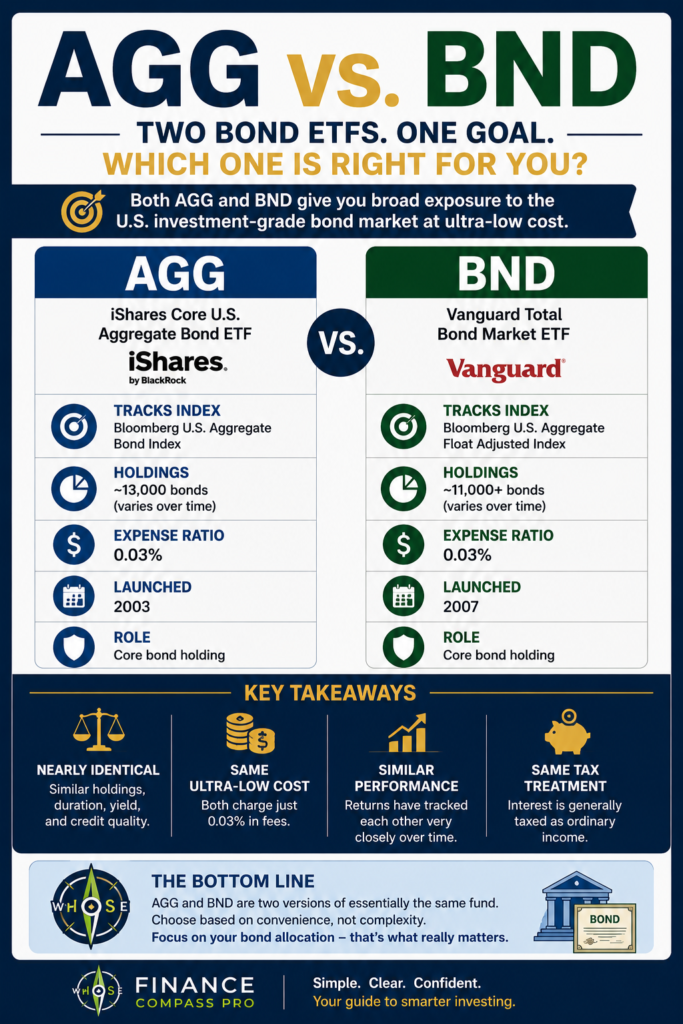
AGG and BND are two versions of essentially the same fund. They track closely related indexes, charge the same 0.03% fee, and produce nearly identical returns over time. The differences – index construction, fund size, issuer – are real but small enough that they rarely justify spending much time deliberating.
For most beginners, the better use of your time is deciding how much of your portfolio should go into bonds at all, not which nearly identical bond fund to choose. Pick either AGG or BND, match it to your existing fund family if you have one, and move on to the decisions that actually move the needle.
If you’re still deciding how bonds fit into your broader portfolio, focus first on the allocation decision rather than spending more time choosing between two nearly identical core bond funds.
For the broader picture of how core, dividend, international, bond, and growth ETFs fit together, see ETFs for Beginners: How to Choose, Compare, and Build a Simple Portfolio.