Disclosure: This post is for informational and educational purposes only. FinanceCompassPro.com may earn compensation through display advertising. We may also reference third-party products, services, or platforms by name for educational purposes – these mentions are not paid endorsements unless explicitly stated. Nothing in this post constitutes personalized financial, legal, tax, or investment advice.
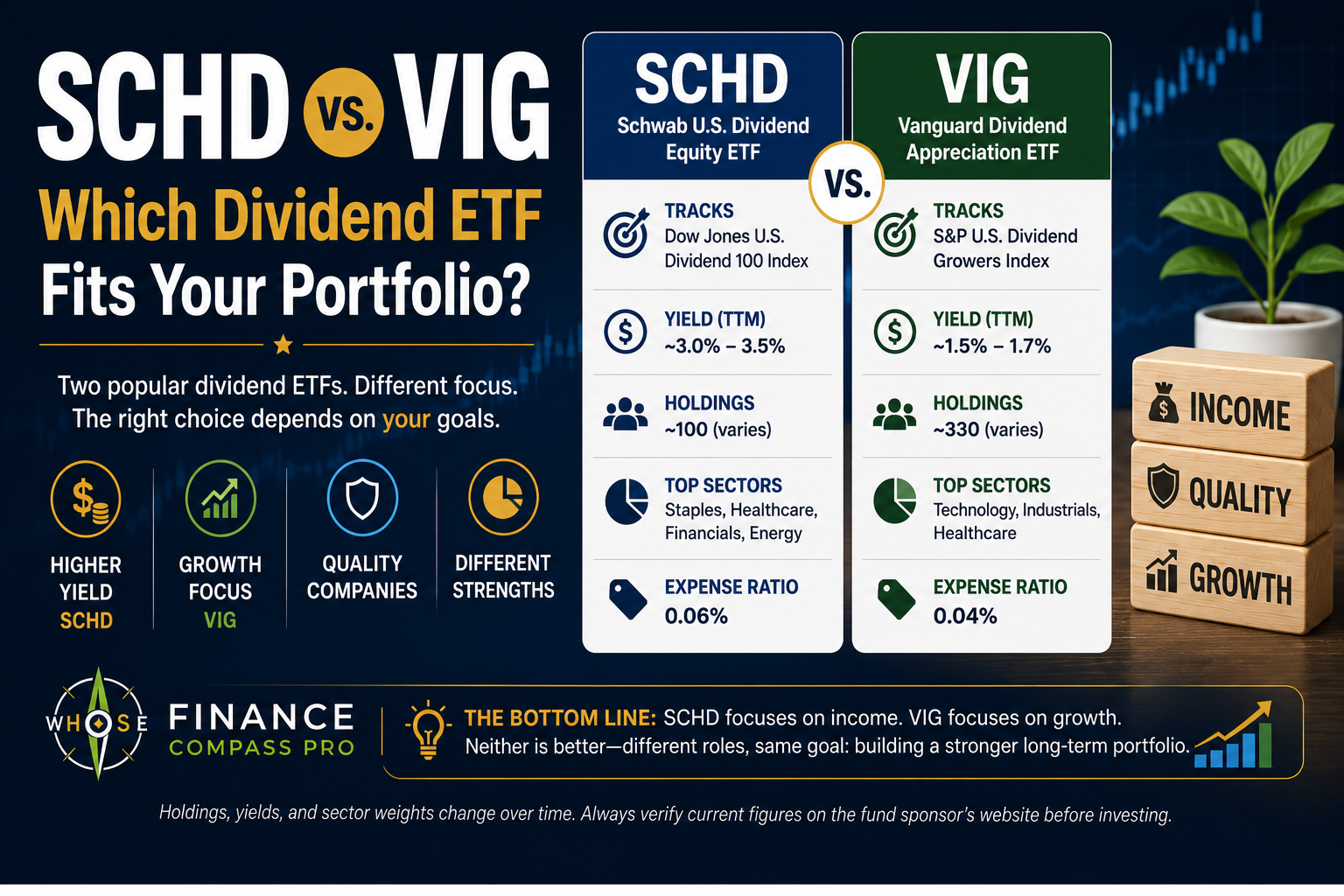
SCHD and VIG are the two dividend ETFs beginners run into most often. Both screen for quality. Both charge rock-bottom fees. But they answer a different question.
SCHD asks: which companies pay a strong dividend today? VIG asks: which companies have reliably grown their dividend for over a decade? That single difference in philosophy shapes everything else – yield, sector mix, volatility, and who each fund tends to fit.
This guide compares what each fund holds, how their yields and fees stack up, and how to decide between them – or whether to hold both.
What Do SCHD and VIG Actually Track?
SCHD tracks the Dow Jones U.S. Dividend 100 Index. The index focuses on high-dividend-yielding U.S. stocks with a record of consistently paying dividends, then screens for fundamental strength using factors such as cash flow to debt, return on equity, dividend yield, and dividend growth. The top 100 by composite score make the cut.
VIG tracks the S&P U.S. Dividend Growers Index. This index also requires at least 10 consecutive years of dividend increases, but it takes a different approach to filtering: it excludes the top 25% highest-yielding eligible companies. As a result, VIG ends up holding more stocks overall, with less emphasis on current yield and more on consistent growth.
| SCHD | VIG | |
|---|---|---|
| Full name | Schwab U.S. Dividend Equity ETF | Vanguard Dividend Appreciation ETF |
| Index tracked | Dow Jones U.S. Dividend 100 | S&P U.S. Dividend Growers |
| Issuer | Schwab | Vanguard |
| Launched | 2011 | 2006 |
| Number of holdings | ~100 (varies over time) | ~330+ (varies over time) |
| Expense ratio | 0.06% | 0.04% |
| Typical portfolio role | Income tilt | Quality growth tilt |
For official fund details, see the Schwab SCHD product page and the Vanguard VIG product page. For a deeper look at each fund individually, see SCHD Explained and VIG ETF Explained.

Yield: SCHD Wins by a Wide Margin
This is the most visible difference between the two funds. SCHD’s dividend yield typically runs in the 3% to 3.5% range. VIG’s yield is usually in the mid-1% range, often around 1.5% to 1.7% depending on the measurement date.
That gap exists by design, not by accident. VIG’s index rules specifically exclude the highest-yielding 25% of eligible companies. SCHD’s index does the opposite. It actively scores companies partly on current yield, which pulls higher-yielding names into the fund.
On a $10,000 investment, SCHD’s yield generates roughly double or more the annual income that VIG produces at current rates. For investors who want meaningful cash flow today, that difference is significant. Yields fluctuate with price and distributions – verify current figures on each fund sponsor’s website before investing.
Sector Exposure: Tech vs. Value
Because VIG is market-cap weighted and does not exclude technology companies for being low-yield, it often carries a meaningfully larger technology allocation than SCHD, while SCHD usually leans more toward value-oriented and defensive sectors such as consumer staples, healthcare, financials, and energy.
SCHD instead leans more heavily toward consumer staples, healthcare, financials, and energy – sectors known for steady cash flow and higher current yields rather than rapid growth.
| Sector Tilt | SCHD | VIG |
|---|---|---|
| Technology | Usually lower | Usually higher |
| Consumer staples | Usually higher | Usually lower |
| Healthcare | Often meaningful | Often meaningful |
| Energy | Often more meaningful | Usually lower |
Sector weights shift with index reconstitutions and market moves. Always verify current figures on the fund sponsor’s website before investing.
This sector difference is the real driver behind most of the performance gap between the two funds in any given year. When technology leads the market, VIG tends to benefit more. When value and defensive sectors lead, SCHD tends to hold up better.
Volatility and Drawdowns
SCHD has often behaved differently from VIG because of its value and higher-yield tilt, while VIG’s larger growth and technology exposure can make it respond differently during market selloffs. Neither fund is immune to a major decline, and past drawdown patterns do not guarantee future behavior.
Neither fund is immune to a major market decline. Both are equity funds, and both can fall sharply in a broad bear market. The differences in volatility are real but modest – not a reason on their own to avoid either fund.
Performance: Closer Than the Yield Gap Suggests
Despite the large difference in current yield and sector mix, the two funds have produced fairly similar total returns over the long run since SCHD’s 2011 launch. In some years SCHD has led; in others VIG has pulled ahead, often depending on whether technology or value sectors were driving the broader market.
This is a useful reminder: a higher dividend yield does not automatically mean a higher total return. SCHD’s larger cash distributions come at the cost of less price appreciation potential from growth sectors like technology. VIG’s lower current income is offset by greater participation in growth.
Expense Ratio: A Small Edge for VIG
VIG charges 0.04%. SCHD charges 0.06%. On a $10,000 investment, that is a $2 annual difference – not meaningful on its own. For more on how expense ratios compound over decades, see ETF Expense Ratios Explained.
Both funds are inexpensive by any standard. The fee gap should not be the deciding factor between them – the yield and sector differences matter far more.
Tax Considerations
Because SCHD’s yield is roughly double VIG’s, it generates more taxable dividend income each year when held in a taxable brokerage account. Many distributions from U.S. equity ETFs like SCHD and VIG may qualify for the lower qualified-dividend tax rate if holding-period requirements are met, but your Form 1099-DIV is the source of truth. Still, a higher yield means more annual tax drag regardless of the dividend’s tax classification.
For this reason, some investors prefer to hold higher-yielding funds like SCHD inside a Roth IRA or Traditional IRA, while keeping lower-yielding, growth-oriented funds like VIG in a taxable account. For the full picture of how account placement affects your after-tax return, see ETF Taxes Explained.
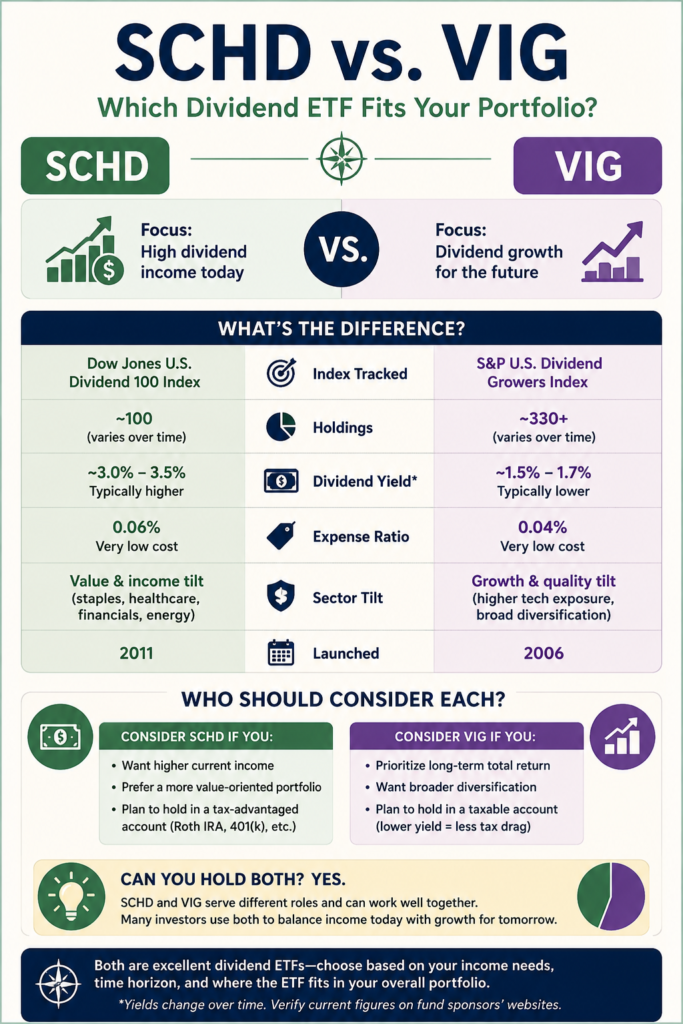
Who Should Consider SCHD?
- Investors who want meaningful current income from their portfolio
- Investors who prefer a more concentrated, value-tilted set of holdings
- Investors holding the fund in a tax-advantaged account where the higher yield doesn’t create extra annual tax drag
Who Should Consider VIG?
- Investors who prioritize long-term total return over current income
- Investors who want broader diversification across roughly 330 holdings
- Investors holding the fund in a taxable account, where the lower yield reduces annual tax drag
Can You Hold Both?
Yes, and many investors do. SCHD and VIG do not hold identical portfolios, and their sector exposures can pull in different directions. Combining the two may diversify the dividend sleeve somewhat, but it does not eliminate stock-market risk or overlap.
Some investors use both funds inside a dividend sleeve, assigning one role to SCHD for income and another to VIG for dividend growth. The exact split depends on your income needs, tax situation, and overlap with the rest of your portfolio. If you’d rather avoid managing two separate funds, DGRO ETF sits between the two – a broader, single-fund alternative with a less restrictive dividend-growth requirement than VIG and less concentration than SCHD. Be careful about overlap with other dividend funds, though – if you also hold VYM, the combined yield and sector tilts can become harder to track. For a third dividend ETF comparison, see VYM vs. SCHD.
Where SCHD and VIG Fit in a Portfolio
Both funds work best as a satellite position alongside a broad-market core holding such as VOO or VTI, rather than as a complete portfolio by themselves. A common structure pairs 70-80% in a broad-market fund with 20-30% in SCHD, VIG, or a blend of the two for an income or quality tilt.
For a full framework on combining core and satellite positions, see The 3-ETF Portfolio Strategy. If you are still deciding how much of your portfolio should be in broad-market funds versus dividend tilts, our guide on asset allocation explains how investors think about portfolio balance.
The Bottom Line
SCHD and VIG are not really competing for the same job. SCHD prioritizes current income through a higher-yielding, more concentrated portfolio. VIG prioritizes dividend growth and broader diversification, with a meaningfully lower current yield in exchange for greater technology exposure.
Neither is automatically better. The right choice depends on whether you need income now or are building for growth over decades – and many investors find that holding both, in the right account types, captures the strengths of each.
If you are still deciding how a dividend tilt fits next to a broad core holding, see VOO vs. VTI to settle on the core first. For a broader, less filtered high-dividend option than either fund, VYM ETF Explained covers Vanguard’s 600+ holding approach. For a direct comparison of SCHD and DGRO on yield, diversification, and concentration, see SCHD vs. DGRO. And for a closer look at VIG against DGRO specifically, see VIG vs. DGRO.
For the broader picture of how core, dividend, international, bond, and growth ETFs fit together, see ETFs for Beginners: How to Choose, Compare, and Build a Simple Portfolio.
FAQ About SCHD vs. VIG
SCHD generally offers a much higher current yield, typically 3–3.5% versus VIG’s 1.5–1.7%. For investors prioritizing current income, SCHD’s index specifically screens for higher-yielding companies, while VIG’s index excludes the highest-yielding 25% of eligible companies.
SCHD screens for current dividend yield combined with quality factors like cash flow and return on equity, resulting in about 100 holdings. VIG screens for 10+ years of consistent dividend growth while excluding the highest yielders, resulting in a broader roughly 330-holding portfolio with more technology exposure.
Yes. Many investors hold both to combine SCHD’s current income with VIG’s dividend-growth and diversification profile. Since the two funds don’t hold identical portfolios, combining them can diversify a dividend sleeve, though it doesn’t eliminate overall stock-market risk.